Councillor Tony Belton’s Latchmere August Newsletter (# 64)
August highlights
- Let’s face it, I’ve just had the longest August holiday in quite a long time
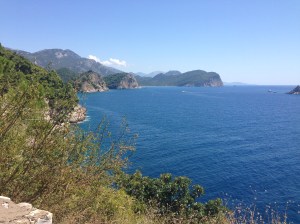 and so there haven’t been many highlights outside of holidaying – though I did get to meet the Deputy Mayor of Sofia, capital of Bulgaria. However I thought I’d share a couple of thoughts about holidaying in the former Yugoslavia and in Bulgaria. First and most obviously the Adriatic coast, of both Montenegro and Croatia where I was, is spectacular. The scenery is staggering, the sea is warm (though I did read last week about Great White Shark attacks in the Adriatic – but after I got back, thank goodness), the wine is good and the food OK. I don’t want to bore with holiday snaps but here is just one of the Montenegro coast.
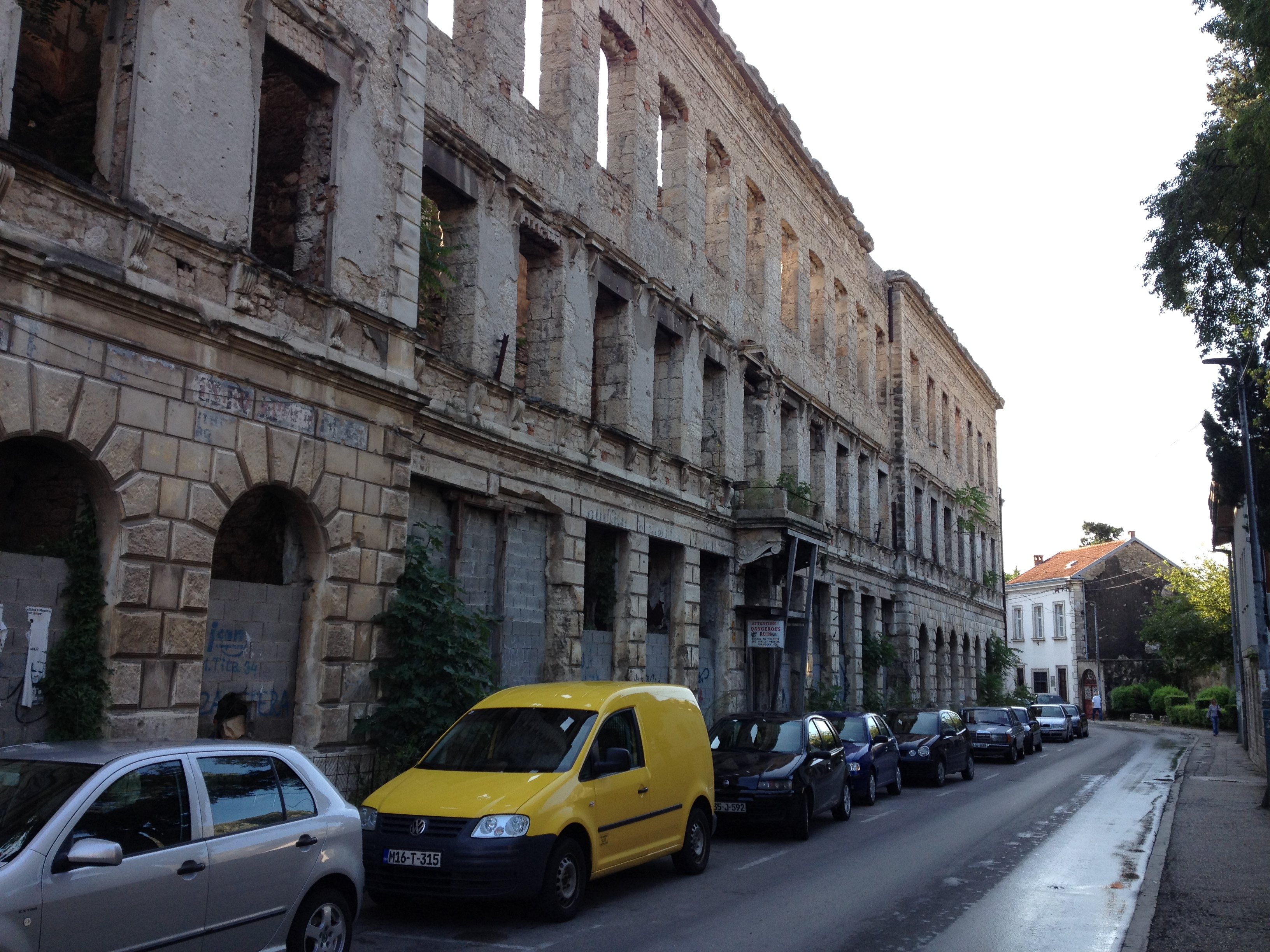
 - Rather more sobering is the realisation that “Yugoslavia” is, or was not that long ago – 1990s, a war zone. The war affected the whole of the Balkans but, as far as I could see, the centre of the war was Bosnia and there the picture is rather less rosy than in Croatia. The bomb sites in the
 centre of town and the bullet and artillery shell holes in the buildings are very noticeable. In the tourist haven of Mostar, the tourist area itself is largely and well re-constructed but just a hundred metres from the tourist sites are empty, derelict houses, flats and businesses. Our B&B host on one night was weeping that she, a Muslim, married to a Catholic, was living happily with her neighbours in the 1980s and then found herself overnight as it were at war with her neighbours. How did it happen and why? She could not understand.
 - It’s perhaps not very clear in this picture but this shelled out building, an empty husk, is a stone’s throw from the tourist hotspots!
- It would be impossible here surely! But then, uncomfortably, temperatures do appear to have risen a little north of the border. We must ensure that bitter feelings are controlled.
- However, the ex-Yugoslavian countries seem fairly vibrant compared to Bulgaria, where the collapse of the old Soviet-style heavy industries seems to have left the country as a complete economic disaster area. Massive industrial complexes stand derelict and empty with much of the rural population left to flee to the capital, Sofia. The Black Sea coastal resorts and, no doubt, the ski resorts are doing well but much of Bulgaria looks like a country with big problems.
- Here in Latchmere, the Council’s Community Safety Team have installed a security camera in Anerley St to assist in issues concerning the theft of mopeds and dangerous driving of the vehicles in the area. Anerley Street is the short link between Dagnall Street and Battersea Park Road and I must say it is encouraging to see the police and the Council co-operating in trying to control the young villains who are largely responsible for this annoying and dangerous vandalism.
- I also heard the good news in August that the South West London Law Centre is going to re-locate in Falcon Road, next to the Mercy Foundation and near to the Prince’s Head. We have not had an appropriate location for the Law Centre for some years now but this new accommodation will be right at the heart of the action and well placed to serve the people who most need its services.

My Programme for September
- I am going to the Labour Party Conference in Manchester, starting on Sunday, 21st.
- The Planning Applications Committee will meet on 15th and the Education & Children’s Services Committee on the 17th.
- I will be at the AGM of GCSE Success, the self-help homework club, at York Gardens Library on 20th.
Did you know? Oh, dear I haven’t got anything to put here this month! Hopefully inspiration will come in time for next month!
MH17 – A one-off disaster or an inevitable by-product of modern warfare?
Heard of Iranian Air Lines flight 655? It was a regular daily flight from the Iranian town of Bandar Abbas to Dubai, which on 3rd July 1988 had 290 on board, though maybe significantly only 39 non-Iranians. It was brought down with all 279 passengers and crew killed by a US fired missile from USS Vincennes. Captain Will Rogers III, a career naval officer, was in command of the Vincennes. He was awarded the Congressional Legion of Merit.
Vincennes was a guided missile destroyer of the US navy, whose crew failed to distinguish between a civilian airliner and an expected Iranian attack force. However, a fellow senior officer in the Gulf hinted that having such a gung-ho commander in the field was at the minimum a risk. Despite the “disaster” a couple of years later Rogers was promoted to be commander of the US Naval Tactical Training Group responsible for training officers in handling combat situations.
The United States and President Reagan got away with this incident amazingly scot-free in terms of worldwide condemnation or criticism. In most people’s language this was a war crime and although considerable compensation was paid, as far as I know the US has never apologised. At the UN, the then Vice-President George Bush argued that it had been an accident of war.
And yet in all the comments on the missile attack on MH17, I have not seen a reference to the Vincennes incident. Comparisons have been made with the Soviet destruction of Korean Airlines KAL007 with the loss of 269 lives off Sakhalin in 1983 and the Ukrainian downing of Siberian Airlines flight 1812 in 2001, with the loss of 88 lives, but not the Vincennes. I rather suspect that says something about the soft power of the US as opposed to the “soft (power) weakness” of Russia.
These four “military incidents” alone have claimed 945 civilian lives over the last 26 years. I don’t know how many have died in air crashes, where the military have not been involved, but I wouldn’t mind betting that military incidents are the single most important cause of aircraft disasters. Perhaps we should spend as much time on how to avoid such fatalities as the designers and engineers spend on improving aircraft safety and performance – no flights within 1000 miles of combat zones, higher levels of locking devices on missiles, passenger involvement in flight path choices?
The Tories face a disaster called Europe
There will always be a right of centre party – of course – but every now and then the Tory Party faces a disaster, a cataclysmic event from which it takes them 10 or 20 years to recover. This happens when long-cherished immovable beliefs and policies come into conflict with financial, political or economic reality.
The examples that come to mind are the 1846 Repeal of the Corn Laws and the 1902 struggle over Imperial tariffs – both in effect about trade policy and import tariffs. In 1846 the interests of the English aristocracy and their farming businesses were beginning to come into conflict with those of the new industrial and commercial elite of Victorian Britain. The catalyst for the 1846 Repeal of the Corn Laws was the Irish Famine. Five years of one of the worst famines in recorded history (the Irish population fell from over 8 million to 6.5 million, which is what it still is to this day) forced Sir Robert Peel to repeal the protectionist Corn Laws.
The party split and it was not until one of the rebels opposed to Peel, Benjamin Disraeli, managed to make the Tories relevant to the new might of British Imperialism with his “one nation” Toryism that they again achieved a parliamentary victory. Disraeli’s win in 1874 was their first since 1841.
Half a century later in the early 1900s the Tory party once again tore itself apart over trade protectionism. This time it was fear of the new growing industrial might of Germany and the USA, which posed the political problem. Joseph Chamberlain resigned from the Government in 1903 to lead a campaign for Imperial Preference levies in opposition to the free trade policies pursued by Prime Minister, Balfour. Chamberlain thought that putting a tariff round the Empire would protect British trade, particularly in India, Canada and Australia, from these aggressive, rising competitors. Balfour wished to maintain the free trade essentially created by the 1846 Repeal Act.
The dispute over free trade or protectionism resulted in big victories for the Liberal Party in the 1906 and 1911 elections. Once again it was 20 years later in the totally different post-WW1 1920s before the Tory Party resumed its “normal” role as the party of Government.
And now in 2014-17 I think we face a similar prospect of Tory division and defeat over trade policies, where once again cherished Tory party notions come into conflict with the political realities. This time the Tory notion is the nostalgia for the UK as a great power and our collective failure even today to come to terms with the truth – that we are an important European nation, dependent upon our relationship with the rest of the continent. The external reality, which is posing the issue so starkly, is the EU.
David Cameron, with his tactics over the Juncker/European Commissioner vote, has made himself uniquely unpopular in Europe and put himself into a truly awful negotiating position for the post-Election “reform” of the EU. As a result it is almost inconceivable that he could win terms from European politicians, which would be remotely acceptable to a large number of Tory MPs or with anyone with UKIP tendencies.
Cameron, therefore, now faces a major dilemma over the 2017 Referendum vote. It’s almost inconceivable that Britain’s industrial and commercial elite would accept or fund a Government and party, which wanted to opt out of the EU, but it also beggars belief that the current Tory party would support a pro-EU campaign. Where would that leave Cameron – dependent upon Labour votes?
There is, of course, one way out for Cameron and that would be to lose the May, 2015, General Election. But assuming that is not his plan then his leadership seems to be leading the Tory Party inexorably into a cul-de-sac and another split over trade policy, with the right wing eventually merging with UKIP and becoming a Tory Party devoid of any real electoral prospects for a dozen years or more. Meanwhile do the pro-EU Tories hitch themselves to the by-then surely divided Liberal/Democratic party? It is an intriguing prospect and holds out great prospects for Labour.
Councillor Tony Belton’s Latchmere May Newsletter (# 60)
2010-14 highlights 1. I guess to most this May is much like any other May. Nice and sunny, we hope, very spring-like – good to be alive territory. But for some of us, including me, it is a bit different. This is the last month of the 2010-14 Council and, one never knows, possibly my last month as a councillor – it all depends upon you on election day, 22nd May. 2. So, I thought this month I would highlight my pick of the most important mome nts of 2010-14. I have to start, of course, with the early announcement after the 2010 Borough Election that the Tories planned to close York Gardens Library. Others will have other memories but I recall a discussion between Simon Hogg, Wendy Speck (my fellow councillors) and I when we decided that we had to call a public meeting at the library to fight the closure. Wendy and Simon had only been councillors for a couple of months so we decided that I had to Chair the meeting, which I was more than glad to do and which I am doing here. 3. In the November, 2010, issue of this newsletter I wrote “And indeed we did not have to wait long (for Tory Council cuts), since that very day (6th November, 2010) we received early notice of the Council’s intention to close York Gardens Library. The local community was quick to campaign against this closure with petitions and a public meeting at the Library on Sunday, 5 December, at 2 pm. Do come if you can but if not please write to Cllr Lister (the then Leader of the Council), Wandsworth Town Hall, to protest at the closure of the library, which is in the poorest and most deprived area in the Borough.” 4. In the December issue I went on to write that, “It was a very successful meeting in that 130 people were th
 ere. There were excellent contributions from many local residents and between us we wrote maybe 50 letters objecting to the proposal. We have also collected about 2,000 signatures on petitions. A few Conservative councillors attended but they kept very quiet. However, I think that the meeting had quite an impact on the Council and I sense that the Council is now trying very hard to come up with a compromise which saves the library and so it should. The Council’s own papers show that a higher proportions of children use the library for homework than in any other library in the Borough. Given the extent of over-crowding in Latchmere we can all guess why that would be but it demonstrates just how important the library is to Latchmere.” 5. As we all now know the campaign was a great success and the library, now often just called YGL, is run by a local management committee on behalf of the local community. My colleague Wendy Speck is a member of the Management team. By the way there had been a long-running battle between the Tory Council and the local community over the library. The first campaign to save, what was then, the Winstanley Children’s Library was fought in 1981! The Community defended it then just as it did 30 years later in 2011.
  6. The main event of 2011, I hesitate to call it a highlight, was of course the riots that took place across London and in Clapham Junction on 6th August, 2011. I produced my one and only special edition of this newsletter to mark the occasion. Here are a couple of the photographs that I took the day after.
 7. It was, of course, a terrible day and had a profound effect, of which more later. One immediate result was that it put me in the front-line against the eviction of innocent Council tenants. The news centred on one lady and her 8 year-old daughter, who was going to be evicted because her 17 year old son was arrested in Clapham Junction. I was not, of course, defending criminal activity, but when the courts eventually imposed a one year prison sentence on the rather silly young man it seemed a bit extreme (to me and to many others) to evict the mother and the totally innocent 8 year-old. I suspect not too many people would be happy to have their security of tenure totally in the hands of their 17 year-old sons! In the end the Council backed down and after a bad 6 months inside young Daniel has become a very nice, caring young man. 8. I was interviewed on this case by many foreign newspapers and TV channels, especially in Spain, France and French Canada. They really found it very difficult to believe that here, in the UK, we could think of evicting whole families because of the “criminality” of one member of the family. I was also proud of the speech I made in Council on the issue, which if you are really interested you can see at http://www.youtube.com/watch?v=rQukL9XxxYk. I am speaking between 0.40 and 11 minutes 26 of the video! 9. The biggest news of 2012, as I wrote in March of that year, “was the Council’s decision to “spend” £100 million on Latchmere and Roehampton wards …at the same time (as) the Big Lottery has also allocated a separate £1 million to Latchmere.” The Council said it was not, of course, a response to the riots, indeed it was claimed to be despite the riots but we can all apply a pinch of salt to that lie/propaganda. What might surprise some is that now 2 years later we do not appear to be very much closer to action on the ground in the so-called estate regeneration. I suspect, however, that appearances are deceptive and that after the election there will be fairly rapid moves. I hope the vast majority of the residents will be happy with the plan but many are aware that some of the residents of the smaller Winstanley Estate blocks are not at all keen on possible demolition.. 10. The Big Lottery grant is also still going through a planning process. There have been several successful events organised in York Gardens and the Wilditch, but I sense a little frustration amongst those of us involved in the planning group that we have not yet found the “Great idea”, which will make our Big Local something unique.
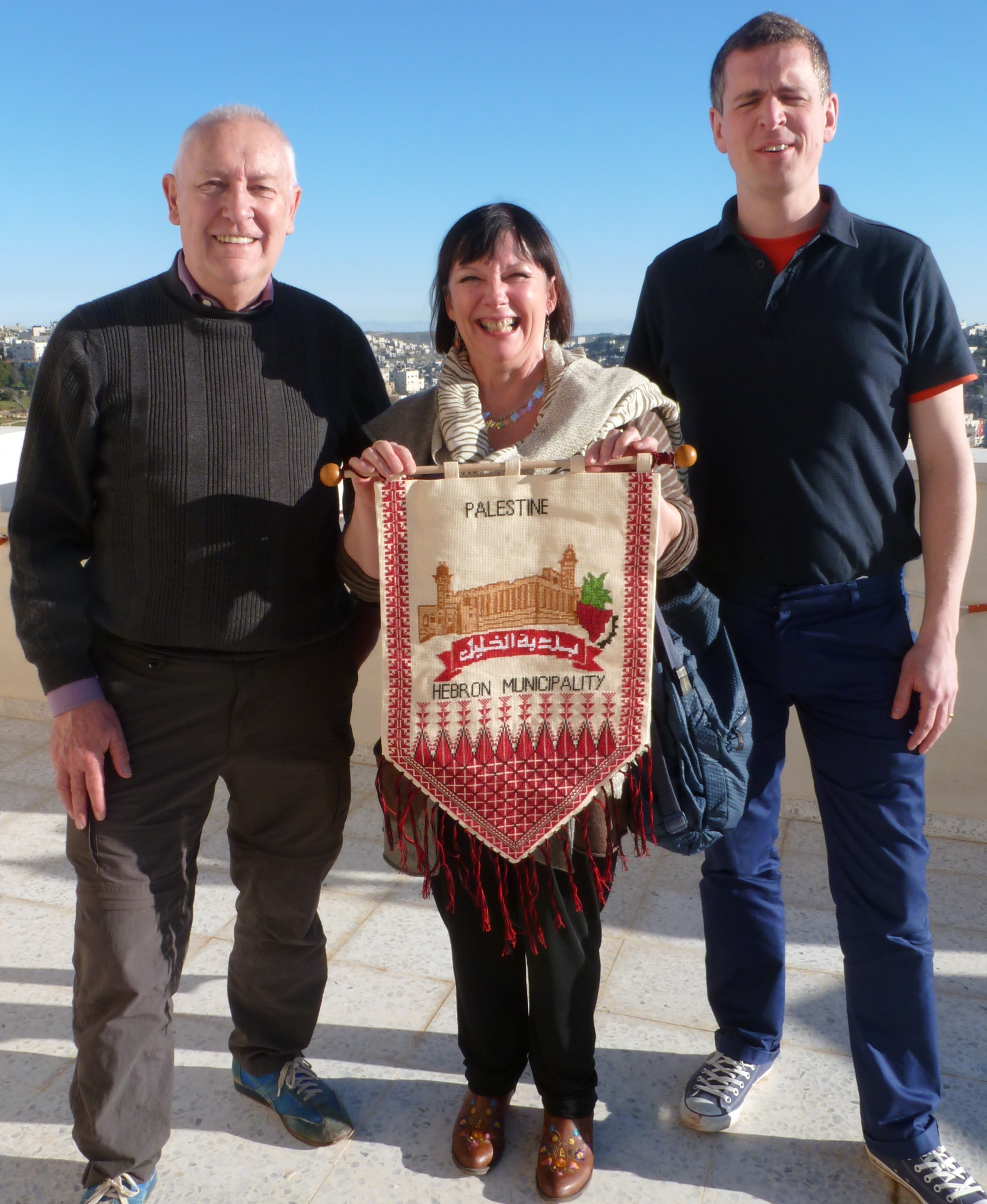
 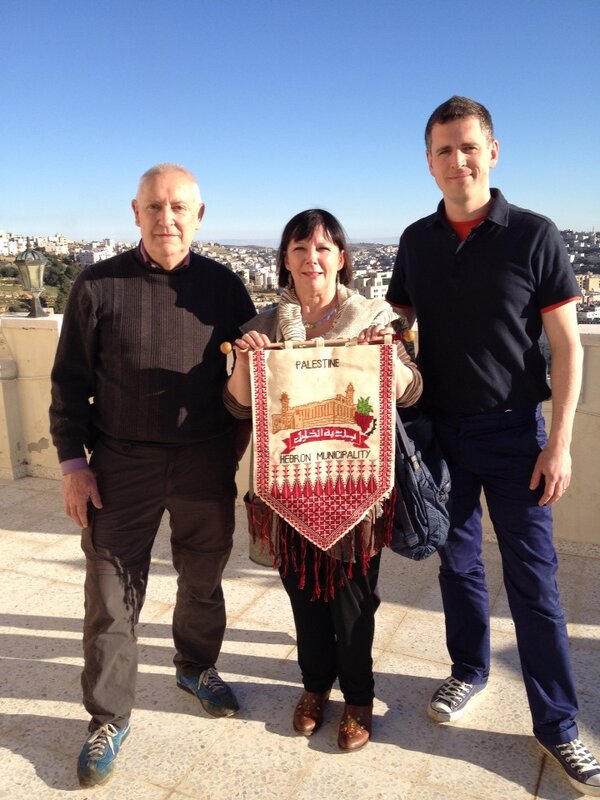 11. My highlights of 2013 were very personal! First there was the trip that we three Latchmere councillors, Wendy Speck, Simon Hogg and myself, made to Palestine in February, which as I said at the time had nothing to do with Latchmere, Battersea or Wandsworth, but it was certainly packed with interest. Here is a picture of the three of us with a banner given to us by the Mayor of Hebron. (As I said then, before any cynics out there think otherwise, it was all paid for out of our own pockets and had nothing to do with the Council!). The trip did give me a chance to take my picture
 of the year, and here it is – a cactus caught by the flash-light in the Judean desert at sunset, high above Bethlehem – and, oh my, was it cold. So cold in fact, I got shingles on this trip and very painful and unpleasant it was too, but at least it went after 3 months! Worse in September when I, and my partner,
  went on a cycling tour of Holland, our bikes were stolen in Amsterdam and I got streptococcal G poisoning in my left knee, after what seemed at the time a rather slight bump. (I am in the centre of this picture in Delft) That resulted in me spending a couple of weeks in St. George’s, feeling as though I was at death’s door! It made the shingles pain seem minor! So to use the Queen’s description of 1992 (the year of the great fire at Windsor Castle) as her “annus horribilis” then I would say the same about 2013! 12. And so to 2014. Well, of course, the major highlight will be the May 22nd election – or at least I hope it will be but to get back to the more day-to-day, I do want to mention a couple of other things. 13. The March figures for use of the Bike docking stations have been very encouraging. No doubt the great spring weather made a difference but use of the bikes went up 83% in March, with individual increases ranging from over 100% in Grant Road to only 67% in Fawcett Close – encouraging but there are still some with only small levels of usage. (Oh, I have been on them twice in the last few weeks!) 14. Many of you will not have seen the 4th May copy of the Observer. In the main section of the paper a full page 19 article is about Providence House Youth Club, which is celebrating its 50th anniversary with a Saturday 10th May party. The success of the Club was originally down to the pioneering work of Elizabeth Braund, who died in 2013 and who I featured in this newsletter (June, 2013), but I want to praise Robert Musgrave, the volunteer youth worker, who has been totally committed to the Club for since going there first in 1973. 15. The Planning Applications Committee on the 14th April had a massively, stupid 530 page agenda, with lots of very chunky applications although not affecting Latchmere directly. The largest two were about the Power Sta
 tion site and Market Towers at Vauxhall, just inside the Borough boundary. I don’t know whether you know it but Vauxhall is just about to become a mini-Manhattan, but I am afraid that it is a development aimed solely at the mega-rich, international business world and will have very little to do with local residents! 16. Finally, it has been a hopeless ambition of mine to get the station named, as it should be Battersea Junction and not, Clapham Junction. If anyone doubts me then look at the boundaries of Battersea parish, look at where Battersea District Reference Library and where Battersea Town Hall (now the arts centre) are. Well I may not have succeeded in getting it renamed but after many years of trying here am I and Wendy Speck celebrating the strapline, Clapham Junction, the Heart of Battersea. My Programme for May 1. Of course there is, as ever, there will be the Planning Applications Committee on the 8th, preceded on the 7th by the final Council Meeting of this four-yearterm.. However, for me and my colleagues there will simply be more and more election campaigning. So give us a wave if you see us about – it’s just part of the process! Oh, and if you swear and curse at having your TV viewing disturbed and exclaim that we are all the same, oh and in it only for the money, just give a thought: “Would you rather live in a country where the only way to change a government was by war or revolution?” Just what do you know about war-time, Battersea? A couple of weeks ago, I was canvassing a couple of elderly ladies
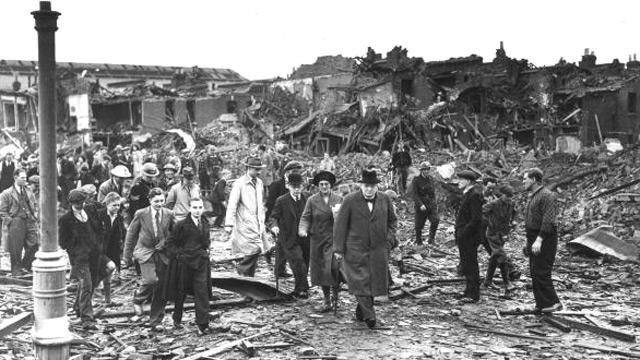 on the Winstanley Estate, who told me about the area before the estate was built and particularly of their memories of the war-time bombing. And although I covered this a couple of months ago I thought it worth reminding you of what a pounding Battersea got during the war. The ladies remembered in particular Speke and Livingstone Roads, which I gather stood more or less where John Parker Square is today. And although I haven’t got a photograph of what happened when they were hit by a V1 here is another of Winston Churchill visiting Nine Elms after a particularly savage attack. PS I just wondered whether the photographer of Christ Church, in last month’s edition was John Archer, the first black mayor? He had a photographer’s business in Battersea Park Road at the time of that picture. But I don’t know. “Promoted and published by Sean Lawless on behalf of Tony Belton, Simon Hogg & Wendy Speck, all at 177 Lavender Hill, Battersea, SW11 5TE”
Great headline in the Guardian today, 30/4/14! “Labour vows to rub out Gove era in education”.
That gave me an unexpectedly great start to the day and what is more the analysis is spot on, with David Blunkett accusing Gove of creating an unmanageable “Kafkaesque” education system. Tristram Hunt goes on to say that atomised schools (by which he means Free Schools, academies, maintained schools) leave a landscape of incoherence, confusion and lack of accountability. Good stuff.
Until, unfortunately, we get to the bit about Labour’s alternative; its recipe for success – independent directors appointed by local authorities on a fixed-term five-year contract from a short-list approved by the education department, by which is obviously meant the Whitehall Education Department and not the local authorities’.
So where is Labour’s case for coherence and clarity and most particularly transparent accountability when we consider local government – gone, caput, nowhere?
A few years ago, it was possible to think that the Labour Party had a coherent strategy towards local government, its powers and its democratic legitimacy. The move in London to make Metropolitan Police Divisions co-terminous with the London Boroughs and then to do likewise with the Health Authority areas opened the opportunity for locally elected councillors, and hence the local electorate, to have more of a say in running these very important civic services.
Combined with the extant structure of local government, it made it possible to think of a local accountable unit with sufficient power and influence to encourage democratic participation in civic governance. OH, how we need to re-vivify local democracy and here was the possibility to do just that.
Of course in this highly centralised state called the UK, there was still a long, long way to go. No true, accountable local authority could flourish without some kind of independence from, or at least accommodation with, the financial control of Whitehall. Unfortunately it always suits the party in power to maintain that control, regardless of the honeyed words about localism – always a tempting illusion under governments of any persuasion – at least until now.
But there were signs that local democracy might be gaining traction – until the take-over of policy-making by instant populists. Tony Blair introduced the Mayoral system and pin-up politics first to London, and then to the rest of the country; and at a lower level David Cameron introduced his elected Police Commissioners. By any stretch of the imagination these reforms added to the atomisation of local authority services, confusion and lack of accountability. They were stimulated by an immediate appeal to the electorate at the price of any coherent view about local as opposed to national democracy.
It will be argued that Ken Livingstone and Boris Johnson have made some sense out of London’s complex transport systems, but that was largely thanks to the coherent consolidation of power and responsibility across a massive urban area.
They will be better remembered for destroying any coherence, clarity or accountability across London’s planning system. Only this week London’s emerging skyline has been said by GLA planning Director, Colin Wilson, to be “very carefully planned. But we prefer to use a flexible framework” leaving us with what others have called an indiscriminate scattering of tall buildings across London.
The new skyline is far from universally popular, will undoubtedly change the look and feel of the city, will be irreversible, will make millions for some developers and will do almost nothing for London’s housing crisis, and it will be incoherent. As for whose responsibility it will have been – you’d need a degree in British local government practise to be able to answer that one.
The major problem is, of course, that people once trusted our local government service as dated but essentially competent and honest – indeed almost the envy of the western world – Westminster politicians now distrust it and abuse it. My suspicion is that Ed Milliband’s major task in domestic politics has to be to build a sensible local government structure into which directors of school standards and police Inspectors can be built. Such a structure would demand, and get, a genuine local political legitimacy. It would also encourage civically minded citizens to stand for local office.
Most important, it would increase election turn-out. The electorate are not stupid. They don’t vote much in local elections and why should they when local authorities are powerless and more and more an arm of national government. Let’s have a return to local government.
Councillor Tony Belton’s Latchmere April Newsletter (# 59)
March highlights
1. Of course it was not until March that the formal Council Tax decision was taken, that is agreed by full Council. But it was a formality and everyone knew what the result would be – a frozen Council Tax. That was pretty much what March was like – a slow wind down in the build up to the Council Election on May 22nd. Indeed the Council has what is known as a purdah when virtually no “political” business takes place until after the election – except of course the Planning Applications Committee, which like “Ole Man River just keeps rolling along”.
2. There wasn’t much on at the Planning Applications Committee either, except for 69-71 Falcon Road. This Halal restaurant is clearly very popular with its customers but is not as popular with its neighbours, who complain about the timing (and therefore noise) of its operations and its waste clearance record. Some of the neighbours are angry about the Committee giving the restaurant permission but the Council was in a bit of a jam. The application included improved waste procedures and a better smell extraction duct. The Committee could hardly refuse improved storage and effective extraction units when they were the main causes of previous complaints.
The Committee insisted, for what it was worth, and I know some neighbours do not think it worth much, that the restaurant will be closely watched by planning inspectors.
3. The other day, walking along Falcon Road, I looked, truly looked rather than just glanced, at the entrance to the Falcon Road Estate. The one right down by the railway bridge, next to the bus stop and opposite the bus garage entrance. Here is a picture of it. I think it’s truly spectacular and a mark of what residents can do given the right kind of project. Have a really close look next time you pass by and feel inspired to do the same to your garden, or estate.
4. A number of constituents have asked me about the piece I wrote on the Bike docking stations and whether I could provide an update – well, I can. The Town Hall provides them to me, if I ask, on a monthly basis and I now have both January’s and February’s figures and can draw a few comparisons and conclusions. January is, of course, 6% longer than February and this year they were both about as wet and cold (or not so cold) as each other and so they are quite good comparators. Overall, the February usage of the bikes at 22,979 was 7% higher than January’s. The range of usage is quite large with over 1,000 usages at Falcon Road, Albert Bridge Road and Queen’s Circus and less than 100 usages in Stewart’s Road (Nine Elms) and Manfred Road, Putney. Although these figures appear quite high to me when you divide them by the numbers of days in the month, then one can wonder at the cost of this scheme.
So for example the usage at Manfred Road is just over 3 a day, which given the cost of the installation means it will be years before there is any real pay-back. We know that the docking installation costs were over £2 million. We also know that Barclay’s Bank has NOT sponsored the scheme to anywhere near the extent that Mayor Johnson (I’m not calling him B…s!) hoped. And we also know that TfL is being very secretive about the running costs. But the truth will out over time and although, I think the bikes are a great idea, I do suspect that TfL has gone over the top a bit on implementation.
As far as Latchmere is concerned, I think it is fairly obvious with a total usage of 759 in February that the Grant Road triple station is far too large for the demand. The contentious station in Fawcett Close with 206 had a large 57% increase in usage over January figures; the equally contentious station in Usk Road had a 52% increase from 162 to 246. Will demand continue to rise or will familiarity breed contempt? Interestingly, with the exception of Falcon Road, the really large usages are very near to Battersea Park. Is this because people want to “give it a go” with a ride round the park or does it demonstrate a substantial commute to Chelsea?
5. From my canvassing for the Council Election, it is clear that the regeneration of the Winstanley and York Road estates is causing considerable concern, not to say distress. One lady, living on her own, told me that she had moved in when the flat was new, in 1956 I think she said. She hated the idea that her flat might be demolished. As far as she was concerned it was her home and she loves it; it was where she had brought up her family and lived with her husband. Now her husband is dead and the kids have fled the coop but this was and is her life and the Council wants to demolish it. It is pretty important that we, the Council, get this one right.
The general strategy has been agreed by the Council, and the Housing Department staff are now on the estates consulting about it. And it is quite right that they should be advising and consulting with residents about the Council’s intention to demolish some of the York Road Estate and replace it with new build. But what I would like to make clear is that NO final decision has been taken yet on any single issue, and indeed there are powerful arguments against some of the suggestions. So if residents want to fight and campaign against the Council’s plans, they should not give up but they should make their voices heard loud and clear.
It is strange that, given the general distrust of the word of anyone in “authority”, that when it comes to one relatively junior officer saying that the Council has a plan to demolish this block, that comment is taken as a definite fact. Let me repeat, it is a plan and plans change as circumstances change, as opposition or support strengthens and weakens and as opinion is clarified. Some or even most of the Council’s plan will happen but I could almost guarantee that it will not happen exactly as is planned. If you can get all your neighbours to oppose one element of the plan then you will probably win the argument. If you can’t get anywhere near 50% to agree with you, then you won’t win and you won’t deserve to win.
6. Last month I wrote about the worrying report from London Sustainability Exchange (LSx) about air pollution in Battersea at levels 5 and 6 times higher than European Union targets. I said that the worst pollution of all is under the Falcon Road railway bridge. Well following publication of this report the Battersea Society organised a morning of action on the 28th March. Some of us were sent off to interview shop workers to see if they were concerned and others looked for lichens and other plant-life that flourished in clean and/or dirty air.
Others of us attached measuring devices to various road sings so that we can measure levels of air pollution more accurately. Here I am fixing one of LSx’s measuring devices to the bus-stop just by the railway bridge – Yes they do have permission to fix measuring devices to bus-stops. As I said in March, I will be using this research to press for early improvements to the environment under the Bridge!
My Programme for April
1. Of course there is, as ever, the Planning Applications Committee on the 14th. However, for me and my colleagues there will simply be more and more election campaigning. So give us a wave if you see us about – it’s just part of the process! Oh, and as you swear and curse at having your TV viewing disturbed and exclaim that we are all the same, oh and in it only for the money, just give a thought. Would you rather live in a country where the only way to change a government was by war or revolution.
Did you know about Christ Church, Battersea?
Last month I wrote of the modest, modern church in  Christ Church Gardens. I also wrote that its very different Victorian predecessor, consecrated on 27 July 1849, was full of all the confidence I associate with Victorian times. I also said that there is a rather splendid photograph of it in a Wandsworth Town Hall Committee Room. Well, here it is!
Well, the church certainly is very different from its current namesake but the picture certainly isn’t as I then said from the 1930s. A quick glance demonstrates that it is earlier than that. Does anyone know, or can anyone work out just when this might have been taken and let me know. I have my own idea, which I will share with you next month. Oh, and can you suggest who the photographer might have been? I have an idea about that too!
Councillor Tony Belton’s Latchmere January Newsletter (# 56)
 December and 2013 highlights
1. There really wasn’t much to say about December except that I went to the Xmas socials/parties/fairs of the Falcon Road and Kambala residents, the Big Local organisation, Battersea Arts Centre and of constituents Vicky and Jacob – thanks to all. There was also nothing of any great interest at the December Planning Applications Committee, and so with nothing much to say about December I thought I’d pull out my highlights of 2013 as recorded in the newsletters. And here they are.
2. No. 1 for me has to be the trip that we three Latchmere councillors, Wendy Speck, Simon Hogg and myself, made to Palestine in February. This, of course, had nothing to do with Latchmere, Battersea or Wandsworth (!) but your three Labour councillors went on this fact-finding trip, purely for interest – and it was certainly packed with interest. Here is a picture of the three of us with a banner given to us by the Mayor of Hebron. (As I said then, before any cynics out there think otherwise, it was all paid for out of our own pockets and had nothing to do with the Cou ncil!).
The trip did give me a chance to take my picture of the year, and here it is – a cactus caught by the flash-light in the Judean desert at sunset, high above Bethlehem – and my was it cold.
3. The most significant ward issues of the year were the Council’s decision to spend up to £100 million on the regeneration of Latchmere and Roehampton wards, of which our share could be about £60 million, the development of the Big Local project in the Winstanley Estate area and the Mosque planning application. The regeneration project is at the stage where major decisions are soon to be taken about the extent of demolition and new build and the Big Local is also at a crucial consultation 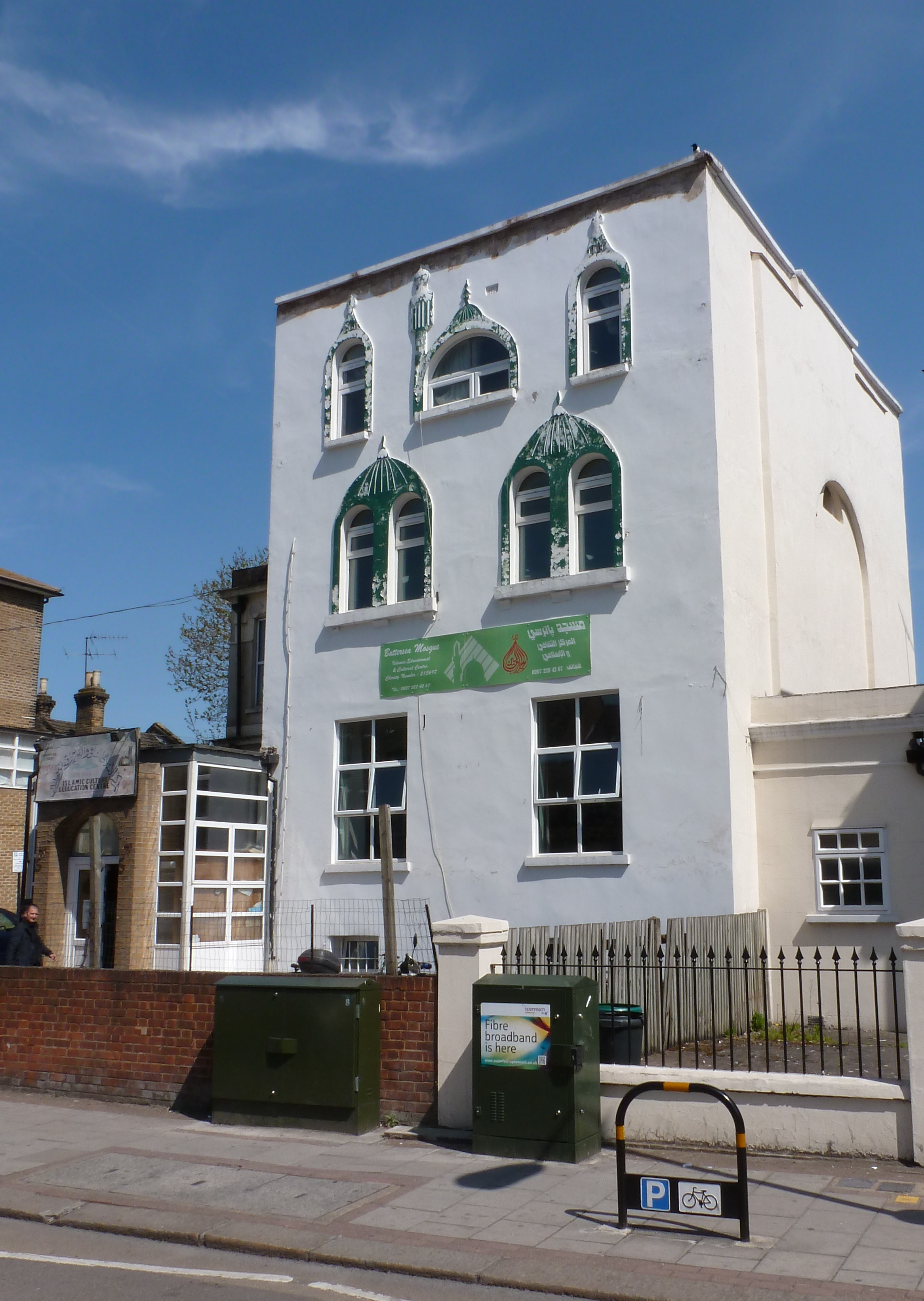 stage. I think we will know much more about the regeneration programme later in January. For some of the problems as well as the potential in the regeneration project, see Tony Belton, ‘All Change North of the Junction’, Battersea Matters: Newsletter of the Battersea Society (Winter, 2013), pp. 4-5.
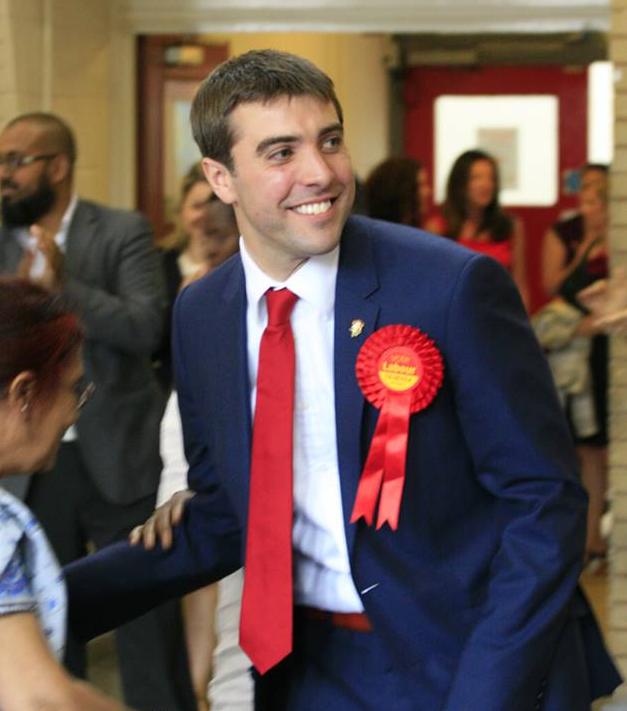
4. In May I was delighted to report that Wendy Speck, Simon Hogg and I were re-selected as Labour’s candidates for the Council elections this coming May 22nd. Two months later my friend and colleague, Will Martindale, was also selected as Labour’s Parliamentary candidate at the General Election in 2015. Here he is pictured after the selection.
5. I was very pleased to take 30 or so local kids to meet the Mayor and to learn something about the Council and its functions. Here they are with the Mayor, and their mentor Victoria Rodney of the Mercy Foundation, on the “marble staircase” in the Town Hall.
6. A sad feature of the year – for me at any rate was the Government’s decision to take Battersea Park School out of the Borough’s control and make it a Harris Academy. As a consequence of this decision I resigned as Vice-Chair of the Governors after more than a dozen years. Rather more important the Head, Gale Keller, also decided to resign as of 31st December.
7. On a very practical level, with considerable support from many of you, I have fought off an idea from Network Rail to close the Grant Road exit from CJ at an earlier time of night; I have got the bus-stop replaced opposite the end of Culvert Road; addressed the Ahmadiyya Muslim Community Eid Celebration in York Gardens Library; dealt with pr obably a couple of hundred cases to do with housing, planning, transport and jobs. I also attended probably about 40 Council and Committee meetings and another 20/30 resident meetings. Wendy Speck and Simon Hogg are equally active in different and complementary ways. Wendy is the Chair of Chesterton Governors and does a tremendous amount in and about the school as well as being a very conscientious councillor. Simon is a policy man and very active in the Committees as well as being very involved in the Winstanley Estate regeneration.
8. And of course my review of 2013 would not be complete without a brief mention of the dreaded streptococcal G poisoning; what a pain, literally, but it is at last showing mild signs of recovery!
9. Finally my Did You Know sections last year were about the Katherine Low Settlement, the Latchmere Estate, Maureen Larkin, Senia Dedic, Darius Knight, Elizabeth Braund, the London, Chatham and Dover Railway Tavern, London’s major transport problem 100 years ago – horse manure; Caius House, Caroline Ganley and John Archer.
My Programme for January
1. On the 9th January I had the Borough Residents Forum, which is actually a bit of a misnomer as by residents is meant Council tenants and leaseholders, and in the week beginning 13th January I have the Passenger Transport Liaison Committee, a Winstanley Estate Steering Group and the Met Police’s Special Neighbourhood Team.
2. The Planning Applications Committee this month is on the 20th and that is followed by the Strategic Planning and Transport and Housing Committees on the 22nd and 23rd.
3. There is also an important Big Local consultation meeting on the 25th at the Wilditch Centre.
Did you know the connection between Maysoule Road and the Victoria Embankment Gardens?
You may remember that in my December Newsletter I had a picture of 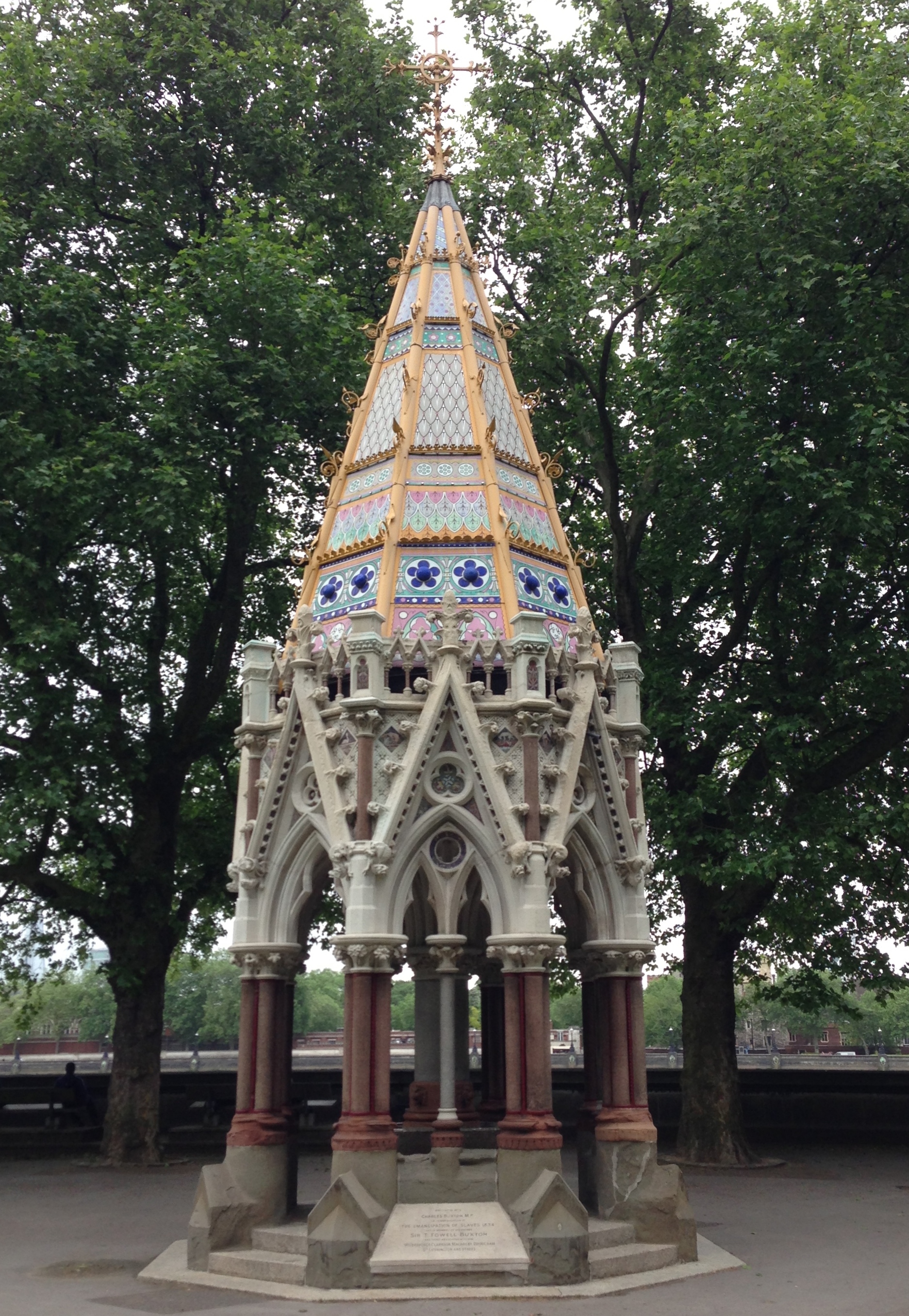 Hyacinth Stone of Buxton House at the John Archer plaque unveiling and that I promised that I would tell her about the connection between Buxton House, Maysoule Road, and Victoria Embankment Gardens. Well here it is.
Not long ago I was early for a meeting in Westminster and so I went for a short walk in Victoria Embankment Gardens. When there I had a look at a monument I had seen before but never particularly noted. Here it is with its inscription. Imagine my surprise to discover that it was a monument to one of the early campaigners against the slavery and below is the inscription.
And of course all the blocks in Maysoule Road are named after many of the men responsible for the abolition of slavery in the British Empire, as it was then. Buxton House is almost certainly named after T Fowell Buxton, who took over the leadership of the anti-slavery cause in the House of Commons in 1825 after Wilberforce retired. Wilberforce, who of course has another Council block on York Road named after him, had succeeded in getting the slave trade abolished in 1807.
But that was the trade in slaves from Africa to the New World. The abolition of slavery in the  British Empire had to wait until 1834 and was achieved under Buxton’s leadership. Charles Buxton was his Liberal (i.e. radical, as there was no Labour Party then) MP son, who had the monument built.
The monument is in easy view for any passenger on the 87 bus into Westminster, on the right immediately after Lambeth Bridge. And you will note the names include Clarkson, after whom another block in Maysoule Road is named.
Councillor Tony Belton’s Latchmere November Newsletter (# 54)
October highlights
1. First of all a big thank you to all those who sent me good wishes for a speedy recovery from streptococcal G poisoning. I am making reasonable but not exactly speedy progress as some of you will have seen as I struggle around, but now on one and not two crutches!
2. Second an even bigger thank you to all those who responded about the possible closure of the CJ Grant Road exits at an earlier time than currently. I got 40 responses between when I put the message out at about 11.30 am and 5 pm on Day 1. I immediately sent those responses off to the Town Hall and then onto the railway companies. I have heard nothing since – hopefully we have nipped that one in the bud.
3. The Battersea Park School (BPS) saga rolls on. You may remember that I suggested that the Government was intending to make the school into an Academy sponsored by Harris (the carpet people). Well this month the Governors were invited on a trip to see two Harris academies in Merton. I am afraid that I thought that I could hardly manage to stumble around a couple of schools in one day and so I did not go. But nothing definite has happened since then and indeed the Government has sent a relatively “soft letter” about the school’s reactions to the original Ofsted Report – perhaps the rather good GCSE results announced in August have resulted in a couple of second thoughts.
I would still bet on the Government pressing on with their dogmatic policy of moving BPS out of local democratic control and making it a sponsored academy. But given the pressures on the Government and the very public failures of their policies in a couple of recently well-publicised cases, there is just a little chance that they might back down.
4. The 8th October Planning Applications Committees had a number of interesting applications, most particularly for the Prince’s Head and the one-time Chopper or @Battersea pubs/clubs. Both of these pubs have been the centre of considerable local concern over the years but now it seems as though both are going to be re-developed. There have been a number of applications, which have reached an advanced stage of consideration on both sites but finally applications came to Committee and were approved.
The Prince’s Head application was for 19 flats (16 two-bed and 3 three-bed), of which 5 would be of a shared ownership type, and therefore classified as “affordable”. These would be built above commercial lettings on the ground floor. Given the nature of the Falcon Road shopping frontage I am not absolutely certain that the shopping units will work – for a start most of the shops in Falcon Road are on the opposite side of the road. But I guess it rather depends upon the nature of the shopping. If it is one of those Tesco/Sainsbury locals then I am sure that it will be a success – but we will have to see. I know that for some of the residents almost anything would be a plus when compared with the Prince’s Head at its worst!
The Chopper application was similar but slightly larger with 29 flats being built above commercial properties, including a new pub. 6 of these flats would be of a shared ownership style tenure. Hopefully the pub will replace the rather belligerent character of the old pub with a pleasant recreational but modernised pub. Both applications were accepted.
I thought three other applications were particularly interesting. One was for 157 flats and houses to be built round the old Elliott School site just off Putney Hill. I mention it because I know lots of kids from Battersea went to Elliott. I couldn’t help noticing the outraged protests of Putney residents. The sale of the land and the use for private residential housing was to pay for the Council’s costs in building the new Ark Academy to replace Elliott. The point was that these were luxury housing built to low densities and costing, well we will have to wait and see, but my guess is north of £2 million – and the locals were protesting!
Another application for a 7 storey building, providing 12 flats, on a miniscule site opposite the Battersea Dogs’ Home provided an interesting contrast. Seven storeys squeezed in on the space of a tennis court as opposed to spacious large properties, two contrasting sites, one in Battersea and the other In Putney – I hardly need to say more!
But I was surprised that the one application that was refused was for a large (13 storey) commercial and residential development on the Upper Richmond Road near to East Putney station. Surprised because the Council has appeared to allow applications of almost any scale in “town centre” sites but on this occasion the recommendation was for refusal and refuse it we did. Was it because it was in the Council Leader’s own ward and his own constituents were protesting?
5. On Thursday, 17th October, I managed to drag myself around the Caius House (Caius is a latinised word for keys and is actually pronounced KEYS) development just behind Badric Cour![647293_f644bcdc[1]](https://tonybelton.blog/wp-content/uploads/2013/12/647293_f644bcdc1.jpg) t. Caius House will mean nothing to many of you because the “old” Caius House youth club was demolished in about 2008. (See below for the history of Caius) The new youth club, and the residential properties above, which are paying for the development, are due to be handed over in spring, 2014. I and several other councillors went round the site and although it is difficult to tell from this photograph it is obvious that we are soon going to have a splendid new club right next to York Gardens, the Kambala and the Winstanley. We were told that it will be the largest youth club in the UK. Let’s hope that it is also the best. The top picture is of the new sports hall at the club and the bottom one is of the old building demolished in 2007/8.
t. Caius House will mean nothing to many of you because the “old” Caius House youth club was demolished in about 2008. (See below for the history of Caius) The new youth club, and the residential properties above, which are paying for the development, are due to be handed over in spring, 2014. I and several other councillors went round the site and although it is difficult to tell from this photograph it is obvious that we are soon going to have a splendid new club right next to York Gardens, the Kambala and the Winstanley. We were told that it will be the largest youth club in the UK. Let’s hope that it is also the best. The top picture is of the new sports hall at the club and the bottom one is of the old building demolished in 2007/8.
6. The 16th October Council meeting did consider the cuts that the Council is going to make in the housing department (and others). Currently the Housing Department is taking the brunt of the cuts, but we will see many more. It is a little difficult to describe all the arguments for those of you who wonder what Council meetings are like look at this link http://www.wandsworth.gov.uk/info/200318/decision_making/1606/council_meetings_online_16_october_2013/4. showing a U-Tube stream of the housing cuts debate. If you don’t want to watch it all – which I could well understand then Cllr Hogg’s speech is 12 minutes into the stream and mine is at 21.20 minutes!
7. On Sunday, 27th October, I attended the Ahmadiyya Muslim Community Eid Celebration in York Gardens Library, where I was asked to give a speech on peace!. I am hardly an expert but I did to an audience of about 50 Battersea residents. The Ahmadiyya mosque in Putney is the first in London and was built in 1913 and their Merton mosque is the largest in western Europe. Some of the local organisers live on the Winstanley estate.
8. Finally a grudging congratulations to Jane Ellison, our MP, who has just been made Parliamentary Under Secretary of State (Public Health). Despite our pretended enmity across the party divide, Jane and I get on quite well and if this appointment is recognition for her work opposing female genital mutilation then it is well deserved even if I hope she loses the job at the next General Election!
My Programme for November
1. Once the clocks go back we are in to the busiest time for councillors, especially in the winter before the next Council Elections – Yes, they are next May and so the rounds of canvassing and leafleting will be starting up soon. I do hope you accept me knocking on your door with patience and humour!
2. On 7th November I have as ever the Planning Applications Committee. On the 19th I have the Strategic Planning and Transport Committee, followed on the 21st by the Housing Committee.
3. The Borough Residents’ Forum, a committee of Council tenants and leaseholders, meets on 13th and I am the Labour Party’s representative on that.
4. The 15th November marks the 120th anniversary of the opening of what was Battersea Town Hall, now Battersea Arts Centre (BAC). BAC is laying on some kind of an event, which I will be attending. I look forward to seeing what exactly they are going to do – fireworks? A theatrical review? An exhibition? I will report back!
5. For my pains I am also the Treasurer of an organisation called SERA, which is a “green lobby” group with the Labour Party. SERA has its annual general meeting in Manchester on 23rd November and so on that Saturday I will be in Manchester.
Do you know anything about Caius House? I guess not.
Caius House is a charity and youth club which has been serving the community of Batt![collegehistory-loganprint_0[1]](https://tonybelton.blog/wp-content/uploads/2013/12/collegehistory-loganprint_01.jpg) ersea for over a century.
ersea for over a century.
Gonville and Caius (see picture and pronounced Keys) College, Cambridge, is a 14th century foundation created by Edmund Gonville, a Norfolk cleric, and refounded two centuries later by John Caius, a successful and very wealthy student from the college. In 1887 some undergraduates and fellows from the College rented a house in what was then the very poor London industrial suburb of Battersea. They started a College “settlement” where former undergraduates from the College lived and ran a range of clubs for local residents. Shortly afterwards they started a boys club (and later a girls club) and found that it attracted members from the poorest and least educated young people in the area.
By 2008 the Caius House youth club building (located on Holman Road) had served the local the young people of Battersea well for about a century but was badly in need of renovation; however the layout was thought to be totally unsuitable for a modern youth club. The Trustees decided to sell the plot of land to a developer who would build residential accommodation with space for a modern youth club on the first two floors. After consultation with youth members, the community and the Council, the derelict old building was demolished and the process of re-building a modern state of the art youth club began.
The #Wheatsheaf, Tooting Bec
I cannot reply in 140 characters for Twitter lobbyists but here is the longer version that I sent to email lobbyists campaigning to save the #Wheatsheaf this afternoon.
“Can I make a friendly comment? When sending lobbying letters it is usually better to change the opening sentence from the standard one. Councillors tend not to rate lobbying letters, which have simply been copied, anywhere near as highly as ones that are individually crafted! Plus one of your stereo-typed letters contains a typo, repeated ad nauseam. You were surely contacting me and not “contracting” me – implies that you hadn’t even read the lobbying letter that you are expecting councillors to read – not convincing.
But enough of the pompous lessons in lobbying and down to the meat. If you have read the Council paper 13-733 (and for those who are really keen then see link http://ww3.wandsworth.gov.uk/moderngov/documents/s29843/13-733%20THE%20WHEATSHEAF.pdf ), you will see several interesting features. I will particularly pick on two:-
1. There is considerable emphasis on Government policies designed to get the local economy moving and that includes allowing permitted development rights in all kinds of locations (NB I am not agreeing with this so don’t argue please but like it or like it not it is the Government’s position). As it happens both parties in the Council are almost equally opposed to these policies, especially as regards permitted development. The Tory Council is no more keen than the Labour Opposition to have planning controls taken away from us. We have to deal with the consequences of un-neighbourly development far too often to be as cavalier as Government Ministers! BUT to help Tory councillors to stand against their own Government it would be very helpful if one or two of you could come up with a contradictory Government policy, apart from “localism”, which seeks to protect the fabric of the existing townscape – short of listing.
2. Paragraph 31 is the key. Members are “asked whether or not they wish to pursue making any Article 4” etc. That is very unusual. Officers usually come to a conclusion and make a definite recommendation to do or not do something. This means they do not really know and/or they have not yet been given political direction by the Tory majority. (the only equivalents that I can think of are when the Council is operating in a semi-judicial way such as licencing committee and occasionally planning applications, when they legally cannot predict what the members may decide.) That could mean that there is still everything to play for on this matter, which means to say that you have to get at more Tory councillors than just those on the Committee and to whom you have sent this email to. For starters you need to email the Leader rgovindia@, the relevant Cabinet member rking@, and the ward members for Nightingale and Bedford, namely adunn@,ajacob@, ihart@, smcdermott@, and swilkie@wandsworth.gov.uk.
I didn’t notice any comments re the Trafalgar Arms? Not worth making a point?
I will do my best, as I am sure my colleague Peter Carpenter will do, to protect the pub, partly because we both would like to extend the precedent to other places such as the Falcon at Clapham Junction, the Spread Eagle in Wandsworth High Street, etc. Oh, and I know it’s a pain but members really are a little frit of a massed public gallery quietly making their point – a simple placard saying Save the Wheatsheaf will do. Heckling does NOT go down well with members.”
Grangemouth – The Deal
Most news media billed this as a “good day” for Scotland with many commentators criticising Unite and by implication the trade union movement. There is little doubt that Unite’s tactics were flawed and they had not thought of how to re-act to Ineos’s counter-attack or the strength of the employer’s position. Rather reminiscent of the NUM in the 1980’s!
But surely we are blinded by the immediacy of the good news. I suggest that the more significant feature of the deal, in the long-term, was the total and effortless victory of international capitalism over the interests of the workforce. Ineos threatened to transfer production, at the stroke of a pen, to the cheapest source of supply, interestingly the USA because of the cost of energy and nothing to do with wage costs.
Add to that the “unaccountable” nature of management decisions made by multi-national billionaires and surely we are faced with a sea change in the centuries old battle between capital and labour. This plays out on an international stage but also at a very local level as we can see from this week’s other headline claiming that Council Compulsory Competitive Tendering (#CCT) is forcing many big out-sourcing suppliers to pay below the legal National Minimum Wage.
The implication is surely that labour is now fatally weak and international capitalism so powerful that the divide between the world’s mega-rich and the rest of us is bound to grow. Faced with this prospect the majority of us – the People – will either resort to national and international legislative control of the market or to violence.
Am I being too alarmist? Commentary from Greece or Spain suggests perhaps not. Politicians have to re-act.
 Tony Belton
