Councillor Tony Belton’s Latchmere January Newsletter (# 56)
 December and 2013 highlights
1. There really wasn’t much to say about December except that I went to the Xmas socials/parties/fairs of the Falcon Road and Kambala residents, the Big Local organisation, Battersea Arts Centre and of constituents Vicky and Jacob – thanks to all. There was also nothing of any great interest at the December Planning Applications Committee, and so with nothing much to say about December I thought I’d pull out my highlights of 2013 as recorded in the newsletters. And here they are.
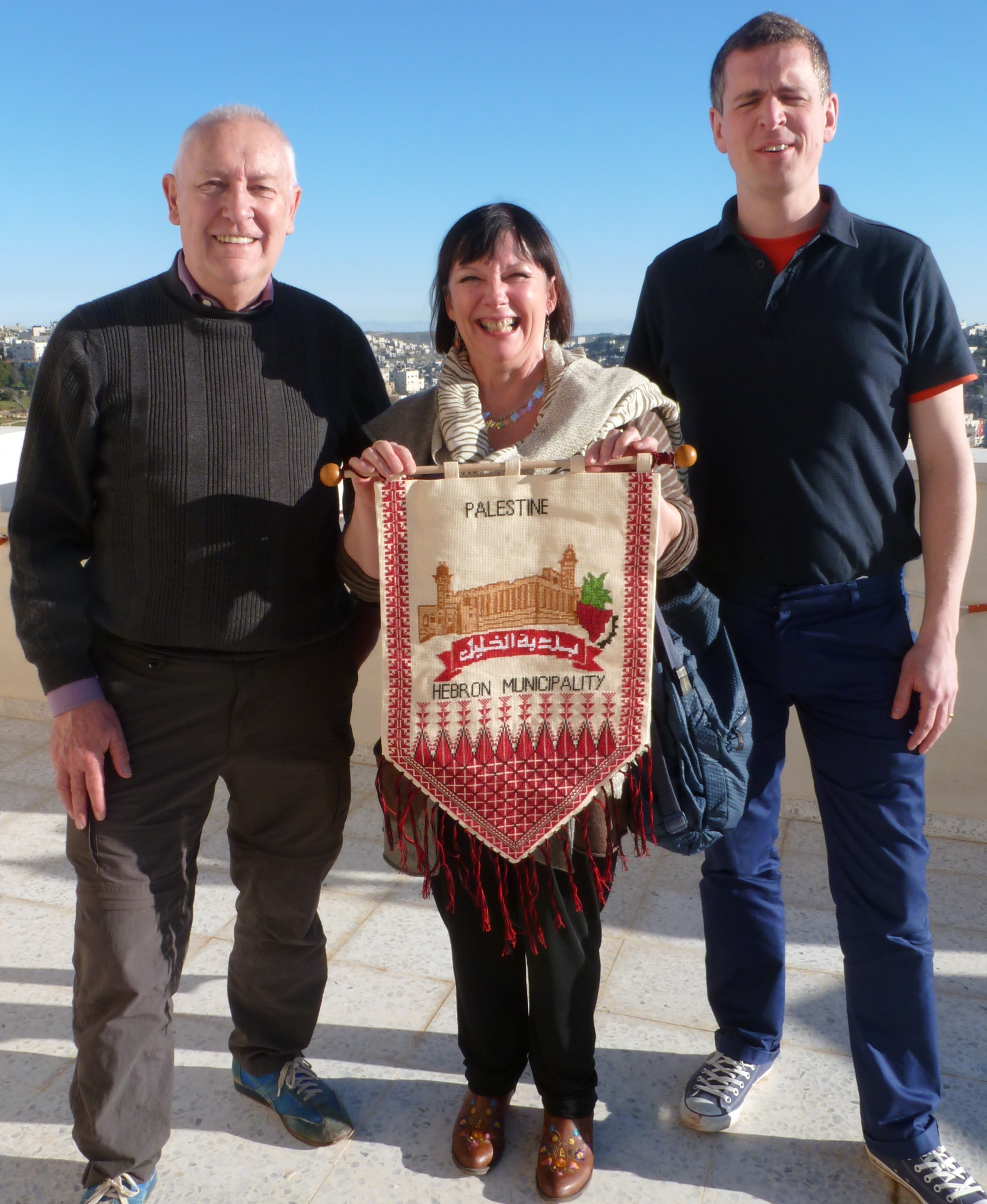
2. No. 1 for me has to be the trip that we three Latchmere councillors, Wendy Speck, Simon Hogg and myself, made to Palestine in February. This, of course, had nothing to do with Latchmere, Battersea or Wandsworth (!) but your three Labour councillors went on this fact-finding trip, purely for interest – and it was certainly packed with interest. Here is a picture of the three of us with a banner given to us by the Mayor of Hebron. (As I said then, before any cynics out there think otherwise, it was all paid for out of our own pockets and had nothing to do with the Cou ncil!).
The trip did give me a chance to take my picture of the year, and here it is – a cactus caught by the flash-light in the Judean desert at sunset, high above Bethlehem – and my was it cold.
3. The most significant ward issues of the year were the Council’s decision to spend up to £100 million on the regeneration of Latchmere and Roehampton wards, of which our share could be about £60 million, the development of the Big Local project in the Winstanley Estate area and the Mosque planning application. The regeneration project is at the stage where major decisions are soon to be taken about the extent of demolition and new build and the Big Local is also at a crucial consultation 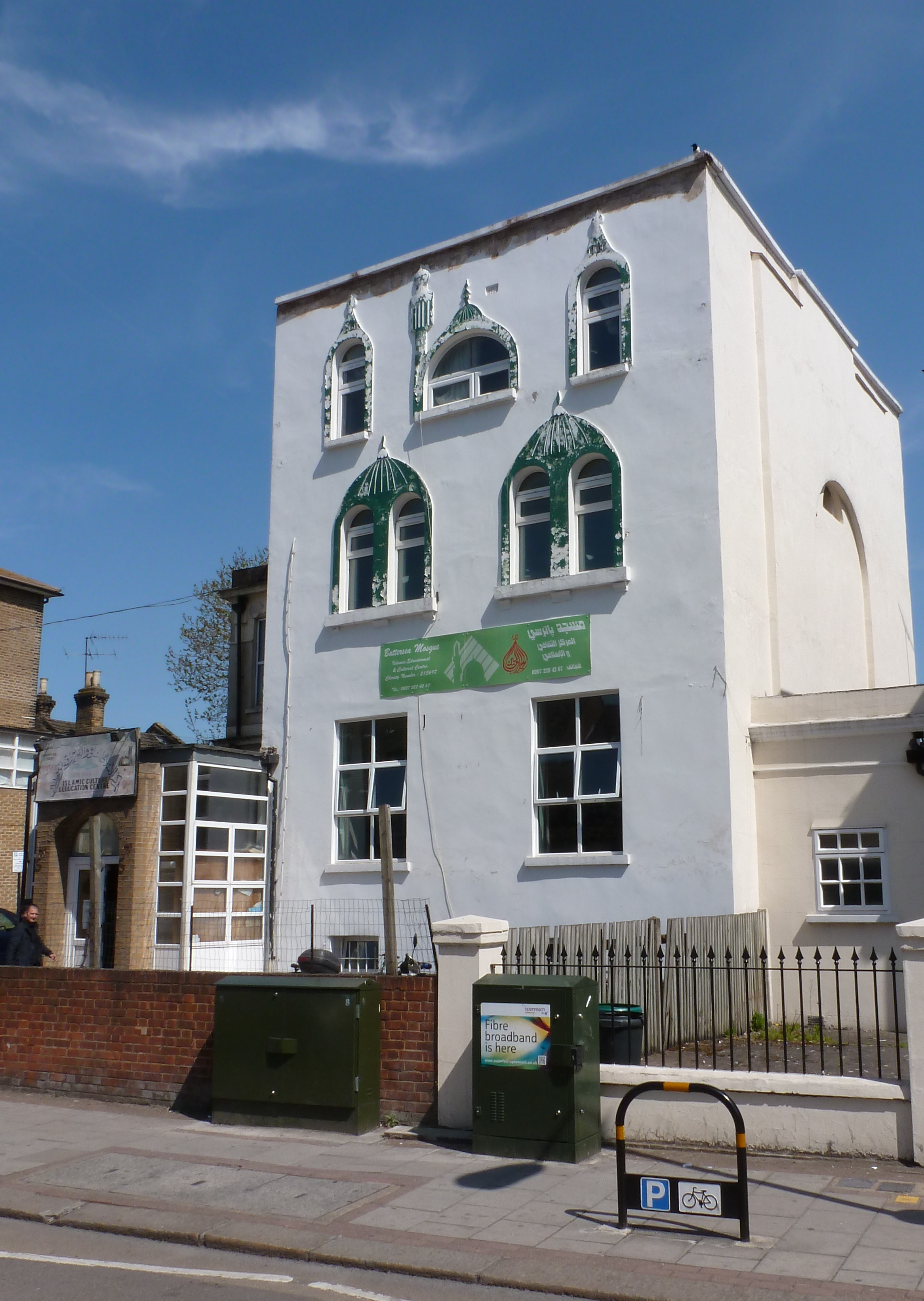 stage. I think we will know much more about the regeneration programme later in January. For some of the problems as well as the potential in the regeneration project, see Tony Belton, ‘All Change North of the Junction’, Battersea Matters: Newsletter of the Battersea Society (Winter, 2013), pp. 4-5.
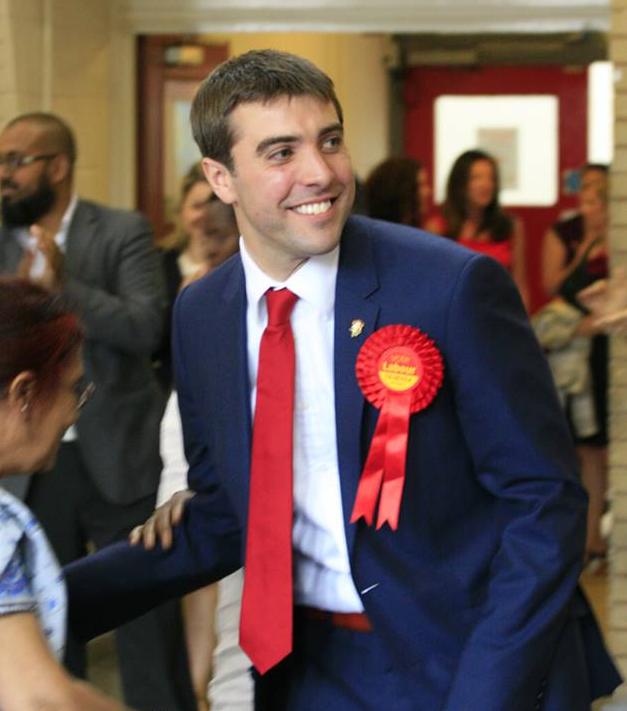
4. In May I was delighted to report that Wendy Speck, Simon Hogg and I were re-selected as Labour’s candidates for the Council elections this coming May 22nd. Two months later my friend and colleague, Will Martindale, was also selected as Labour’s Parliamentary candidate at the General Election in 2015. Here he is pictured after the selection.
5. I was very pleased to take 30 or so local kids to meet the Mayor and to learn something about the Council and its functions. Here they are with the Mayor, and their mentor Victoria Rodney of the Mercy Foundation, on the “marble staircase” in the Town Hall.
6. A sad feature of the year – for me at any rate was the Government’s decision to take Battersea Park School out of the Borough’s control and make it a Harris Academy. As a consequence of this decision I resigned as Vice-Chair of the Governors after more than a dozen years. Rather more important the Head, Gale Keller, also decided to resign as of 31st December.
7. On a very practical level, with considerable support from many of you, I have fought off an idea from Network Rail to close the Grant Road exit from CJ at an earlier time of night; I have got the bus-stop replaced opposite the end of Culvert Road; addressed the Ahmadiyya Muslim Community Eid Celebration in York Gardens Library; dealt with pr obably a couple of hundred cases to do with housing, planning, transport and jobs. I also attended probably about 40 Council and Committee meetings and another 20/30 resident meetings. Wendy Speck and Simon Hogg are equally active in different and complementary ways. Wendy is the Chair of Chesterton Governors and does a tremendous amount in and about the school as well as being a very conscientious councillor. Simon is a policy man and very active in the Committees as well as being very involved in the Winstanley Estate regeneration.
8. And of course my review of 2013 would not be complete without a brief mention of the dreaded streptococcal G poisoning; what a pain, literally, but it is at last showing mild signs of recovery!
9. Finally my Did You Know sections last year were about the Katherine Low Settlement, the Latchmere Estate, Maureen Larkin, Senia Dedic, Darius Knight, Elizabeth Braund, the London, Chatham and Dover Railway Tavern, London’s major transport problem 100 years ago – horse manure; Caius House, Caroline Ganley and John Archer.
My Programme for January
1. On the 9th January I had the Borough Residents Forum, which is actually a bit of a misnomer as by residents is meant Council tenants and leaseholders, and in the week beginning 13th January I have the Passenger Transport Liaison Committee, a Winstanley Estate Steering Group and the Met Police’s Special Neighbourhood Team.
2. The Planning Applications Committee this month is on the 20th and that is followed by the Strategic Planning and Transport and Housing Committees on the 22nd and 23rd.
3. There is also an important Big Local consultation meeting on the 25th at the Wilditch Centre.
Did you know the connection between Maysoule Road and the Victoria Embankment Gardens?
You may remember that in my December Newsletter I had a picture of 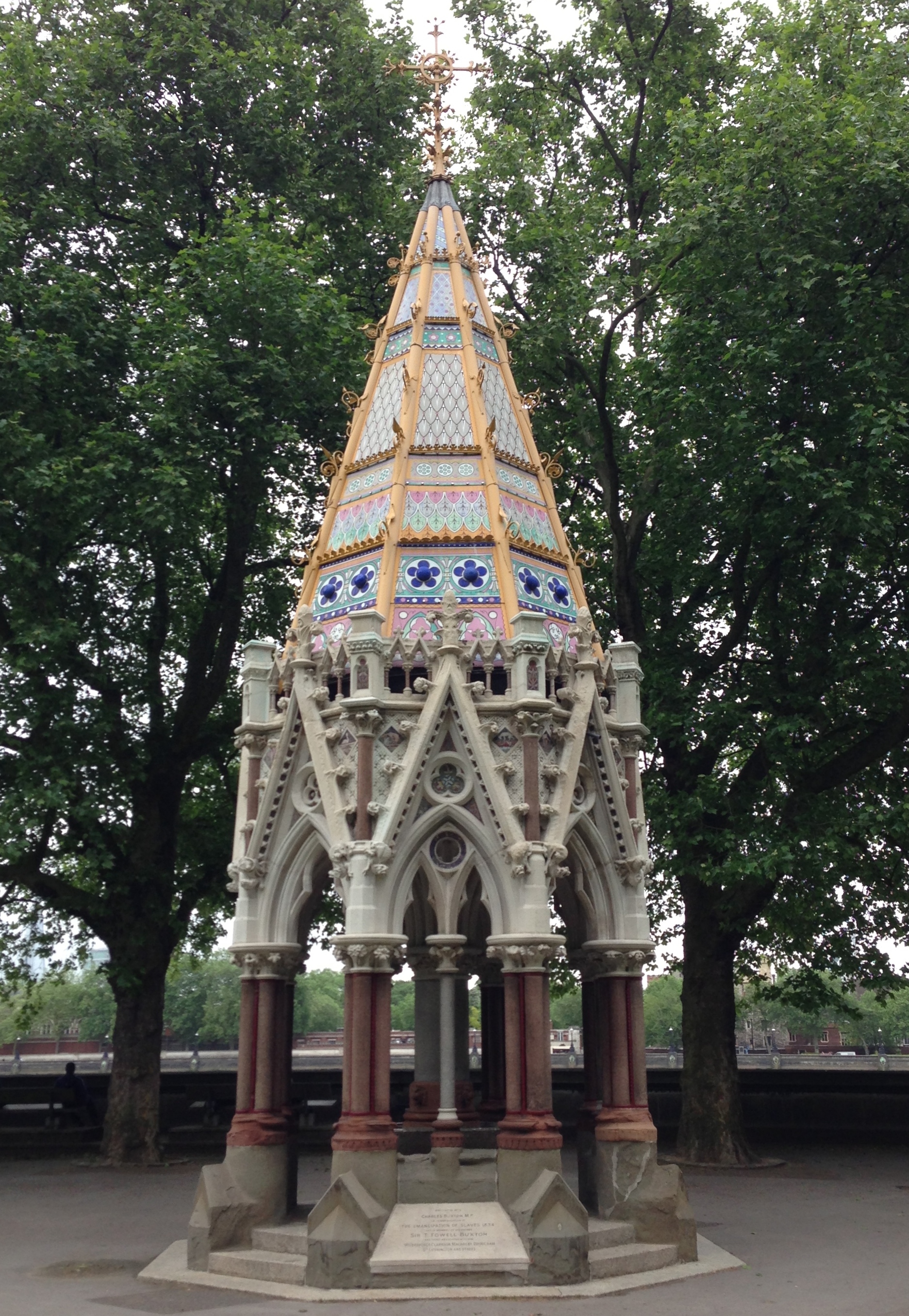 Hyacinth Stone of Buxton House at the John Archer plaque unveiling and that I promised that I would tell her about the connection between Buxton House, Maysoule Road, and Victoria Embankment Gardens. Well here it is.
Not long ago I was early for a meeting in Westminster and so I went for a short walk in Victoria Embankment Gardens. When there I had a look at a monument I had seen before but never particularly noted. Here it is with its inscription. Imagine my surprise to discover that it was a monument to one of the early campaigners against the slavery and below is the inscription.
And of course all the blocks in Maysoule Road are named after many of the men responsible for the abolition of slavery in the British Empire, as it was then. Buxton House is almost certainly named after T Fowell Buxton, who took over the leadership of the anti-slavery cause in the House of Commons in 1825 after Wilberforce retired. Wilberforce, who of course has another Council block on York Road named after him, had succeeded in getting the slave trade abolished in 1807.
But that was the trade in slaves from Africa to the New World. The abolition of slavery in the  British Empire had to wait until 1834 and was achieved under Buxton’s leadership. Charles Buxton was his Liberal (i.e. radical, as there was no Labour Party then) MP son, who had the monument built.
The monument is in easy view for any passenger on the 87 bus into Westminster, on the right immediately after Lambeth Bridge. And you will note the names include Clarkson, after whom another block in Maysoule Road is named.
Councillor Tony Belton’s Latchmere November Newsletter (# 54)
October highlights
1. First of all a big thank you to all those who sent me good wishes for a speedy recovery from streptococcal G poisoning. I am making reasonable but not exactly speedy progress as some of you will have seen as I struggle around, but now on one and not two crutches!
2. Second an even bigger thank you to all those who responded about the possible closure of the CJ Grant Road exits at an earlier time than currently. I got 40 responses between when I put the message out at about 11.30 am and 5 pm on Day 1. I immediately sent those responses off to the Town Hall and then onto the railway companies. I have heard nothing since – hopefully we have nipped that one in the bud.
3. The Battersea Park School (BPS) saga rolls on. You may remember that I suggested that the Government was intending to make the school into an Academy sponsored by Harris (the carpet people). Well this month the Governors were invited on a trip to see two Harris academies in Merton. I am afraid that I thought that I could hardly manage to stumble around a couple of schools in one day and so I did not go. But nothing definite has happened since then and indeed the Government has sent a relatively “soft letter” about the school’s reactions to the original Ofsted Report – perhaps the rather good GCSE results announced in August have resulted in a couple of second thoughts.
I would still bet on the Government pressing on with their dogmatic policy of moving BPS out of local democratic control and making it a sponsored academy. But given the pressures on the Government and the very public failures of their policies in a couple of recently well-publicised cases, there is just a little chance that they might back down.
4. The 8th October Planning Applications Committees had a number of interesting applications, most particularly for the Prince’s Head and the one-time Chopper or @Battersea pubs/clubs. Both of these pubs have been the centre of considerable local concern over the years but now it seems as though both are going to be re-developed. There have been a number of applications, which have reached an advanced stage of consideration on both sites but finally applications came to Committee and were approved.
The Prince’s Head application was for 19 flats (16 two-bed and 3 three-bed), of which 5 would be of a shared ownership type, and therefore classified as “affordable”. These would be built above commercial lettings on the ground floor. Given the nature of the Falcon Road shopping frontage I am not absolutely certain that the shopping units will work – for a start most of the shops in Falcon Road are on the opposite side of the road. But I guess it rather depends upon the nature of the shopping. If it is one of those Tesco/Sainsbury locals then I am sure that it will be a success – but we will have to see. I know that for some of the residents almost anything would be a plus when compared with the Prince’s Head at its worst!
The Chopper application was similar but slightly larger with 29 flats being built above commercial properties, including a new pub. 6 of these flats would be of a shared ownership style tenure. Hopefully the pub will replace the rather belligerent character of the old pub with a pleasant recreational but modernised pub. Both applications were accepted.
I thought three other applications were particularly interesting. One was for 157 flats and houses to be built round the old Elliott School site just off Putney Hill. I mention it because I know lots of kids from Battersea went to Elliott. I couldn’t help noticing the outraged protests of Putney residents. The sale of the land and the use for private residential housing was to pay for the Council’s costs in building the new Ark Academy to replace Elliott. The point was that these were luxury housing built to low densities and costing, well we will have to wait and see, but my guess is north of £2 million – and the locals were protesting!
Another application for a 7 storey building, providing 12 flats, on a miniscule site opposite the Battersea Dogs’ Home provided an interesting contrast. Seven storeys squeezed in on the space of a tennis court as opposed to spacious large properties, two contrasting sites, one in Battersea and the other In Putney – I hardly need to say more!
But I was surprised that the one application that was refused was for a large (13 storey) commercial and residential development on the Upper Richmond Road near to East Putney station. Surprised because the Council has appeared to allow applications of almost any scale in “town centre” sites but on this occasion the recommendation was for refusal and refuse it we did. Was it because it was in the Council Leader’s own ward and his own constituents were protesting?
5. On Thursday, 17th October, I managed to drag myself around the Caius House (Caius is a latinised word for keys and is actually pronounced KEYS) development just behind Badric Cour![647293_f644bcdc[1]](https://tonybelton.blog/wp-content/uploads/2013/12/647293_f644bcdc1.jpg) t. Caius House will mean nothing to many of you because the “old” Caius House youth club was demolished in about 2008. (See below for the history of Caius) The new youth club, and the residential properties above, which are paying for the development, are due to be handed over in spring, 2014. I and several other councillors went round the site and although it is difficult to tell from this photograph it is obvious that we are soon going to have a splendid new club right next to York Gardens, the Kambala and the Winstanley. We were told that it will be the largest youth club in the UK. Let’s hope that it is also the best. The top picture is of the new sports hall at the club and the bottom one is of the old building demolished in 2007/8.
t. Caius House will mean nothing to many of you because the “old” Caius House youth club was demolished in about 2008. (See below for the history of Caius) The new youth club, and the residential properties above, which are paying for the development, are due to be handed over in spring, 2014. I and several other councillors went round the site and although it is difficult to tell from this photograph it is obvious that we are soon going to have a splendid new club right next to York Gardens, the Kambala and the Winstanley. We were told that it will be the largest youth club in the UK. Let’s hope that it is also the best. The top picture is of the new sports hall at the club and the bottom one is of the old building demolished in 2007/8.
6. The 16th October Council meeting did consider the cuts that the Council is going to make in the housing department (and others). Currently the Housing Department is taking the brunt of the cuts, but we will see many more. It is a little difficult to describe all the arguments for those of you who wonder what Council meetings are like look at this link http://www.wandsworth.gov.uk/info/200318/decision_making/1606/council_meetings_online_16_october_2013/4. showing a U-Tube stream of the housing cuts debate. If you don’t want to watch it all – which I could well understand then Cllr Hogg’s speech is 12 minutes into the stream and mine is at 21.20 minutes!
7. On Sunday, 27th October, I attended the Ahmadiyya Muslim Community Eid Celebration in York Gardens Library, where I was asked to give a speech on peace!. I am hardly an expert but I did to an audience of about 50 Battersea residents. The Ahmadiyya mosque in Putney is the first in London and was built in 1913 and their Merton mosque is the largest in western Europe. Some of the local organisers live on the Winstanley estate.
8. Finally a grudging congratulations to Jane Ellison, our MP, who has just been made Parliamentary Under Secretary of State (Public Health). Despite our pretended enmity across the party divide, Jane and I get on quite well and if this appointment is recognition for her work opposing female genital mutilation then it is well deserved even if I hope she loses the job at the next General Election!
My Programme for November
1. Once the clocks go back we are in to the busiest time for councillors, especially in the winter before the next Council Elections – Yes, they are next May and so the rounds of canvassing and leafleting will be starting up soon. I do hope you accept me knocking on your door with patience and humour!
2. On 7th November I have as ever the Planning Applications Committee. On the 19th I have the Strategic Planning and Transport Committee, followed on the 21st by the Housing Committee.
3. The Borough Residents’ Forum, a committee of Council tenants and leaseholders, meets on 13th and I am the Labour Party’s representative on that.
4. The 15th November marks the 120th anniversary of the opening of what was Battersea Town Hall, now Battersea Arts Centre (BAC). BAC is laying on some kind of an event, which I will be attending. I look forward to seeing what exactly they are going to do – fireworks? A theatrical review? An exhibition? I will report back!
5. For my pains I am also the Treasurer of an organisation called SERA, which is a “green lobby” group with the Labour Party. SERA has its annual general meeting in Manchester on 23rd November and so on that Saturday I will be in Manchester.
Do you know anything about Caius House? I guess not.
Caius House is a charity and youth club which has been serving the community of Batt![collegehistory-loganprint_0[1]](https://tonybelton.blog/wp-content/uploads/2013/12/collegehistory-loganprint_01.jpg) ersea for over a century.
ersea for over a century.
Gonville and Caius (see picture and pronounced Keys) College, Cambridge, is a 14th century foundation created by Edmund Gonville, a Norfolk cleric, and refounded two centuries later by John Caius, a successful and very wealthy student from the college. In 1887 some undergraduates and fellows from the College rented a house in what was then the very poor London industrial suburb of Battersea. They started a College “settlement” where former undergraduates from the College lived and ran a range of clubs for local residents. Shortly afterwards they started a boys club (and later a girls club) and found that it attracted members from the poorest and least educated young people in the area.
By 2008 the Caius House youth club building (located on Holman Road) had served the local the young people of Battersea well for about a century but was badly in need of renovation; however the layout was thought to be totally unsuitable for a modern youth club. The Trustees decided to sell the plot of land to a developer who would build residential accommodation with space for a modern youth club on the first two floors. After consultation with youth members, the community and the Council, the derelict old building was demolished and the process of re-building a modern state of the art youth club began.
The #Wheatsheaf, Tooting Bec
I cannot reply in 140 characters for Twitter lobbyists but here is the longer version that I sent to email lobbyists campaigning to save the #Wheatsheaf this afternoon.
“Can I make a friendly comment? When sending lobbying letters it is usually better to change the opening sentence from the standard one. Councillors tend not to rate lobbying letters, which have simply been copied, anywhere near as highly as ones that are individually crafted! Plus one of your stereo-typed letters contains a typo, repeated ad nauseam. You were surely contacting me and not “contracting” me – implies that you hadn’t even read the lobbying letter that you are expecting councillors to read – not convincing.
But enough of the pompous lessons in lobbying and down to the meat. If you have read the Council paper 13-733 (and for those who are really keen then see link http://ww3.wandsworth.gov.uk/moderngov/documents/s29843/13-733%20THE%20WHEATSHEAF.pdf ), you will see several interesting features. I will particularly pick on two:-
1. There is considerable emphasis on Government policies designed to get the local economy moving and that includes allowing permitted development rights in all kinds of locations (NB I am not agreeing with this so don’t argue please but like it or like it not it is the Government’s position). As it happens both parties in the Council are almost equally opposed to these policies, especially as regards permitted development. The Tory Council is no more keen than the Labour Opposition to have planning controls taken away from us. We have to deal with the consequences of un-neighbourly development far too often to be as cavalier as Government Ministers! BUT to help Tory councillors to stand against their own Government it would be very helpful if one or two of you could come up with a contradictory Government policy, apart from “localism”, which seeks to protect the fabric of the existing townscape – short of listing.
2. Paragraph 31 is the key. Members are “asked whether or not they wish to pursue making any Article 4” etc. That is very unusual. Officers usually come to a conclusion and make a definite recommendation to do or not do something. This means they do not really know and/or they have not yet been given political direction by the Tory majority. (the only equivalents that I can think of are when the Council is operating in a semi-judicial way such as licencing committee and occasionally planning applications, when they legally cannot predict what the members may decide.) That could mean that there is still everything to play for on this matter, which means to say that you have to get at more Tory councillors than just those on the Committee and to whom you have sent this email to. For starters you need to email the Leader rgovindia@, the relevant Cabinet member rking@, and the ward members for Nightingale and Bedford, namely adunn@,ajacob@, ihart@, smcdermott@, and swilkie@wandsworth.gov.uk.
I didn’t notice any comments re the Trafalgar Arms? Not worth making a point?
I will do my best, as I am sure my colleague Peter Carpenter will do, to protect the pub, partly because we both would like to extend the precedent to other places such as the Falcon at Clapham Junction, the Spread Eagle in Wandsworth High Street, etc. Oh, and I know it’s a pain but members really are a little frit of a massed public gallery quietly making their point – a simple placard saying Save the Wheatsheaf will do. Heckling does NOT go down well with members.”
Grangemouth – The Deal
Most news media billed this as a “good day” for Scotland with many commentators criticising Unite and by implication the trade union movement. There is little doubt that Unite’s tactics were flawed and they had not thought of how to re-act to Ineos’s counter-attack or the strength of the employer’s position. Rather reminiscent of the NUM in the 1980’s!
But surely we are blinded by the immediacy of the good news. I suggest that the more significant feature of the deal, in the long-term, was the total and effortless victory of international capitalism over the interests of the workforce. Ineos threatened to transfer production, at the stroke of a pen, to the cheapest source of supply, interestingly the USA because of the cost of energy and nothing to do with wage costs.
Add to that the “unaccountable” nature of management decisions made by multi-national billionaires and surely we are faced with a sea change in the centuries old battle between capital and labour. This plays out on an international stage but also at a very local level as we can see from this week’s other headline claiming that Council Compulsory Competitive Tendering (#CCT) is forcing many big out-sourcing suppliers to pay below the legal National Minimum Wage.
The implication is surely that labour is now fatally weak and international capitalism so powerful that the divide between the world’s mega-rich and the rest of us is bound to grow. Faced with this prospect the majority of us – the People – will either resort to national and international legislative control of the market or to violence.
Am I being too alarmist? Commentary from Greece or Spain suggests perhaps not. Politicians have to re-act.
The Housing Crisis – Is a massive building programme sufficient to resolve the housing crisis?
It is a common-place that a massive building programme is the way, even the only way, to resolve the housing crisis facing the young, those on low and middle incomes and the homeless. Well if my Borough of Wandsworth is any indication the answer is definitely NO.
In Nine Elms, less than a mile from Westminster a development of 20,000+ flats, home to maybe 60,000 people, has begun and will be largely completed in ten years time. But no one imagines that this development will have any affect whatsoever on the housing crisis in London. It is not a problem we have with the construction industry, nor with the planning system. The problem is distribution!
Nine Elms and Battersea Power Station, with first sales going to rich Malaysians but also rich Europeans (including Brits) may not be absolutely typical but what if the higher earners continue to trade up and use their market power to invest in the housing market and use rental income as an alternative to final salary pensions? What if they act as the mortgage lenders for their children – the so-called Bank of Mum and Dad? What if the massive growth of the buy-to-rent mortgage industry is clear evidence of a long-term trend to yet more exploitive rents.
The Tory mantra about the market clearly just doesn’t work – at least not in the UK in housing. We have to take back control of the market; as a society we have to resolve the issue of distribution. The Tories recognise this to an extent and are trying to tackle the issue in the socially rented sector with the mean-spirited Bedroom Tax, but it only tackles a small sector of the market and it only tackles an easy defenceless target – the poor, social tenants. Meanwhile the social sector gets smaller and smaller and the better off collar more and more of the market.
There are three interesting and dramatic examples of this process apparent in my analysis of how “right-to-buy” has operated in Tory Wandsworth. Firstly let’s look at the overall impact. Of the 18,000 Wandsworth Council properties sold nearly 6,000, 1 in 3, are now privately rented. (see my blog of December, 2012) Some of these rental properties are part of quite large portfolios. Several millionaires have been created. Their millions have, of course, been created out of the increased rents imposed on private tenants, rents ironically frequently paid by the state in the form of housing benefits. Many examples exist in Battersea’s Doddington estate, where Council flats being let at £200 per week to families classified by the Council as being “in need”, sit side by side with others being rented out at over £500 per week using landlord practises not far short of what fifty years ago would have been known as Rachmanism (Google Peter Rachman for a brief history).
Another completely different example is where small council blocks have been bought up by developers and redeveloped as very expensive town houses. One example is in Sisters’ Avenue (see March, 2013, Blog), where six modest post-war family flats were sold to sitting tenants in the 1980s at an average price of £17,500. In the late 1990s and early 2000s they were sold on to a developer at about £300,000 each. Now the six replacement town houses are being bought at £1.95 million a time. The end result has no doubt been a major improvement in the quality and scale of the housing stock and certainly the relative enrichment of six working class Battersea families but also a complete loss of affordable housing. The effect, unintentional of course, has been of some lucky people pulling up the ladder behind themselves.
Whatever the rationale, the benefits for the original purchaser, the enormous political gain for the Tory Party, there can be little doubt that “right-to-buy” has been disastrous for the future of affordable housing in Wandsworth and by extension much of London.
To counter this situation the London Labour Housing Group (LLHG) has produced a powerful and useful manifesto for the London Borough Elections of 2014 but it admits that as long as the Government and the London Mayor are under Tory control there are limits to what can be done. Typical of the dilemma facing Labour is the comment of Councillor Peter John, Leader of London Borough of Southwark at a recent Battersea Labour Party meeting, where he asked, “Just what are the prospects for social housing in Southwark, when the new council housing we are building now is subject to government subsidised right-to-buy schemes”?
The LLHG understands the problem but it is beyond its competence or political power to challenge the real issue, which in my view is the way that much of politics in general and property taxation in particular is so warped in favour of higher income groups. There is clear evidence of the former in George Osborne’s introduction of the “Help to Buy” incentive aimed at encouraging house price rises but doing very little for housing construction – a plan many economists clearly believe to be about creating a feelgood factor and not a sustainable housing boom. As to the latter the inequity of property taxation in the UK hardly needs mention – in Wandsworth for example the Council Tax on the many expensive £1 million+ properties in the Borough is currently £1,357 per year, exactly double that on the average property (serious comparisons difficult as no revaluations since 1991 – another example of the moneyed classes, scaring Governments off re-distributive taxation).
Unfortunately, the only policy remedies that I see are to take control of the market, to close the market in social housing and to control the private rented sector. But the politics of controlling the market (subsidising large scale construction for the social sector), abolishing “right-to-buy” and controlling rents is beyond the Labour Party as at present and, to be fair, beyond political reality unless the political mood can be changed in the same radical way that the Tories managed in the 1980s.
Social Media, Blogs and political parties
Ever since the 2008 Obama campaign it’s been a sine qua non of English speaking politicians that parties and individuals must have excellent social media skills. Go canvassing, run a street stall, kiss a baby but make sure you get the story on Twitter and the picture on Facebook. I hear plenty of rationalisations for this behaviour with my favourite being that it scares the Tories witless – we seem to have a low opinion of our opponents’ nerve and intelligence and a high opinion of just how newsworthy our stories are.
Which is not to say that I don’t think that social media has its role, but just as Facebook seems to have peaked already and lost some of its appeal, I suspect that Tweeting is going to calm down – after all admirer of Danny Blanchflower, the footballer as well as the economist, as I am I get fed up with his thoughts on sport, the weather and everything else tweeted 10 and 20 times a day.
Tweets seem to me to be superb campaigning and rallying cries designed for elections, announcements and dramatic events – not for everyday stuff like haircuts or canvassing. 99.9% of the tweets I have ever been responsible for announce that I have published another blog entry and that seems to me to be an ideal use.
But the Blog is, I think, of a different order. I am told, repeatedly that my blogs are too long, that people just won’t read them, that they are sometimes boring, but that isn’t the point. They are the modern version of the old essay, as written by essayists. Mine are for my benefit not primarily the readers. If you, dear reader, find one or two of them interesting then that’s great but primarily they provide a vehicle for my thoughts.
But whilst writing this, it occured to me that for a party politician this opens up a hatful of opportunities, and for parties a complex new problem.
For a century democratic politics has struggled with the problem of communicating with the electorate. This struggle has largely been “avoided” by the use of party labels. It has been impossible to speak to all the electorate, so we use short-hand. I am Labour, therefore, nice and caring. You are a Tory and, therefore, nasty but better at making decisions.
It is this facet that has led me to justify the party whip and party discipline. Indeed the most frequent use of the argument is in justifying party politics in local democracy. In local elections it is surprising to the professional politicians just how many voters think that there should not be any party politics at all.
And then along comes the blog. No longer is it possible for the party to control what the candidate says to the electorate; or really the whip to control the elected politiican and enforce the party line; or the Electoral Commissioner to monitor expenditure on elections.
Now I can publish my own maybe maverick views and get a level of support for them based purely and simply on my own persuasiveness and the extent of my readership; but so can all my councillor colleagues. What kind of challenge does this pose for party politics. That is, of course, difficult to say right now, but it is almost certainly going to be very profound.
In the States it appears as though the major parties virtually cease to exist for the four years between the national conventions with social media used by the leading candidates to grab funding and then encourage volunteer canvassers. The Tea Party appeared for a time to be the only active force between elections: a strange parallel with UKIP perhaps. Given the still falling membership of British political parties are we going to go the same way?
Councillor Tony Belton’s Latchmere March Newsletter (# 47)
February highlights
1. On Friday 1st February I flew from Luton to Tel Aviv with a group of 30 people organised by Labour Friends of Palestine (LFP). We were on a fact-finding tour. LFP is organised by ex-Battersea MP, Martin Linton, and this trip had a very Battersea feel about it with other trippers being my colleagues Councillors Wendy Speck and Simon Hogg. (Here we are with a banner given to us by the Mayor of Hebron.) This was no ordinary trip however but a pretty tough, hard-working one. (Oh and before any cynics say otherwise, it was all paid for by us!)
We met the Palestinian Foreign Secretary and his number two, the Governor of Hebron Province and the Mayor of Hebron City. We met Meir Margalit, a Jewish, left-wing Jerusalem city councillor with the difficult portfolio of looking after Palestinian affairs in East Jerusalem. We had a discussion with the British Consul in Jerusalem and were given a talk by a senior UN representative with responsibility for Palestine. We had discussions with the relatives, mainly mothers of course, of Palestinian prisoners, mainly young men of course, in Israeli prisons.
- We visited a Palestinian refugee camp in Ramallah, a Bedouin encampment
 in the Judean desert, a Jewish settlement and several Palestinian villages surrounded by Jewish settlements – and all in four days! Oh and we also managed to fit in one or two of the major tourist sites such as the Church of the Sepulcre, the Wailing Wall and the Dome on the Mount (Christian, Jewish and Moslem sites) in Jerusalem, as well as the Church of the Nativity in Bethlehem and the tomb of Abraham and his family in Hebron. The picture is of a sunset scene in the Judean desert.

It was a busy trip, which of course I could write about for pages and pages but I will try and make just a few brief observations. First, and whilst I hadn’t expected Palestine to be at all hot in February I was not prepared for it being even colder than London was last month. Jerusalem is 3,800 feet or 1,000 metres up in the Judean Mountains and with clear nights the temperature really plummeted.
Secondly whatever the politics I was struck by the overwhelming physical ugliness of man’s inhumanity to man – the thirty foot high, 700 mile long wall that the Israeli Government is building round and in Palestine is as ugly as the picture suggests. Anyone who saw the Berlin Wall or the wall in West Belfast will know exactly what I mean.
But there are also a lot of half-demolished homes, where the Israeli authorities have decided to move Palestinians out, or half complete homes where the Palestinians in return have half built homes without planning permission (I longed for Britain’s planning systems). There are brand-new sparkling highways for Israelis built alongside litter-strewn, wreck-spattered, pot-holed roads for Palestinians (puts our pot holes into context!). Not even South Africa under Apartheid had segregated roads, did they?
On another note the religious sites, the churches, mosques and synagogues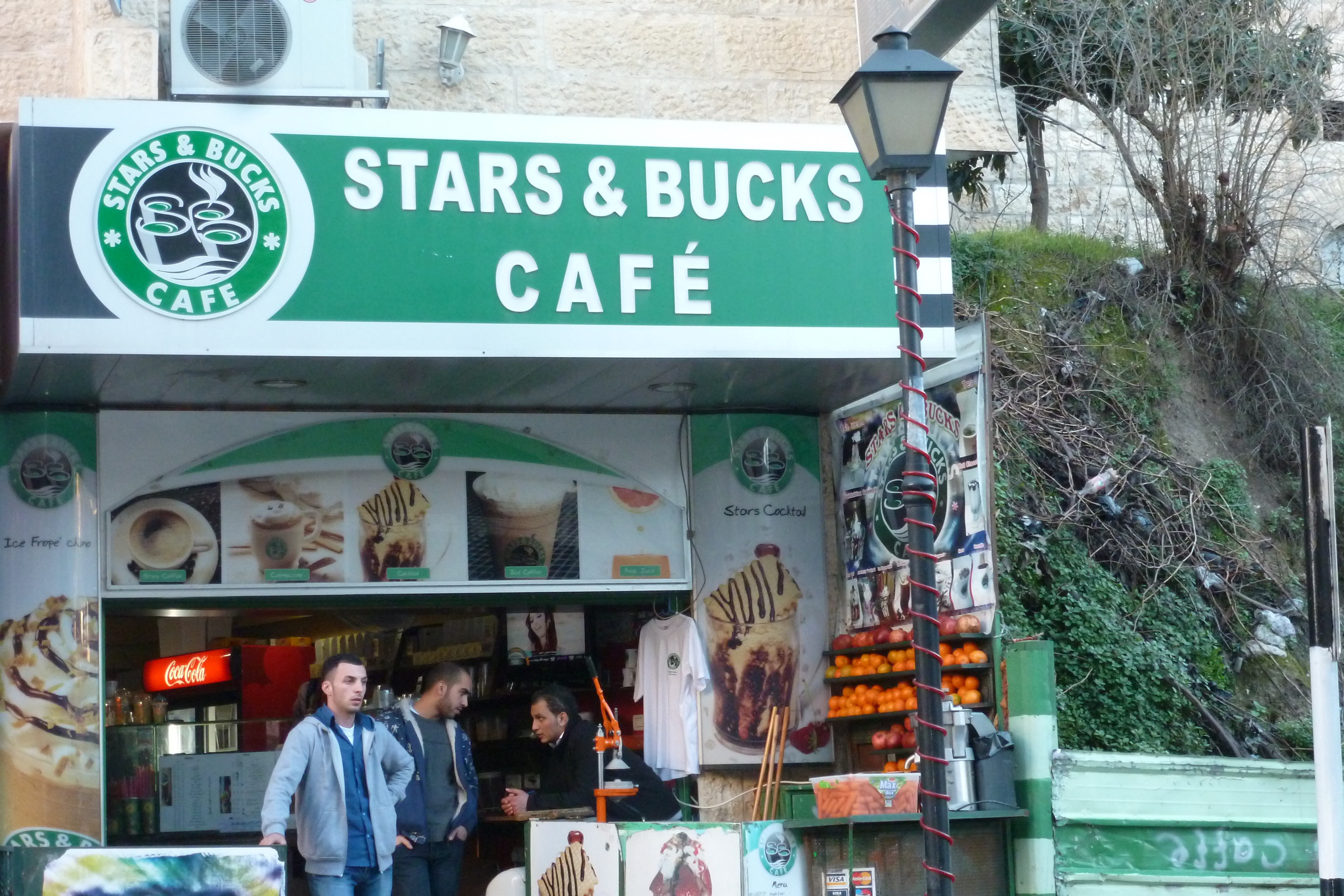 don’t really work for me partly because as they are shared between faiths they had neither the over-the-top garishness of say the Greek Orthodox Church nor the puritanical simplicity of a British church. But I also did not warm to kissing the very spot where Jesus was born – partly because the person, who decided where that spot should be lived 300 years after Christ and couldn’t have possibly known. And the old Xmas carol “Oh, little town of Bethlehem” will never feel quite the same now that I have seen the traffic, the mess and the commercialisation of religious tourism in modern Bethlehem. Though occasionally, as here, it has its amusing sides. But the real point of the trip was to look at Palestinian/Israeli relationships and what lies in the future for them.
The first thing to say is that life for the under-dog is always going to be rough and at the moment the Palestinians are the under-dogs all right. One doesn’t have to be anti-Israeli or pro-Palestinian to see that being bossed around by gun-toting 20 year old Israeli soldiers can be a demeaning experience for a middle aged Palestinian and an absolutely infuriating one for a 20 year old, unemployed, one. But more importantly experience on the ground tends to suggest that the much talked about two state solution just does not look a credible possibility. Palestine is just too small, and too broken up by ever-expanding Jewish settlements to be viable.
It may be pie-in-the-sky but a united non-sectarian, democratic state seems to me to the only possible future for the two peoples. But that can only happen if one, two or three other things take place. They are that the USA decides it can no longer afford, or no longer wants, to fund the Israeli state; that the rich Arab states decide between them that they are going to fund Palestine as generously as the USA does Israel; or finally that the people of the area get fed up with beating themselves up just as pretty much the whole of western Europe decided in the years after 1945 that two millennia of war was just about enough. Funnily enough, I think it may happen sooner than you think!
2. The day after we got back, 6th February, was the Council Meeting. One thing that certainly could be said for our trip was that it put the normal Labour:Tory badinage into context! There really was not a big debate but there was some discussion about paying all Council staff at least the London Living Wage of £8.55 per hour. Despite paying our top officers over £100,000 apparently we cannot afford to pay a minimum of £8.55!
3. The Planning Applications Committee on 11th February had few interesting applications but there were five for Boris bike docking stations. I have mentioned before that £2 million is being spent on this scheme in the Borough. None of these were in Latchmere, because none of those designed for Latchmere have been objected to, but I have a feeling people are not going to be pleased when they see the number of such docking stations planned. I also have my own suspicion that the scheme will not be quite so successful here as in the City and the West End, not least because out here it starts getting hilly and Latchmere Road Hill is pretty steep however young and fit you are.
4. The Strategic Planning and Transportation Committee had a paper about lobbying for a Heathrow/Clapham Junction link, which will be of interest to many in the ward. But perhaps more will be interested that the Council is looking into making parking enforcement the same on Council estates as it is everywhere else. You may know that car clamping, which the Council used to do on estate roads is no longer legal so the Council had to do something. It also obviously wants to save money by having the same traffic warden system everywhere in the Borough. I am not sure exactly how it is going to work but clearly the intention is to have one system that applies on both estate roads and public roads – and about time to, some would say.
5. On the 26th we had the Housing Committee and I really am struggling to think of anything interesting to say about that – so I won’t report anything.
6. On the 19th Jane Ellison organised a meeting at Providence House to discuss the plans for the extension of the Falcon Road Mosque. Representatives of the mosque presented their plans and Jane had asked me, as a member of the Planning Applications Committee, to outline the planning position and just some of the planning issues.
There were about 50 people present and local concerns were expressed. The major concern was clearly parking though there was mention of the proposed change in the building line and of the installation of a dome. At one point, the meeting threatened to get a little lively but I have to admit Jane handled it very well – ‘tis pity she is the wrong party!
7. I have an apology to make to everyone. On 8th February I had 10 solar panels fitted on my roof and became a member of the “oh so green brigade”. It is obviously the reason that we haven’t seen the sun since.
My Programme for March
1. There is a Council meeting on Wednesday, 6th March (OK, I know that’s passed but that will have to wait until next month!), with Planning Applications on the 12th.
2. The Falcon Road Estates Resident Association is on the 7th but there is also a Big Local meeting at Providence House on the same day. I will go to the Big Local meeting.
3. The Big Local is having a couple of consultation meetings. One is at the Sports Centre in Hope Street and will be an opportunity for locals to give their views on what the area needs. The second, much larger event will be a fun day for all on Saturday 16th. In the morning this will be centred on the Chapel in Pennethorne Square and in the afternoon it will be centred on York Gardens and the Library and will include football coaching, bouncy castles, face painting, etc. You name it and it will be there.
Do you know?
Maureen Larkin? I can’t remember when I first met Maureen but it was at an 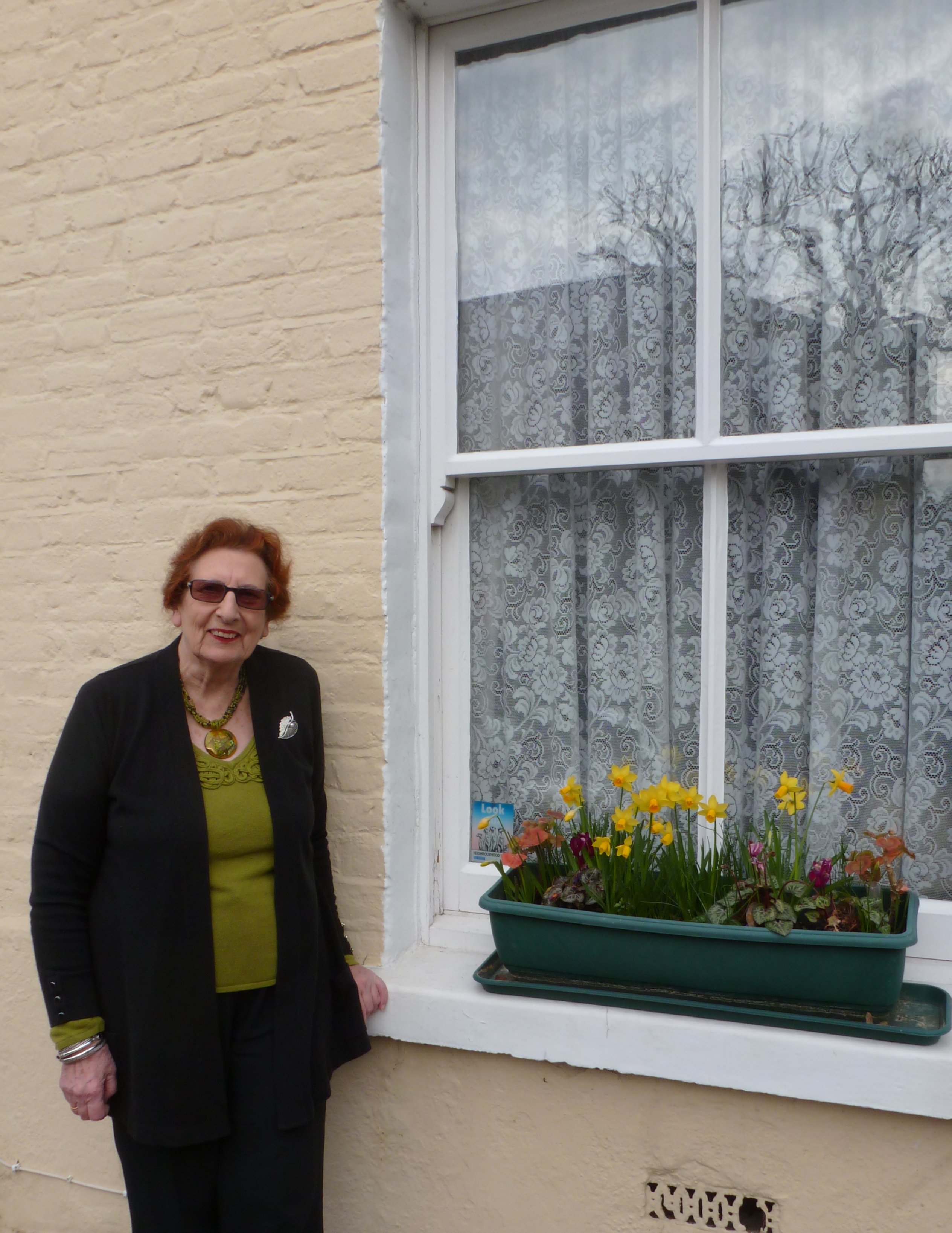 election, when I was standing for the Labour Party. I guess it might have been 1982. I called on some chap and got talking to him and it turned out that he had lived in the same house since the fifties and as I expressed surprise he told me about Maureen who was a far more senior citizen. So I called on Maureen and she told me she was born in her house in 1932 and as you see she is still there in the same house 81 years later. Can anyone beat that? Let me know if you can.
Many of you will know Maureen, who is still today very active as the Membership Secretary and Events Organiser of the Battersea Society. She has in her time been the Secretary or organiser of the Triangle (Poyntz Road, Shellwood and Knowsley Roads) Neighbourhood Watch and the Residents Association. She organises the Triangle Annual street party (she says she doesn’t organise it nowadays but I bet she has her say), which by the way I can say from experience is by far the best in the Borough.
In 2010 Maureen was presented with a Civic Award by Wandsworth Council in recognition of her services to the community. I remember it as a splendid occasion where she was accompanied by her daughter, Terry Barber. When I went round and took the photograph we chatted about Battersea when each little terraced house like hers had a family living upstairs and another downstairs and when the shared loo was a brick out-house in the yard, when the bath was a tub under the sink and Battersea, then the major industrial centre in west London, was filthy with coal soot and industrial grime.
Maureen clearly loves her community but she is not such an old sentimentalist to believe that everything was so good in the good old days, indeed she very much looks forward to tomorrow’s event to be organised and insisted that I had the Triangle party date firmly in my diary.
The Wandsworth Story behind Right to Buy
Wandsworth Tories introduced an aggressive Right-to-buy (RTB) policy a year before Mrs Thatcher came to power and made it a national Tory plank. It was, of course, a barn stormer and won many votes for the Tory party – and lost many more for a Labour Party perplexed about exactly how to tackle a policy, which was so perfectly attuned to an 80s Loadsamoney philosophy and such an anathema to any collectivist dream.
Lost in the political firestorm were some quiet voices on the Labour side, me included, who said as loudly as we could that outright opposition to the RTB policy was pointless but that reasoned criticism was valid and should have been pursued relentlessly. I recall two particular threads to our criticism. One was that receipts from sales should be used to replace housing stock.
Now in the current crisis about the lack of affordable housing everyone, even the Cameron Government, is talking, however disingenuously, about council house sales being accompanied by a policy of like for like replacement. The fact that the Blair/Brown Governments did no more to replace like for like than the Major/Cameron Governments does not make it any easier!
But the second criticism we had was that RTB would in the end result in the loss of affordable housing and would not be a long-term gain to the goal of creating a “property owning democracy”. Perhaps it is a little difficult to recall just how much Mrs Thatcher made of the creation of a share-owning, property-owning democracy but it was a central plank of the Tory philosophy of the 1980s. Now, however, with the first analyses of the 2011 Census figures we discover that for the first time since the war the proportion of the population living in private sector rented accommodation is on the rise and the number of owner occupiers is actually declining. Just what has happened to the property owning democracy?
Well using Wandsworth as an example reveals some interesting trends. Since 1978, the Council has sold 16,000 leasehold properties out of a stock of approximately 40,000 (there have also been thousands of freehold sales, including sales of whole estates). Having done some research on these 16,000 it appears that 5,650, or 35%, are now in the hands of private landlords, who have developed private sector rented empires on many Wandsworth estates.
The Council admits that one landlord owns 93 leases, from where he runs a private rented empire, whose asset value, very conservatively estimated, is worth more than £10 million. These 93 flats are let out almost exclusively to students of Roehampton University.
Moreover the Council admits to the fact that a further 17 landlords own more than 10 properties and another 83 own more than 5. But having done my own research on the figures and talking to the Council about their methodology, I am fairly confident that they have under-estimated the situation. The Council’s own figures are done on a simple spreadsheet exercise against a file of leaseholder names. They have not been asked to look more closely at the data and they have not done so – but I have.
It is clear that there are networks of ownership between members of the same family and apparently independent companies, often sharing the same addresses. Hence there are several small rental empires on, for example, Battersea’s famous Doddington Estate. In these properties, the Council makes an estimate for housing benefit calculations of rents are about 250% higher than the Council equivalent for the neighbouring properties. So for example, a two-bed Council owned flat is let at £123 per week and the privately owned neighbouring flat has a base of £320 per week for benefit calculation – the actual rent might be much higher.
As of early December, 2012, 31 of these properties were leased back by the Council for housing homeless families, all of whom were in receipt of Housing Benefit or Local Housing Allowance. No doubt some of these families will be hit by the so-called Benefits Reform that some Tory councillors defend on the rather ironic grounds that it will force private landlords to lower their rents. What a trick! Essentially guilty of creating a rental market with highly inflated rents they now accuse those very same landlords, they created, of exploiting the benefits system.
What I find extraordinary about this situation is that the Council officers, and the Tories, find none of this surprising. As one officer said to me, “If you return the properties into the market place then you will see the market acting as it always does with tendencies towards monopolies and exploitation”. He was accepting the reality of the situation. The Tory response is, of course, to defend the market despite, or because of, its faults, and actively to work to destroy the collectivist response to a major human need, which was the original purpose of council housing.
They have the temerity to criticise council housing and many of the subsidies that they claim it was based on and yet do not bat an eyelid at those very same once public resources being used for personal profit and gain.
This is perhaps not surprising amongst Tory councillors, who in Wandsworth are distinguished by the rise of its very own rentier class. It is not necessarily easy to interpret from the members’ register of interests but it looks possible that up to 10 Tory councillors, 20% of the whole, rent out properties for an income. But what I do find fascinating is that some Labour members seem to accept the market-place’s role, the place of market rents as a standard and the inevitable supremacy of market forces. Curious, when council housing has for a hundred years been a collectivist and, despite the occasional disaster, a highly successful response to the major problem of housing the totality and not just the affluent in our population. Doubly curious given that the two oldest council estates in the country, the Totterdown estate, and the direct works built Latchmere estates, are both Wandsworth estates!
Prisoners and the Right to Vote
David Cameron and the Tory Party state that they are physically sick at the prospect of being forced to legislate to allow convicted prisoners the vote. Many on the left, though from my personal experience those temperamentally on the autocratic left, are inclined to agree with him. But I can think of at least four reasons to legislate to allow prisoners to vote.
1. The Practical Argument.
The European Court of Human Rights (ECHR) demands that we should do so and until we do many civilised communities in Europe will think of us as hardly more democratic than, say, many of the ex-Soviet bloc. And the ECHR is not some Brussels dominated anti-democratic organisation but a Court largely established by British lawyers in the aftermath of WWII precisely to prevent the human rights’ abuses of the Nazi and Soviet regimes. We should be proud of it.
Just why get into this political fight, when the British prison population, the largest in Europe outside of the old Soviet bloc, is less than 100,000. It is actually less than 90,000, which means on average the 650 Parliamentary constituencies would have a possible 138 voters each, less than 0.02% of the electorate. Assuming that all voted the same way in an organised and consistent way that could have affected the result in 2 constituencies at the 2010 Election, Fermanagh and Tyrone, where they would have had to have voted for the Independent candidate and Hampstead and Kilburn, where they would have had to have voted Tory.
2. The Judicial Argument
One curious feature of the opposition to this reform on the left is that it assumes the perfection and consistency of the judicial system. In practise 10 years of service on the bench as a JP taught me much more scepticism. Big time fraudsters often get away without imprisonment and small time welfare benefit recipients often don’t. We all have pet examples, even the Daily Mail, when we are shocked that imprisonment has been meted out as the punishment. One thing is certain, the judicial system is not, and probably never could be consistent.
3. The Enlightened Argument.
Any judicial system worth its salt should not just be punitive in intent but also restorative. Depriving a prisoner of the vote not only shows what society thinks of him/her but does nothing to encourage him/her to take an active and responsible part in the society, which almost certainly s/he will re-join.
4. The Philosophical Argument.
The democratic struggles of the last three centuries, in this country and around the world, have centred on the Right to Vote. It is called a Right and not a privilege granted by the state. To attack this right is very dangerous territory indeed and yet the Tory Party and many on the un-democratic left want to dabble in this quagmire rather than simply accept the European Court’s view that all, including convicted prisoners, should have the right not privilege to vote.
It is not a privilege to be taken away by the state at the whim of the elected majority but an inalienable right. As soon as it is in the gift of those in power then there is no distinction in principle between our society and many others of which we all disapprove.
Councillor Tony Belton’s Latchmere November Newsletter (# 43)
October highlights
1. I received a couple of comments following last month’s newsletter about my failure to mention the campaign about the Adventure Playgrounds in York Gardens, Battersea Park and Kimber Road – and sadly the demolition pictured here. This was obviously a mistake and I apologise for the omission, but I can only say that I thought the “Pay to Play” campaign had had more publicity than any issue I can recall since the battle to save York Gardens Library. If you want to see some of the comments made by me and my colleagues then take a look at this blog: http://labourinwandsworth.wordpress.com/
However, whilst I am on the issue, I see absolutely no indication of any change of mind from the Tory Party in Council.
2. Congratulations to York Gardens Library, which was last month awarded £5,000 from the Lloyds Banking Group’s Community Fund. I know from Wendy Speck, who is on the steering group that there is still much work to be done to make the Library self-sustaining but this is an excellent step in the right direction.
3. October’s Council Meeting produced a couple of facts worth mentioning. Firstly it turns out that 105 people working for the Council earn less than the London Living Wage (LLW). I have a list of the jobs that they do and although I cannot be certain it looks to me as though almost all are women workers. I don’t want to be sexist and one can’t be certain but as half of them are “Carers” working in Adult Services and many of the rest are cleaners and cooks, I think it is a pretty fair guess.
It would cost the Council less than £60,000 pa to become a LLW employer; that is something like 25% of the Chief Executive’s salary. This is an idea “whose time has come” according to PM David Cameron. And yet I have it on pretty good authority that the Tory councillors have considered the matter and rejected it – so much for us all being in this together!
4. Secondly it turns out that nearly 6,000 of the Council’s 18,000 odd leasehold properties are not lived in by the actual leaseholder, or to be absolutely precise they have their management mail from the Council sent to different addresses. The Council believes that this means they are probably let to private tenants. One leaseholder owns over 90 ex-Council properties, and whilst he is in a “class” of his own, 17 others own more than 10 each.
Surely when the “Right To Buy” policy was introduced and the Council started its aggressive sales policies it was not their intention to create at least 17 multi-millionaires and to jack up rents on the estates from the Council’s rent levels of roughly £200 per week to the private sector’s £500+ per week.
I suspect that this was very much a case of introducing a policy, which has had unintended consequences. And one, which as the lack of affordable housing becomes ever more acute, has become more and more serious.
5. The October Planning Applications Committee had absolutely no application of any major significance to Latchmere (there was one application for a roof extension).
6. On Saturday, 20th October, I went on the TUC march for jobs from Blackfriars to Hyde Park. The picture shows me and my colleagues with the Battersea Labour Party banner in Hyde Park. I thought the lack of media coverage was pretty disgraceful, given that there must have been 200,000 people there – I know the Met estimated 100,000 but I have never seen that many people at a big sports event and I have been to one or two.
7. I went, along with the Battersea Society, to see Benjamin Franklin’s House. For those of you, who do not know the history Ben Franklin was a British patriot living in Philadelphia, Pennsylvania, in the eighteenth century. Britain was faced with the problems of ruling the 13 colonies from 3,000 miles away and as the conflicts grew Franklin decided that independence was the only practical conclusion. He had a hand in writing the Declaration of Independence and the US Constitution.
H e was, however, also a polymath. He invented the lightening conductor and was an early experimenter in electricity. He invented a musical instrument and was in effect both US ambassador to France and to Britain. He was at the Treaty of Paris in 1783, which established the USA in international circles. And his picture adorns this US $100 bill
 His house is an original eighteenth century mansion in Craven Street, right next to Trafalgar Square and if you want an interesting hour and a half visit I thoroughly recommend it. It is brilliantly “enacted”.
My Programme for November
1. I have a Strategic Planning & Transportation Committee (I know it is a pompous title, but it’s not mine!) and a Housing Committee on 12th and 14th November. There is the Planning Applications Committee on the 20th.
2. I hope to get to the Women of Wandsworth AGM on 26th November and I have a couple of important Battersea Park School governor meetings this month. I also intend to go to either the London Summit, which is a large London-wide Conference for all councillors in London about various issues of concern to us all – no doubt mainly discussing the financial cuts being imposed across the city.
Did you know?
 Last month I wrote about North and South Lodge in Latchmere Road, but now thanks to one of you I can say a lot more about these two buildings and what a fascinating story it is too!
On 25th March, 1836, the Wandsworth and Clapham Poor Law Union was formed. It’s job was to build and run workhouses for the poor. It was run by an elected Board of Guardians, representing its 6 constituent parishes, Battersea (3 governors), Clapham (6), Putney (2), Streatham (2), Tooting Graveney (2), Wandsworth (4).
By the end of the nineteenth century, Wandsworth and Clapham was London’s largest union, with a population of more than 350,000 — a twelfth of the capital’s total. The Wandsworth and Clapham Union was renamed the Wandsworth Union in 1904.
Like other London unions, Wandsworth & Clapham operated a number of relief offices and dispensaries. And in 1886, a new purpose-built combined relief station and dispensary was erected on Latchmere Road, Battersea. The building was our North and South Lodge and much more – see the picture. It was Battersea’s very own workhouse – a reminder of a grim past!
This is Architect, T.W. Aldwinckle’s design for what was known as the Latchmere Road dispensary and relief station.
 Tony Belton
 Tony Belton