Councillor Tony Belton’s Latchmere January Newsletter (# 68)
December highlights
- I went to Nightingale School on 1st December. It is meant to be for difficult children. There is, of course, an “acceptable” description and that is an EBDS school or a school for pupils with emotional, behavioural and social difficulties. Let’s be honest: I was not impressed. OK, so I am no expert but in many ways this school felt more like a prison than a school. I will be keeping a close eye on it in future. I do not think it is the sort of place in which we ought to be raising our kids, even if (or especially if) they are children with difficulties.
- On the 8th I had the so-called Education and Standards Group, no excitement there, and on the next day the December Council Meeting. This was difficult for me! Having not been Leader of the Opposition for the best of part of four years now, I have got used to not playing as large a role in the Council Meeting but with many more Labour councillors (good thing) and far fewer Council meetings (really bad thing) for the first time in my memory – for the first time for 40 years maybe – I didn’t say a word! OK, I mock, and maybe I am taking the mickey out of myself to a degree. Nonetheless, our (the councillors that is) lessening role in the whole operation does make me wonder where democracy is going – at least at the local level. Should we just let the local government officers get on with it – make them all in effect national civil servants? Of course, I don’t think so. What do you think?
- Two days later I did see an interesting play at the Royal Court in Sloane Square called Hope, which posed many of the same issues. In the play, when the councillors refused to impose any more government imposed cuts, the civil servants did take over and everything got cut. I wrote a review of the play that you can see a couple of entries back on this blog.
- Talking of which did you
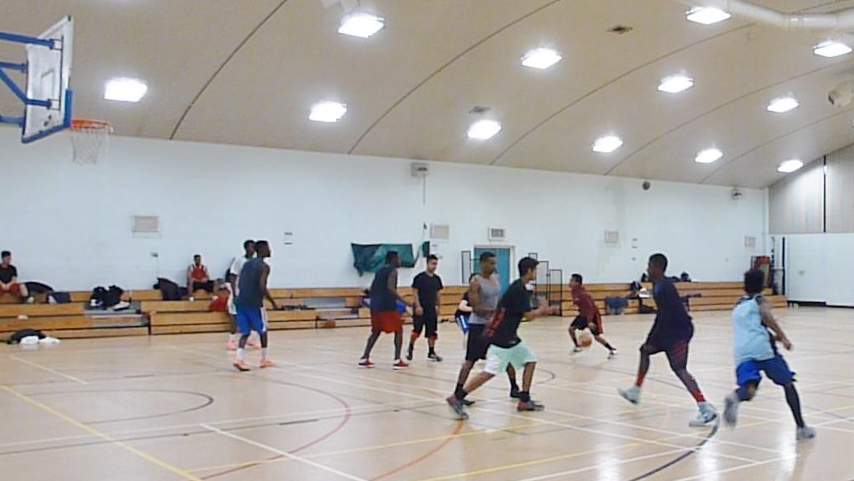
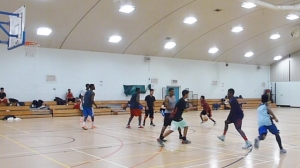 see/know about the Council’s threat to close Battersea’s Sports Centre in Hope Street. It was “announced” to the staff on 16th December. The Sports Centre is very busily used by well over 20 sports clubs and local organisations and it is not as though the area is over-endowed with alternatives. What did the Council’s own reports about the 2011 riots say – there was not a lot for young people to do in the area. But now they want to close down one of the busiest centres of them all! There is a petition for signature at the following address http://www.willtowin.org.uk/#!save-battersea-sports-centre/c150j if you wish to express your opposition.
 - The Planning Applications Committee was on the 16th. There was one significant local application, which was for shopping and housing development on the site of the Prince’s Head pub in Falcon Road. The pub has been far from popular with some of its neighbours for many years now and the thought of it being replaced with shops and 27 housing units will be welcome. The development at some 4/5 storeys will fit in with the general scale of the 1970’s estate. However, it is not the first time that an application has been approved for this site and there is no guarantee that it will happen; but let’s hope that it proceeds.
- There were two much larger applications on sites many Latchmere residents will know well. The first in the rather shambolic area immediately opposite Battersea Park Railway Station. It will include St. Mary’s Catholic School, Lockington Road, Patcham Terrace and railway viaducts and arches including a number of small neighbouring sites. The new development will have 290 housing units and a new purpose-built two-form entry school. There will also be a direct access route from Battersea Park station to a new entrance to Queenstown Road Station passing along what will effectively be a new road with shops and offices. One of the blocks will be 16 storeys high but although I am usually opposed to yet more high buildings in Battersea I thought that this was rather a good scheme and supported it.
- The second application is in the heart of Wandsworth and includes Welbeck House, yes the Council’s old Social Services Department, and the Housing Department office in 17-27 Garratt Lane, along with some South Thames College land. The application was for 201 residential units, 25% “affordable”, some commercial space and a new Wandsworth Town Centre library. But it also went up to 26 storeys and included some pretty uninspired looking architecture. I didn’t like it much and voted against.
- I spent Xmas with grandchildren and had a HAPPY NEW YEAR’s Eve at a Jazz Club I rather like in Streatham!.
My Programme for January
- I know some of you know about my wonky knee, thanks to a cycling holiday in Holland in September, 2013. Well on January 7th I had a minor operation, an “arthroscopy”, on that and, whilst strictly for my next newsletter, I will say that it seems to have gone quite well, though a bit stiff and sore. More next month!
- On the 12th I am going to the launch of a new Wandsworth Radio station, which is going to be based in Latchmere, in Battersea Park Road. There has been an internet based radio station covering Wandsworth called Raider’s for some time, but this new one is aimed solely at Wandsworth. Interesting and I hope I can tell you more about it and its launch next month.
- Yet again I have the so-called Education and Standards Group on 15th January.
- The Planning Applications Committee will be on the 20th.
- And then in the diary there is a “Special” Council Meeting on the 28th, but I don’t know why and I guess it is not going to happen! – so actually I haven’t got much on in January!
You may recall that last month I asked “Did you or do you know Fara Williams?” 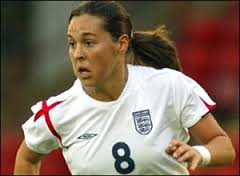
Well, I am afraid that there has not been any response as yet so I thought I’d go a bit further and test you out with a few views taken between Xmas and NY.
Here they are with a couple of quiz questions:-
 On the left, what and where is this?
And where is this below, what would it be called up North (Yorkshire & Lancashire), and which roads does it link? 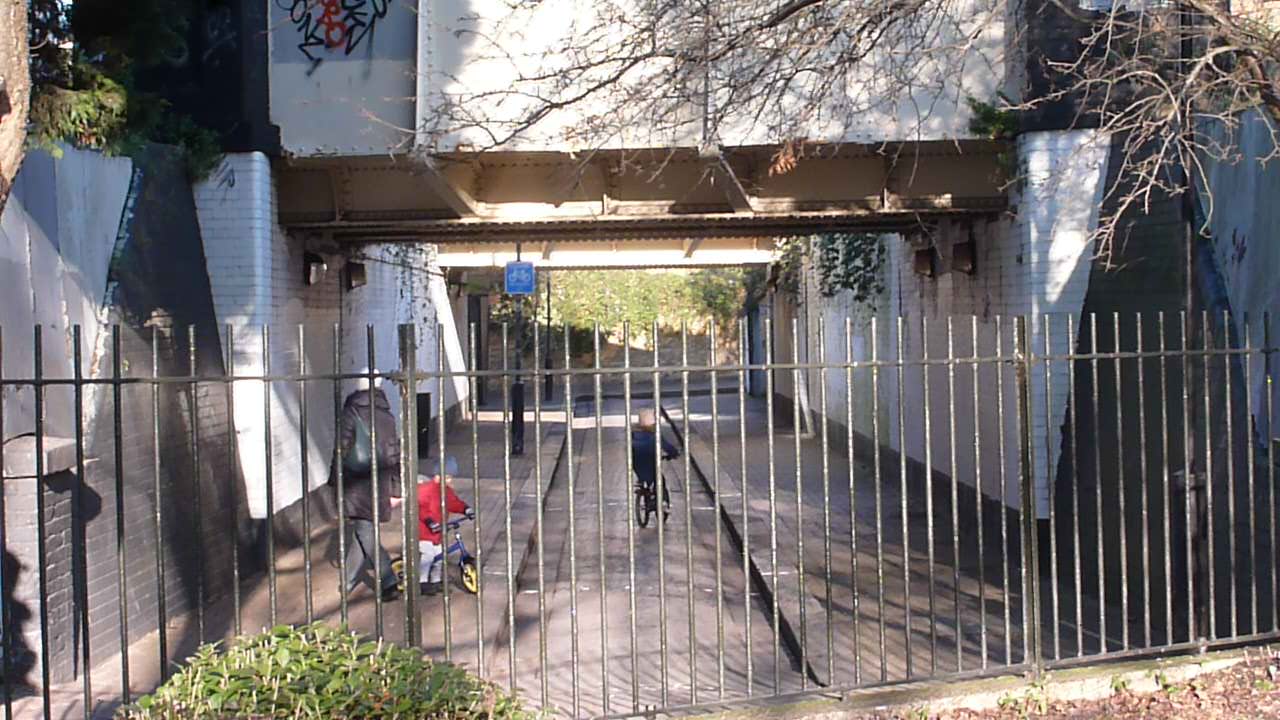
Where is this gypsy encampment? This one is a stone’s throw outside Latchmere. The other two are in the ward.
High Rise developments in London – and Battersea
Just in case anyone out there still believes that the development of high rise residential blocks, on the Battersea river-front and all round the Nine Elms Lane area, has anything to do with housing need or provision of housing for Londoners then see “The Super-Rich and Us” on iPlayer BBC2 last night, 8th January at 9 pm.
This is an excellent analysis by Jacques Peretti of the tax haven and property speculation hub London has become with Battersea playing one of the major roles in the property area. The one thing it misses out on is, not only are these properties nothing whatsoever to do with supplying demand, but they are actually worsening the position.
I am not sure quite how to prove my point but I have more than sufficient anecdotal “evidence” to suggest that the ludicrous property boom along the Battersea river-front far from reducing prices in the market (which is surely what classic economics would suggest) is actually encouraging house and rental inflation in the rest of Battersea/Vauxhall, etc.
This should be compulsory viewing for all those Tory councillors and their not inconsiderable number of Labour sympathisers who believe that building more and more is anything like a sufficient response to the housing crisis. We desperately need more control of the market – oh and pretty hefty taxation of the rich!
Councillor Tony Belton’s Latchmere December Newsletter (# 67)
November highlights
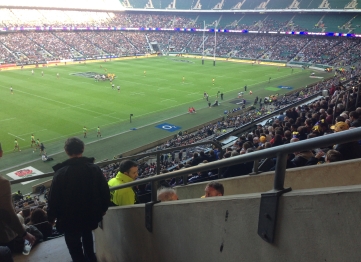
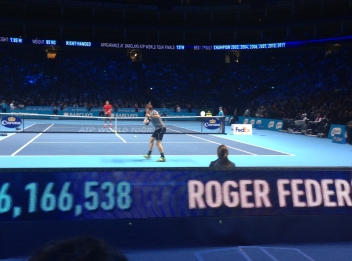
- I had an unusually sporty start to November. My partner, rather uncharacteristically, suddenly said that she wanted to go to some “big” sporting events so we went to Twickenham to see Australia take on the Barbarians on the 1st November and on the 15th we went to the semi-final of the ATP World Tour Finals tennis tournament at the O2. Now, at the cost of losing support all over Latchmere, I have to say that big-time rugby does not do an awful lot for me, even when 76 points are scored! Modern stadia are so big that you are miles from the action even when it is down your end but when a high proportion of the action is in the scrum and even Brian Moore, on the telly, can’t tell you what is happening then what are you meant to make of it in Row ZZ? But we were lucky at the O2. We had great tickets and saw what was, by common consent, the best match of the tournament – Roger Federer’s 4-6, 7-5, 7-6 (6) win over fellow Swiss Stan Wawrinka.
 I went to the Fireworks Display in Battersea Park on
 8th November. It was a bit wet and miserable and probably for that reason not as crowded as the previous year. The fireworks really are spectacular. Two things about it struck me, well three actually. Ever since the 2000 Sydney Olympics these shows appear to have been dominated by Oz-choreography (Is that the word for someone who designs firework displays?). Are our friends, the Australians, now the world’s experts on fireworks? Secondly, whilst the fusion of music and fireworks is dramatic and incredibly well done, does the sheer volume of the music detract from some of the pleasure? I used to enjoy hearing the “Oohs and Aahs” of the crowd and the excited shrieks of the kids but nowadays everything is drowned out by massively amplified music.
  Who agrees with me? Third as I gazed at the rockets a mere 3 or maybe 4,000 feet above are the airliners coming in to Heathrow. What do passengers, who know nothing of Guy Fawkes, think? Do any wonder whether they have entered a war zone?
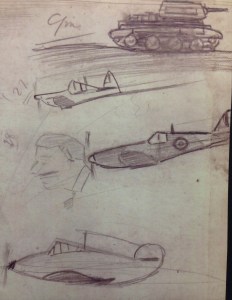
- Talking of war zones, earlier on the same day I had been to the Emanuel School First World War centenary exhibition. It was a very personal exhibition in that it had school photographs and memorabilia associated with old boys (and staff) from the school relating to war during the last 100 years. I was particularly taken with this doodle in a school exercise book from 1943, which clearly depicts a Spitfire along with a tank and a couple of other fighter planes.
- On the 9th I went to the Remembrance Day service in
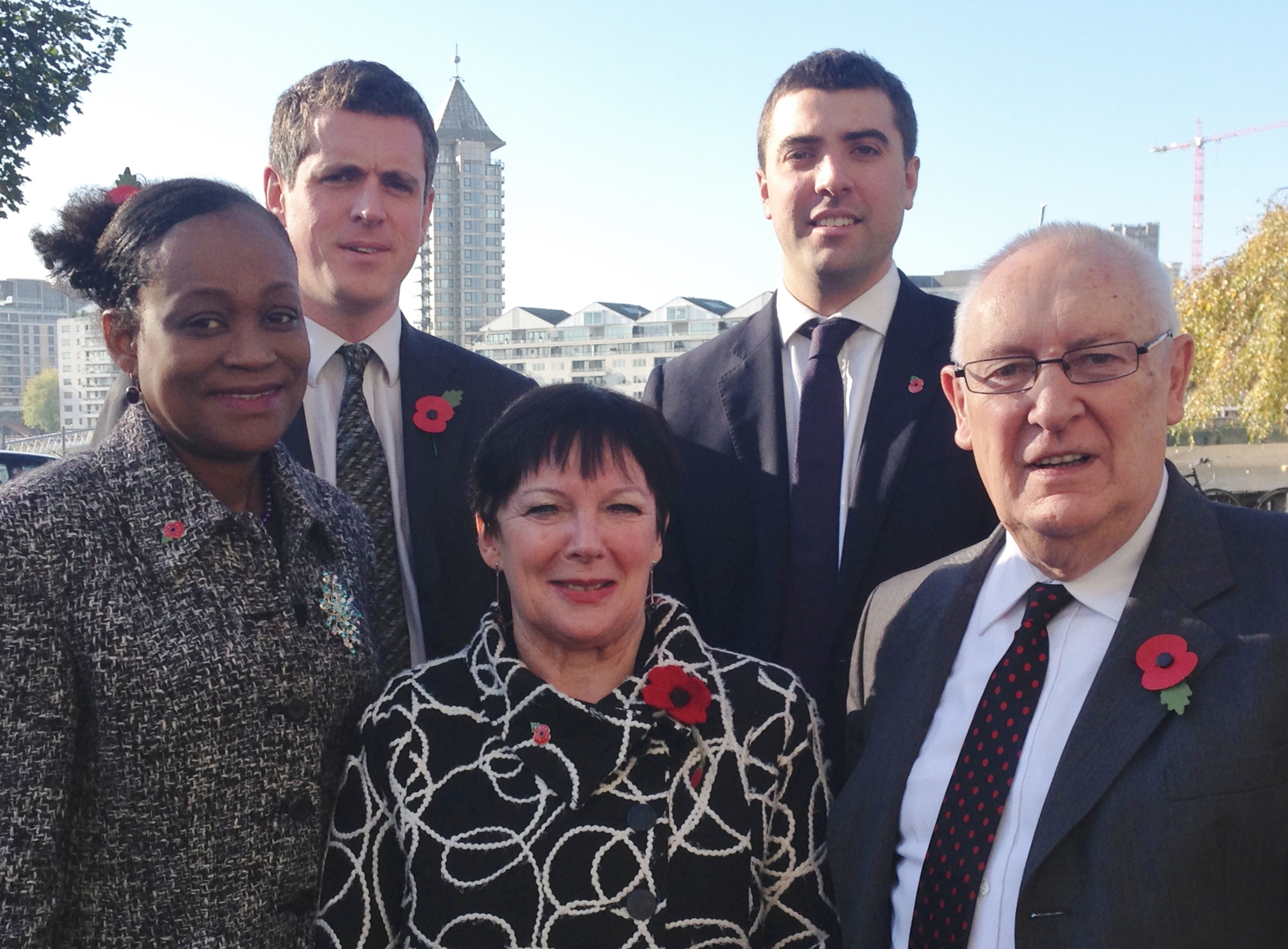
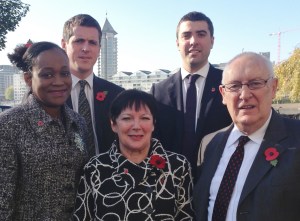 St. Mary’s, Battersea, along with Wendy and Simon, my fellow Latchmere councillors, Sally-Ann Ephson, Queenstown councillor, and Will Martindale, Labour’s Parliamentary candidate in next May’s General Election.. The ceremony was a suitably sombre and moving occasion and was followed as always by a march past. For me, however, the “real” and moving occasion is at 11.00 on the 11th itself in Battersea Park. There is something about the open-air nature of the ceremony, with the late autumn leaves falling and crows and sea gulls wheeling around under leaden skies, which always makes it very appropriate.
 - On that very same evening I took part in the interview panel for the Deputy Director of Education at Wandsworth Council. The successful candidate was Catherine Duffy.
- On the evening of the 10th November, I was at the Civic Awards presentation, which is always an enjoyable occasion where the borough “honours” volunteers, who have had a record of service to the Borough. One award recipient, who may be known to many readers, is Liz Shaw. Liz is well known for her charitable work and fundraising, especially her organising of the Xmas Day Party for the Elderly held on Xmas Day itself in Battersea Park. She is also known as a freelance photographer to be seen behind the lens at many a Wandsworth event.
- The Planning Applications Committee on the 12th considered a mass of applications but was totally dominated by the Covent Garden Market application. This of course lies outside of Latchmere ward but the giant scale of this application will affect the whole of Wandsworth and is therefore worth at least a mention! The site is actually bigger than the Battersea Power Station site and covers the whole area of the so-called Covent Garden Market Towers and the flower market, the vast sheds of the vegetable market on the Wandsworth Road side of the railway, the large entrance site on Nine Elms Lane and quite a few smaller ancillary sites tucked round the edge of the area. (By the way, from the mid-nineteenth to the mid-twentieth centuries, this huge site included the old Nine Elms station and the London and South-Western railway works and believe it or not I can just remember steam trains crossing Nine Elms Lane.)
- This development was all described in one giant application, reported to the Committee in a paper of more than 200 pages in length. The application provided for over 3,000 new homes, let alone a new Covent Garden market, offices, new shopping, a new school, public open space, a playing field, access roads and a car-park. How exactly the Committee is meant to make a clear and sensible Yes/No decision on such an enormous application, I do not know – we are not allowed to amend but merely say Yes or No. It clearly leaves masses of question marks over a planning process, which covers both, say, roof extensions worth say £50,000 and applications of this kind which will take ten years to implement in full and will cost several £billions. But we did our best! I voted against the application although some of you seek to persuade me that all modern development is inevitable and really good but then again others claim that it is usually evil and ugly.
- So here are a few words in self-defence! I knew that the application would be passed and therefore I had what one might describe as a free vote – I knew my vote would not make a difference on the night but that it was an expression of opinion, which may or may not affect future applications. And I have several criticisms of all these vast developments that we are now seeing in Nine Elms. My first, and main objection, is that there is nowhere near enough provision of so-called affordable housing. There is plenty of discussion in political circles about what affordable might mean and whether housing said to be affordable for people on £50,000 a year is really affordable or not for the majority of Wandsworth residents. My position is simply that there is not enough affordable housing, whatever the definition.
- Secondly, and this I know is contentious, I think we are providing far too much retail space. With two giant new Westfield Centres now within easy train journeys access from Clapham Junction and with more and more people doing their shopping on-line, I think that developers are being far too bullish about the need for shopping centres in Nine Elms – especially if we are going to protect the existing Clapham Junction, Wandsworth, Balham, Putney and
 Tooting shopping centres. Over-develop and some of these other centres will suffer. Actually, I am winning hands-down on this issue as every time developers come back with revised plans, and they often do, the shopping is down-sized.
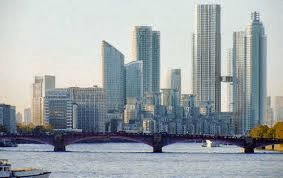
 - Thirdly, and far more contentious still, I do not like the march of ever higher tower blocks into both the Borough and the City. A couple of the tower blocks we agreed in November are going to be even higher than the Tower, which is shown on the right of this picture from Lambeth Bridge.
- On the 24th the Education and Children’s Services Committee considered the admissions criteria for primary schools and a whole raft of other issues. The controversial issue for primary schools is that some parents can afford to “work” the system, by buying or renting property near the “best” schools so as to ensure that their little ones go to the schools with the best examination results – at the cost of some very local children, who get displaced. This is a major issue in south Battersea but for some reason or other does not seem to cause such concern in Latchmere.
- You may recall that I made some critical remarks last month about what was happening to Westbridge primary school, Bolingbroke Walk. The problems related to it becoming part of the Chapel Street Academy Trust. Well I heard early in December that the Trust has taken steps to address the problems that all the Education Committee members saw and have strengthened the governance of the school and provided greater support to the Head. Let’s hope these measures work!


My Programme for December
- I went to Nightingale School on 1st December.
- On the 8th I had the so-called Education and Standards Group.
- The December Council Meeting was held on the 10th.
- The Planning Applications Committee was on the 16th.
- And then there was Xmas and a HAPPY NEW YEAR to you all.
Finally did you or do you know Fara Williams?
Do you know England’s greatest footballer – at least in terms of being the most capped player in English history. Fara Williams, pictured here, has been capped for England 131 times – and for Great Britain in the Olympics 5 times. She now plays professionally for Liverpool Ladies, having played for Chelsea, Charlton and Everton. She is employed by the Women’s FA as a skills coach.
Why do I mention her here? Because I recently read about her history in a national newspaper article and learnt that she grew up on a North Battersea estate, which has got to mean that Fara stands a pretty fair chance of having been a Latchmere resident. Her history includes being homeless and living on the streets for some of her early England career. I also think that she might have gone to Elliott School before it became an Ark Academy.
Whatever the history  and whatever the details, and I hope some of you might be able to fill in some of them, it is clear that her fame would be far greater if she was a man who had played over 100 times for England (she compares her mid-field role to that of Steven Gerard’s) and represented the country at 2 World and 3 European championships. Can anyone help me with this story, because she should be recognised by the Borough!
School Governors & governance.2
Hilary writes to tell me that I am wrong (see blog earlier this month). She tells me that skills are necessary in the modern governing board and that the time of the stakeholder is past. Well I agree on the last point but that is a regret and I need to thank Hilary for forcing me to make my point more clearly.
It is actually worse than I relayed. Now that we are looking for skill sets and not stakeholders we are also handing over most of the appointment process to the Head. The end result is not likely to be people in a very strong position to challenge either head or school.
In my considerable experience as a governor, it was mainly the stakeholders, who had the self-confidence and frankly the clout to challenge the head or the school’s ingrained modus operandi. In future as more and more governors are appointed through school controlled mechanisms there will be, in my submission, less and less, not more and more, challenge.
As once a technician and for a long-time a councillor, I think I know, which was the more likely to be a challenger. Give me the councillor over a financial whizz any day.
Councillor Tony Belton’s Latchmere August Newsletter (# 64)
August highlights
- Let’s face it, I’ve just had the longest August holiday in quite a long time
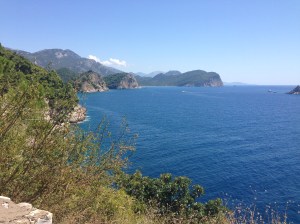 and so there haven’t been many highlights outside of holidaying – though I did get to meet the Deputy Mayor of Sofia, capital of Bulgaria. However I thought I’d share a couple of thoughts about holidaying in the former Yugoslavia and in Bulgaria. First and most obviously the Adriatic coast, of both Montenegro and Croatia where I was, is spectacular. The scenery is staggering, the sea is warm (though I did read last week about Great White Shark attacks in the Adriatic – but after I got back, thank goodness), the wine is good and the food OK. I don’t want to bore with holiday snaps but here is just one of the Montenegro coast.
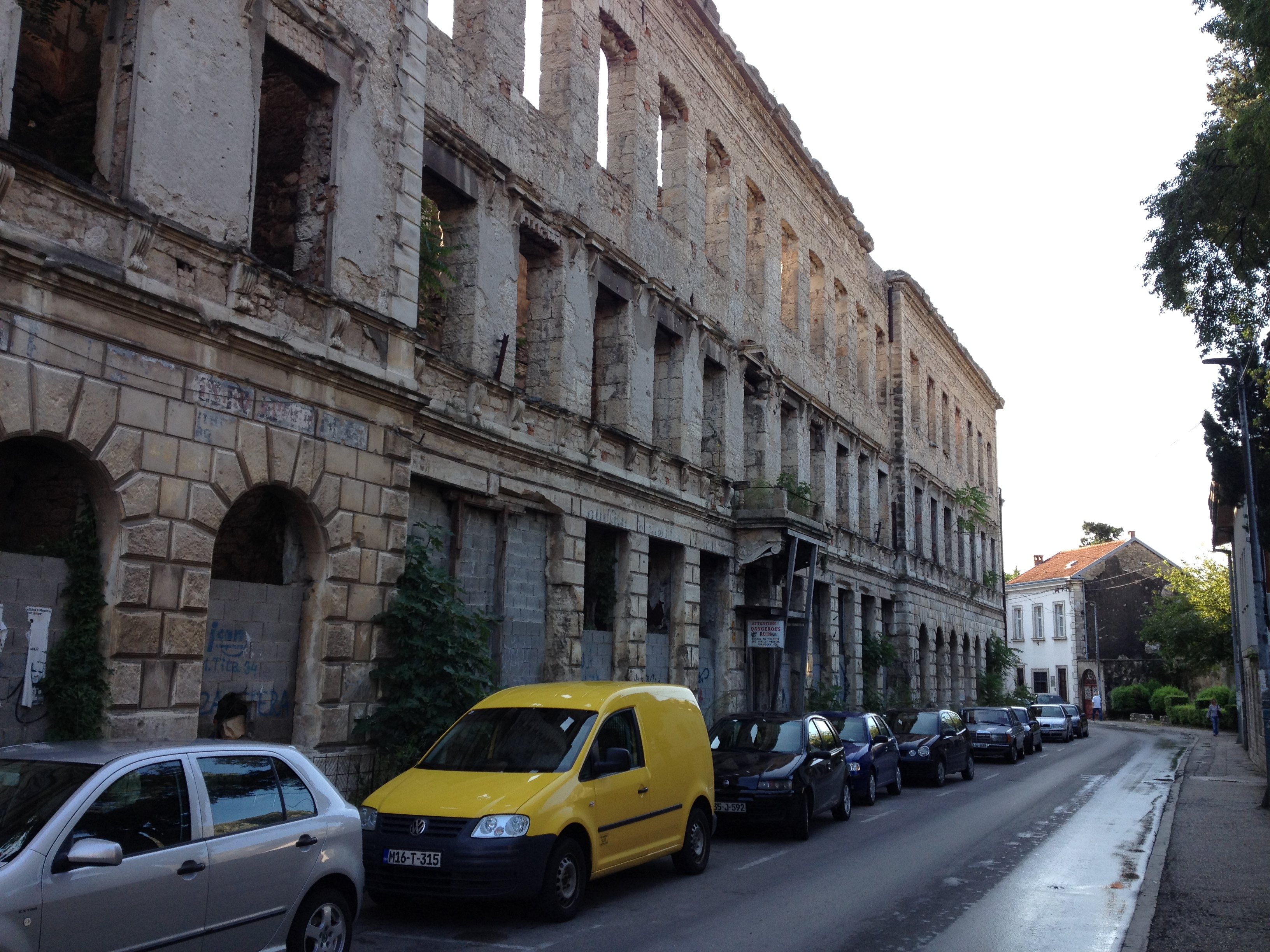
 - Rather more sobering is the realisation that “Yugoslavia” is, or was not that long ago – 1990s, a war zone. The war affected the whole of the Balkans but, as far as I could see, the centre of the war was Bosnia and there the picture is rather less rosy than in Croatia. The bomb sites in the
 centre of town and the bullet and artillery shell holes in the buildings are very noticeable. In the tourist haven of Mostar, the tourist area itself is largely and well re-constructed but just a hundred metres from the tourist sites are empty, derelict houses, flats and businesses. Our B&B host on one night was weeping that she, a Muslim, married to a Catholic, was living happily with her neighbours in the 1980s and then found herself overnight as it were at war with her neighbours. How did it happen and why? She could not understand.
 - It’s perhaps not very clear in this picture but this shelled out building, an empty husk, is a stone’s throw from the tourist hotspots!
- It would be impossible here surely! But then, uncomfortably, temperatures do appear to have risen a little north of the border. We must ensure that bitter feelings are controlled.
- However, the ex-Yugoslavian countries seem fairly vibrant compared to Bulgaria, where the collapse of the old Soviet-style heavy industries seems to have left the country as a complete economic disaster area. Massive industrial complexes stand derelict and empty with much of the rural population left to flee to the capital, Sofia. The Black Sea coastal resorts and, no doubt, the ski resorts are doing well but much of Bulgaria looks like a country with big problems.
- Here in Latchmere, the Council’s Community Safety Team have installed a security camera in Anerley St to assist in issues concerning the theft of mopeds and dangerous driving of the vehicles in the area. Anerley Street is the short link between Dagnall Street and Battersea Park Road and I must say it is encouraging to see the police and the Council co-operating in trying to control the young villains who are largely responsible for this annoying and dangerous vandalism.
- I also heard the good news in August that the South West London Law Centre is going to re-locate in Falcon Road, next to the Mercy Foundation and near to the Prince’s Head. We have not had an appropriate location for the Law Centre for some years now but this new accommodation will be right at the heart of the action and well placed to serve the people who most need its services.

My Programme for September
- I am going to the Labour Party Conference in Manchester, starting on Sunday, 21st.
- The Planning Applications Committee will meet on 15th and the Education & Children’s Services Committee on the 17th.
- I will be at the AGM of GCSE Success, the self-help homework club, at York Gardens Library on 20th.
Did you know? Oh, dear I haven’t got anything to put here this month! Hopefully inspiration will come in time for next month!
MH17 – A one-off disaster or an inevitable by-product of modern warfare?
Heard of Iranian Air Lines flight 655? It was a regular daily flight from the Iranian town of Bandar Abbas to Dubai, which on 3rd July 1988 had 290 on board, though maybe significantly only 39 non-Iranians. It was brought down with all 279 passengers and crew killed by a US fired missile from USS Vincennes. Captain Will Rogers III, a career naval officer, was in command of the Vincennes. He was awarded the Congressional Legion of Merit.
Vincennes was a guided missile destroyer of the US navy, whose crew failed to distinguish between a civilian airliner and an expected Iranian attack force. However, a fellow senior officer in the Gulf hinted that having such a gung-ho commander in the field was at the minimum a risk. Despite the “disaster” a couple of years later Rogers was promoted to be commander of the US Naval Tactical Training Group responsible for training officers in handling combat situations.
The United States and President Reagan got away with this incident amazingly scot-free in terms of worldwide condemnation or criticism. In most people’s language this was a war crime and although considerable compensation was paid, as far as I know the US has never apologised. At the UN, the then Vice-President George Bush argued that it had been an accident of war.
And yet in all the comments on the missile attack on MH17, I have not seen a reference to the Vincennes incident. Comparisons have been made with the Soviet destruction of Korean Airlines KAL007 with the loss of 269 lives off Sakhalin in 1983 and the Ukrainian downing of Siberian Airlines flight 1812 in 2001, with the loss of 88 lives, but not the Vincennes. I rather suspect that says something about the soft power of the US as opposed to the “soft (power) weakness” of Russia.
These four “military incidents” alone have claimed 945 civilian lives over the last 26 years. I don’t know how many have died in air crashes, where the military have not been involved, but I wouldn’t mind betting that military incidents are the single most important cause of aircraft disasters. Perhaps we should spend as much time on how to avoid such fatalities as the designers and engineers spend on improving aircraft safety and performance – no flights within 1000 miles of combat zones, higher levels of locking devices on missiles, passenger involvement in flight path choices?
The Tories face a disaster called Europe
There will always be a right of centre party – of course – but every now and then the Tory Party faces a disaster, a cataclysmic event from which it takes them 10 or 20 years to recover. This happens when long-cherished immovable beliefs and policies come into conflict with financial, political or economic reality.
The examples that come to mind are the 1846 Repeal of the Corn Laws and the 1902 struggle over Imperial tariffs – both in effect about trade policy and import tariffs. In 1846 the interests of the English aristocracy and their farming businesses were beginning to come into conflict with those of the new industrial and commercial elite of Victorian Britain. The catalyst for the 1846 Repeal of the Corn Laws was the Irish Famine. Five years of one of the worst famines in recorded history (the Irish population fell from over 8 million to 6.5 million, which is what it still is to this day) forced Sir Robert Peel to repeal the protectionist Corn Laws.
The party split and it was not until one of the rebels opposed to Peel, Benjamin Disraeli, managed to make the Tories relevant to the new might of British Imperialism with his “one nation” Toryism that they again achieved a parliamentary victory. Disraeli’s win in 1874 was their first since 1841.
Half a century later in the early 1900s the Tory party once again tore itself apart over trade protectionism. This time it was fear of the new growing industrial might of Germany and the USA, which posed the political problem. Joseph Chamberlain resigned from the Government in 1903 to lead a campaign for Imperial Preference levies in opposition to the free trade policies pursued by Prime Minister, Balfour. Chamberlain thought that putting a tariff round the Empire would protect British trade, particularly in India, Canada and Australia, from these aggressive, rising competitors. Balfour wished to maintain the free trade essentially created by the 1846 Repeal Act.
The dispute over free trade or protectionism resulted in big victories for the Liberal Party in the 1906 and 1911 elections. Once again it was 20 years later in the totally different post-WW1 1920s before the Tory Party resumed its “normal” role as the party of Government.
And now in 2014-17 I think we face a similar prospect of Tory division and defeat over trade policies, where once again cherished Tory party notions come into conflict with the political realities. This time the Tory notion is the nostalgia for the UK as a great power and our collective failure even today to come to terms with the truth – that we are an important European nation, dependent upon our relationship with the rest of the continent. The external reality, which is posing the issue so starkly, is the EU.
David Cameron, with his tactics over the Juncker/European Commissioner vote, has made himself uniquely unpopular in Europe and put himself into a truly awful negotiating position for the post-Election “reform” of the EU. As a result it is almost inconceivable that he could win terms from European politicians, which would be remotely acceptable to a large number of Tory MPs or with anyone with UKIP tendencies.
Cameron, therefore, now faces a major dilemma over the 2017 Referendum vote. It’s almost inconceivable that Britain’s industrial and commercial elite would accept or fund a Government and party, which wanted to opt out of the EU, but it also beggars belief that the current Tory party would support a pro-EU campaign. Where would that leave Cameron – dependent upon Labour votes?
There is, of course, one way out for Cameron and that would be to lose the May, 2015, General Election. But assuming that is not his plan then his leadership seems to be leading the Tory Party inexorably into a cul-de-sac and another split over trade policy, with the right wing eventually merging with UKIP and becoming a Tory Party devoid of any real electoral prospects for a dozen years or more. Meanwhile do the pro-EU Tories hitch themselves to the by-then surely divided Liberal/Democratic party? It is an intriguing prospect and holds out great prospects for Labour.
Councillor Tony Belton’s Latchmere May Newsletter (# 60)
2010-14 highlights 1. I guess to most this May is much like any other May. Nice and sunny, we hope, very spring-like – good to be alive territory. But for some of us, including me, it is a bit different. This is the last month of the 2010-14 Council and, one never knows, possibly my last month as a councillor – it all depends upon you on election day, 22nd May. 2. So, I thought this month I would highlight my pick of the most important mome nts of 2010-14. I have to start, of course, with the early announcement after the 2010 Borough Election that the Tories planned to close York Gardens Library. Others will have other memories but I recall a discussion between Simon Hogg, Wendy Speck (my fellow councillors) and I when we decided that we had to call a public meeting at the library to fight the closure. Wendy and Simon had only been councillors for a couple of months so we decided that I had to Chair the meeting, which I was more than glad to do and which I am doing here. 3. In the November, 2010, issue of this newsletter I wrote “And indeed we did not have to wait long (for Tory Council cuts), since that very day (6th November, 2010) we received early notice of the Council’s intention to close York Gardens Library. The local community was quick to campaign against this closure with petitions and a public meeting at the Library on Sunday, 5 December, at 2 pm. Do come if you can but if not please write to Cllr Lister (the then Leader of the Council), Wandsworth Town Hall, to protest at the closure of the library, which is in the poorest and most deprived area in the Borough.” 4. In the December issue I went on to write that, “It was a very successful meeting in that 130 people were th
 ere. There were excellent contributions from many local residents and between us we wrote maybe 50 letters objecting to the proposal. We have also collected about 2,000 signatures on petitions. A few Conservative councillors attended but they kept very quiet. However, I think that the meeting had quite an impact on the Council and I sense that the Council is now trying very hard to come up with a compromise which saves the library and so it should. The Council’s own papers show that a higher proportions of children use the library for homework than in any other library in the Borough. Given the extent of over-crowding in Latchmere we can all guess why that would be but it demonstrates just how important the library is to Latchmere.” 5. As we all now know the campaign was a great success and the library, now often just called YGL, is run by a local management committee on behalf of the local community. My colleague Wendy Speck is a member of the Management team. By the way there had been a long-running battle between the Tory Council and the local community over the library. The first campaign to save, what was then, the Winstanley Children’s Library was fought in 1981! The Community defended it then just as it did 30 years later in 2011.
  6. The main event of 2011, I hesitate to call it a highlight, was of course the riots that took place across London and in Clapham Junction on 6th August, 2011. I produced my one and only special edition of this newsletter to mark the occasion. Here are a couple of the photographs that I took the day after.
 7. It was, of course, a terrible day and had a profound effect, of which more later. One immediate result was that it put me in the front-line against the eviction of innocent Council tenants. The news centred on one lady and her 8 year-old daughter, who was going to be evicted because her 17 year old son was arrested in Clapham Junction. I was not, of course, defending criminal activity, but when the courts eventually imposed a one year prison sentence on the rather silly young man it seemed a bit extreme (to me and to many others) to evict the mother and the totally innocent 8 year-old. I suspect not too many people would be happy to have their security of tenure totally in the hands of their 17 year-old sons! In the end the Council backed down and after a bad 6 months inside young Daniel has become a very nice, caring young man. 8. I was interviewed on this case by many foreign newspapers and TV channels, especially in Spain, France and French Canada. They really found it very difficult to believe that here, in the UK, we could think of evicting whole families because of the “criminality” of one member of the family. I was also proud of the speech I made in Council on the issue, which if you are really interested you can see at http://www.youtube.com/watch?v=rQukL9XxxYk. I am speaking between 0.40 and 11 minutes 26 of the video! 9. The biggest news of 2012, as I wrote in March of that year, “was the Council’s decision to “spend” £100 million on Latchmere and Roehampton wards …at the same time (as) the Big Lottery has also allocated a separate £1 million to Latchmere.” The Council said it was not, of course, a response to the riots, indeed it was claimed to be despite the riots but we can all apply a pinch of salt to that lie/propaganda. What might surprise some is that now 2 years later we do not appear to be very much closer to action on the ground in the so-called estate regeneration. I suspect, however, that appearances are deceptive and that after the election there will be fairly rapid moves. I hope the vast majority of the residents will be happy with the plan but many are aware that some of the residents of the smaller Winstanley Estate blocks are not at all keen on possible demolition.. 10. The Big Lottery grant is also still going through a planning process. There have been several successful events organised in York Gardens and the Wilditch, but I sense a little frustration amongst those of us involved in the planning group that we have not yet found the “Great idea”, which will make our Big Local something unique.
 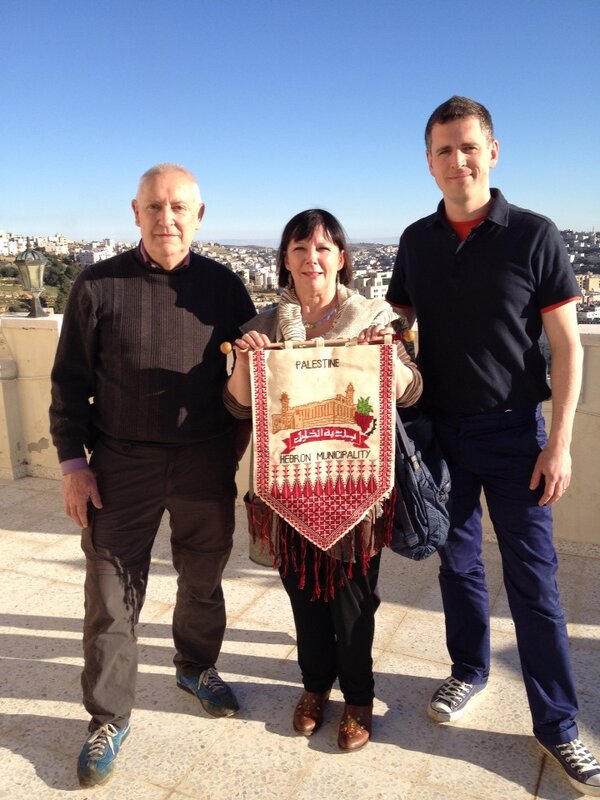 11. My highlights of 2013 were very personal! First there was the trip that we three Latchmere councillors, Wendy Speck, Simon Hogg and myself, made to Palestine in February, which as I said at the time had nothing to do with Latchmere, Battersea or Wandsworth, but it was certainly packed with interest. Here is a picture of the three of us with a banner given to us by the Mayor of Hebron. (As I said then, before any cynics out there think otherwise, it was all paid for out of our own pockets and had nothing to do with the Council!). The trip did give me a chance to take my picture
 of the year, and here it is – a cactus caught by the flash-light in the Judean desert at sunset, high above Bethlehem – and, oh my, was it cold. So cold in fact, I got shingles on this trip and very painful and unpleasant it was too, but at least it went after 3 months! Worse in September when I, and my partner,
  went on a cycling tour of Holland, our bikes were stolen in Amsterdam and I got streptococcal G poisoning in my left knee, after what seemed at the time a rather slight bump. (I am in the centre of this picture in Delft) That resulted in me spending a couple of weeks in St. George’s, feeling as though I was at death’s door! It made the shingles pain seem minor! So to use the Queen’s description of 1992 (the year of the great fire at Windsor Castle) as her “annus horribilis” then I would say the same about 2013! 12. And so to 2014. Well, of course, the major highlight will be the May 22nd election – or at least I hope it will be but to get back to the more day-to-day, I do want to mention a couple of other things. 13. The March figures for use of the Bike docking stations have been very encouraging. No doubt the great spring weather made a difference but use of the bikes went up 83% in March, with individual increases ranging from over 100% in Grant Road to only 67% in Fawcett Close – encouraging but there are still some with only small levels of usage. (Oh, I have been on them twice in the last few weeks!) 14. Many of you will not have seen the 4th May copy of the Observer. In the main section of the paper a full page 19 article is about Providence House Youth Club, which is celebrating its 50th anniversary with a Saturday 10th May party. The success of the Club was originally down to the pioneering work of Elizabeth Braund, who died in 2013 and who I featured in this newsletter (June, 2013), but I want to praise Robert Musgrave, the volunteer youth worker, who has been totally committed to the Club for since going there first in 1973. 15. The Planning Applications Committee on the 14th April had a massively, stupid 530 page agenda, with lots of very chunky applications although not affecting Latchmere directly. The largest two were about the Power Sta
 tion site and Market Towers at Vauxhall, just inside the Borough boundary. I don’t know whether you know it but Vauxhall is just about to become a mini-Manhattan, but I am afraid that it is a development aimed solely at the mega-rich, international business world and will have very little to do with local residents! 16. Finally, it has been a hopeless ambition of mine to get the station named, as it should be Battersea Junction and not, Clapham Junction. If anyone doubts me then look at the boundaries of Battersea parish, look at where Battersea District Reference Library and where Battersea Town Hall (now the arts centre) are. Well I may not have succeeded in getting it renamed but after many years of trying here am I and Wendy Speck celebrating the strapline, Clapham Junction, the Heart of Battersea. My Programme for May 1. Of course there is, as ever, there will be the Planning Applications Committee on the 8th, preceded on the 7th by the final Council Meeting of this four-yearterm.. However, for me and my colleagues there will simply be more and more election campaigning. So give us a wave if you see us about – it’s just part of the process! Oh, and if you swear and curse at having your TV viewing disturbed and exclaim that we are all the same, oh and in it only for the money, just give a thought: “Would you rather live in a country where the only way to change a government was by war or revolution?” Just what do you know about war-time, Battersea? A couple of weeks ago, I was canvassing a couple of elderly ladies
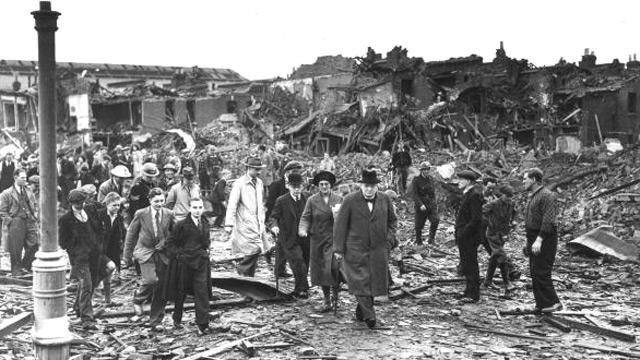 on the Winstanley Estate, who told me about the area before the estate was built and particularly of their memories of the war-time bombing. And although I covered this a couple of months ago I thought it worth reminding you of what a pounding Battersea got during the war. The ladies remembered in particular Speke and Livingstone Roads, which I gather stood more or less where John Parker Square is today. And although I haven’t got a photograph of what happened when they were hit by a V1 here is another of Winston Churchill visiting Nine Elms after a particularly savage attack. PS I just wondered whether the photographer of Christ Church, in last month’s edition was John Archer, the first black mayor? He had a photographer’s business in Battersea Park Road at the time of that picture. But I don’t know. “Promoted and published by Sean Lawless on behalf of Tony Belton, Simon Hogg & Wendy Speck, all at 177 Lavender Hill, Battersea, SW11 5TE”
Great headline in the Guardian today, 30/4/14! “Labour vows to rub out Gove era in education”.
That gave me an unexpectedly great start to the day and what is more the analysis is spot on, with David Blunkett accusing Gove of creating an unmanageable “Kafkaesque” education system. Tristram Hunt goes on to say that atomised schools (by which he means Free Schools, academies, maintained schools) leave a landscape of incoherence, confusion and lack of accountability. Good stuff.
Until, unfortunately, we get to the bit about Labour’s alternative; its recipe for success – independent directors appointed by local authorities on a fixed-term five-year contract from a short-list approved by the education department, by which is obviously meant the Whitehall Education Department and not the local authorities’.
So where is Labour’s case for coherence and clarity and most particularly transparent accountability when we consider local government – gone, caput, nowhere?
A few years ago, it was possible to think that the Labour Party had a coherent strategy towards local government, its powers and its democratic legitimacy. The move in London to make Metropolitan Police Divisions co-terminous with the London Boroughs and then to do likewise with the Health Authority areas opened the opportunity for locally elected councillors, and hence the local electorate, to have more of a say in running these very important civic services.
Combined with the extant structure of local government, it made it possible to think of a local accountable unit with sufficient power and influence to encourage democratic participation in civic governance. OH, how we need to re-vivify local democracy and here was the possibility to do just that.
Of course in this highly centralised state called the UK, there was still a long, long way to go. No true, accountable local authority could flourish without some kind of independence from, or at least accommodation with, the financial control of Whitehall. Unfortunately it always suits the party in power to maintain that control, regardless of the honeyed words about localism – always a tempting illusion under governments of any persuasion – at least until now.
But there were signs that local democracy might be gaining traction – until the take-over of policy-making by instant populists. Tony Blair introduced the Mayoral system and pin-up politics first to London, and then to the rest of the country; and at a lower level David Cameron introduced his elected Police Commissioners. By any stretch of the imagination these reforms added to the atomisation of local authority services, confusion and lack of accountability. They were stimulated by an immediate appeal to the electorate at the price of any coherent view about local as opposed to national democracy.
It will be argued that Ken Livingstone and Boris Johnson have made some sense out of London’s complex transport systems, but that was largely thanks to the coherent consolidation of power and responsibility across a massive urban area.
They will be better remembered for destroying any coherence, clarity or accountability across London’s planning system. Only this week London’s emerging skyline has been said by GLA planning Director, Colin Wilson, to be “very carefully planned. But we prefer to use a flexible framework” leaving us with what others have called an indiscriminate scattering of tall buildings across London.
The new skyline is far from universally popular, will undoubtedly change the look and feel of the city, will be irreversible, will make millions for some developers and will do almost nothing for London’s housing crisis, and it will be incoherent. As for whose responsibility it will have been – you’d need a degree in British local government practise to be able to answer that one.
The major problem is, of course, that people once trusted our local government service as dated but essentially competent and honest – indeed almost the envy of the western world – Westminster politicians now distrust it and abuse it. My suspicion is that Ed Milliband’s major task in domestic politics has to be to build a sensible local government structure into which directors of school standards and police Inspectors can be built. Such a structure would demand, and get, a genuine local political legitimacy. It would also encourage civically minded citizens to stand for local office.
Most important, it would increase election turn-out. The electorate are not stupid. They don’t vote much in local elections and why should they when local authorities are powerless and more and more an arm of national government. Let’s have a return to local government.
Councillor Tony Belton’s Latchmere April Newsletter (# 59)
March highlights
1. Of course it was not until March that the formal Council Tax decision was taken, that is agreed by full Council. But it was a formality and everyone knew what the result would be – a frozen Council Tax. That was pretty much what March was like – a slow wind down in the build up to the Council Election on May 22nd. Indeed the Council has what is known as a purdah when virtually no “political” business takes place until after the election – except of course the Planning Applications Committee, which like “Ole Man River just keeps rolling along”.
2. There wasn’t much on at the Planning Applications Committee either, except for 69-71 Falcon Road. This Halal restaurant is clearly very popular with its customers but is not as popular with its neighbours, who complain about the timing (and therefore noise) of its operations and its waste clearance record. Some of the neighbours are angry about the Committee giving the restaurant permission but the Council was in a bit of a jam. The application included improved waste procedures and a better smell extraction duct. The Committee could hardly refuse improved storage and effective extraction units when they were the main causes of previous complaints.
The Committee insisted, for what it was worth, and I know some neighbours do not think it worth much, that the restaurant will be closely watched by planning inspectors.
3. The other day, walking along Falcon Road, I looked, truly looked rather than just glanced, at the entrance to the Falcon Road Estate. The one right down by the railway bridge, next to the bus stop and opposite the bus garage entrance. Here is a picture of it. I think it’s truly spectacular and a mark of what residents can do given the right kind of project. Have a really close look next time you pass by and feel inspired to do the same to your garden, or estate.
4. A number of constituents have asked me about the piece I wrote on the Bike docking stations and whether I could provide an update – well, I can. The Town Hall provides them to me, if I ask, on a monthly basis and I now have both January’s and February’s figures and can draw a few comparisons and conclusions. January is, of course, 6% longer than February and this year they were both about as wet and cold (or not so cold) as each other and so they are quite good comparators. Overall, the February usage of the bikes at 22,979 was 7% higher than January’s. The range of usage is quite large with over 1,000 usages at Falcon Road, Albert Bridge Road and Queen’s Circus and less than 100 usages in Stewart’s Road (Nine Elms) and Manfred Road, Putney. Although these figures appear quite high to me when you divide them by the numbers of days in the month, then one can wonder at the cost of this scheme.
So for example the usage at Manfred Road is just over 3 a day, which given the cost of the installation means it will be years before there is any real pay-back. We know that the docking installation costs were over £2 million. We also know that Barclay’s Bank has NOT sponsored the scheme to anywhere near the extent that Mayor Johnson (I’m not calling him B…s!) hoped. And we also know that TfL is being very secretive about the running costs. But the truth will out over time and although, I think the bikes are a great idea, I do suspect that TfL has gone over the top a bit on implementation.
As far as Latchmere is concerned, I think it is fairly obvious with a total usage of 759 in February that the Grant Road triple station is far too large for the demand. The contentious station in Fawcett Close with 206 had a large 57% increase in usage over January figures; the equally contentious station in Usk Road had a 52% increase from 162 to 246. Will demand continue to rise or will familiarity breed contempt? Interestingly, with the exception of Falcon Road, the really large usages are very near to Battersea Park. Is this because people want to “give it a go” with a ride round the park or does it demonstrate a substantial commute to Chelsea?
5. From my canvassing for the Council Election, it is clear that the regeneration of the Winstanley and York Road estates is causing considerable concern, not to say distress. One lady, living on her own, told me that she had moved in when the flat was new, in 1956 I think she said. She hated the idea that her flat might be demolished. As far as she was concerned it was her home and she loves it; it was where she had brought up her family and lived with her husband. Now her husband is dead and the kids have fled the coop but this was and is her life and the Council wants to demolish it. It is pretty important that we, the Council, get this one right.
The general strategy has been agreed by the Council, and the Housing Department staff are now on the estates consulting about it. And it is quite right that they should be advising and consulting with residents about the Council’s intention to demolish some of the York Road Estate and replace it with new build. But what I would like to make clear is that NO final decision has been taken yet on any single issue, and indeed there are powerful arguments against some of the suggestions. So if residents want to fight and campaign against the Council’s plans, they should not give up but they should make their voices heard loud and clear.
It is strange that, given the general distrust of the word of anyone in “authority”, that when it comes to one relatively junior officer saying that the Council has a plan to demolish this block, that comment is taken as a definite fact. Let me repeat, it is a plan and plans change as circumstances change, as opposition or support strengthens and weakens and as opinion is clarified. Some or even most of the Council’s plan will happen but I could almost guarantee that it will not happen exactly as is planned. If you can get all your neighbours to oppose one element of the plan then you will probably win the argument. If you can’t get anywhere near 50% to agree with you, then you won’t win and you won’t deserve to win.
6. Last month I wrote about the worrying report from London Sustainability Exchange (LSx) about air pollution in Battersea at levels 5 and 6 times higher than European Union targets. I said that the worst pollution of all is under the Falcon Road railway bridge. Well following publication of this report the Battersea Society organised a morning of action on the 28th March. Some of us were sent off to interview shop workers to see if they were concerned and others looked for lichens and other plant-life that flourished in clean and/or dirty air.
Others of us attached measuring devices to various road sings so that we can measure levels of air pollution more accurately. Here I am fixing one of LSx’s measuring devices to the bus-stop just by the railway bridge – Yes they do have permission to fix measuring devices to bus-stops. As I said in March, I will be using this research to press for early improvements to the environment under the Bridge!
My Programme for April
1. Of course there is, as ever, the Planning Applications Committee on the 14th. However, for me and my colleagues there will simply be more and more election campaigning. So give us a wave if you see us about – it’s just part of the process! Oh, and as you swear and curse at having your TV viewing disturbed and exclaim that we are all the same, oh and in it only for the money, just give a thought. Would you rather live in a country where the only way to change a government was by war or revolution.
Did you know about Christ Church, Battersea?
Last month I wrote of the modest, modern church in  Christ Church Gardens. I also wrote that its very different Victorian predecessor, consecrated on 27 July 1849, was full of all the confidence I associate with Victorian times. I also said that there is a rather splendid photograph of it in a Wandsworth Town Hall Committee Room. Well, here it is!
Well, the church certainly is very different from its current namesake but the picture certainly isn’t as I then said from the 1930s. A quick glance demonstrates that it is earlier than that. Does anyone know, or can anyone work out just when this might have been taken and let me know. I have my own idea, which I will share with you next month. Oh, and can you suggest who the photographer might have been? I have an idea about that too!
 Tony Belton
 Tony Belton