Councillor Tony Belton’s Battersea, February 2026, Newsletter (# 200)
- 2026 is a special year for us councillors, as it is the year of the Borough General Election, and the date is May 7th. For me this is the last year with fellow councillors, Juliana Annan and Maurice McLeod. Juliana, I know will continue her work in the community, but perhaps more especially in the Winstanley Estate than in Battersea Park; whilst Maurice will spend more time in Tooting constituency. We have had a successful four years – but people move on. Good luck to both of you, Juliana and Maurice.
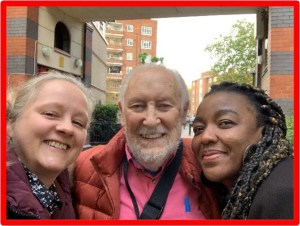
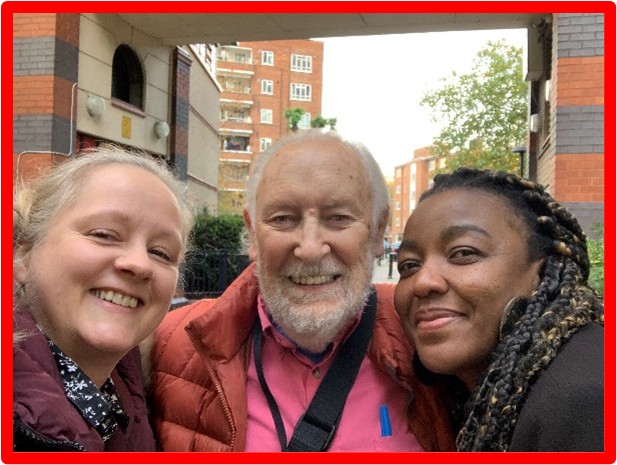
- My new colleagues are Battersea Park residents Daria Haas, and Victoria (Vicky) Asante. Daria lives on the Doddington Estate and Vicky in the Winstanley Estate, and they join me as the prospective Labour candidates for Battersea Park ward at the election. Daria is, or was, a primary school teacher but has recently resigned to concentrate on the election campaign. Vicky is a community worker with very close links with Battersea’s minority community. In the picture Daria is on the left and Vicky on the right, with me, Tony Belton, between. I look forward to campaigning with Daria and Vicky, and working with them over the next four years.
- Long-time readers of my newsletter will know that my Penny was the President of the International Society for Eighteenth Century Studies from 2019-
 23. We (well certainly I) had hoped that it would have meant lots of international trips but unfortunately Covid destroyed much of that, though we did have trips to Germany, Denmark, Ireland, Italy, and Spain. But now, in recognition of her work as President and of her status as a historian, the Brazilian Association has invited her to their conference in Belo Horizonte (200 miles inland from Rio) in June. And that is a long intro to saying that on 9th January we hosted our Brazilian host, Prof Karine Salgado, to an enjoyable dinner in the West End.

- On the 12th January, Penny and I went to
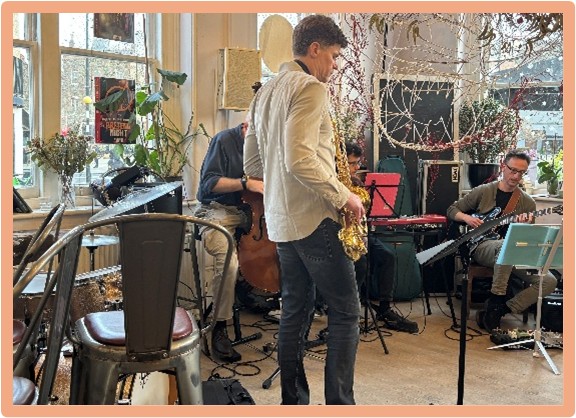
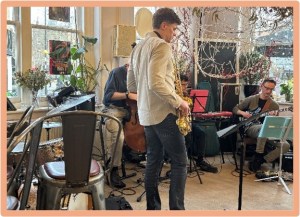 MP, Marsha de Cordova’s, annual welcome to new Labour Party members in the House of Commons Jubilee Room. Marsha was, of course, her usual very cheerful self, hosting a morale-boosting occasion. A week later, we walked over to her place to deliver a birthday card. On the way we called in at the Providence Theatre on the Common for a quick lunch, where we came across a group of jazz musicians, from Battersea, who play there in various groupings on Sundays. Apologies for the rotten picture – but I thought the saxophonist was very cool!
- Some of you will know that every month I deliver welcome letters to all
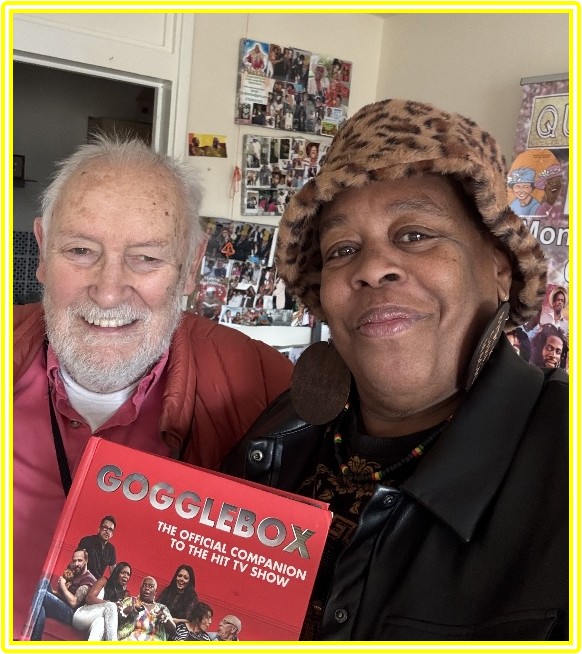
 newcomers on the electoral register. Of course, frequently people are not at home – out working, shopping, or just out – but it is good to talk to the approximately 25% who are at home. Very occasionally, I get a really big surprise but not usually do I meet someone quite like Sandra Martin. Now I have to confess that I had never seen Gogglebox, but when she answered the front-door, I met face-to-face a TV personality, new to Battersea Park ward, who tells me that in the 4 years when she was a regular on Gogglebox she had literally millions of followers on social media – definitely a mark against me that I had never seen Gogglebox. Do you have memories of Sandra on Gogglebox, 2013-17?
 - I deliver about 200 of these letters every month, which takes me about 6 three-hour sessions each month. It keeps me fit, but it is also a good way of keeping an eye on what is going on in the ward. So here are a few examples of January
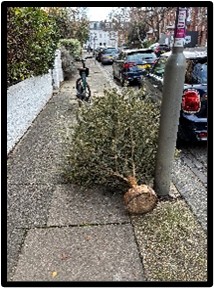
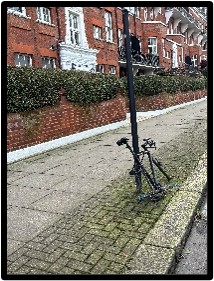
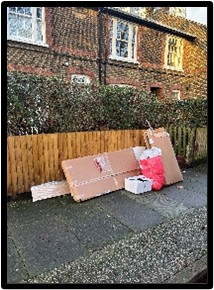
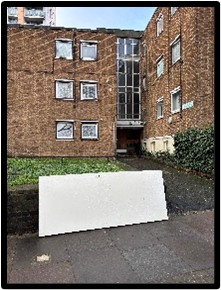
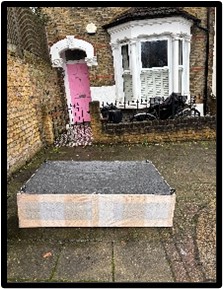 sightings, which I report to the Town Hall, and which hopefully get cleared soon afterwards. Abandoned bikes, Xmas trees & bad bike parking, building materials, a door and a mattress – just why are some of our neighbours so anti-social? No tree roots and bad pavements this time, but often there are. It would help the Council an enormous amount if everyone of my readers photographed obstructions like these and reported them on the Council’s website, which is always being updated to make reporting like this much easier – search for fly tipping. But it would not only be helping the Council; it would also make life better for us all to see the rubbish cleared quickly and cleanly.
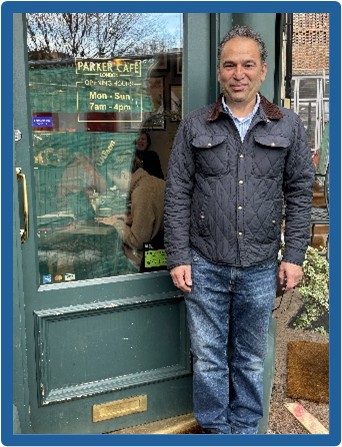
- I, and Mike Jubb of the Battersea Society, met one morning with residents of Hester Road,
 including the Thameswalk Apartments, in Parker’s Café on the corner of Parkgate Road and Radstock Street. There we had coffee and croissants, whilst we talked through with them, what to expect in the upcoming March hearing into the Glassmills appeal against the Council’s rejection of the proposed skyscraper development on Battersea Bridge. The friendly and popular proprietor, Parker, pictured here, kept us well plied with both coffees and croissants!
- On 17th January, Penny and I went to see Othello at the Theatre Royal, Haymarket. It was the first time that I had seen
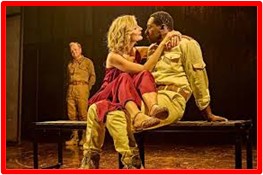 the tragedy on the stage, although I do recall seeing Franco Zefferelli’s 1986 film, starring Placido Domingo as the Moor. My memory of that was of its cinematic qualities but I was not at all convinced about Desdemona, or Othello’s turbulent moods, or indeed the evil Iago. But this play was totally different. The staging was simple but very effective. The acting was, however, brilliant. Toby Jones was suitably oleaginous as Iago, and David Harewood made Othello’s epilepsy and his moods not only credible but convincing. However, for my money, Caitlin Fitzgerald won the acting plaudits. She managed to be loving, justifiably terrified and sensuous all equally and almost simultaneously. We were delighted to catch the play on its last night.
 - I chaired the Planning Applications Committee (PAC) on 20th The big issue of the evening was the future of the Vivienne Westwood Headquarters in Elcho Street, off Parkgate Road. We agreed to the development plans, for a 6-10 storey building, which will accommodate the expanding work-force operating out of one of the UK’s leading fashion houses. Hopefully the new building will be a more architecturally suitable building than the current one.
Also, at PAC that evening was a TPO or Tree Preservation Order, which we agreed for the Grapefruit Tree in Queenstown Road, thought to be the only one in the UK, and which recently got much coverage in the London media.
- On the 22nd of January I had the Finance Committee. We discussed the steps the Council is having to take to live through the coming cuts in Government funding. We also noted the Leader’s, Simon Hogg’s, ambition to make Wandsworth Council the most digitised council in the country by 2030. This will inevitably mean that many more council services will go online, and that many of the jobs and the departments will need to be re-engineered and re-constructed over the next four years. Exactly how this will work is difficult to say at this stage of the process (almost the beginning). The only plausible alternative would be a massive reduction in services – an option Labour councillors will refuse to take.
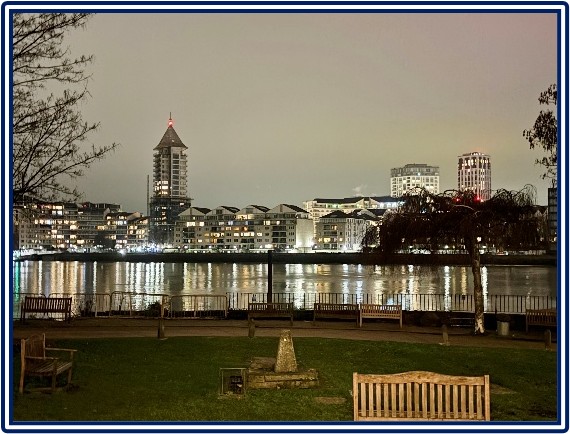
- On the 29th January I could/should have gone to Wandsworth’s Planning Forum o
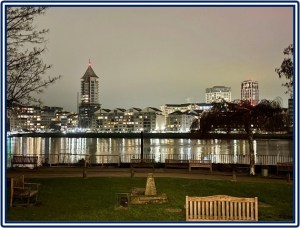 r the Labour Group but instead I went to hear Penny lecturing in St. Mary’s to the Battersea Society on “Homo Sapiens to Homo Zappiens: How variously human beings describe themselves” – a typically ambitious project. Like much of this January it was a cold, blustery evening and the attendance was not great and also to be blunt Penny was not at her best – the lecture needs some refinement. But two completely very different things were striking about the evening. First was just how exciting the night-time view of Chelsea Harbour and Imperial Wharf is from the church steps, especially at high tide – see picture. But secondly, we were looking for somewhere to eat in Battersea Square and Battersea High Street, and it was worrying to see just how desperately short of custom the restaurants were. They need our support! At least that is how it looked in one unscientific survey on one cold Thursday evening in mid-January.
- On 30th January I attended the funeral of Martin Johnson, a St. Johns ward councillor 1968=71 and
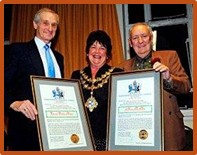 then councillor for Northcote ward 1974-2018. Martin was one of, what Mrs. T would have called, the ‘wettest of wet Tories.’ Because of that, Martin was Yo-Yo-like in and out of the 44 year-long Tory cabinet (1978-2022), that ruled Wandsworth Council. In that time, two major victories of his come to my mind. One was essentially the final defeat of the London Motorway Ringway ‘plots’ – Martin played a big part in avoiding Battersea being at the heart of a Spaghetti Junction to rival the real one in Birmingham – and having studied the history extensively I say ‘plots’ and not plans advisedly. Secondly, he was the major inspiration behind a project called the Hidden Homes Programme, which created some 250-350 new council homes from unused spaces on the estates.
The picture is of Martin on the left and me on the right being presented with diplomas by then Mayor Jane Cooper.
It was appropriate that Putney Vale Crematorium was packed not only with many senior current and ex-Tory councillors but also, a Wandsworth Council Chief Executive of the past and many departmental heads. RIP Martin.
- Finally, unusually, indeed uniquely, for this newsletter, can I burden you with some real politics. In my view the Brexit vote was the biggest catastrophe to hit the UK since World War 2, but it is possibly the biggest self-imposed catastrophe ever. As the world has moved on since 2016, as Putin pursues his imperial dreams and Trump leads his violent way back to American isolationism, it simply becomes more and more urgent to pursue rejoining the EU. I know that it will not be easy; we might even have to face the odd rejection; but it is nevertheless crucial for our future. If you agree with me, then please add your names to the rejoin register at this link rejoinregister.org/?recruiter_id=1272
My February Programme
- I have the Council Meeting on 4th
- I have the Alf Dubs Lecture by Professor Philippe Sands KC, international human rights lawyer and author on 5th
- I have the Transport Committee on 11th February, the Environment Committee on the 12th and the Planning Applications Committee on 19th,
- I will be speaking at the unveiling of a plaque to Shapurji Saklatvala 20th
Did you know?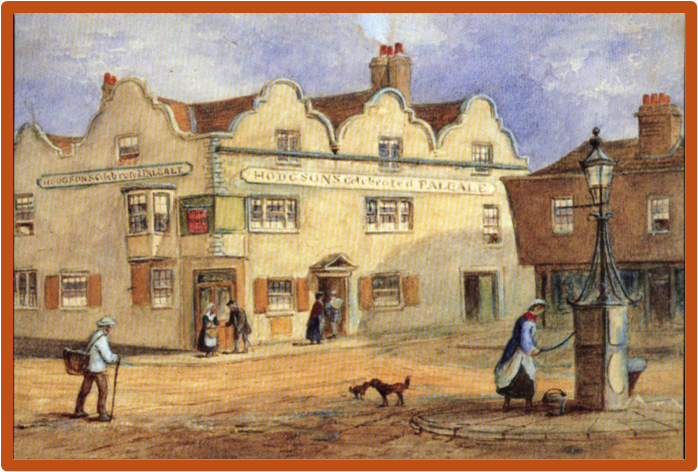
Last month I said that this Battersea pub was rumoured to have had a secret tunnel, used by smugglers, linking it to the Thames. What was the pub’s name, and where is it?
Quite a few answered that it was the Ship, either the now lost pub at St. Mary’s or the one at Jew’s Row. But, as some correctly replied, the one in the picture is/was the Raven in Battersea Square – now an Italian restaurant.
In any event all three are so near to the river and so low, I cannot see how they could keep a tunnel water-free – but that’s the story!
And this month?
Who was the distinguished architect, who designed Battersea Town Hall (now the Arts Centre) and Battersea Library, as well as the Old Bailey? OK some of you will know that but can you also name a religious building in South Battersea, that he also designed?
Councillor Tony Belton’s Battersea June 2021, Newsletter (# 144)
- I am having a season of anniversaries! What with
 reaching the dreaded 80 in April, on 13th May I notched up 50 years as a Labour councillor – it must be a drug – or certainly an addiction. The Town Hall put out a press release, which was nice of them. They dredged up a picture of yours truly in 1971. Here it is; as shown in my election leaflet, would you believe? I won Northcote ward that year and subsequently Graveney before settling down in Latchmere in 1982 – but enough of me.
 - On 2nd May, I went canvassing in Bedford ward, just near Tooting Bec station with the Labour candidate in the Bedford ward by-election, which was held along with the GLA election on 6th May. It was a Labour area and it was an enjoyable occasion – canvassing is always much more fun when you do NOT get doors slammed in your face and have no abuse to deal with (I am not suggesting, by the way, that Tory canvassers don’t get the same treatment in reverse). I was impressed with Labour’s candidate, Hannah Stanislaus. Whatever else she brings to the Council – she has a good, bold, confident doorstep manner.
- On 6th May itself, Labour did well in London in general and in Bedford and Wandsworth in particular. The by-election result was strikingly similar to the Bedford result in the 2018 Borough election. The turn-out at just over 51.4% was very slightly higher this year than the 48% turn-out in the Borough election and the Labour and Tory votes were very similar, with Labour on 50% as opposed to 49% and Tories on 24% as opposed to 23%. Interestingly, the Green candidate gained 50% more votes than in 2018 – admittedly from a far lower base but the Greens must feel that they are on the move.
- On the same day, of course, Sadiq Khan was
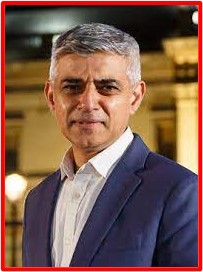 re-elected Mayor of London and Leonie Cooper re-elected as the Assembly Member for Merton and Wandsworth. Congratulations to both of them, who I know well having been a fellow Wandsworth councillor for more than a dozen years. They are part of the story that London has become an overwhelmingly Labour city. But I think that both, Sadiq and Leonie, have questions to answer. In Sadiq’s case, his first term has been defined by disaster, with the Grenfell Tower disaster of 2017, being followed by the Covid crisis of 2019-21 (22, 23?). And in this election he had an admittedly small (1.6%) swing against him achieved by someone universally perceived as one of the weakest Mayoral candidates ever, the Tory Shaun Bailey. The opening of the Elizabeth Line Crossrail might have given him a completely undeserved triumph, but in fact, it has left him with an equally undeserved calamity – “undeserved” in both cases because the decisions, the planning, the construction mostly pre-dated his time as Mayor and triumph or calamity they “merely” happened on his watch. Can he realistically achieve much in the three years left to him, given that Covid remains the significant factor that it is? Does he decide to go for a third term? Does he like Johnson before him, plan to return to the Commons? He will still only be 54 years old, so he still has time to achieve yet more. But if I know Sadiq, and I think I do, then he will have a pretty shrewd idea now of what he is going to do and he will not let on about it to anyone.
 - I think Leonie’s questions are easier, at least to pose. Does she decide
 to be primarily the first Labour Leader of Wandsworth Council since 1978 or the deputy leader of Labour in the London Assembly? I know which I would consider the more important (what after all does being an Assembly member mean apart from getting a massive salary?). But on the other hand, being on the Assembly is arguably a better stepping stone to the Mayoralty (how about being London’s first female Mayor?) or a seat in the Commons. But either way, Leonie does not need to decide, nor will she, until after the May, 2022, Borough election, when she will discover whether she is, or is not, Leader of Wandsworth Council.
 - On the 11th May, Penny and I went for a walk in Nunhead
 Cemetery. It’s well worth a visit in spring, or I guess in autumn for the falling leaves. Wildflowers and generally rampant undergrowth climb over magnificent late 19th and early 20th century statuary, spread across a very large site. A quick rule of thumb comparison on Google Maps suggests that it is about half the size of Battersea Park and almost completely empty – at least of live bodies! It also commands magnificent views of the city, with one view, in particular, focused on St. Paul’s Cathedral. It is actually a “protected” view (in planning terms, i.e. new buildings are not allowed to obstruct the view) as indeed is a similar distant view of the Cathedral from Richmond Park.
 - Talking of which, did you happen to see a recent list produced, by a Wandsworth news blog, of 10 special open-places to visit in South London? Strikingly we, in Wandsworth, are right in the epi-centre, with Richmond Park top of the list and others included Wimbledon Common, Battersea Park, Wandsworth Common (a mistake there I think as the write-up didn’t sound like the common I know), the Crystal Palace dinosaur Park, Nunhead Cemetery, Greenwich Park and a couple of complete strangers near Sidcup, south-east London. With all the travel restrictions we face today, perhaps we will bump into each other at one of these London beauty spots!
- On 25th May I had the Planning Applications Committee. In
 the last couple of months, I have rather down-played the interest in this committee but May was different. As always there were a number of small and locally important applications but only two of major significance and they were both in Nine Elms. I voted against both, though the first vote was almost a gesture of frustration as I knew that it was really a box-ticking exercise at the “details” level of the process. Nonetheless, despite the poor re-production I hope you can see why I should be against such a monolithic construct! The second was a giant hotel next to, and destroying the view of, the American Embassy.
 - You might have seen coverage in the press of the new Nine Elms “Sky Pool”, which was opened in May. My Labour colleague, Aydin Dickerdem, who represents the area
 of Nine Elms where the Sky Pool is situated, reminded me of my August 2015 Newsletter when I asked whether people had seen “the fantasy proposal for a swimming pool in the sky? Captioned in the Daily Telegraph as the “Glass-bottomed floating ‘sky pool’ to be unveiled in London”. Now, it is completed, it confirms my worst fears. It is a display of conspicuous consumption by an arrogant affluent class of developers, which reminds me of Marie Antoinette quipping that the starving Parisians of pre-revolutionary France should eat cake. No wonder she was soon to lose her head: I wouldn’t wish quite that on the planning committee and the developers responsible, but with the homeless walking the streets and foodbanks doing a roaring trade, they deserve some telling punishment.
 - On 26th May we had the Council’s Annual Meeting. All 60 of us in the Civic Suite were spaced out like candidates in a major public examination but instead of preventing us from cheating this lay-out was: so that we could socially distance. Of course, the effect was precisely the opposite, as it was clear we were meant to be unsocially distanced. This procedure was rather strange as these annual meetings are meant to be for the new Mayor’s family and friends to share a drink and a chat with everyone who attends. So we had a Mayor-Making when not one person talked to the Mayor. A new experience for all and especially for the Mayor, Richard Field, a councillor in Nightingale ward, Tooting.
- On 30th May Penny and I stayed with Mary Jay in Oxford.
 Some of you, but not many I guess, will know Mary, the widow of Douglas Jay, Battersea’s Labour MP from 1946 to 1983. We were also there to introduce a Brazilian friend to both the city and the Bodleian Library. We took Antonio round Oxford and, in particular, round Magdalen College. Both looked magnificent in the early summer sun and, whilst we were in the Cloisters, this feathered friend popped by for a chat.
 - On 22nd April, I had the Planning Applications Committee (PAC) and, if I said that the March PAC, was uneventful, then the April version made it seem positively momentous. The interest in individual planning applications was still sufficient, however, to inspire the virtual attendance by 52 people – it was very rare for pre-Covid, pre-online PAC ever to have an audience of 50 – so perhaps there will be some benefits from the new post-Covid regime. But councillors and officers will have to learn a few more broadcasting related presentational skills if they expect to be taken seriously!
My Programme for June
- On June 7th I look forward to hearing Diane Hayter talking about the first 29 Labour MPs, who started the PLP, the Parliamentary Labour Party, in 1906.
- On June 10th, I am talking to a group of Croydon trade unionists about the rights and wrongs of having elected Mayors. Croydon is planning to have a referendum on the matter in the autumn and clearly many are undecided about which way to vote. I am very much opposed.
- On June 11th, I am going to give my knees a trial run on an 18-hole golf course for the first time in several years! Fortunately, my partner’s knees are worse than mine so we will be using buggies! Too much football for too many years did for our knees!
- The Planning Applications Committee (PAC) is on the 22nd
Did you Know: Last month I asked, “What was the connection between the famous Sydney Harbour Bridge and Battersea?”
And the answer was simply that the British company, Dorman Long, which won the contract to build the bridge, had a significant part of its London operation in Queenstown ward, Battersea.
And for this month can you tell me:
How many pubs are there in Latchmere ward? Their names? And how many have closed to your knowledge in the recent past and their names? And whilst I will be open to rational debate, I will be the final arbiter on what is, or is not, a pub, etc.
Councillor Tony Belton’s North Battersea July, 2017, Newsletter (# 97)
My Programme for July
Opinion Piece Two months ago I wrote that “we in Battersea should, therefore, vote for the candidate most likely to argue (and vote) against Hard Brexit, whatever that is, and fight still for a Remain position”. I did say that the Lib/Dem candidate would also vote for a Remain position but that the Lib/Dems were not a realistic winning option. In that context, some have argued that Marsha’s vote against the Chuka Umunna amendment to the Queen’s speech was a mistake and, worse, a betrayal of her constituents. I think that is a rather premature judgement. Clearly both major parties have major difficulties coming to terms with Brexit/Remain, especially given the Referendum’s majority in favour of Brexit and given the complex make-up of the Labour and Conservative parties. I believe that it is probable that either or both of the Labour and Tory Parties will face a major internal crisis over the EU. How they get there and who gets there first will be major factors in the future of the UK. I am sure that there is much more jockeying for position to come and I know that Marsha will take an active, anti-Brexit role in the parliamentary debates. Do you know? Last month, I asked whether anyone knew anything about this house, including the simple question “Where is it?” Well, the only correct answers came from people who lived there or were friends of those who did. The house is 22 Mossbury Road, barely 100 yards from the Falcon and the centre of modern Battersea. Actually, the rather more imposing traditional front is on the west side of the building, the right as you look at it, but unfortunately can only be seen from inside the property. The house is one of the oldest in Battersea, dating from the very first years of the nineteenth century and so about 200 years old. |





Austerity in the Town Halls; Recession out there for working people
Today the Bank of England took crisis action by lowering interest rates to 0.25% and throwing money at the business heights of the economy. Will it work? Cutting rates to 0.5% seven years ago didn’t. Nothing, Osborne did, really changed the equation.
What would work immediately, however, would be to take the heat off public expenditure. What do I mean?
Well right now Wandsworth and Richmond-upon-Thames are cutting service levels and reducing the number of jobs right here in south west London under pressure from this Government’s cuts in local government grants; 400 jobs to be precise. And all because the Tory party has an ideological commitment to reducing the size of the state – whatever that means.
The same thing, and worse, is happening in every local authority across the country. Similar cuts are happening in many more public sector organisations.
Meanwhile what do the councillors do? Well, all of us were under great pressure to vote for the jobs cuts. The majority (Tory) party councillors voted for the cuts because they cannot face opposing “their” government and the minority (Labour) councillors are not in a position to defy the government and are “scared” of being accused of voting for an increased Council Tax.
I’ve been around long enough to remember when the Ted Heath Government (1970-74), the Thatcher Government (about 1982-86) and the first Tony Blair Government (1997-2002) faced similar economic crises. What did they do? They threw money at local government with orders to spend, spend, spend in an attempt to kick-start the economy.
The public sector turned out to be far more effective than throwing money at the banks; that was tried in 2009 and it didn’t work.
Just when will Teresa May take the same kind of actions and just how silly will the cuts of 2010-16 look when that happens?
Warfare or Co-operation
The Relationship of elected councillors and salaried local government officers.
Who are Council officers? Are their interests different from those of councillors’? Do the officers work to the same objectives? Are they motivated by the interests of the electorate as interpreted by the majority party or by rules coming from Whitehall and the law courts? What do they think of elected councillors?
The first thing to note is that officers are not simply local equivalents of the national Civil Service. The Civil Service exists principally to carry out the wishes of the crown, as was, and the elected Government, as is. So historically the civil service administers the Crown’s Government and cares little, at least in theory, for MPs, who from their perspective are merely the electoral body from which the Prime Minister and his colleagues are chosen.
Local government officers, on the other hand, are appointed by their respective Councils, at least in principle, to provide ALL elected members equally with advice. Hence the most junior councillor, even if in a minority of one, and, say, the Leader of the Council have equal rights to get advice, whether on procedural or personal matters, and assistance with constituency issues and casework. In that sense, the junior councillor has access to the highest level of senior officer advice available, in a way that MPs can only dream of from Civil Service Departments. In my experience, new councillors often fail to recognise this opportunity and seldom take advantage of the resources that are there for them.
Local Government officers, however, also serve the elected majority administration of whatever political persuasion. Hence whilst advising councillors as to how they might frame any criticism of the majority party policies, the officers must be careful not to over-step the mark into advising against the administration’s policies.
This is a delicate balance to maintain on a tight-rope and is perhaps why councillors often seem to have more difficulty accepting the political neutrality of their officers than do national politicians of the Civil Service. In my own case, as a councillor on a strongly Tory Council, namely Wandsworth, I have encountered several different but in some ways jaundiced views about the officers.
Some opposition (and here I speak of Tory opposition councillors in the 70s as much as of Labour ones later on) councillors have now, and always have had, an instinctive suspicion that the officers carry out the administration’s policies, not just because that is their job, but because they really are Conservative or Labour supporters.
I could give many examples and no doubt that is why there appears to be more of a tendency to cull senior officers after a change in power at a local rather than a national level.
Other councillors simply think that the officers just happen to be doing their job as best they can. Perhaps because of my background as a local government officer, who wanted to be a “public servant”, I instinctively lean to the view that officers want to perform a public service well. Hence, in the broadest sense, I expect officers to want a healthy and well-funded public service and, therefore, to be inherently more inclined to Labour rather than Tory attitudes, or at least those Tory attitudes that want to limit or even abolish local government services. But clearly this is no more the case than believing that all teachers are Labour voters. Maybe they should be but they most clearly are not – the same is true of local government officers.
But if local government officers are more variegated than elected members often assume, they do have one thing in common and that is their background in local government. Hence they are coloured by the extremely rule-based, legally-encompassed nature of their jobs. Ironically, the attitudes and approaches this training engenders often infuriates councillors, Labour and Tory, who are frustrated by the officers’ very (small c) conservative approach. So that many councillors often end up thinking they have more in common with the “hated” enemy across the Chamber than they do with the officers.
Again, this viewpoint may be dramatically shaped by my experience in Wandsworth where leading lights in both major parties have been very radical in their outlook, whether over their opposition to the Motorway Box, or their pursuit of GLC abolition, or their enthusiasm for an expansionist Council, 1964-90, or a contracting one, 1990-2015. But, whichever the political party, the cries of frustration were often aimed at the cautionary approach of the officers, and not the robust opposition of the opposition councillors, who were merely and quite appropriately doing the job of opposing. Labour and Tory councillors can sometimes behave rather like rival football teams, who are only stopped from having a really good argument by the man with the whistle, the referee or officer, who says, “You can’t do that – we don’t have the powers”.
This state of things results in some misunderstandings, which are reflected in some surprising ways. For officers, whose job it is to carry out the majority party policies and deliver the best possible service within that constraint, the tactics of the opposition can look most confusing. After all, if opposition councillors genuinely believe the services would be better if run by them than by the current majority party, then it becomes relatively easy to justify almost any form of legal wrecking tactics, with the only constraint being what the electorate might think.
From officers, unable to imagine themselves in the opposition’s role, such opposition looks stupid at best and unprincipled at worst. But on the other hand opposition councillors need some room for manoeuvre and may even manufacture opposition rather than run the risk of becoming irrelevant lobby fodder. Any officer, who whilst supporting the administration’s policies, points subtly to the weaknesses in the policies without actually leading the opposition by the hand, deserves the support and praise of both the opposition and, actually, the majority party, which needs a vibrant opposition to keep it on its toes.
Is there any conclusion to draw from this meditation? Well I think there is. Forgetting the time-servers of whom there are enough amongst officers, majority and minority party councillors, I think its best always to recognise a complex mix of motivations is at the heart of any argument.
So we’re not talking about open warfare between councillors and officers, nor complete co-operation either. It’s a complex but endlessly fascinating process of opposition, co-operation and something else between.
Hope by Jack Thorne at the Royal Court
Compulsory entertainment for Labour councillors struggling with Tory cuts in local government!
Saw this play at the Royal Court just before Xmas and I thoroughly recommend it for all Labour councillors and perhaps for some LDs and Tories too. It reminded me very strongly of my own experiences many years ago when as a raw, young Labour councillor I thought that Ted Heath was setting about destroying local government with his Housing Finance Act. It may seem odd now to think of the contortions that we went through then and all over a 50P enforced rent rise on Council tenants but this play recalled some of the same raw emotions.
The claustrophobic nature of politics comes through strongly. Non-politicians may think that practising politicians get absurdly isolated from the “people” but the voters don’t usually have the experience of the hot-house, or any idea of the pressures and of the criticism. This play gives a taste of what it is like.
How much do you cut? How much of a gesture of opposition do you pose to the overwhelming power of Whitehall? Do you fight to the last and leave the final decisions to the civil servants drafted in to take over? Or do you sell your conscience down the river and win a few small concessions? Do you take the pain of local opposition by trimming? Or the contempt of your electorate for ducking the issue?
One difference from the 1970s, as I recall them, is the absence of the “revolting” masses. Then we had marches on Town Halls and national federations of tenant associations urging on the rebels. Today, with the threat to local government arguably even greater than it was then, just where are the protests against this government’s suicidal austerity policy. I suppose the difference is that we lost that battle against central government dictation and, since then, everyone has known that in the end Whitehall will win.
Ironically, of course, the masses might win with the coming defeat of all the mainstream parties, leaving us with years of resolving the differences between left and right without any party really articulating the left. Is that the irony in the title – Hope? Is Thorne suggesting that the only hope is for the Labour Party to come out of its slumbers and issue a rallying call to the left? I would like to think so, but my word, there is some way to go!
PS Tom Georgeson, Wandsworth LP member, takes the acting plaudits with his portrayal of the ex-Leader of this gritty small, northern town. The dramatic action is limited, even if the politics is raw and real.
PPS The Housing Finance Act, 1971, led to central, nationalised control of council rents, which previously had been entirely in the control of local authorities, who had been free to subsidise rents from other council funds. It began by enforcing a 50P rent increase from 1st April 1972 and was resisted by many Labour authorities. It may have only been 50P but with hindsight it was clearly the first major defeat for local government, which has had more and more powers stripped from it ever since regardless of the bogus claims of increased localism by both the Blair/Brown and Cameron governments.
Schools, community and local authorities
I attended Wandsworth’s Education & Standards Group (ESG) last Wednesday (22/10/14). It is an attempt by the Tory Council to maintain some kind of role in our fractured education system. Given the competent, conscientious set of Tory members on the Group, the review seems to be working but I am sure it is an illusion! It is all based on the “magician’s smoke and mirrors”.
Until 1997, the British (actually English and Welsh) education system was a largely coherent, local government controlled system. The Blair Government decided to add to this mix “independent” academies and faith schools, where independent meant funded by national government but run by largely autonomous organisations. But then in 2010 the truly Jacobin Michael Gove became the Secretary of State and he set about introducing academies, faith and free schools as quickly as possible. He made it impossible for local authorities to build new schools, even in areas of fast population growth like London and he forced any school with a poor inspection report out of the state system. This haste was a naked attempt to destroy the traditional structure by the time of the coming 2015 General Election.
But I happen to believe that Wandsworth Tories see the dangers of this policy and are using the ESG (and its similar Free Schools and Academies Commission) to try and mitigate the worst effects of Govian chaos. The Group’s main function is interviewing the Heads and Chairs of Governors, usually of two schools in an evening, in a four yearly cycle. The purpose is to assess the school’s performance and to help schools to improve or to maintain it. The role is, however, largely advisory, since Ofsted clearly makes the inspections and the assessments that really count.
This lack of a formal role may not matter too much with schools operating well, where a few words of encouragement and appreciation from the local authority are all that is required. But what if the school has difficulties? One school we saw last week, according to Ofsted, “requires improvement” and “is not good because”, amongst other things, “teaching across the school requires improvement”. To be fair that assessment was made in 2012 and, since then the school has a new governing board and has been taken over by the Chapel Street Schools – a new group of academies. Nonetheless Wandsworth’s own education officer, and indeed the councillors, were clearly not convinced that the performance is improving sufficiently rapidly to be of much help to the current cohort of school kids.
Chapel Street Schools Trust, according to its website, is linked to the Salvation Army. There are eight such schools although two of them are not due to become Chapel Street Schools until 2015 or 2016 and two others, including the Wandsworth school, have only become Chapel Street schools this year, having been forced out of the local authority structure by the Government. The Trust did not even exist in January, 2012.
Do Chapel Street Schools have any experience in getting a school, required to improve, in fact to improve? Do their seven staff (again apparently and according to their website) have any relevant experience? Well one or two of them have been teachers but that’s about it. As the discussion about the school’s progress developed, I couldn’t help but wonder what the Council’s education officer and his inspector colleague thought of the matter. They after all are only responsible for running 85 schools most of which now achieve Ofsted ratings of “outstanding” or “good”!
What can we do about our concerns? Can we help the school through its difficult patch? Can we help with skilled resources? Apparently not as it is no longer a local authority school. We can, however, ask to go and visit the appropriate Regional Schools Commissioner and tell him our concerns.
Who you might well ask is s/he? Well in Wandsworth’s case it is the South London and South East Commissioner to whom we should turn. He is one Dominic Herrington, who until recently was a senior civil servant and Director of the DFE’s Academies Group. As far as I can tell Mr. Herrington is solely accountable to the Secretary of State. Nothing in the structure has anything remotely to do with the public or elected authorities, except of course that the Secretary of State is an elected MP but appointed to the job by the Prime Minister. Herrington’s appointment was announced, without fanfare, in a Departmental press release in September, 2014.
The Commissioners for the other regions are: two Chief Executive Officers of Academy Trusts; Essex’s Director of Education; the Heads of two grammar schools and of two Academy schools. The trenchant views of the General Secretary of the NUT are worth reading at http://teachers.org.uk/node/21434.
None of these regional commissioners seem to have anything remotely like democratic legitimacy. Yet between them they control, or at least oversee, millions and millions of public money. David Cameron, and his Education Secretary Michael Gove (most of the damage was done prior to the Cabinet re-shuffle), have successfully led an assault on much of local democracy and local accountability.
Academies, faith and free schools are all, of course, overwhelmingly funded by us, the taxpayers yet they are free from any democratic overview except at the rarefied national, Secretary of State level. Will a Labour Government have the courage to restore a coherent, democratic education system? Will the on-the-ground experience of councillors, who regularly visit and oversee schools, be lost from the system, to be replaced by faceless non-elected commissioners?
Great headline in the Guardian today, 30/4/14! “Labour vows to rub out Gove era in education”.
That gave me an unexpectedly great start to the day and what is more the analysis is spot on, with David Blunkett accusing Gove of creating an unmanageable “Kafkaesque” education system. Tristram Hunt goes on to say that atomised schools (by which he means Free Schools, academies, maintained schools) leave a landscape of incoherence, confusion and lack of accountability. Good stuff.
Until, unfortunately, we get to the bit about Labour’s alternative; its recipe for success – independent directors appointed by local authorities on a fixed-term five-year contract from a short-list approved by the education department, by which is obviously meant the Whitehall Education Department and not the local authorities’.
So where is Labour’s case for coherence and clarity and most particularly transparent accountability when we consider local government – gone, caput, nowhere?
A few years ago, it was possible to think that the Labour Party had a coherent strategy towards local government, its powers and its democratic legitimacy. The move in London to make Metropolitan Police Divisions co-terminous with the London Boroughs and then to do likewise with the Health Authority areas opened the opportunity for locally elected councillors, and hence the local electorate, to have more of a say in running these very important civic services.
Combined with the extant structure of local government, it made it possible to think of a local accountable unit with sufficient power and influence to encourage democratic participation in civic governance. OH, how we need to re-vivify local democracy and here was the possibility to do just that.
Of course in this highly centralised state called the UK, there was still a long, long way to go. No true, accountable local authority could flourish without some kind of independence from, or at least accommodation with, the financial control of Whitehall. Unfortunately it always suits the party in power to maintain that control, regardless of the honeyed words about localism – always a tempting illusion under governments of any persuasion – at least until now.
But there were signs that local democracy might be gaining traction – until the take-over of policy-making by instant populists. Tony Blair introduced the Mayoral system and pin-up politics first to London, and then to the rest of the country; and at a lower level David Cameron introduced his elected Police Commissioners. By any stretch of the imagination these reforms added to the atomisation of local authority services, confusion and lack of accountability. They were stimulated by an immediate appeal to the electorate at the price of any coherent view about local as opposed to national democracy.
It will be argued that Ken Livingstone and Boris Johnson have made some sense out of London’s complex transport systems, but that was largely thanks to the coherent consolidation of power and responsibility across a massive urban area.
They will be better remembered for destroying any coherence, clarity or accountability across London’s planning system. Only this week London’s emerging skyline has been said by GLA planning Director, Colin Wilson, to be “very carefully planned. But we prefer to use a flexible framework” leaving us with what others have called an indiscriminate scattering of tall buildings across London.
The new skyline is far from universally popular, will undoubtedly change the look and feel of the city, will be irreversible, will make millions for some developers and will do almost nothing for London’s housing crisis, and it will be incoherent. As for whose responsibility it will have been – you’d need a degree in British local government practise to be able to answer that one.
The major problem is, of course, that people once trusted our local government service as dated but essentially competent and honest – indeed almost the envy of the western world – Westminster politicians now distrust it and abuse it. My suspicion is that Ed Milliband’s major task in domestic politics has to be to build a sensible local government structure into which directors of school standards and police Inspectors can be built. Such a structure would demand, and get, a genuine local political legitimacy. It would also encourage civically minded citizens to stand for local office.
Most important, it would increase election turn-out. The electorate are not stupid. They don’t vote much in local elections and why should they when local authorities are powerless and more and more an arm of national government. Let’s have a return to local government.
 Tony Belton
 Tony Belton