Councillor Tony Belton’s Latchmere March Newsletter (# 47)
February highlights
1. On Friday 1st February I flew from Luton to Tel Aviv with a group of 30 people organised by Labour Friends of Palestine (LFP). We were on a fact-finding tour. LFP is organised by ex-Battersea MP, Martin Linton, and this trip had a very Battersea feel about it with other trippers being my colleagues Councillors Wendy Speck and Simon Hogg. (Here we are with a banner given to us by the Mayor of Hebron.) This was no ordinary trip however but a pretty tough, hard-working one. (Oh and before any cynics say otherwise, it was all paid for by us!)
We met the Palestinian Foreign Secretary and his number two, the Governor of Hebron Province and the Mayor of Hebron City. We met Meir Margalit, a Jewish, left-wing Jerusalem city councillor with the difficult portfolio of looking after Palestinian affairs in East Jerusalem. We had a discussion with the British Consul in Jerusalem and were given a talk by a senior UN representative with responsibility for Palestine. We had discussions with the relatives, mainly mothers of course, of Palestinian prisoners, mainly young men of course, in Israeli prisons.
- We visited a Palestinian refugee camp in Ramallah, a Bedouin encampment
 in the Judean desert, a Jewish settlement and several Palestinian villages surrounded by Jewish settlements – and all in four days! Oh and we also managed to fit in one or two of the major tourist sites such as the Church of the Sepulcre, the Wailing Wall and the Dome on the Mount (Christian, Jewish and Moslem sites) in Jerusalem, as well as the Church of the Nativity in Bethlehem and the tomb of Abraham and his family in Hebron. The picture is of a sunset scene in the Judean desert.

It was a busy trip, which of course I could write about for pages and pages but I will try and make just a few brief observations. First, and whilst I hadn’t expected Palestine to be at all hot in February I was not prepared for it being even colder than London was last month. Jerusalem is 3,800 feet or 1,000 metres up in the Judean Mountains and with clear nights the temperature really plummeted.
Secondly whatever the politics I was struck by the overwhelming physical ugliness of man’s inhumanity to man – the thirty foot high, 700 mile long wall that the Israeli Government is building round and in Palestine is as ugly as the picture suggests. Anyone who saw the Berlin Wall or the wall in West Belfast will know exactly what I mean.
But there are also a lot of half-demolished homes, where the Israeli authorities have decided to move Palestinians out, or half complete homes where the Palestinians in return have half built homes without planning permission (I longed for Britain’s planning systems). There are brand-new sparkling highways for Israelis built alongside litter-strewn, wreck-spattered, pot-holed roads for Palestinians (puts our pot holes into context!). Not even South Africa under Apartheid had segregated roads, did they?
On another note the religious sites, the churches, mosques and synagogues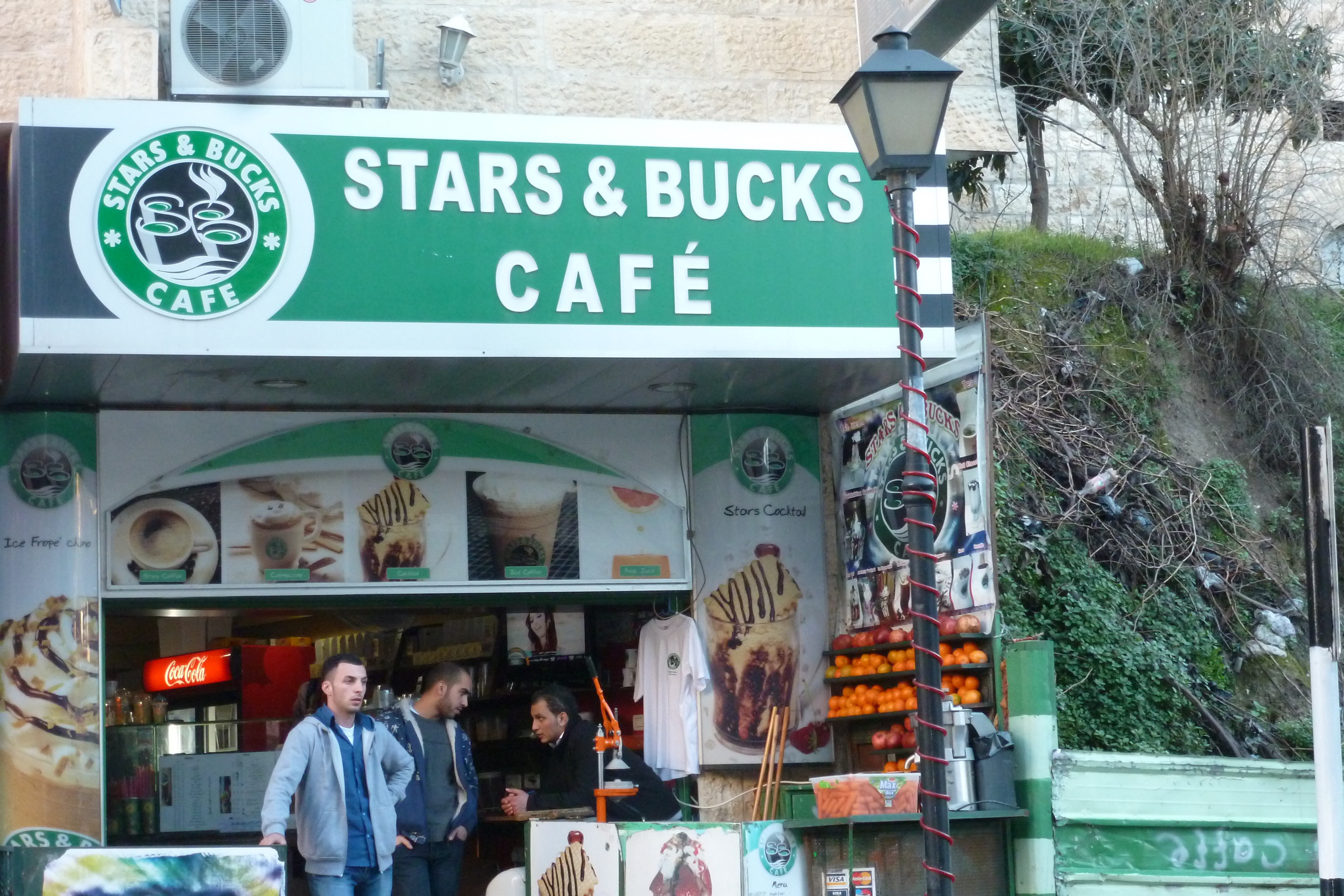 don’t really work for me partly because as they are shared between faiths they had neither the over-the-top garishness of say the Greek Orthodox Church nor the puritanical simplicity of a British church. But I also did not warm to kissing the very spot where Jesus was born – partly because the person, who decided where that spot should be lived 300 years after Christ and couldn’t have possibly known. And the old Xmas carol “Oh, little town of Bethlehem” will never feel quite the same now that I have seen the traffic, the mess and the commercialisation of religious tourism in modern Bethlehem. Though occasionally, as here, it has its amusing sides. But the real point of the trip was to look at Palestinian/Israeli relationships and what lies in the future for them.
The first thing to say is that life for the under-dog is always going to be rough and at the moment the Palestinians are the under-dogs all right. One doesn’t have to be anti-Israeli or pro-Palestinian to see that being bossed around by gun-toting 20 year old Israeli soldiers can be a demeaning experience for a middle aged Palestinian and an absolutely infuriating one for a 20 year old, unemployed, one. But more importantly experience on the ground tends to suggest that the much talked about two state solution just does not look a credible possibility. Palestine is just too small, and too broken up by ever-expanding Jewish settlements to be viable.
It may be pie-in-the-sky but a united non-sectarian, democratic state seems to me to the only possible future for the two peoples. But that can only happen if one, two or three other things take place. They are that the USA decides it can no longer afford, or no longer wants, to fund the Israeli state; that the rich Arab states decide between them that they are going to fund Palestine as generously as the USA does Israel; or finally that the people of the area get fed up with beating themselves up just as pretty much the whole of western Europe decided in the years after 1945 that two millennia of war was just about enough. Funnily enough, I think it may happen sooner than you think!
2. The day after we got back, 6th February, was the Council Meeting. One thing that certainly could be said for our trip was that it put the normal Labour:Tory badinage into context! There really was not a big debate but there was some discussion about paying all Council staff at least the London Living Wage of £8.55 per hour. Despite paying our top officers over £100,000 apparently we cannot afford to pay a minimum of £8.55!
3. The Planning Applications Committee on 11th February had few interesting applications but there were five for Boris bike docking stations. I have mentioned before that £2 million is being spent on this scheme in the Borough. None of these were in Latchmere, because none of those designed for Latchmere have been objected to, but I have a feeling people are not going to be pleased when they see the number of such docking stations planned. I also have my own suspicion that the scheme will not be quite so successful here as in the City and the West End, not least because out here it starts getting hilly and Latchmere Road Hill is pretty steep however young and fit you are.
4. The Strategic Planning and Transportation Committee had a paper about lobbying for a Heathrow/Clapham Junction link, which will be of interest to many in the ward. But perhaps more will be interested that the Council is looking into making parking enforcement the same on Council estates as it is everywhere else. You may know that car clamping, which the Council used to do on estate roads is no longer legal so the Council had to do something. It also obviously wants to save money by having the same traffic warden system everywhere in the Borough. I am not sure exactly how it is going to work but clearly the intention is to have one system that applies on both estate roads and public roads – and about time to, some would say.
5. On the 26th we had the Housing Committee and I really am struggling to think of anything interesting to say about that – so I won’t report anything.
6. On the 19th Jane Ellison organised a meeting at Providence House to discuss the plans for the extension of the Falcon Road Mosque. Representatives of the mosque presented their plans and Jane had asked me, as a member of the Planning Applications Committee, to outline the planning position and just some of the planning issues.
There were about 50 people present and local concerns were expressed. The major concern was clearly parking though there was mention of the proposed change in the building line and of the installation of a dome. At one point, the meeting threatened to get a little lively but I have to admit Jane handled it very well – ‘tis pity she is the wrong party!
7. I have an apology to make to everyone. On 8th February I had 10 solar panels fitted on my roof and became a member of the “oh so green brigade”. It is obviously the reason that we haven’t seen the sun since.
My Programme for March
1. There is a Council meeting on Wednesday, 6th March (OK, I know that’s passed but that will have to wait until next month!), with Planning Applications on the 12th.
2. The Falcon Road Estates Resident Association is on the 7th but there is also a Big Local meeting at Providence House on the same day. I will go to the Big Local meeting.
3. The Big Local is having a couple of consultation meetings. One is at the Sports Centre in Hope Street and will be an opportunity for locals to give their views on what the area needs. The second, much larger event will be a fun day for all on Saturday 16th. In the morning this will be centred on the Chapel in Pennethorne Square and in the afternoon it will be centred on York Gardens and the Library and will include football coaching, bouncy castles, face painting, etc. You name it and it will be there.
Do you know?
Maureen Larkin? I can’t remember when I first met Maureen but it was at an 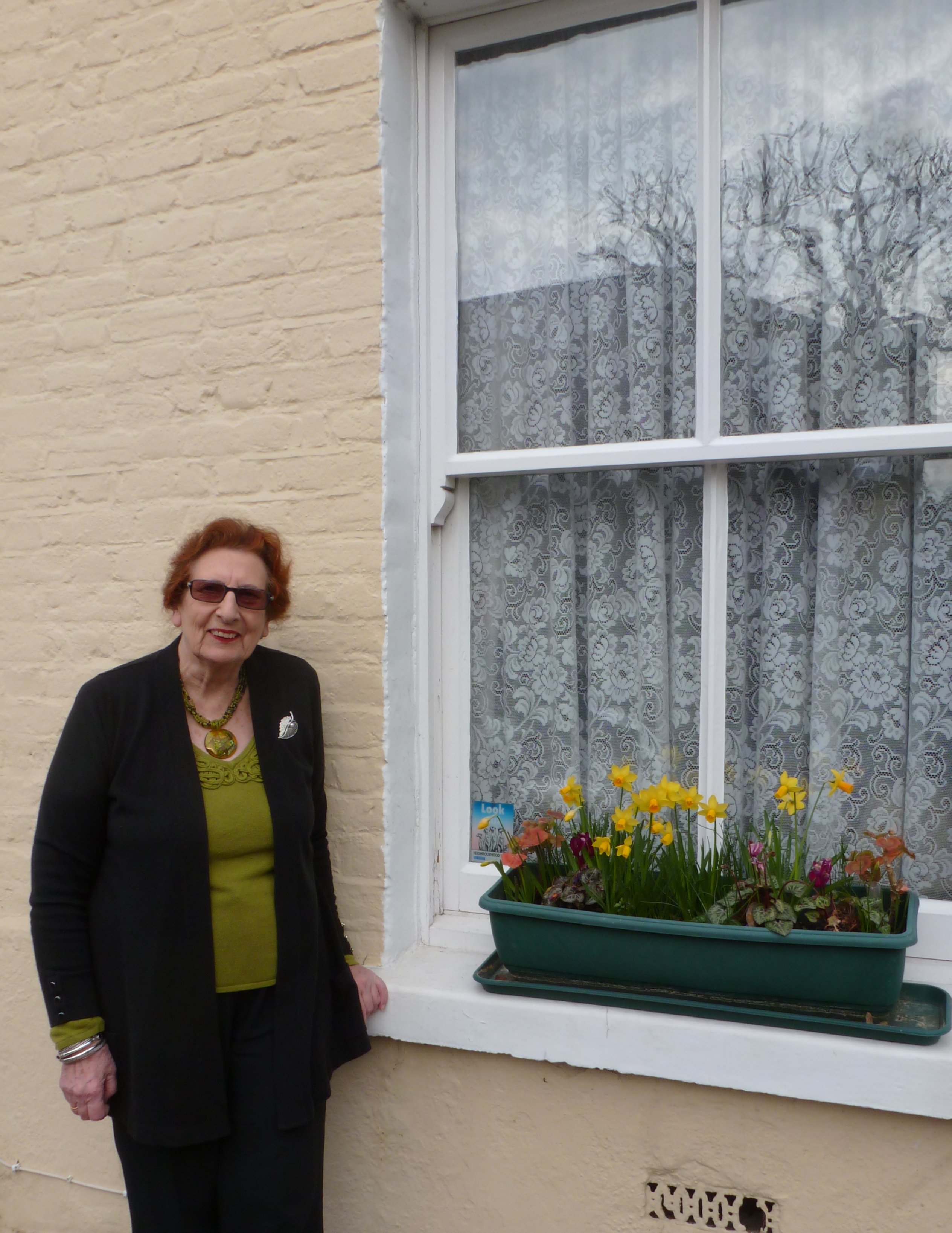 election, when I was standing for the Labour Party. I guess it might have been 1982. I called on some chap and got talking to him and it turned out that he had lived in the same house since the fifties and as I expressed surprise he told me about Maureen who was a far more senior citizen. So I called on Maureen and she told me she was born in her house in 1932 and as you see she is still there in the same house 81 years later. Can anyone beat that? Let me know if you can.
Many of you will know Maureen, who is still today very active as the Membership Secretary and Events Organiser of the Battersea Society. She has in her time been the Secretary or organiser of the Triangle (Poyntz Road, Shellwood and Knowsley Roads) Neighbourhood Watch and the Residents Association. She organises the Triangle Annual street party (she says she doesn’t organise it nowadays but I bet she has her say), which by the way I can say from experience is by far the best in the Borough.
In 2010 Maureen was presented with a Civic Award by Wandsworth Council in recognition of her services to the community. I remember it as a splendid occasion where she was accompanied by her daughter, Terry Barber. When I went round and took the photograph we chatted about Battersea when each little terraced house like hers had a family living upstairs and another downstairs and when the shared loo was a brick out-house in the yard, when the bath was a tub under the sink and Battersea, then the major industrial centre in west London, was filthy with coal soot and industrial grime.
Maureen clearly loves her community but she is not such an old sentimentalist to believe that everything was so good in the good old days, indeed she very much looks forward to tomorrow’s event to be organised and insisted that I had the Triangle party date firmly in my diary.
Councillor Tony Belton’s Latchmere February Newsletter (# 46)
January highlights
1. I went to the Passenger Transport Liaison Group on 7th January. Sounds dull, I know, but actually it deals with quite a bit of important detail. I asked why the Grant Road exit from CJ station is closed before the other exits. This means that many of you, catching the late trains from Waterloo and Victoria, have to walk out of the main exit and all the way round under the Falcon Road bridge – not the pleasantest of walks! The Network Rail representative said that he would look into the issue and just maybe get it extended to 1 am.
I also asked the TfL representative about “forcing” passengers to get off the C3 and 295 in St. John’s Hill, when it would be more convenient and safer for them (you) to stay on the bus to the terminus at Grant Road. I am afraid that the TfL man was a right “jobsworth” and was more concerned about the safety issue of getting off the bus at such a free-stand as the terminus and less about walking under the bridge. Of course if anything did happen at the terminus then TfL would be liable, whilst if you simply get mugged under the bridge then one thing’s for certain: TfL won’t get it in the neck! A frankly pathetic response! However, perhaps the Council can include some re-structuring of that bus stand as part of its big investment in regenerating Latchmere!
2. At the Planning Applications Committee on 14th January we approved the demolition of the gas holders that stand behind Battersea Park Station. Though not exactly in Latchmere, they are almost as well known a landmark of Battersea as the Power Station. I guess it will be a couple of years at least before they disappear but here is a reminder of them as they look now. There was no significant application relating directly to Latchmere.
3. I was at the Strategic Planning and Transportation Committee (I hate that name) on the 21st.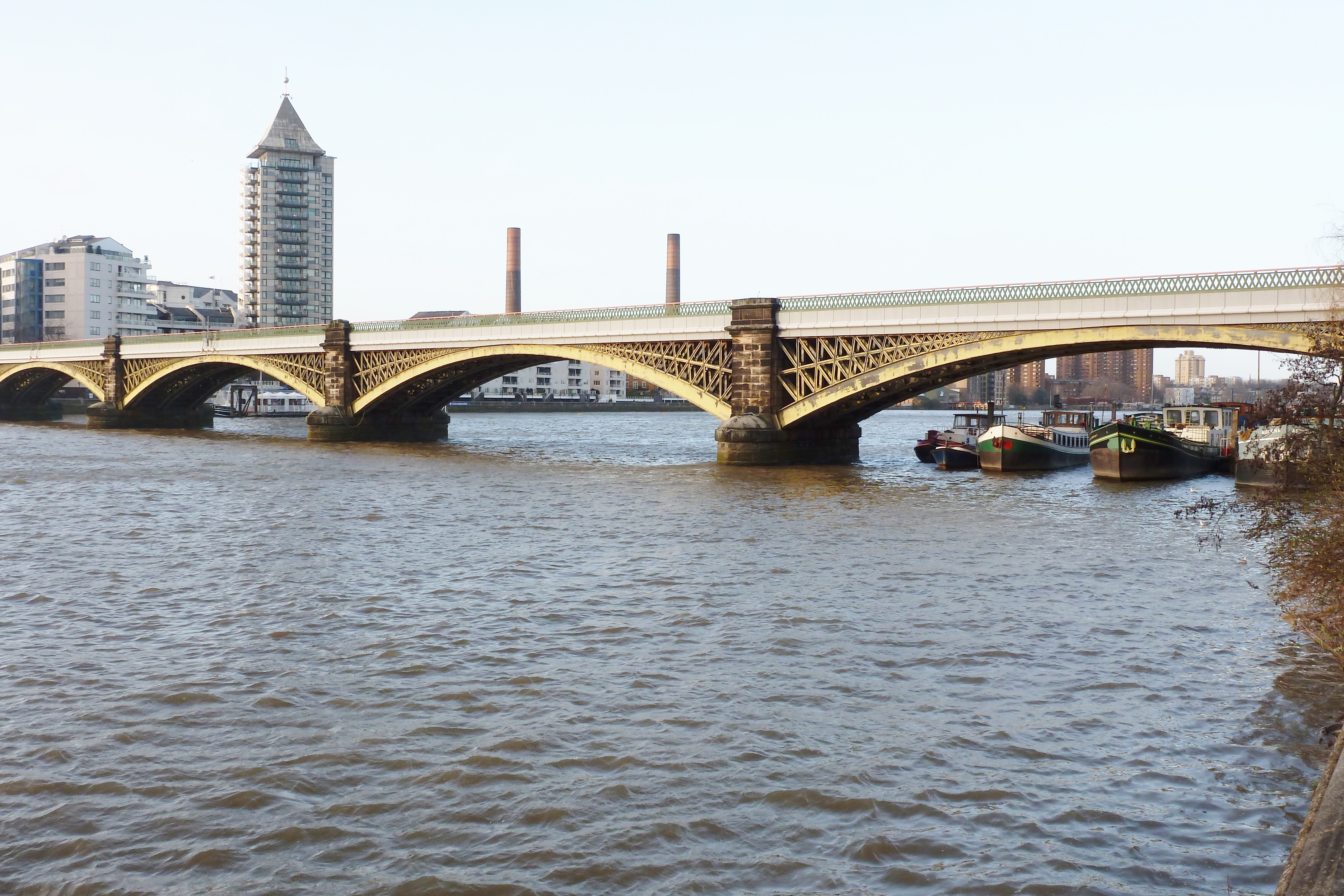 There was an awful lot about speed humps and parking controls but largely in streets in Tooting. The only matters which, I thought, were of wider interest and especially here in Latchmere were a paper about building a pedestrian and bicycle bridge across the Thames between Vicarage Crescent and Imperial Wharf, and the plan to expand the Mayor’s bike scheme.
The bridge would be on the upstream side of the Cremorne or Battersea Railway Bridge and would obviously be a great addition to life since as you know there is a big gap in bridges between Battersea and Wandsworth Bridges. However, the expected cost is £20 million and there is no known source of funding and so I am afraid it is merely a “bridge dream”.
The Mayor’s bike scheme is, however, going ahead and the cost in Battersea will be the best part of £2 million with cycle stands (docking stations) installed all over the place. A few of the 17 Latchmere sites are Grant Road, Sheepcote Lane and Plough Road. A full list can be seen at this link http://ww3.wandsworth.gov.uk/moderngov/documents/s26267/13-61%20Appendix%201%20to%20Cycle%20Hire%20Report.pdf. I can see some arguments coming up when they go the Planning Applications Committee! But at £2 million for Battersea alone I really, and rather unfashionably, wonder whether just some of this money could be spent reversing other cuts, such as welfare benefits, adventure playgrounds and one o’clock clubs. What do you reckon?
4. On the 23rd we had the Housing Committee. There were a few technical matters but two main changes: one about the annual rent increase, which is more or less in line with inflation at a weekly average of £3.44, and secondly the impending change to housing and Council Tax benefits. The first thing to be said here is that the Government are cutting these drastically and that many people at the poorer end of the spectrum are going to find life really tough. There is already anecdotal evidence of quite a few children with free school meals “disappearing” from our primary schools. It seems that schools are picking up signs, before the housing department, that quite large numbers of people are being forced out of London. I think it is too early to say quite what level of disaster this is for some in the community, but we do know quite a bit about the impact of the so-called “bedroom” tax. I have a local and worrying case that you can read about on my blog site at https://tonybelton.wordpress.com/ under the title “State Snooper in the bedroom”
Highlights of 2012
1. My colleague, Simon Hogg, has produced his own blog of a few of our (Latchmere Labour councillor) achievements in 2012. You can see his account at http://simonhoggblogs.com/2012/12/31/9-things-your-local-labour-party-did-for-you-this-year/
2. I haven’t really kept a diary of my own “achievements” but am now making a resolution to do so in 2013, but my own personal highlight is fighting the Council’s policy to evict the families of those involved in the riots of August, 2011. As I have often said, it is not that I have much sympathy for the rioters but making them homeless, and more particularly their innocent mothers and younger siblings, seems like pointless revenge. The international interest was staggering and I was interviewed by press and TV from Russia, France, Spain and Canada. In the end the Council backed down!
My Programme for February
1. There is a Council meeting on Wednesday, 6th February, with Planning Applications on the 11th and Strategic Planning and Transportation on the 20th with the Housing Committee following on 27th.
2. The Finance Committee will decide on the 27th February next year’s Council Tax but essentially since that has been nationalised for some years now, we know that will be frozen or more or less so.
3. There is the Greater London Labour Conference on the week-end of 16th and 17th February, though by then some of us will be deep into the Six-Nations Rugby Championships!
4. There is the police Special Neighbourhood Team (SNT) on the 7th and numerous other smaller meetings.
Did you know?
Everything about the Latchmere Estate? I thought I knew quite a bit but this month my attention was drawn to a blog-site called Municipal Dreams. This is obviously the pride and joy of a real municipal historian and there is masses in there about the reconstruction of bomb blitzed Plymouth and about Poplar but if you scroll down to the 1st January entry there is a really interesting bit on the Latchmere Estate – a must for history buffs, the Battersea Society, etc.
Are Wandsworth’s tenancy agreements legal?
Remember Wandsworth Council’s attempt to evict the mother of an accused rioter on the basis of a “so-called” breach of tenancy conditions? This was in the context of the Council’s secure tenancy terms, introduced in 2009. They included a number of things that tenants, “lodgers, friends, relatives, visitors and any other person living in the property are not allowed to do whilst in the London Borough of Wandsworth”, including causing a nuisance to others, causing damage to property etc.
I maintained at the time that surely it cannot be “reasonable” to include in a tenancy agreement matters that are quite outside the specific requirements of the tenancy and that, therefore, the whole basis of the Council’s tenancy agreements were flawed. I understand that in legal terms this might be referred to as “personal obligations” and not relevant to tenancy agreements. Just imagine a contract to buy a car or a washing machine, which included clauses covering personal behaviour!
I know this will sound fanciful to some but this kind of clause covering personal behaviour and not just the main object of a legal contract was the kind of mechanism used by the aristocracy in Tsarist Russia to keep the peasantry under control and in Hitler’s Germany to keep unionists in check and if allowed to pass unchallenged could, in theory, be used by Tory Wandsworth as a reason for evicting Labour voting tenants – or in Lambeth of evicting Tory voting tenants. I jest, but only a little. Clearly contract law should not be used to impose standards of behaviour on anyone – after all one person’s right to protest is another’s riotous assembly.
Well, I have just heard about a County Court judgment in Wandsworth County Court, where the district judge took exactly my position.
The tenant was a Wandsworth secure tenant for some 30 years. There had been no known problems with his tenancy until 2010/11 when he went to another estate, and, for a period of about 8 months, “painted” unpleasant graffiti on someone else’s front door. He had a “perceived” grudge against the other resident.
The tenant was arrested, pleaded guilty and received a prison sentence. About 3 months after he was released. Wandsworth brought possession proceedings on the grounds specified in the tenancy contract, i.e. of causing a nuisance to anyone living in the borough of Wandsworth and/or the local area, of doing anything which interferes with the peace, comfort or convenience of other people living in the borough of Wandsworth, of causing damage to property belonging to other people or council property in the borough of Wandsworth, etc.
The District Judge held that insofar as it applied to the entire borough, the clause was not an “obligation of the tenant”; that insofar as it related to anything which was “local” to his flat then Wandsworth had failed to prove, as a matter of fact, that his ASB (anti-social behaviour order) was in the area or in any event, it too was not an obligation of the tenancy and hence it wasn’t reasonable to make an order for possession. Stripped of the legal phrasing that means that, in the judge’s opinion, the tenant had done nothing to impact his tenancy. The judge did not attempt to justify the tenant’s behaviour or excuse it but he did say that right or wrong it had nothing to do with his rights to contimue his tenancy.
The possession claim was dismissed. In my view, Wandsworth has little choice but to appeal. If it does not, then it essentially accepts that its tenancy agreement is fatally flawed and any management actions taken on the basis of the agreement is doomed to fail. If it loses the appeal then the Council, and many others will have to re-think.
Indeed if the courts throw out Wandsworth’s position then David Cameron and others will have to re-think their unconsidered recommendations to Councils to evict and/or introduce legislation to change the law. However, this would be so controversial that I imagine the Law Lords would have problems with it – once again the Tory tendency to act on the hoof is getting them into trouble.
My thanks to my fellow Councillor Simon Hogg and website nearlylegal for much of the content of this blog.
State Snooper in the Bedroom. A Question of Distribution – Not supply.
Two ex-Council flats in my Battersea patch have been bought by the same person and converted into one comfortably sized house, occupied by one person. Two other terrace houses in the posh part of the ward, usually up for sale at about £1 million a time, are currently being converted into one mansion.
A close personal friend owns a flat in Prince of Wales Drive and bought the neighbouring flat with the result that he and his wife now have a very large, comfortable flat facing Battersea Park. Think how many spare bedrooms there are in these three properties. (By the way, my partner and I live in a comfortably sized house, which has three spare rooms we use as personal studies and a bedroom – I do not deny that I am in the same boat).
There is no bedroom tax on any of us, nor a mansion tax. Indeed since, in 1980, the Thatcher Government abolished domestic rates, a tax that reflected the size and value of private residencies, there has been ZERO disincentive to “under-occupy” in the private sector. Indeed given the inflation in house prices the incentive is to under-occupy as much as one can afford.
Meanwhile this Conservative-led Government has ruled that Councils must increase Council rents on Council tenants where they are “under-occupied”. Forget the interesting concept of charging on the basis of the customer’s situation, as opposed to the more normal charge on the value of the good being purveyed, this involves all kinds of problems interpreting “under-occupation”. It also demands statesnooping and bureaucracy in every socially rented house – indeed every bedroom.
That is, of course, because the Tories (and I am afraid increasingly the public at large) have a completely different attitude towards the rights of Council tenants as opposed to others. But just what does this mean on the ground?
Well here is a real example sent to me by a Battersea resident:
“i have lived here for 18 years i have 2 children that have now left home [a three bed flat] that’s why i am getting hit with the bedroom tax i have a 5 year old grandson who stays with me when his mum works and he stays with me when she is felling depressed as the grandsons dad was murderd in 2011 i suffer with chronic migraines and get blackouts with them when i am to ill to look after my grandson my mum and my son comes and stays here to help i have been on home swapper for over 1 year but have no luck as no one wants to move here i don’t mind moving to a smaller place but have not had any luck yet the council rang me back in nov 2012 and asked if i wanted to move to tooting i told them that i had asked for battersea or near i would like the council to let me have a 2 bed room because of my grandson staying here and just in case he comes to live with me full time which i think could happen in the near futher i do think that it is wrong that people who are willing to downsize have to pay the bedroom tax when the council have not got any smaller places allso my dad is in a wheelchair so i have to have somewhere that one can fit in i have told the council this as i would still like my dad to visit me thank you for taking the time to try and help”
The Tory position demands enquiring into a family’s personal circumstances and yet not allowing Councils to use their discretion depending upon those very circumstances – I thought they were opposed to the nanny state. In this case, and I suspect in many others, the Tory position potentially undermines both the family and the community – I thought they were supposed to believe in both. The Tory position is that the extra rent per bedroom will be levied regardless of whether the tenant is on the transfer list and whether the Councl has the ability to provide a smaller flat.
The broader Tory view is that they (the state) have the right to dictate how the council tenant uses our common resources. They (tenants) do not have rights of residency, they are allowed occupation on sufferance as long as their circumstances do not change. Talk about the dreaded Tory fear of encouraging women (sorry! the feckless poor) to have babies so as to keep their Council flats or to lie about whether their kids and grandparents are resident or not. At the very least it will discourage tenants from going on the transfer list as they will immediately open themselves up to the bedroom tax! What a perverse result.
At the same time the more affluent are incentivised to grab a larger and larger share of our national resource without taxation – indeed until recently they were given Council Tax relief on under-occupied second homes. The Tory position displays class prejudice of an extreme kind – and they like to claim that it is the left that pursues class politics – the politics of envy – what nerve! What thoughtless arrogance!
Oh, and by the way, just the other day, one mile down the road at Battersea Power Station studio flats were put up for sale for £338,000 and penthouses for £6 million – and they won’t even be built for years. Within days 60% were snapped up by British and foreign owners – I wonder just how many by those on the waiting lists of Wandsworth!
My January Newsletter (# 45)
December highlights
- I went to the Doddington Estate Garden Xmas fete on Saturday 1st Dece
 mber and the Policeman’s Ball on the Saturday evening. Here I am photographed joining in the carol singing at the Fete, whilst much to my astonishment I won a painting of Battersea Power Station at the Policeman’s Ball and so December had started festively!
 - There was a Council Meeting on Wednesday 5th, where the main subjects of discussion were the benefit cuts, the housing crisis and the Chancellor’s autumn statement and its impact on Wandsworth’s budget. I don’t think that we learnt anything much other than that the Conservative councillors, and the Conservative Party, have no Plan B. Apart from blaming Labour for the economic crisis (strange that given the crisis is affecting the whole of Europe), and cutting welfare benefits, they seem to have nothing to say.
- At the Planning Applications Committee on 13th December we approved yet another planning application for Battersea Power Station. I have been on the Committee a long time and seen many, many planning applications for the Power Station approved. None of them have ever amounted to much but this time there appears to be a real chance that work on the site will start late next year. I hesitate to say that because I have said it before but just maybe this time it will happen.
- A local application that went through was for the demolition and re-construction
 of the Castle pub in Battersea High Street. The public gallery was full and the application was clearly not popular but in reality the committee had very little choice. There is little that the Committee can do to stop demolition of a building, unless it is listed for protection, and its replacement by another pub plus flats is totally consistent with the Council’s planning policies.
 - On the 10th I went on opening run of the new rail service from Clapham Junction through south and east London to Highbury and Islington. This line completes London’s orbital rail line. I went on it from CJ to Wapping and back to Wandsworth Road station. The best description of it, I have found is at http://www.therailengineer.com/2012/11/02/london-orbital-rail-network-complete/. Here is a picture of the new rolling stock pulling into Wandsworth Road station. The line offers new ways of getting to the O2 stadium, Canary Wharf and Stratford. It is a good line opening up lots of new destinations from CJ but was it me or was it rather slow. I felt that in crossing so many other lines it had to be very carefully timetabled and perhaps came off second best at some junction points.
- On New Year’s Eve, I went to a Jazz Club in Streatham. Here is a picture of the
 band, Soul Street, who gave us an entertaining evening. I hope that you had a good time!
Highlights of 2012
- My colleague, Simon Hogg, has produced his own blog of a few of our achievements in 2012. You can see his account at http://simonhoggblogs.com/2012/12/31/9-things-your-local-labour-party-did-for-you-this-year/
- I haven’t really kept a diary of my own highlights but am now making a resolution to do so in 2013, but my own personal highlight is fighting the Council’s policy to evict the families of those involved in the riots of August, 2011. As I have often said, it is not that I have much sympathy for the rioters but making them homeless, and more particularly their innocent mothers and younger siblings, seems like pointless revenge. The international interest was staggering and I was interviewed by press and TV from Russia, France, Spain and Canada. In the end the Council backed down!
My Programme for January
- I am back into the Council swing on Monday, 7th January, with a meeting of the Transport Liaison Group, where councillors exchange views with Transport for London and the rail companies about the state of public transport in London. That might sound like just a talking shop but in the last few years I think that we have been just a little responsible for getting the lifts installed at CJ and seats at most of our bus-stops – just two examples of many items discussed over the years.
- There is a Big Local meetingon Wednesday 9th, and a Planning Applications Committee on the 14th. I intend to go to the Cancer Support AGM on the 16th in the Mission on the north side of York Road.
- I have the Strategic Planning and Transportation Committee on the 21st and the Housing Committee on the 23rd and a Battersea Park School Governors meeting on the 28th. And on the 30th I am attending a teach-in on the new Housing Benefit rules. Anyone, who has followed my comments very carefully will know that I think that these cuts are going to be an absolute disaster for many people on our housing estates. By the end of the month, I hope to be proved wrong but expect to be proved right!
Did you know?
Why the Katherine Low Settlement (or KLS) in Battersea High Street and pictured here has that name and who Katherine Low was? I attended my first Battersea political meetings there many years back and never knew, or if I did I have forgotten, why that name.
Well it turns out (thanks to Wikipedia) that KLS was named after Katherine Mackay Low, who was born in Georgia, USA, on July 9th 1855. Her parents were British, and when her mother died in 1863, her father, a prosperous merchant and banker, brought his family back to England and settled in Leamington. When he died, the family came to London, and Katherine devoted herself to the care of the less fortunate. When she died, on January 2nd, 1923, her many friends decided to create a memorial to her which would also further the kind of service to which she had devoted herself.
The small committee formed to achieve this purpose discovered that the area around Orville Road, Battersea was described as “irreclaimable”. They visited Battersea and found, right on Orville Road, a large empty house. Then called “The Cedars”, the house was owned by Christ’s College, Cambridge. The College agreed to lease the house at a nominal rent if money could be found to repair and redecorate it. Katherine Low’s friends raised the funds and on May 17th, 1924, HRH the Duchess of York (later Her Majesty Queen Elizabeth the Queen Mother) came to Battersea and declared open the Katherine Low Settlement.
The Wandsworth Story behind Right to Buy
Wandsworth Tories introduced an aggressive Right-to-buy (RTB) policy a year before Mrs Thatcher came to power and made it a national Tory plank. It was, of course, a barn stormer and won many votes for the Tory party – and lost many more for a Labour Party perplexed about exactly how to tackle a policy, which was so perfectly attuned to an 80s Loadsamoney philosophy and such an anathema to any collectivist dream.
Lost in the political firestorm were some quiet voices on the Labour side, me included, who said as loudly as we could that outright opposition to the RTB policy was pointless but that reasoned criticism was valid and should have been pursued relentlessly. I recall two particular threads to our criticism. One was that receipts from sales should be used to replace housing stock.
Now in the current crisis about the lack of affordable housing everyone, even the Cameron Government, is talking, however disingenuously, about council house sales being accompanied by a policy of like for like replacement. The fact that the Blair/Brown Governments did no more to replace like for like than the Major/Cameron Governments does not make it any easier!
But the second criticism we had was that RTB would in the end result in the loss of affordable housing and would not be a long-term gain to the goal of creating a “property owning democracy”. Perhaps it is a little difficult to recall just how much Mrs Thatcher made of the creation of a share-owning, property-owning democracy but it was a central plank of the Tory philosophy of the 1980s. Now, however, with the first analyses of the 2011 Census figures we discover that for the first time since the war the proportion of the population living in private sector rented accommodation is on the rise and the number of owner occupiers is actually declining. Just what has happened to the property owning democracy?
Well using Wandsworth as an example reveals some interesting trends. Since 1978, the Council has sold 16,000 leasehold properties out of a stock of approximately 40,000 (there have also been thousands of freehold sales, including sales of whole estates). Having done some research on these 16,000 it appears that 5,650, or 35%, are now in the hands of private landlords, who have developed private sector rented empires on many Wandsworth estates.
The Council admits that one landlord owns 93 leases, from where he runs a private rented empire, whose asset value, very conservatively estimated, is worth more than £10 million. These 93 flats are let out almost exclusively to students of Roehampton University.
Moreover the Council admits to the fact that a further 17 landlords own more than 10 properties and another 83 own more than 5. But having done my own research on the figures and talking to the Council about their methodology, I am fairly confident that they have under-estimated the situation. The Council’s own figures are done on a simple spreadsheet exercise against a file of leaseholder names. They have not been asked to look more closely at the data and they have not done so – but I have.
It is clear that there are networks of ownership between members of the same family and apparently independent companies, often sharing the same addresses. Hence there are several small rental empires on, for example, Battersea’s famous Doddington Estate. In these properties, the Council makes an estimate for housing benefit calculations of rents are about 250% higher than the Council equivalent for the neighbouring properties. So for example, a two-bed Council owned flat is let at £123 per week and the privately owned neighbouring flat has a base of £320 per week for benefit calculation – the actual rent might be much higher.
As of early December, 2012, 31 of these properties were leased back by the Council for housing homeless families, all of whom were in receipt of Housing Benefit or Local Housing Allowance. No doubt some of these families will be hit by the so-called Benefits Reform that some Tory councillors defend on the rather ironic grounds that it will force private landlords to lower their rents. What a trick! Essentially guilty of creating a rental market with highly inflated rents they now accuse those very same landlords, they created, of exploiting the benefits system.
What I find extraordinary about this situation is that the Council officers, and the Tories, find none of this surprising. As one officer said to me, “If you return the properties into the market place then you will see the market acting as it always does with tendencies towards monopolies and exploitation”. He was accepting the reality of the situation. The Tory response is, of course, to defend the market despite, or because of, its faults, and actively to work to destroy the collectivist response to a major human need, which was the original purpose of council housing.
They have the temerity to criticise council housing and many of the subsidies that they claim it was based on and yet do not bat an eyelid at those very same once public resources being used for personal profit and gain.
This is perhaps not surprising amongst Tory councillors, who in Wandsworth are distinguished by the rise of its very own rentier class. It is not necessarily easy to interpret from the members’ register of interests but it looks possible that up to 10 Tory councillors, 20% of the whole, rent out properties for an income. But what I do find fascinating is that some Labour members seem to accept the market-place’s role, the place of market rents as a standard and the inevitable supremacy of market forces. Curious, when council housing has for a hundred years been a collectivist and, despite the occasional disaster, a highly successful response to the major problem of housing the totality and not just the affluent in our population. Doubly curious given that the two oldest council estates in the country, the Totterdown estate, and the direct works built Latchmere estates, are both Wandsworth estates!
Prisoners and the Right to Vote
David Cameron and the Tory Party state that they are physically sick at the prospect of being forced to legislate to allow convicted prisoners the vote. Many on the left, though from my personal experience those temperamentally on the autocratic left, are inclined to agree with him. But I can think of at least four reasons to legislate to allow prisoners to vote.
1. The Practical Argument.
The European Court of Human Rights (ECHR) demands that we should do so and until we do many civilised communities in Europe will think of us as hardly more democratic than, say, many of the ex-Soviet bloc. And the ECHR is not some Brussels dominated anti-democratic organisation but a Court largely established by British lawyers in the aftermath of WWII precisely to prevent the human rights’ abuses of the Nazi and Soviet regimes. We should be proud of it.
Just why get into this political fight, when the British prison population, the largest in Europe outside of the old Soviet bloc, is less than 100,000. It is actually less than 90,000, which means on average the 650 Parliamentary constituencies would have a possible 138 voters each, less than 0.02% of the electorate. Assuming that all voted the same way in an organised and consistent way that could have affected the result in 2 constituencies at the 2010 Election, Fermanagh and Tyrone, where they would have had to have voted for the Independent candidate and Hampstead and Kilburn, where they would have had to have voted Tory.
2. The Judicial Argument
One curious feature of the opposition to this reform on the left is that it assumes the perfection and consistency of the judicial system. In practise 10 years of service on the bench as a JP taught me much more scepticism. Big time fraudsters often get away without imprisonment and small time welfare benefit recipients often don’t. We all have pet examples, even the Daily Mail, when we are shocked that imprisonment has been meted out as the punishment. One thing is certain, the judicial system is not, and probably never could be consistent.
3. The Enlightened Argument.
Any judicial system worth its salt should not just be punitive in intent but also restorative. Depriving a prisoner of the vote not only shows what society thinks of him/her but does nothing to encourage him/her to take an active and responsible part in the society, which almost certainly s/he will re-join.
4. The Philosophical Argument.
The democratic struggles of the last three centuries, in this country and around the world, have centred on the Right to Vote. It is called a Right and not a privilege granted by the state. To attack this right is very dangerous territory indeed and yet the Tory Party and many on the un-democratic left want to dabble in this quagmire rather than simply accept the European Court’s view that all, including convicted prisoners, should have the right not privilege to vote.
It is not a privilege to be taken away by the state at the whim of the elected majority but an inalienable right. As soon as it is in the gift of those in power then there is no distinction in principle between our society and many others of which we all disapprove.
Councillor Tony Belton’s Latchmere December Newsletter (# 44)
November highlights
1. I had a Strategic Planning & Transportation Committee and a Housing Committee on 12th and 14th November, and also the Planning Applications Committee on the 20th. However, to be honest there was not really much to report and no very significant planning permissions this month – except, that is, for the dire likely consequences of the so-called welfare reforms and just some of these were considered by the Housing Committee.
I know, of course, that welfare spending is not currently very popular with the public at large but I hope that here in Latchmere we know some of the real consequences of these cuts. What is clear from reports to Council is that the Town Hall officers expect an increase in the number of families made homeless because of the impact of housing allowance cuts as well as penalties for those, who “under-occupy” their council flats. They expect that some families will have to be re-housed well outside of the London area and indeed I already know of one single mother who has been placed in Loughton in Essex, despite the fact that her sons attend a primary school in Tooting!
2. I went to the opening of 39 new Council-built flats on the Doddington and Rollo estate on the 22nd November. You may have seen them being built alongside the railway track between CJ and Queenstown Road station. Here is a picture of them close up. They are the first purpose built council flats in Wandsworth since the early 80s and although a very small gesture towards the housing crisis, I must say they appeared very well designed and built.
3. I am afraid that I did not get to the Women of Wandsworth AGM or the London Summit but I did attend a couple of important Battersea Park School governor meetings. The school is struggling with its “failure” to achieve Academy status this year and is now faced with a period of uncertainty as it appears as though the only way to be certain of its future is for its results to get worse, in which case it would automatically become an Academy. NO, you didn’t read that incorrectly. Under the perverse incentives that the Government has imposed on schools there is an advantage, if you think it is an advantage of course, for your school to do badly in exam results in order to become an Academy! You couldn’t make it up, could you!
4. Last month, I reported that nearly 6,000 of the Council’s 18,000 odd leasehold properties are not lived in by the actual leaseholder, or to be absolutely precise they have their management mail from the Council sent to different addresses. I said that one leaseholder owns over 90 ex-Council properties, and whilst he is in a “class” of his own, 17 others own more than 10 each.Well, I have been doing some work on the information that I have got and it is clear that there are networks of private landlords operating on Council estates, with some flats “owned” by husbands and wives, brothers and sisters, and City holding companies. Frankly I find this an astonishing racket with hundreds of “landlords” making profit rents from Council-built and subsidised dwellings!
My Programme for December
1. I went to the Doddington Estate Garden Xmas fete on Saturday 1st December and the Policeman’s Ball on the Saturday evening. Here I am photographed joining in the carol singing at the Fete, whilst much to my astonishment I won a painting of B attersea Power Station at the Policeman’s Ball and so December has started festively!
2. There is a Council Meeting on Wednesday 5th, where the main subject of discussion will be the benefit cuts, the housing crisis and the Chancellor’s autumn statement and its impact on Wandsworth’s budget.
3. On the 10th I intend to go to the opening run of the new rail service from Clapham Junction through south and east London to Highbury and Islington. This will complete London’s orbital rail line, which was first talked about in the late nineteenth century following the success of the Metropolitan and Circle tube lines. Well, here it is well over a century later and the orbital route has arrived! The best description of it, I have found is at http://www.therailengineer.com/2012/11/02/london-orbital-rail-network-complete/.
4. Apart from these events there are as you may imagine lots of festive drinks and fetes that councillors get invited to run by resident organisations, school groups and others. I look forward to seeing some of you at some of these occasions!
Did you know?
About “Movember”, the November prostate cancer awareness campaign, the idea for which came out of an Australian pub about 5 years back and now has millions of men supporting it by growing moustaches and beards in the month of November.
Well I decided to join in despite protests from some quarters and this is how it looked on December 1st and whilst for me it is not an original look – there is quite an amusing picture of me in the archives with long hair, moustache and beard from way back – it was a bit of a shock for some.
It has now gone – to be repeated next year? We will have to wait and see but in any event I raised some small amount of money for the Prostate Cancer Awareness Campaign.
Councillor Tony Belton’s Latchmere November Newsletter (# 43)
October highlights
1. I received a couple of comments following last month’s newsletter about my failure to mention the campaign about the Adventure Playgrounds in York Gardens, Battersea Park and Kimber Road – and sadly the demolition pictured here. This was obviously a mistake and I apologise for the omission, but I can only say that I thought the “Pay to Play” campaign had had more publicity than any issue I can recall since the battle to save York Gardens Library. If you want to see some of the comments made by me and my colleagues then take a look at this blog: http://labourinwandsworth.wordpress.com/
However, whilst I am on the issue, I see absolutely no indication of any change of mind from the Tory Party in Council.
2. Congratulations to York Gardens Library, which was last month awarded £5,000 from the Lloyds Banking Group’s Community Fund. I know from Wendy Speck, who is on the steering group that there is still much work to be done to make the Library self-sustaining but this is an excellent step in the right direction.
3. October’s Council Meeting produced a couple of facts worth mentioning. Firstly it turns out that 105 people working for the Council earn less than the London Living Wage (LLW). I have a list of the jobs that they do and although I cannot be certain it looks to me as though almost all are women workers. I don’t want to be sexist and one can’t be certain but as half of them are “Carers” working in Adult Services and many of the rest are cleaners and cooks, I think it is a pretty fair guess.
It would cost the Council less than £60,000 pa to become a LLW employer; that is something like 25% of the Chief Executive’s salary. This is an idea “whose time has come” according to PM David Cameron. And yet I have it on pretty good authority that the Tory councillors have considered the matter and rejected it – so much for us all being in this together!
4. Secondly it turns out that nearly 6,000 of the Council’s 18,000 odd leasehold properties are not lived in by the actual leaseholder, or to be absolutely precise they have their management mail from the Council sent to different addresses. The Council believes that this means they are probably let to private tenants. One leaseholder owns over 90 ex-Council properties, and whilst he is in a “class” of his own, 17 others own more than 10 each.
Surely when the “Right To Buy” policy was introduced and the Council started its aggressive sales policies it was not their intention to create at least 17 multi-millionaires and to jack up rents on the estates from the Council’s rent levels of roughly £200 per week to the private sector’s £500+ per week.
I suspect that this was very much a case of introducing a policy, which has had unintended consequences. And one, which as the lack of affordable housing becomes ever more acute, has become more and more serious.
5. The October Planning Applications Committee had absolutely no application of any major significance to Latchmere (there was one application for a roof extension).
6. On Saturday, 20th October, I went on the TUC march for jobs from Blackfriars to Hyde Park. The picture shows me and my colleagues with the Battersea Labour Party banner in Hyde Park. I thought the lack of media coverage was pretty disgraceful, given that there must have been 200,000 people there – I know the Met estimated 100,000 but I have never seen that many people at a big sports event and I have been to one or two.
7. I went, along with the Battersea Society, to see Benjamin Franklin’s House. For those of you, who do not know the history Ben Franklin was a British patriot living in Philadelphia, Pennsylvania, in the eighteenth century. Britain was faced with the problems of ruling the 13 colonies from 3,000 miles away and as the conflicts grew Franklin decided that independence was the only practical conclusion. He had a hand in writing the Declaration of Independence and the US Constitution.
H e was, however, also a polymath. He invented the lightening conductor and was an early experimenter in electricity. He invented a musical instrument and was in effect both US ambassador to France and to Britain. He was at the Treaty of Paris in 1783, which established the USA in international circles. And his picture adorns this US $100 bill
 His house is an original eighteenth century mansion in Craven Street, right next to Trafalgar Square and if you want an interesting hour and a half visit I thoroughly recommend it. It is brilliantly “enacted”.
My Programme for November
1. I have a Strategic Planning & Transportation Committee (I know it is a pompous title, but it’s not mine!) and a Housing Committee on 12th and 14th November. There is the Planning Applications Committee on the 20th.
2. I hope to get to the Women of Wandsworth AGM on 26th November and I have a couple of important Battersea Park School governor meetings this month. I also intend to go to either the London Summit, which is a large London-wide Conference for all councillors in London about various issues of concern to us all – no doubt mainly discussing the financial cuts being imposed across the city.
Did you know?
 Last month I wrote about North and South Lodge in Latchmere Road, but now thanks to one of you I can say a lot more about these two buildings and what a fascinating story it is too!
On 25th March, 1836, the Wandsworth and Clapham Poor Law Union was formed. It’s job was to build and run workhouses for the poor. It was run by an elected Board of Guardians, representing its 6 constituent parishes, Battersea (3 governors), Clapham (6), Putney (2), Streatham (2), Tooting Graveney (2), Wandsworth (4).
By the end of the nineteenth century, Wandsworth and Clapham was London’s largest union, with a population of more than 350,000 — a twelfth of the capital’s total. The Wandsworth and Clapham Union was renamed the Wandsworth Union in 1904.
Like other London unions, Wandsworth & Clapham operated a number of relief offices and dispensaries. And in 1886, a new purpose-built combined relief station and dispensary was erected on Latchmere Road, Battersea. The building was our North and South Lodge and much more – see the picture. It was Battersea’s very own workhouse – a reminder of a grim past!
This is Architect, T.W. Aldwinckle’s design for what was known as the Latchmere Road dispensary and relief station.
Timon of Athens, starring Simon Russell Beale or Shakespeare on today’s political dynamic
I saw this late Shakespeare play at the Olivier last night (22/10/12). I will leave it to the professionals to review Beale’s performance, safe to say that he was brilliant, but I want to talk about the play.
Surely this is Shakespeare’s least known play, and perhaps deservedly so. The ending is a dramatic failure; the character development is limited at least by the bard’s standards. What is more in the whole play I did not recognise a single quote or aphorism. You know how it is in a normal Shakespeare play – that instant recognition – Oh, that’s where that phrase comes from. But not once did this happen in Timon.
What was striking was the central role of money. Unlike any other of his plays, money is the oil, the black, nasty, sickly sweet blood pumping through the whole play corrupting first the rich, lazy, feckless rich living off Timon’s generosity; then Timon himself as he corrupts the artists living off his wealth and then as he abuses the power that it gives him; then the rich and mean, who refuse to bail him out of debt; then the rabble, who want to foment a revolution but have neither the discipline or the skills to do so, and finally the revolutionary leader, the Stalin as I saw him, who like all the rest sold out to the power that is – money.
The tragedy was set in Athens and played rather poignantly in modern day Athens and for anyone who has been there recently (I was there at Xmas 2010) the rubbish strewn, graffiti blown, wreckage of a great city was all too real. However, the first scenes are in Timon’s luxurious mansion, where he is surrounded by his sycophantic, rich, scrounger friends. He believes himself to be “wealthy in my friends”. They marvel at his honour, his generosity; they thank him for buying their debts, providing their dowries. I felt it to be a Shakespearean commentary on the celebrity culture, but perhaps that is a little anachronistic.
Timon’s descent to the slums is tragic and his acceptance of it and his rejection of humanity, his bitter hatred understandable given the rejection he faces from the beneficiaries of his gifts. The self-righteous, self-serving, posturising of these n’ever-do-wells had me in mind of Wandsworth Tories on a bad day. I particularly liked the woman, who would have paid off all his debts if only he had asked her first rather than leaving her to the end of the queue of requests. I rather felt with Timon. He walked off to his death, though how and by what agency it is not clear.
Meanwhile the beggars, who stole gold from him go off to fight, untold but no doubt to the death after the trio in Chaucer’s Miller’s Tale, the rich and powerful oligarchy re-establish the control of the state and the leader of the rabble join them, no doubt to become the strong man, the Stalin, of the re-imposed state.
It is a bitter and black tale, in which money plays “the universal whore, the universal pimp of men and peoples” as Karl Marx wrote in an 1844 review. But it is also a play with some relevance to the modern day as we see austerity bringing Athens to its knees, and the British version of austerity imposing massive housing benefit cuts only months after riots in the streets.
I don’t think I had Shakespeare down as such a socialist, even if a rather pessimistic one, until I saw Beale’s riveting performance as Timon of Athens.
 Tony Belton
