Councillor Tony Belton’s Battersea February, 2018, Newsletter (# 104)
-
-
-
- On Twelfth Night, I went to an enjoyable dinner with members of the Battersea Society. The Society organises a myriad of local and London based events and campaigns about local amenity issues, such as planning and the state of our parks and public spaces. If you are interested in joining but don’t know how then do, please, let me know.
- On 12th January, we went to see The Darkest Hour, the film about the decisive month of May, 1940, when Churchill became Prime Minister. The film was shot in such a way that it emphasised how dark and claustrophobic the world must have appeared in Whitehall’s underground war room. I thought it was brilliant – personally I preferred it to Dunkirk, which I thought a bit sanitised. But there was a dud scene with Churchill, the PM, on the Tube between the Embankment and Westminster. It was excruciating. Intended, I suppose, to demonstrate how Churchill instinctively understood the British public rather better than did the other stuffed shirts in the Cabinet; it was like no tube journey you or I have ever experienced. Quiet enough for an in-depth debate, between 10-15 people, with frankly a token West Indian in a 1940 crowd.
- On Monday, 15th January, I met a newly appointed Council officer, selected by and paid for by the Home Office but working for Wandsworth and Richmond Councils. His job is to assist the Council and the Home Office to counter extremism in Wandsworth and Richmond. This is a Government initiative, but to be honest, I think the Government has perceived a problem and decided it had to act but doesn’t know what to do. Sure, we have known some civil disturbances; we have some crime issues; in the 80s there were a couple of IRA cells in Battersea (Do you remember the discovery of two IRA bomb factories near Clapham Common?), but if we have violent extremists, they haven’t exactly advertised themselves. Tough job, but hopefully not one that’s needed here.
- Wandsworth Labour’s Shadow Cabinet, of which I am a member by virtue of being the planning lead, met on 19th January. I don’t normally indulge in internal party business in this newsletter but, three months before May’s Borough Election, this was rather different. We were discussing our plans for changes in Council policies and, by implication, our manifesto for May. It is NOT yet ready for publication but it will be no surprise to anyone that housing provision will be high on the list.
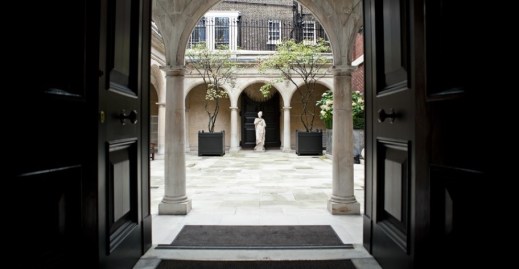
- On the 22nd, I went to a book launch in an historic building in the City. This time it was the Skinners’ Hall, a stone’s throw from St. Paul’s and Cannon Street station. From the outside, Skinners’ Hall looks nothing special, but inside you discover a Grade 1 listed building, dating from the thirteenth century, although the whole building was destroyed in the Great Fire of 1666 and the current one was built 1667-1683. Amazingly enough, like the cathedral, it was almost untouched by World War 2 bombing. I don’t suppose there are many real skinners (of animals largely for leather) left in the Worshipful Company, one of the richest and oldest in the city, but it demonstrates the historical importance of the trade! The book was Essays on Medieval London by Professor Caroline Barron, a family friend.
- The next morning it was back to the important,
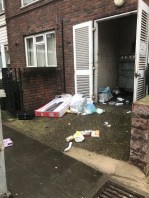 even if mundane, business of joining with Council officers and some residents for a tour of the Kambala, Falcon and Wayford Road estates. On the whole, we thought they were in good nick but as always on the Kambala Estate, there were problems with rubbish! This picture is of conditions behind Haven Lodge. I trust that it got cleared soon after our visit – but it is a perennial problem.
- The January meeting of the Planning Applications Committee was on the 25th and it was packed with major applications, four of them in Battersea. First, the half-completed Peabody Estate development: Peabody had to stop the development, as planned, because it was becoming financially unviable. So, they came back asking for 52 more flats, half for sale on the open market and half for social renting. They suggested adding a couple of storeys here and a couple there. The Committee did not really have much choice but to agree: and we did. I suspect the change will hardly be noticed as the additional storeys are lower down St. John’s Hill than the blocks already completedI voted against two very large developments, which were, however, approved by the committeFirst, 13 blocks between 8 and 15 storeys with 517 residential units are planned for the Smugglers’ Way, B&Q site. 35% of these are described as affordable. There are things to be said in favour of the development. However, in my view it is just too big, with too many high blocks at too high a density. Secondly, a large 82-unit block rising to 14 storeys was approved on York Road, on the Chopper/@Battersea pub site. Again, I voted against on much the same grounds.
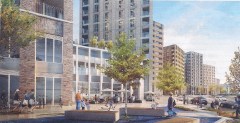
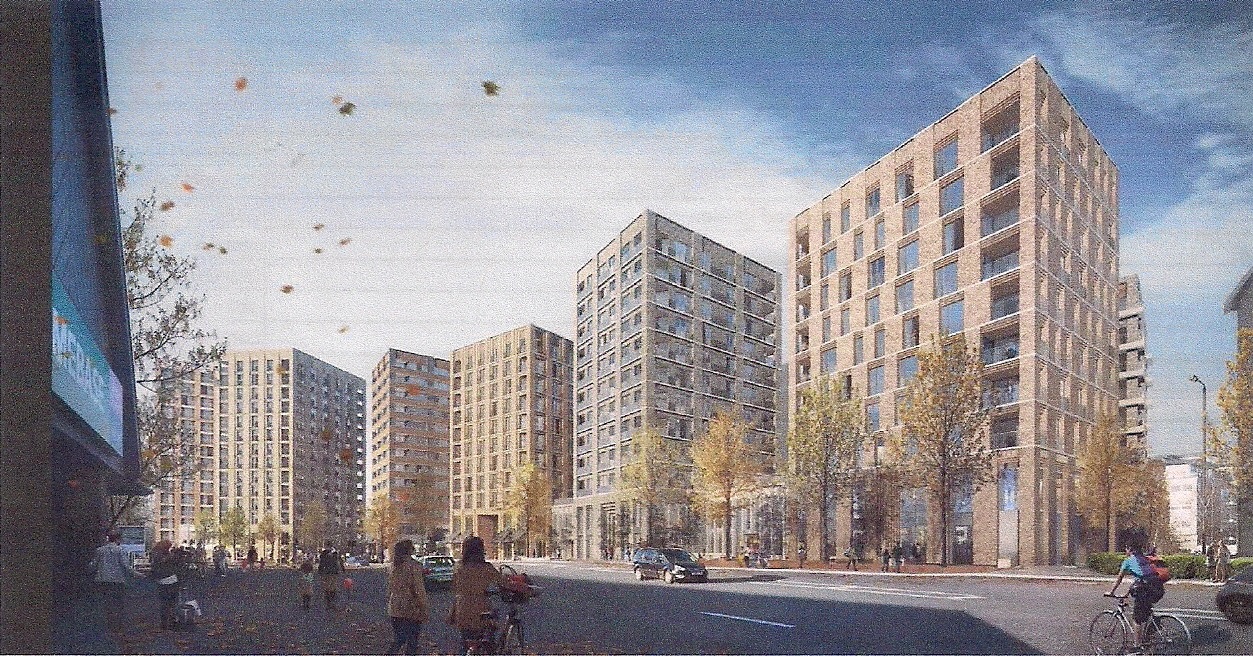
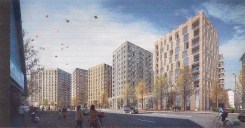 What do you think of these developments either side of Swandon Way?
- The fourth major Battersea development was an application to expand the Royal College of Art campus on Battersea Bridge Road. This had many objections from the immediate neighbourhood of Parkgate Road and, frankly, I can see why. This large university building looks as if it will dominate the area, but the Committee thought that the major benefit of having the University in North Battersea outweighed the disadvantages. On this occasion, I agreed.
- There was also an interesting application for 86 residential units with one, six storey block at Jaggard Way, which is behind Wandsworth Common station, just yards outside Battersea. The planners’ recommendation was to refuse it, which we did unanimously. However, I must confess that I had the ungenerous thought that the Committee was keen to vote against a quite small development in rich, posh Wandsworth Common when substantially larger, less pleasing developments in North Battersea were being approved.
- On 29th January, I had a fun meeting at the youth club, Providence House, in Falcon Road, where we made plans to bring Devon’s Shallowford Farm to Battersea, or more particularly some sheep, calves, pigs and a tractor from the Farm for four days in early June. The farm, which is twinned with Providence House, is visited by many youth club members and is an invaluable rural experience for hundreds of Battersea kids. Keep a look out for it!
- The next day I had discussions with planners at the Town Hall about a planning application for developments near both Time House and Sendall Court. At the moment this application seems unlikely to be considered in Committee before April. I am sure that it will be contentious and I am rather concerned that the Council is trying to get too large a development through on the coat-tails of the so-called Winstanley regeneration.
- Finally, Wandsworth’s Design Awards Panel met on 31st January. The panel of architects, amenity societies and two
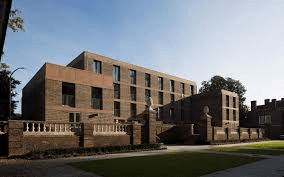 councillors, including me, had before it all the North Battersea “icon” buildings like the Lombard Road Tower and the Nine Elms Lane development. But actually, none of those got near to winning, the victor being the under-stated, cleanly designed Chadwick Hall students’ accommodation at Roehampton University.
- On Twelfth Night, I went to an enjoyable dinner with members of the Battersea Society. The Society organises a myriad of local and London based events and campaigns about local amenity issues, such as planning and the state of our parks and public spaces. If you are interested in joining but don’t know how then do, please, let me know.
-
-

My Programme for February
- On 7th February there is a special Council Meeting. There is actually nothing special about it as it happens every year and is largely a technical operation agreeing the record of expenditure during the year and the approximate shape of the budget the year 2018-19. There will however be ratification of a 1% rent increase for council tenants and decisions on next year’s budget leading to the Council Tax decision on March 7th. I think I can guarantee that in Election year there will not be any really unpleasant surprises!
- On 13th February, I have a meeting of the Central Housing Panel, a quarterly consultation meeting with council tenants in Latchmere and other parts of the Borough.
- There is the Community Services Committee on the 20th followed by the Planning Applications Committee on 22nd February.
- On 27th February, I am off to St. Paul’s Cathedral for a celebration of the life of Mary Turner, of whom more next month.
Do you know?
Last month I didn’t set a question and this month’s is ridiculously easy but I just couldn’t resist the picture – thanks to the Battersea Memories website as the source. And as for the questions then:-
- Where? When? How?
- How many things can you name that are still there and what are they?
- And can you name what is there now?
Councillor Tony Belton’s Battersea January, 2018, Newsletter (# 103)
-
-
-
- On 1st December, I went to Theatre 503 to see The Dark Room, an Australian play by Angela Betzien. First a word about Theatre 503, it is based above the Latchmere pub. It is, as they say, intimate or, rather more plainly, very small, which puts you in really close contact with the action and the actors. It invariably hosts “experimental” theatre and as it’s above the pub, it gives one a great chance, after the show, to have a drink and chat with the cast and discuss the play, which I did with Alasdair Craig, one of the four actors.
- As for the show: The Dark Room was
 about one of Australia’s darkest subjects, the relationship between the indigenous population and the overwhelmingly white, European population of today. What starts off as a “scene” between a white, female social worker and a young aboriginal woman develops, with a confrontation between two white policemen over the death in police custody of an aboriginal boy. To complicate matters the social worker also has a dysfunctional relationship with one of the policemen. Interestingly directed and well-acted, the play poses difficult questions. If my experience is anything to go by Theatre 503 is always worth a visit.
- I had my Council Surgery on the morning of 2nd December, but it was not a very busy event. I only had one constituent visit. Looking through the log, it is very rare that more than two constituents turn up. I know that MPs always have far busier surgeries, which is understandable, but frequently misplaced as MP’s cases are often about essentially Council issues, such as housing. But actually, nowadays not many constituents come in person as most casework usually comes through email or the telephone.
- Talking of cases, one reader commented last month that my newsletters were all about social events and that he rather doubted that I did anything real or useful. For the record, I dealt with 81 separate housing cases in 2017, which was 6% of the cases dealt with by 59 councillors (N.B. honesty compels me to admit that one independent councillor dealt with just under 40% of the whole! He really is exceptional.) The system for monitoring queries other than housing is not so simple but these figures suggest to me that I dealt with above 200 cases in 2017.
- As for what these cases are all about then the housing ones are largely about rehousing, over-crowding, homelessness and repairs and maintenance. Unfortunately, actually succeeding in getting someone re-housed is a pretty rare triumph. Non-housing matters are most frequently about environmental issues such as planning disputes, pot-holes, fly-tipping and road sweeping, oh, and, of course, noisy neighbours!
- I also don’t make much of many other necessary activities, most notably Labour Party matters, which whilst not of great public interest are an essential part of being a councillor. Nor do I write about the boring stuff of reading agendas, preparing for meetings, writing letters, etc. But they all take time.
- On the 3rd, Battersea Labour Party ran its own jazz night, starring Rosena Allin-Khan, Tooting MP, on vocals and Martin Linton, ex-Battersea MP, on horn, with Battersea’s own Junction Jazz band. Rosena is a star in her own right and it’s stunning that, as an MP, a doctor and a mother, she manages also to perform as she does.
- I had the Passenger Transport Liaison Group on 4th December, which was principally concerned with the continuing engineering works on the mainline into Waterloo. Nothing really new was noted then but, talking of transport, I later had notice of roadworks on Battersea Park Road just to the west of the Latchmere pub on 8th-9th January. My advice is to avoid that stretch of the road if at all possible – for example, turning left from Latchmere Road into Battersea Park Road will not be allowed – even for cyclists.
- On 6th December we had the last full Council Meeting of the year. There was one set piece debate with half a dozen contributions from both sides. These debates don’t get any press coverage nowadays, but I really enjoyed making an off-the-cuff speech. If you are really, really interested then you can see and hear it at the following address, whenever the Council loads the video, which is not yet! http://www.wandsworth.gov.uk/info/200318/decision_making
- And on the 7th December, I appeared at the Licensing Committee arguing for tighter licensing controls on the Anchor pub, Hope Street.

The Anchor
This was a difficult matter in that neither I, nor the residents I was representing, wanted to close the Anchor – far from it. After all, it is one of the very few public facilities in that part of Battersea. However, pub use should not be allowed to disturb the peace of close neighbours beyond reasonable hours and I was persuaded that the nuisance caused by the Hope justified some restriction. The Committee agreed with me and the neighbours; but unfortunately, early indications (as of 4th January) are that the nuisance continues. Early days! But the festive season is hardly over and we shall see.
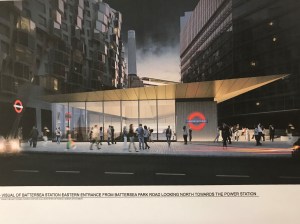
- The December meeting of the Planning Applications Committee was on the 14th. Many of the applications were “technical”, such as, for example, changes in obscure building conditions. But there were some interesting exceptions. One was the application for the new Battersea Power Tube station, which is being built right now, opposite the Duchess pub. In reality, of course, there was not much for us to decide. Clearly refusing permission was not an option, nor was changing fundamentals about layout but we could have expressed a view about the “finishing”; a bit like choosing the colour of the wallpaper. My view was that given the amount of time and effort put into the design of a really, modern, attractive station by good designers, it was absurd for us to disagree with their recommendations – we shall see whether the station is as good as I thought it looked!
- There was also notice of an application in Lambeth, which will affect nearly everyone, who travels up and down to town, and that was for the re-design of the Vauxhall bus terminus. Lambeth Council wants to change, as in get rid of, the massive Vauxhall one-way road system and were asking for our observations! I am not being totally flippant in saying, “Good luck to them on that one”, but I can’t imagine it will happen any time soon.
- And there was one other interesting set of 24 applications for advertising hoardings all over the Borough. The hoardings will replace telephone kiosks and will include information bulletins and mobile phone charging points as well as the illuminated ads. They will, however, need careful monitoring. The addition of brightly-lit billboards along many main roads in Wandsworth could confuse drivers, cause distractions, increase street clutter (contrary to recent trends in trying to simplify street scenes) and add further garish lighting just when the Council (wearing its environmental hat) is installing new street lights to reduce the amount of light needlessly beamed into the night skies. We must not worsen street design for the sake of advertising revenue – but rather improve street safety, efficiency and environmental friendliness for all.
- The rest of my December was full of Seasonal events, such as an Xmas lunch with the other Labour councillors and Xmas drinks with the Battersea Society; a couple of resident association Xmas drinks and three visits to the theatre. Two of these were to see plays by Oscar Wilde and George Bernard Shaw, A Woman of No Importance and Misalliance respectively. They were both very funny and clever and, appropriately for these days, very “feminista.”
- But the third theatre visit was the one that has made my friends very envious as it was a visit to the Victoria Palace Theatre to see the American blockbuster Hamilton. How I got the tickets is a long story but they are like gold-dust! I didn’t have high expectations. I didn’t really think that an American rap musical, played by a multi-ethnic cast, about an Independence war essentially between two groups of Brits (and a few French and German settlers) could work. I was wrong. The cast were great, the rap worked really well, the staging was great. The history wasn’t perfect; but nothing is perfect though Hamilton almost was.
- I spent both Christmas Day and New Year’s Eve quietly and very happily at home (from where I took this pic on the 25th!) and went to
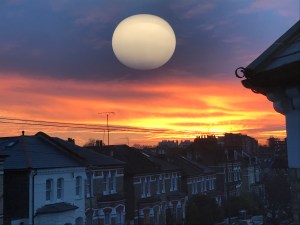
 see the grandchildren on Boxing Day. PS do you like the lunar illusion over the sunset as seen from the bedroom?
- Finally, you might remember that last month I commented on the wretched condition of the old Vestry School, on Battersea Rise. Well, I am now delighted to note that there is scaffolding round the building and positive steps are being taken by the church authorities to safeguard the building and carry our essential repairs and maintenance before a final decision is taken on what use is to be made of this slice of Battersea’s heritage.
- On 1st December, I went to Theatre 503 to see The Dark Room, an Australian play by Angela Betzien. First a word about Theatre 503, it is based above the Latchmere pub. It is, as they say, intimate or, rather more plainly, very small, which puts you in really close contact with the action and the actors. It invariably hosts “experimental” theatre and as it’s above the pub, it gives one a great chance, after the show, to have a drink and chat with the cast and discuss the play, which I did with Alasdair Craig, one of the four actors.
-
-



My Programme for January
- On 4th January I have a meeting of Wandsworth’s Design Panel. This is an advisory body relating to architectural design and the physical appearance of the Borough.
- This is followed by the Conservation Area Advisory Group on the 9th.
- And on 25th January, the Planning Applications Committee, followed by the Heliport Consultation Group on 30th January – a quiet month
Do you know?
In November, I asked “Who or what were Fawcett, Coppock, Hicks, McDermott and Wolftencroft – apart from being Battersea street names? Last month I gave the answer as regards John Bridgeford Coppock, so this month let’s try Fawcett Close.
Most people I know assume that Fawcett Close is named after Millicent Garrett Fawcett (1847-1929), who gave her name to the Fawcett Society, an organisation, which campaigned for women’s suffrage. However, I think it more likely that the Close is actually named after her daughter, Philippa Garrett Fawcett (1868 – 1948).
Philippa went to school in Clapham High School (now Thomas’s School in Broomwood Road). She was a brilliant mathematician and achieved the best Cambridge maths degree in 1890, at a time when women were not actually awarded degrees. She was subsequently unable to get an academic job, simply because she was a woman, but in 1905 she was appointed principal assistant to the Director of Education of the then newly-formed London County Council – surprisingly, at the same salary as a man would have received. She developed the south London teacher training colleges of Furzedown and Avery Hill. It is because she was a Battersea school-girl and died only 20 odd years before the Kambala Estate was built that makes me think that the Close was named after her and not her mother.
Councillor Tony Belton’s Battersea December, 2017, Newsletter (# 102)
-
-
-
- On 1st November, my partner Penny hosted a book launch in the Speaker’s House, Westminster. The book, edited by Mary Clayton, is entitled A Portrait of Influence: Life and Letters of Arthur Onslow, the Great Speaker.
 Onslow was an eighteenth-century Speaker of the House of Commons, who set the standard for the role, which is why the book was launched in this very private part of the Palace of Westminster. The current Speaker, John Bercow, welcomed about 70 of us to his home – both graciously and humorously. Something tells me that he rather enjoys the being Speaker! Penny has written a brief review of the evening at https://blog.history.ac.uk/2017/12/report-of-ihrs-long-eighteenth-century-seminar-book-launch-in-the-speakers-house/
- The following day, I went to the CAW (Citizens Advice Bureau/Wandsworth) Annual General Meeting at Battersea Library. (Why the CAB has decided to re-brand itself as CAW when everyone in the country knows the CAB – beats me). It was a sombre occasion, because the Council has decided to cut its funding by 10%. What is more the cut is happening just as the Government’s disastrous Universal Credit Scheme is due to be rolled out in Wandsworth. Given experience across the country, this could make it a hard Xmas for too many Battersea residents. The Tory Northcote ward councillor, Peter Dawson, and I had a slight altercation over the Tory role in imposing this kind of cut on our services. He does a nasty job pretty well!
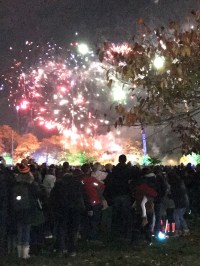
- Off to Battersea Park for the Fireworks on November 4th – good show as always.
- On the 6th, I went to the Wandsworth Conservation Advisory Committee. This is a quiet committee devoted to maintaining the best of Wandsworth’s heritage – few political hassles, not
 many arguments, some might say rather dull. On this occasion we discussed the old Vestry School seen here on Battersea Rise. Some of you will not even have noticed this small building, which is now 151 years old (built in 1866), but it is sorely in need of restoration.
- It is part of Battersea history. Before state schools were created by the 1870 Education Act, most education was provided through the church, and Vestry schools like this one were commonplace. I was responsible for getting it listed about 20 years ago but neither St. Mark’s Church nor the diocese have done much to restore it. Now, I am pleased to say, the Council is talking about putting a Repairs Notice on the building. I realise that some churches with small congregations do not have much money for “nice” spending on old buildings but St. Mark’s must be one of the richest churches in suburban London – the Diocesan Board really should do something about its heritage!
- The next day, on 7th November I went to City Hall to take part in WOW (Women of Wandsworth)’s
 Annual General Meeting in City Hall. It was really an excuse for a party and a first trip for most to the heart of London’s Government. The host was WOW boss, Senia Dedic. Here she is, with GLA member, and Council colleague of mine, Leonie Cooper, on the right, presenting prizes.
- On the 9th we had the Thamesfield by-election. It was a brilliantly sunny day but fearsomely cold. I spent 7 hours of it standing and occasionally sitting outside two of the polling stations. Not the most fun-way of fighting an election but worse from my point of view, I am afraid, was the result. With the Tories winning the seat relatively comfortably.
- The very next day, I went on a visit – to
 the new Battersea Park underground station being built opposite the Duchess pub on Nine Elms Lane and right next to the Dogs’ Home. Many of you will have seen the hole in the ground either from the railway or the top deck of the 44 bus, but nothing quite prepares one for the scale of the whole thing when you are there. This picture shows the platform area with, in the distance, the tunnel disappearing towards Vauxhall; the orange shows high vis wearing workers. Being there that morning appealed to my little boy syndrome of wanting to get out the Meccano set and building a grand, iconic building – or in this case digging a massive tunnel in the heart of the city – fun!
- On 11th November, I went to the second Providence House Fund Raising Dinner – at Providence House, Falcon Road. Every time I go there, which is probably not as often as I ought, I am struck by what a great job Robert Musgrave and his team do encouraging, educating and entertaining the young people of Battersea. We should be proud of and grateful to them.
- On the 12th I went to the Remembrance Day service at St. Mary’s. As ever it was a moving occasion. Unusual features of the service were the rather complex hymns that we tried to sing. They were traditional English nineteenth-century hymns alright, but not the usual ones. Fortunately, we had St. Mary’s excellent choir leading us through the service, but sadly St. Mary’s very own Director of Music is, very shortly, off to do his stuff in the States.

- The Council’s Civic Awards presentation was on the 14th November. I am pleased to say that on this occasion Senia Dedic, see paragraph 5 above, was presented with one of the awards. Senia has missed out on this award several times in the past. It is only right that she has now had the recognition for her work with WOW, building relationships across Battersea between black and white, young and old, female and male.
- The Community Services Committee on 15th November featured a couple of items of general interest (and quite a few very boring ones too). Interesting ones were Battersea’s Jubilee Bridge and the rapid spread of charging points for electric cars. The Jubilee Bridge is planned to run alongside Cremorne Bridge, which is the rail bridge used by the Overground service between Clapham Junction and Imperial Wharf. It would be for cyclists and pedestrians only and would put a considerable number of Battersea residents within easy walking distance of Imperial Wharf station. The newly designed and completed skyscraper in Lombard Road was designed the south bank bridge structure in mind and there is also a considerable amount of money earmarked for the bridge. However, there is still a significant funding gap (£millions) and no immediate timetable for construction – so this plan is as yet a gleam in the eye.
- Meanwhile, the assumed rise of the electric car will call for massive
 changes to our roads – we will need millions of roadside charging points. The change in the next 30 years will be like that in the first half of the last century. In 1900, London had well over 50,000 horses on the roads – imagine shifting all that manure: and if you can’t imagine it, then take a look at http://www.historic-uk.com/HistoryUK/HistoryofBritain/Great-Horse-Manure-Crisis-of-1894/. Sixty years later horses were a sight in London and there were over a million cars.
- I know some of you are very sceptical about the benefits that this new change will bring but just imagine quieter, cleaner streets, fewer asthma sufferers and fewer deaths through air poisoning. There will be problems and one I can think of is the problem with having wires trailing all over the roads. I have been assured by the Town Hall that this will not be a problem. But you will not have been re-assured by this picture of tangled wiring on page 6 in a recent Guardian. I have demanded further reports from the officers on this issue, which I see as big problem with electric cars.
- On the 16th November, I went with 20 members of the Battersea Labour Party to see Labour of Love at the Noel Coward Theatre. It is a comedy, by James Graham, of life in the political world, during the period 1990-2017. It is definitely NOT just for Labour Party people but it is very political and enlivened for us, up in the gallery, by a comic and dismissive description of “Lah-di-Dah” Battersea. See my review at https://tonybelton.wordpress.com/
- On 17th November I went with the
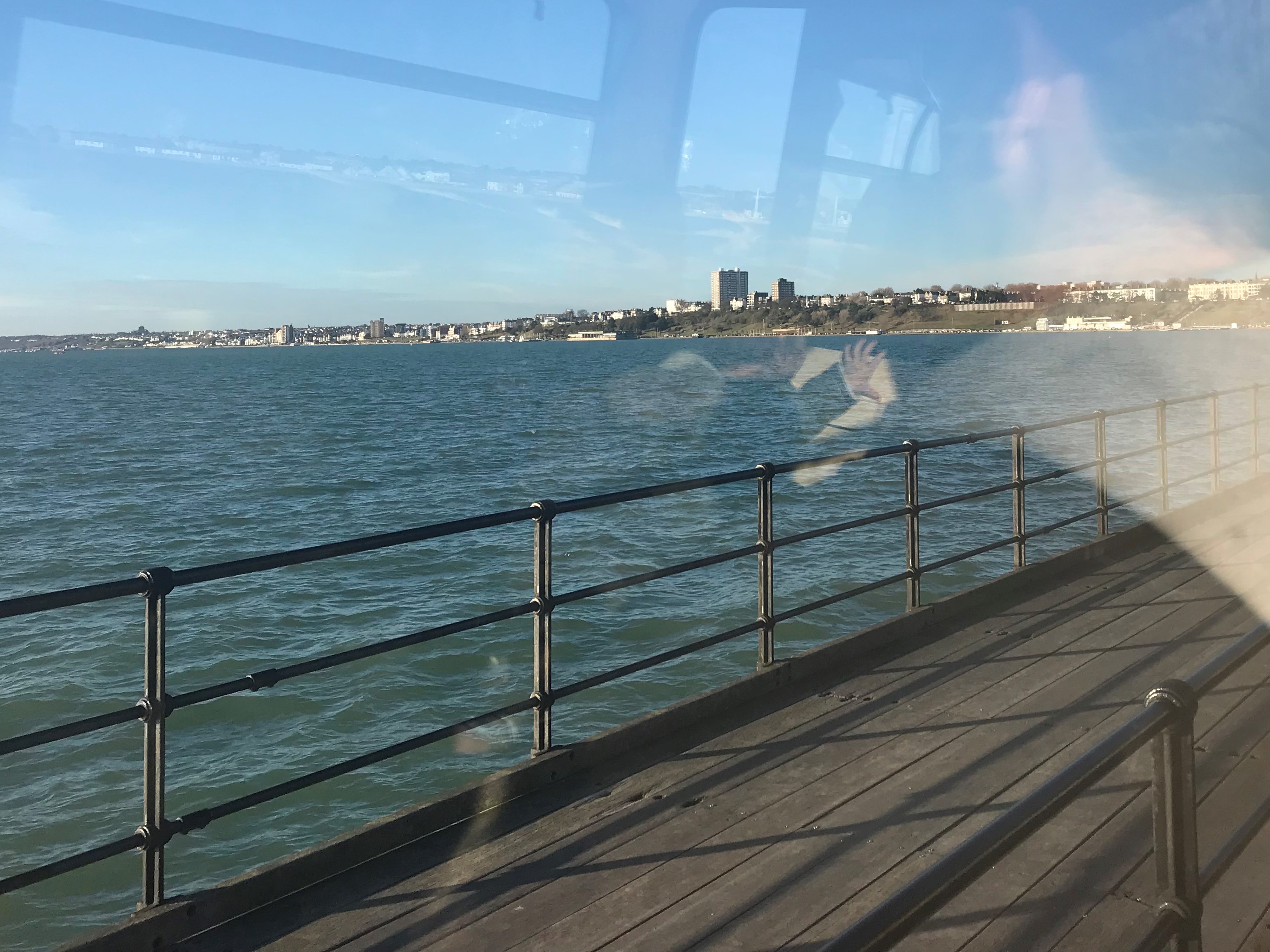
 grandchildren to see my brother-in-law in Southend-on-Sea. It was a beautiful cold, clear winter’s day. We went out on to the Pier, which I first knew many years ago when my parents would pack me off to spend summer holidays with my aunt and uncle, who lived there. I had a lovely day – I think the two kids did too!
- The November meeting of the Planning Applications Committee was on the 22nd. In many ways it was fairly uneventful. One application was, however, a 10% variation to the very large development, about to go up across York Road from Hope Street. This will include 299 residential units, the College of Dance, some shopping and entertainment facilities. This plan confirms the massive changes taking place on and around the Lombard Road/York Road junction – more expensive private apartments and not many so-called affordable but still expensive flats.
- Marsha de Cordova, Battersea’s MP, and I hosted a Reception for new Battersea Labour Party members in the House of Commons on 23rd. It was attended by about 50 party members and a fun evening was had by all.
- I went to the Battersea Police Ball, along with 2,000 others, in Battersea Park on the 25th. It was great fun with plenty of food, fun and fancy dresses. However, for my taste, there was not enough dancing – though I am not sure these days that I would trust my metallic knee for a long bout of dancing.
- You may recall that last month I
 took Falconbrook School Year 6 pupils on a history walk around the Falcon Road area. Well following that, on Tuesday, 28th November, I was interviewed by Byron, Link and Freya, three of the students, as part of a film on the area being made by the pupils. The film is part of a written, narrated and photographed story of the Winstanley and York Road estates, which it is hoped will be launched in a world premier at Battersea Arts Centre in March, 2018.
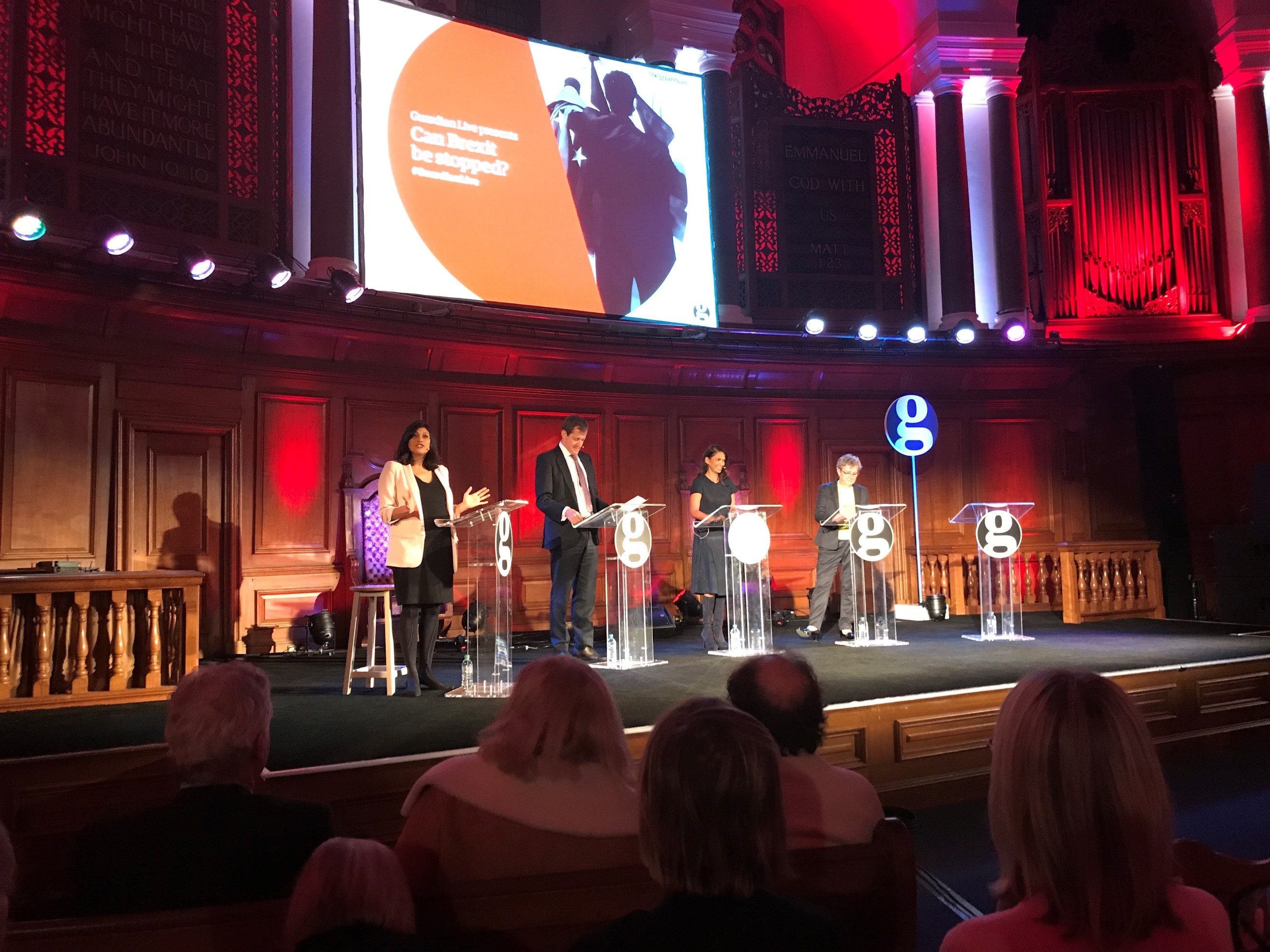
- Finally, on 29th November, I attended a Guardian “Live Events” at the Emmanuel Centre, SW1, entitled “Can Brexit
 be stopped?“ The session was chaired by the Guardian’s political editor Anushka Asthana and the panel members were Gina Miller, who initiated the court case against the government over whether or not Parliament should have a final vote over Brexit, Alastair Campbell, formerly Blair adviser and vocal remainer, ex-Labour MP Gisela Stuart and John Mann MP, both Labour Brexiters; pictured here (Mann had not yet arrived). Although I am very much a remainer, I thought that Mann was very impressive and Stuart frankly rather weak. It was difficult not to have a lot of respect for Miller but Campbell, love or loathe him, was clearly in a different class as a communicator.
- One slightly sobering event during the month was a phone call from the Met about my stolen bike, which you may remember I lost in September. Despite several photographs of one of the “villains”, with whom I was struggling and despite the police constable’s certainty that he knew who the young rascal actually was, the Crown Prosecution Service have decided not to take the case to court.
- On 1st November, my partner Penny hosted a book launch in the Speaker’s House, Westminster. The book, edited by Mary Clayton, is entitled A Portrait of Influence: Life and Letters of Arthur Onslow, the Great Speaker.
-
-



My Programme for December
- On 1st December, I went to Theatre 503, above the Latchmere pub. I went with a dozen friends to see Australia’s “best new play”, The Dark Room – see next month.
- On Sunday 3rd December, Battersea Labour Party was entertained by Junction Jazz.
- On the Monday, 4th December, I went to the Passenger Transport Liaison Group.
- On the 6th I have a meeting with a constituent to discuss her plans for enlivening and improving the Falcon Road/Battersea High Street link between Clapham Junction and Battersea Square.
- And, in the evening, we have the last full Council Meeting of 2017.
- On the morning of 7th December, I am going on a tour of Christchurch school, whilst in the evening I could go to the Kambala Residents Association or the Police Special Neighbourhood Team at the George Shearing Centre but will in fact go to the Licensing Committee to ask it, on behalf of residents, to modify the opening hours of the Anchor pub, Hope Street.
- On Saturday, 9th December there is a party given by the Battersea Fields Tenants.
- And on 14th December, the Planning Applications Committee, and then on to Christmas and the New Year and on May 3rd the Borough election
Do you know?
Last month I asked “Who or what were Fawcett, Coppock, Hicks, McDermott and Wolftencroft (which are names of roads on the Kambala Estate)? Can you answer just one or all five?
I am starting with Coppock Close and the answer is John Bridgeford Coppock, who was born in 1910, and died in 1981. He was a Lecturer and research chemist, who taught at Battersea Polytechnic from 1935-41. Perhaps he is an unlikely inspiration for the naming but not only is there an education connection with Fawcett (of whom more next month), but his death is just about the same year as the Kambala Estate was completed. The most detailed description of John Coppock that I can find comes from the American Journal of Public Health. I am no expert but this speaks wonders for the international regard for this little known Battersea-based scientist. See: http://ajph.aphapublications.org/doi/pdf/10.2105/AJPH.72.8.782
Labour of Love
A Play by James Graham @ Noël Coward Theatre, 16th November, 2017
If NEC, LGC, GMC, AMM, LCF, EC, and a score of other acronyms are second nature to you then this is a “must see” play about life in the Labour Party. I went with 20 other addicts from Battersea and Tooting and got a powerful shot of nostalgia, regret and sentimentality. James Graham, who specialises in political drama, is clearly equally captivated by the intimate dynamics of personal pyscho-drama.
The action covers the rise and fall of Blairism in the Labour Party in the period from the fall of Thatcher in 1990 to the “triumph” of Corbynism in June, 2017. Martin Freeman, as David Lyons, is the spirit of Tony Blair and Tamsin Greig, as Jean Whittaker, represents the heart and soul of the party.
Their failures and triumphs are first plotted backwards from the failure/triumph (as in Dunkirk) of the June, 2017, General Election. It opens with Lyons awaiting his inevitable defeat in a Midland heartland seat, which along with defeats in Stoke and Mansfield, represented the nadir of the early morning of 9th June. Here there is a good laugh for Battersea locals, I suspect Tories as well as Labour, as Lyons humorously contrasts his fate with Labour in Battersea and Leamington.
From here, the action takes us back, step by step, from election to election; from the disaster of 2010 to the triumphs of 2005, 2001 and 1997 to the hubris of 1992. The action, as the play goes into reverse concentrates, on the triumph of Blairite modernism from bringing in new technology to the constituency office to the replacement of the coalmines with call centres.
There are plenty of good jokes on the way and not a little personal drama. Lyons’ wife Elizabeth, just too-too Cherie-like, shows appropriate metropolitan disdain for both his constituency office and the local party activists. Whilst the CLP (see what I mean! For the uninitiated I mean Constituency Labour Party) organiser/agent, Whittaker, is dismissive and disparaging of both the new MP’s and his wife’s metropolitan ways and affectations.
At the interlude, it was clear that the second act was going to change into forward gear and replay the history but why and to what purpose? By the end of the play, I was only left to admire how Graham had created and used this temporal structure to show the different sides of personal dramas, political imperatives and technical gismos.
As the curtain fell, I was left to ponder the vagaries of political certainties; of how yesterday’s truths become today’s old lies and presumably how today’s certainties are as likely to be just as vulnerable to the ravages of time. Time had been just as harsh, as it happened, on new technologies as on new labour, with the fax machine and the tele-text as redundant as any New Labour nostrum. But the play also demonstrated how time and the intense pressures of political lives can be just as damaging for many personal relationships.
The question remained: how were the personal dramas, Lyons and his wife and more particularly Whittaker and her two husbands, going to be played out? As it turns out, of course, the denouement could be divined within the action, both in reverse gear and in forward gear. Along with another message, deeply embedded in the play and that was a successful Labour Party needs both the “winners” and the “dreamers”.
James Graham has given us another clever and witty play for political nuts of all persuasions, not just those of a left-wing bent.
Councillor Tony Belton’s Battersea November, 2017, Newsletter (# 101)
- On 9th October, I was due to be on the platform at Shaftesbury ward’s version of the Council’s Let’s Talk meeting, but, unfortunately, I got substituted. This was a pity, because it turned out to be a bit of a bunfight between outraged voters and Tory councillors, Cook and Senior. Neither are known for pulling their punches or retreating from a fracas and with, an angry audience, the evening must have had its highs and lows. One thing is for certain the evening embarrassed ex-Tory now Independent Councillor Jim (James) Cousins. Jim, a senior member of the Wandsworth Tory Cabinet for many years, now writes an interesting blog at jamescousins.com, which includes coverage of that evening. Many of us are waiting with bated breath to see if he is going to challenge the Tories at next May’s Council elections, meanwhile his blog makes a well-informed commentary on some aspects of Wandsworth Tories.
- The 11th October, Council Meeting, was as unexciting as I predicted it would be. Nowadays, we councillors don’t even get answers to the questions we ask in Council (a bit like Prime Minister’s Question Time but without the answers! Can you imagine PMQs without the answers!). This is important for me, and on this occasion for some of you, as this month I asked about an issue bothering many residents of the Latchmere Estate and what’s more I promised them an answer. BUT I am afraid I don’t yet have an answer and can only apologise to those of you still worried about this neighbourhood issue – hopefully I will have one soon.
- I have been concerned about some of the
 back-land developments that have recently been given planning permission. One particular development that has concerned me is one in Cabul Road, which I visited on the 13th October. First, it strikes me as being very close to the rear of the houses in Rowena Crescent (from which this photograph was taken) and secondly because the developers have chosen to use their own building regulations inspector rather than the Council’s. The freedom to do this was granted by David Cameron’s Government in one of the crazier anti-regulation moves made in recent times. It leaves the poor neighbours with no recourse to an independent arbiter. I await developments with interest.
- On the 14th October, I and maybe 150
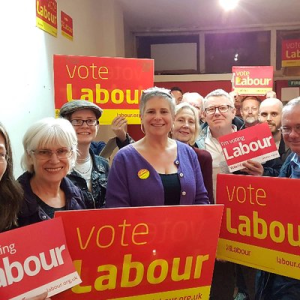 others attended the launch of Sally Warren’s bid to win the Thamesfield by-election on November 9. Sally makes a very impressive candidate, very local, friendly, extremely articulate and committed. Labour won Thamesfield way back in 1971 so clearly winning next month, for the first time since then, has to be a long shot. But the Tories are currently in such disarray, that anything is possible.
- On the 15th, I attended an “awayday” think session on how we, Labour candidates, are going to tackle next May’s election. We held it on a glorious autumn day, in the bucolic surroundings of Manresa College – part of the Roehampton University campus. The mood was buoyant but we must avoid complacency. I have been on the verge of two other Borough elections we were “certain to win” only weeks before the event – on one occasion General Galtieri launched the Falklands War and overnight turned Mrs. Thatcher’s fortunes from being the most unpopular PM in modern history into Saviour of the Nation!
- The October meeting of the Planning Applications Committee was on the 18th. There was one application, which I know is a cause of concern to residents of the Battersea Fields Estate and that was the extended permission, for three years, to Harris Academy to use their playground for a car boot sale. It is now 18 years since the school first got temporary permission and during that time there have been plenty of objections, as well as a lot of support for the “market”. It is often tricky when developments are given “temporary” permission as too often they then seem to go on for ever.
- On the 20th I went to County Hall to see Agatha Christie’s Witness for the Prosecution. I don’t mean the modern City Hall, near London Bridge, but the old County Hall standing on the Thames alongside the Eye and boldly facing Parliament. The play, staged in the old debating chamber, was splendidly done and I recommend it to everyone – though it is not a cheap evening – it was almost worth it just for being in the chamber. You can see my review of the play on my blog site at https://tonybelton.wordpress.com/.
- On the 23rd I went to see Iannucci’s Death of Stalin, a film which I was looking forward very much to seeing. What a great subject! A film about a man, who my working-class London family (and many others) revered, in war-time, as Uncle Joe, much more, to their minds, the saviour of embattled Britain than the Johnny Come-Lately Yanks. Yet Stalin later turned out to be a tyrant and an ogre. The film had also had rave reviews and plaudits from many friends – but I found it vaguely disappointing. Somehow treating the death of this giant historical figure, both responsible for millions of innocent deaths and saviour of the Soviet Union, as the centre of a farce was massively inappropriate. Did one care whatever happened to the ghastly Beria, or the cowardly Malenkov or the scheming Khrushchev or any of the other villains of the piece? Well, I didn’t. It is billed as a “dark comedy”, but I guess I found the subject a little too dark to be very comical.
- On the 30th I had a meeting with planners and designers about the so-called Winstanley Re-generation scheme. The scheme is, at last, beginning to get under-way. It is aimed at maintaining the number, but vastly improving the quality (and looks), of social housing available in Battersea, but it is also providing private sector housing for sale and rent – very much in line with the London Plan and the city’s population growth. However, one thing I wish to put on record, is that the largest tower blocks, which, dominate the models and drawings, have NOTHING to do with Winstanley regeneration. They are instead related either to the Council’s plans for major developments in York Road or to the plans for Crossrail 2. Crossrail 2 and the potential new interchange at Clapham Junction does not yet have any funding or Government approval, and even if does get approved it will not happen until at least 2030. And all the developments in York Road are already happening now regardless of Winstanley regeneration.
- Late in the month, I made a point of going to look at Tooting Common’s
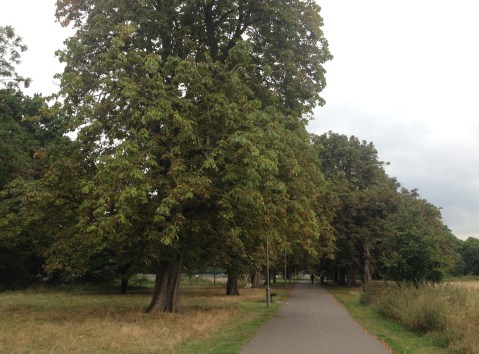
grand “Chestnut Avenue”, which you may remember I highlighted last month when it was due to come under the council chop. On the left
 you can see the mature chestnuts, before the axeman came, and on the right the new lime saplings. From maturity to fragile immaturity almost overnight! Whether you think it an environmental disaster or good husbandry, it certainly makes the point that landscape design and planning is a multi-generational project and not something to be resolved in one electoral cycle.
- On the 31st October, I took Year 6 pupils of Falconbrook School
 on a 75-minute tour of the Winstanley area. Obviously most of them live on the estate and know it very much better than I do – but they don’t know it in an adult or geographer’s way. I hope that they found following the course of the Falcon Brook, the naming history of the estate and William Mitchell’s concrete sculptures interesting. I certainly enjoyed it and, if keeping 30 odd 11 year-olds’ attention for 75 minutes is a measure, then it went well.
My Programme for November
- On 1st November, my partner Penny is hosting a book launch in the Speaker’s House, Westminster. The book is about Arthur Onslow, the Great eighteenth-century Speaker of the House of Commons so Penny and the author wrote to Speaker Bercow to ask for use of “his” House to launch the book. The House, in the corner of the Palace of Westminster, next to the Big Ben tower and facing over the river, should make an impressive venue.
- The next day, I am going to CAW (Citizens Advice Wandsworth) Annual General Meeting at Battersea Library.
- On the 6th I have a meeting of Wandsworth Conservation Advisory Committee.
- I hope to go to WOW (Women of Wandsworth)’s Annual General Meeting in City Hall on 8th November.
- On the 9th we have the exciting and surprisingly tight Thamesfield by-election.
- The Second Providence House Fund Raising Dinner is on the 11th November and the Council’s Civic Awards dinner is on the 14th. And, of course, on the 12th there will be Remembrance Day services across the Borough.
- I have the Community Services Committee on 15th November and the Planning Applications Committee on 22nd.
- On Saturday, 18th November, there is something called the London Councils Summit held in the City of London’s Guildhall. All councillors from across London are invited to attend and the Summit is usually addressed by the Mayor and a Government Minister. It should be an interesting day.
- Marsha de Cordova, Battersea’s MP, and I are hosting a Reception for new members of the Battersea Labour Party in the House of Commons on 23rd.
- The Battersea Police Ball, the Borough’s largest and brassiest charity big bash, takes place in Battersea Park on the 25th.
Do you know?
Last month: not many of you appeared to be very interested in why this boat moored at Vicarage Crescent is called Ringvaart III.  According to Wikipedia, Ringvaart is a 38 mile circular canal, built 1839-1845, as part of Holland’s land drainage system. It is also a commercial, industrial and recreational canal, part of the very extensive Dutch commercial waterway. This houseboat, being extensively renovated by Joel and Rosie, must have started its life hauling freight around Holland until some enterprising sailor decided to take this river/canal boat across the North Sea and into the Thames.
As for my question this month: it relates to the Kambala Estate, the red-brick, 2 and 3 storey estate on the west-side of Falcon Road. The street names on the estate are Fawcett Close, Coppock Close, Hicks Close, McDermott Close, Wolftencroft Close (note 2 ‘f’s and no s), as well as Ingrave, Wye, York, Mantua and Kambala. Forget the last 5, Who or what were Fawcett, Coppock, Hicks, McDermott and Wolftencroft? Can you answer just one or all five?
Witness for the Prosecution by Agatha Christie
I went to County Hall to see Lucy Bailey’s Witness for the Prosecution. The play’s action largely takes place in an Old Bailey court-room with a couple of scenes in the defence counsel’s chambers. Designer, William Dudley, might not have done much to stage the play in County Hall’s Council Chamber, but whatever he did do he did brilliantly, because it proved to be ideally and dramatically suited to be transformed into a magnificent Old Bailey court-room. The Chamber was built for political debate, with majority and minority parties benches, a Mayoral dais and press gallery splendidly reflecting the prosecution and defence, judge and clerks of the court and jury seats required for staging a court-room drama. The single-purpose, somewhat claustrophobic, controlled environment of a political chamber also has its obvious parallels with the court-room.
For those unaware of the plot, the play has a very clever, typically Agatha Christie, twist. However, the twists and turns of the plot do demand a remarkable performance from Leonard Vole, the defendant, played by Jack McMullen. He needs to be thrillingly and seductively attractive to women of all ages and at the same time to be naïve and of Machiavellian cunning; unfortunately, McMullen’s acting did not quite have the range to make his character totally credible. Actually, of course, the problems really are the demands of the script. Agatha Christie’s work is to be enjoyed for the clever twists and turns of the plot and not necessarily for the credibility of the demands she places on her characters.
In any event, the central character, defence counsel, Sir Wilfred Roberts QC, is beautifully played by David Yelland and it is his character, which is the central lynchpin of the plot. Indeed, Sir Wilfred is the tragic hero of the piece; well intentioned, polished and sophisticated, elegant and fearsomely clever in a nice aristocratic manner he is made a buffoon and a loser by a scoundrel. The powerful last scene lost nothing by being so well known to many of the audience.
The setting and the dramatic conclusion, the moral dilemmas posed by the story and Yelland’s acting made for a very enjoyable theatrical performance in an interestingly new environment.
Go early and spend 20 minutes walking around the outside of the Chamber, reading the marbled engraved names of the leaders of the London County Council (LCC), the Greater London Council (GLC) and the Inner London Education Authority (ILEA) – most of them now sadly merely names in the records of the past, but some still talked of today – most notably Ken Livingstone, but there is also Chris Chataway (pacemaker along with Chris Brasher for Roger Bannister’s Four Minute Mile but also briefly a Tory Leader of the ILEA) and Sir Ashley Bramall. Less well known but with a very small connection to me, one can also find Norman Prichard, later Sir Norman – as well as being Chairman of the LCC he was also a Labour councillor for Latchmere ward – my ward, then of Battersea and now of Wandsworth.
Witness for the Prosecution runs at County Hall until January and I heartily recommend it although I may have been slightly swayed in that I worked in County Hall for 23 years and it was, therefore, a bit of a sentimental journey. I look forward to seeing many more dramas, especially courtroom ones, staged there in future.
Just a word of warning! If you go in the cheaper seats (but not exactly cheap), in what used to be the public gallery, both view and accessibility need to be checked in advance!
Councillor Tony Belton’s Battersea October, 2017, Newsletter (# 100)
My Programme for October
Opinion Piece This is NOT an original observation but my caseload as a councillor more and more reveals just how bad the housing crisis in London is. Housing problems have always topped the list of issues brought to me as a Latchmere councillor, but this year there has been a significant increase in both the number and seriousness of the issues people are facing. The most desperate cases are frequently very young families coming from broken relationships, and usually with no job and no income and very little in the way of personal belongings. The shortage of cheap, rented accommodation – council housing – is desperate but meanwhile we continue to see luxury flats, often built as an investment and not an answer to a housing shortage, springing up in North This Council development of 6 council flats in Rowditch Lane is one very small exception to the trend. This block is intended for re-housing folks displaced by the Winstanley Estate regeneration. It’s a small step in the right direction but we need a new building programme numbered in hundreds, not in tens, Do you know? I mentioned Joel above. He had read my last newsletter, about the bike theft, and so he emailed me to say that he had a spare bike that he kept on his houseboat (pictured here), moored near Vicarage Crescent – and I was welcome to have it. I went and picked it up the other day and had a nice chat with him and Rosie, who is joint owner of the boat. They tell an So, my question is “What does that tell us about the boat’s history and where does the boat come from?” A new fixture on the Battersea scene with, no doubt, its own interesting story. |




Councillor Tony Belton’s North Battersea September, 2017, Newsletter (# 99)
- This newsletter is going to be short, well, comparatively – August was a quiet month! In passing, have you noticed the number (# 99) in the heading? It indicates that this is the 99th edition of my monthly newsletter. In other words, I have been producing this for 8 years and 3 months, well actually 2 months, because in August, 2011, I produced 2 editions so as to cover the Clapham Junction riots. I am now wondering if and how to celebrate the 100th edition, next month!
- One of the first things I did, after I got back from Scotland, was to have lunch at the Fish in A Tie restaurant in Falcon Road with fellow councillor, Simon Hogg. I went by bike and padlocked my bike against street railings in full sight of where I sat. So, imagine my anger, and amazement, when I saw three youths about 16/17 years’ old fiddling about with the padlock. I charged out, as best as my new metal knee would allow, and tackled the three of them. They rode off, after a short scuffle, but unfortunately on my bike and two of their own, assuming that they weren’t stolen too, leaving me holding one of theirs – and a broken padlock!
- The Special Neighbourhood Team, or most of it (pictured here with captured bike), arrived after a call from Simon. One of them came in and took a statement from me – at the dinner table. They said that one of
 the villains was arrested in Dagnall Street, but I have heard nothing since. I lost my bike and the police have “acquired” a bike as material evidence. What a nuisance! More to the point, what a tragedy! Three young villains, well on the way to wasting their lives on petty crime and under-achievement. It would have been good to have caught them properly and talked to them long and seriously, before they graduate onto more serious crime.
- On August 13th I went to a Labour
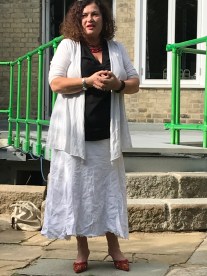 Party fund raising garden party in Putney. Leonie Cooper (pictured here), our Greater London Assembly member, was the main attraction at this enjoyable summer occasion. She spoke about life at City Hall, the Grenfell Tower fire disaster and the housing crisis in London.
- On the 16th Seth Gowley, an Oxford geography student, writing a PhD thesis on urban regeneration, visited me to ask about my views on the Winstanley Estate regeneration. He had interviewed some of the residents and other local “experts” and had visited a few other examples of major regeneration projects in London and other big cities. Gratifyingly, he commented that he thought that we have done quite well here on the Winstanley, compared to other places in the country. He based this view on the largely positive reactions that he had had from residents.
- You may be surprised to hear that I am a member of the Licensing Committee – I have never previously mentioned it. It met on August 22nd to decide whether a Putney restaurant should be allowed or not to use some outside space for drinking and smoking for an extra 30 minutes. What a bore – a summer evening spent on such a minor matter!
- This was part of Tony Blair’s 1997-2002 reforms of local government and, to my mind, this was one of the more useless of those reforms. Prior to 1997, licensing at this level was decided by local magistrates. Having been a magistrate, I know that this kind of decision would be taken in 10 minutes, or maybe 30, in a busy day full of other largely administrative matters. Blair argued that he was returning powers to local government.
- This, however, was no such thing. Local government was being handed power over the trivial but was totally constrained on the major licencing policy issues, such as deciding on the total number of drinking establishments, pubs or bars, that would be acceptable in, say, Clapham Junction. Government thinking was, and is, that decision should be left “to the market”. Then, of course, one is left with the old neo-liberal lie “that one cannot defy the market”.
- The following evening, I had the Planning Applications Committee, which on this occasion had no decision to take of any significance, except to the applicant him/herself, and their neighbours.
- On 26th I went to the Ingrave People’s Project Street Party, Hicks Close. The party was organised by Donna Barham, who some of you will know is a Hicks Close resident. Donna has been doing sterling
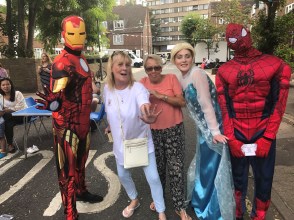 work, maintaining community spirit in the Kambala Estate, organising summer day trips to the coast and winter trips to the Christmas market in Oxford. Donna was thinking of standing to be a councillor at next May’s Council election. It would have been great to have had her on Wandsworth Council as a colleague, but she decided her community work was, and is, more important to her. Here is Donna, second left, along, with two Spidermen, Princess Elsa, from Walt Disney’s Frozen, and a Kambala resident.
- On the political front, I was pleased to read Keir Starmer’s 26th August statement on the Labour Party’s position on Brexit negotiations. It has been agreed by Jeremy Corbyn and the Labour Leadership and hence is of national importance. It has been clear to me that the previous ambivalent stance could not stand for long. Given the Government’s hopeless stance on Brexit, our two-party political system demanded that Labour, as the official Opposition, made its position clear.
- Changing the focus, have you seen the new electric car charging points installed in Grant Road opposite the station entrance. There are others promised across the Borough, Cabul Road for example. Soon we will all have to get used to having cars wired up across the pavement. That is bound to raise issues that have not yet been considered. But in the next 10 years we will see the end of new combustion engine cars and a massive increase in electric cars.
- Finally, I should congratulate all those students, who did so well in this year’s exams, with special mention of students at Latchmere’s Harris Academy and Thames Christian College.
My Programme for September
- On 11th September, my colleagues, Simon Hogg and Wendy Speck, and I will be on the platform at York Gardens Library at the Council’s Let’s Talk meeting. This is an opportunity for Latchmere residents to question us, and a team of council officers, about anything from potholes, to progress on the Winstanley Estate regeneration, from safety on our roads to social care for the elderly.
- On 13th September, I hope to go the Royal College of Arts (RCA), to see the plans for the new RCA building in York Road.
- On the 19th September, I have the Community Services Committee. I don’t know yet what will be on the agenda, but one possibility is a proposal to demolish and reconstruct the Northcote Road Library.
- The September meeting of the Planning Application Committee is on the 20th
- The Labour Party Conference runs from 23rd to 27th September and I am booked in to Brighton for the duration. I have been often enough before but this one promises to be something a bit special. I am sure that there will be masses of discussion about the future of the UK in, or out, of the EU.
Opinion Piece
The Tory Party is currently putting up a good imitation of total implosion. In July, 2014, I wrote a blog, where I suggested that the Tory party was in danger of a major split – right now that blog looks prescient. Read it at:-
https://tonybelton.wordpress.com/2014/07/14/the-tories-face-a-disaster-called-europe/
Tell me what you think. Is this just a blip or something more serious for the Tory Party? And if the Tory Party does implode, then what will be the impact on Labour? I don’t think that such a collapse will be simply an unmitigated benefit for Labour, except in the short-term.
Do you know?
Last month I asked whether anyone knew where is the larger identical twin to this the Barbara Hepworth statue, pictured here by the lake in Battersea Park.
A n umber of you got the right answer, which is the United Nations Building in New York City. It was commissioned from Hepworth as a memorial to Dag Hammarskjöld, following his death in an air crash in Africa in 1961. Hammarskjöld (pronounced Hammershelt) was General Secretary of the UN and his death was the subject of much speculation – was the plane shot down by Western agents or African warlords? Was it really an accident or was it an assassination? Were the killers, agents of western imperialism, or tribal warriors? A modern mystery.
Councillor Tony Belton’s Battersea August, 2017, Newsletter (# 98)
- I said last month that I was off to Sardinia for a
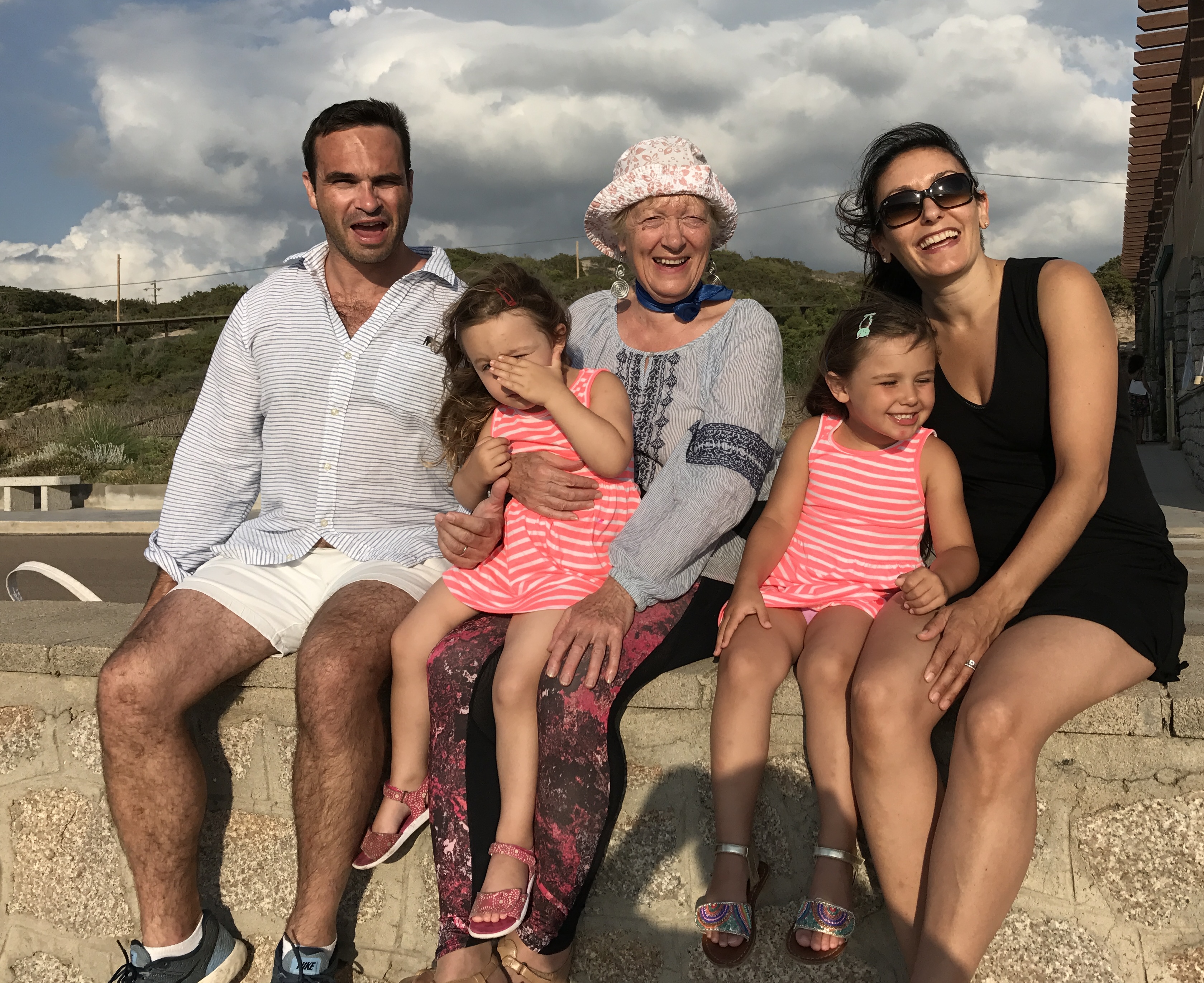
 week on 24th June, with the grandchildren. We had a great time in a “resort”, which, whilst not exactly my style, was good for the kids with four (!) adult and kids’ pools and plenty of good mainly, but not exclusively, Italian food. The first few days were, however, soporifically hot. Global warming really is making much of the Mediterranean almost impossible for summer holidays – except for lobsters of course. Here is the clan, minus me the photographer.
- I got back on the evening of 1st July, hoping to get to the Falcon Festival, but was too late. The Festival started in 2016 and will now hopefully be an annual event. I am told it went really well and that the Battersea Labour Party stall, with a guest appearance from our MP, Marsha de Cordova, was a great success – I am sure that our stall will be a regular feature of the Festival in the future.
- On 4th July, I had a meeting of Wandsworth Council’s Heritage Selection Panel. 456 heritage assets were reviewed, by the Battersea Society and the other Wandsworth ame
 nity societies (Balham, Putney, etc.). The meeting ran for more than three hours and nominations for the various categories were put forward for final approval. The categories include:-
- post boxes, e.g. VR (Victoria Regina post boxes in Battersea Square)
- boundary markers
- blue enamel street signs
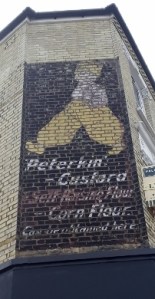
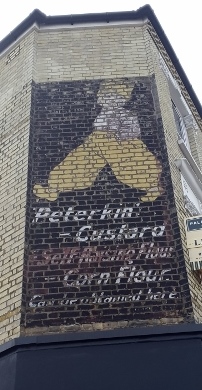
- ghost signs, like this Peterkin Custard ad on St. John’s Hill (Do you know it?)
- “street furniture” such as granite setts, York paving stones, the electricity sub-stations and sewer sink pipes, etc.
- English Heritage blue plaques.
The full revised list will be submitted to the Council’s Heritage committee in September.
A private company has mapped all these assets on to a “geographic database” and in future we have the exciting prospect of being able to research all these assets on-line, placing them in our neighbourhood and seeing images of them as well.
- On 5th I was rung up by Poppy Naylor, a politics
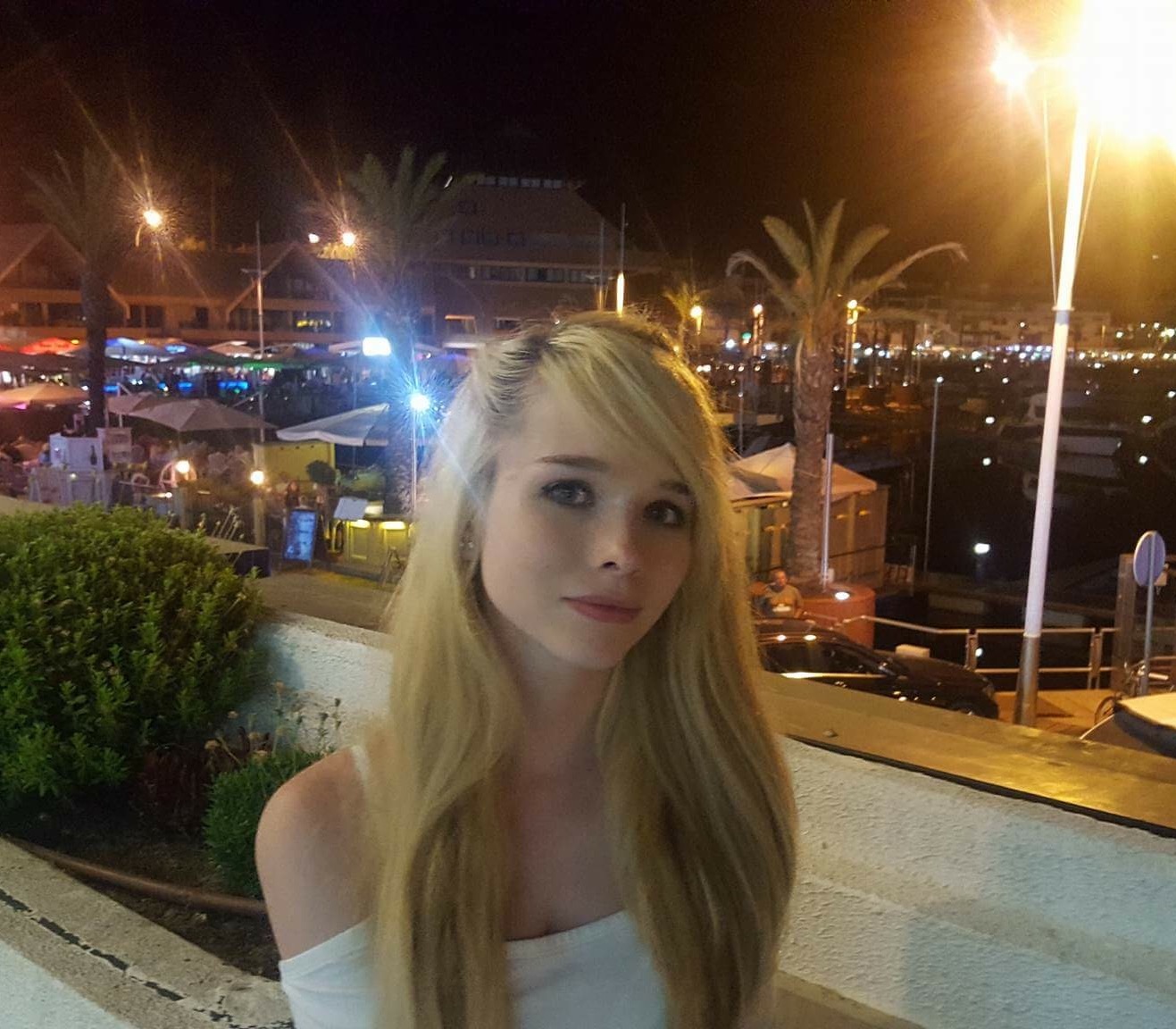
 student at Graveney School. She asked me if she could “shadow me” for a month or so and learn something about politics at both a local and practical level. Over time, I have had university students studying, say, journalism, who have worked with me writing news stories as part of their course, but I have never had a school student looking for some work experience in politics, prior to deciding whether to study the subject at university. It struck me as an interesting project and so now meet Poppy, for a month at least part of the team! And here is her contribution!
“I approached Councillor Tony Belton in the Summer of my first A Level year as I wanted to find out more about politics at a local level. Our politics course at Graveney School focuses on government and parties at a national level. I felt I knew a little about councils and how they worked. By the time I attended my first council meeting, I knew I understood absolutely nothing. I was very grateful that Tony had given me the opportunity to start to figure things out.
So far, I have attended a Labour group meeting and a council meeting in Wandsworth Town Hall. The meeting rooms are very grand and the council meeting itself seemed to run along the lines of the debates I have seen in the House of Commons. It was encouraging to see how united everyone was in the light of the Grenfell Tower fire about implementing the correct safety measures in Wandsworth. There was a real grass roots and local feel to these meetings. Councillors talked about how the Grenfell fire had touched the lives of some constituents who lost family that night.
It has been an interesting experience so far to see how decisions are made locally that can affect our everyday lives. There is still a lot that I wonder about.”
- A couple of councillors have for some time now
 organised annual week-end trips to battlefields to commemorate the part that Wandsworth military men have played in either World War I or II. This year the trip was to Villers Plouich, near Douai, over the week-end 7th June to 9th June. The village was totally obliterated 100 years ago in 1917, but was liberated by troops from Wandsworth, and particularly Battersea. This was such a major event in the history of the village that there is a square called “Place de Wandsworth”! But my favourite story of the area was of this man, who only 10 years ago discovered this World War l tank buried in a bomb crater – after a dozen years of looking! It was one of the first ever used.
- We had a Council Meeting on 12th July. The main debate was about the truly awful Grenfell Tower disaster and its implications for us here in Wandsworth. I wrote about this last month and about our concerns, but the Council Meeting was an opportunity, a month later, to discuss and review the steps that Wandsworth has taken to ensure the safety of our residents. Clearly, we were all shocked by Kensington & Chelsea’s abject failure. We can only hope that we have taken all necessary steps to avoid such a disaster in Wandsworth.
- The sheltered housing residents of D
 oris Emmerton Court, Wynter Street SW11, had a BBQ on 14th July. They invited me and I was delighted to attend, even if I did get there a little late. Doris Emmerton Court is a purpose-built sheltered housing block of 66 flats for older people aged 55+ who choose to live independently in the community with access to support offered by the sheltered housing officer.
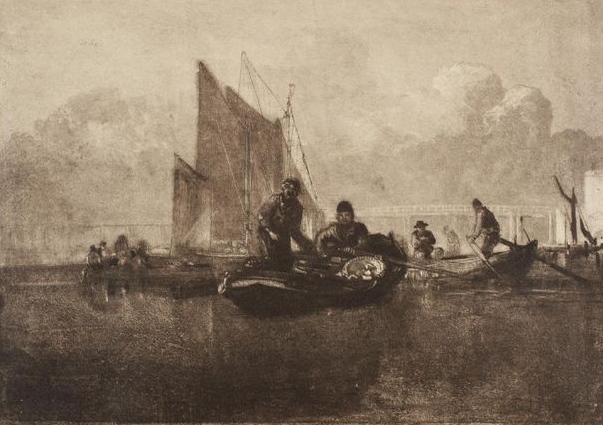
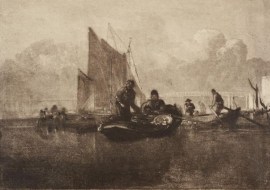 A couple of hours later, Poppy and I were at the Battersea Society Summer Garden Party in the grounds of St. Mary’s Church on the river-front. It is one of the most spectacular spots for such an occasion, that one could imagine. No one that J M Turner painted river scenes here, but about 200 years ago when the view was just a little different!
- I won a pair of tickets to the men’s
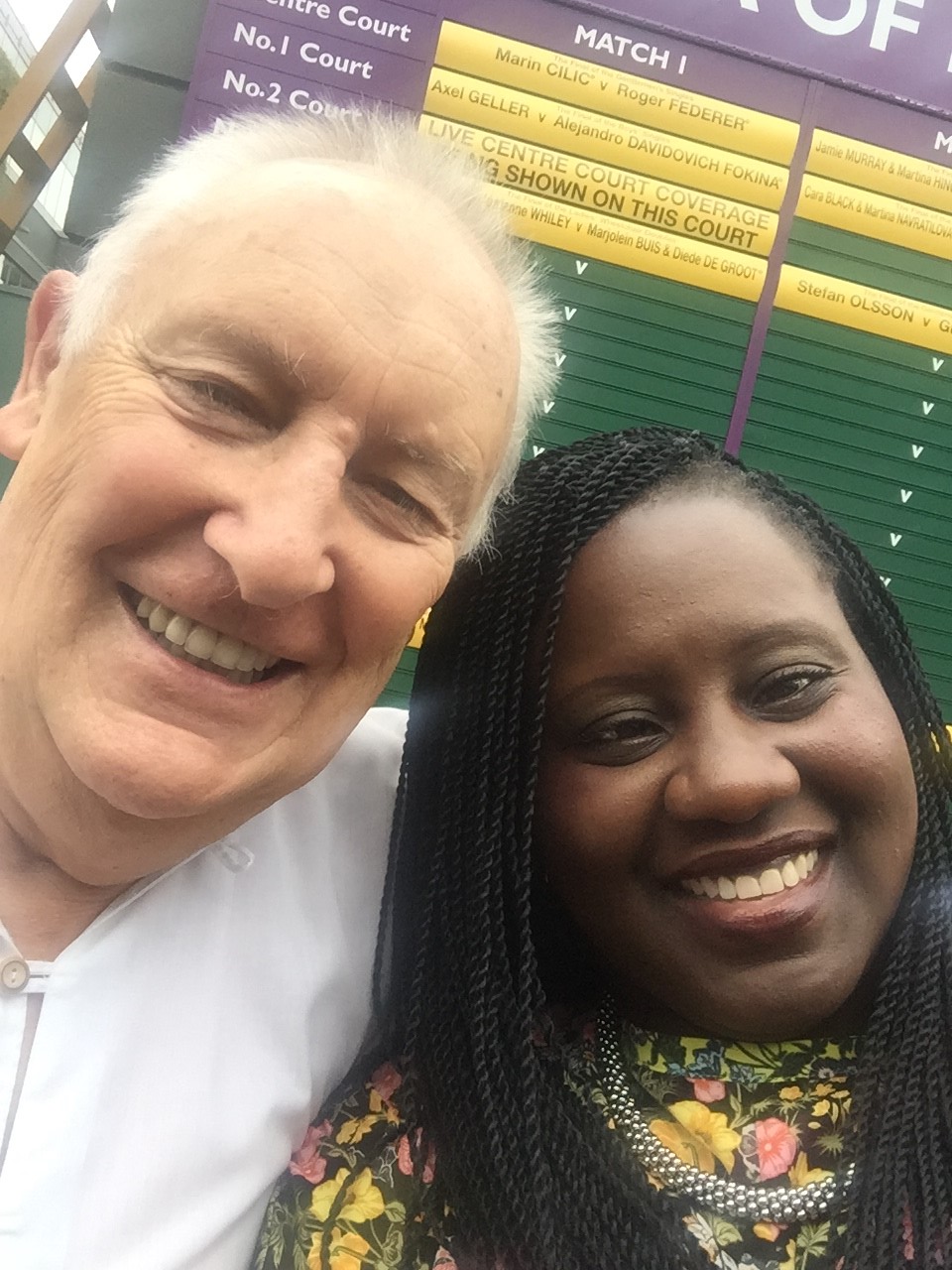
 final at Wimbledon on 16th July! (N.B. I won the right to buy them! This was not a freebie) I took Marsha with me – see the dreaded selfie! As for the game itself, Federer was, of course, immaculate even if Cilic was over-awed and injured. Perhaps the second match, in which Jamie Murray and Martina Hingis defeat Heather Watson and Henri Kontinen, was the more entertaining spectacle.
- On 20th July, I had the Planning Applications Committee, which on this occasion was very important for the future of Battersea. The first application, relating to a site opposite the Dogs’ Home, was to demolish Palmerston Court, and the Pavilion and Flanagan’s pubs and to replace them with 4 buildings up to 16 stories high, comprising 162 residential units, a replacement pub, retail and some open space. No doubt the 162 units will be useful but only 25% of them will be “affordable”, that is far too expensive for, say, the majority of first-time buyers! What is more, we all know that demolishing a vibrant community pub like Flanagan’s is rather more important than just replacing bricks and mortar. The replacement pub, in perhaps 5 years’ time, is extremely unlikely to have the same roots in the community as Flanagan’s. This application was opposed by the Battersea Society and the Labour councillors but was passed by the Conservative majority! No doubt the fact that the development will bring £6+ million into the Council’s coffers also had some influence on the decision!
- The second major application referred to the Candle Factory site. This time we are talking about a 25-storey block, containing 136 flats and a gym. 21% of these units will be “affordable” and the contribution to the Council’s coffers will be £4.9 million. The result of the discussion was much as the Flanagan’s debate; opposed by the Labour councillors and supported by the Tories, though interestingly enough one of the Conservative councillors representing the area spoke against the application!
- And on 21st July I was off on hols, again. I am making up
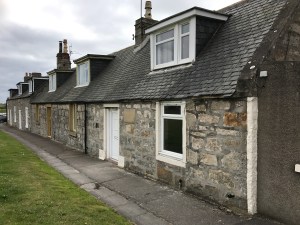
Ramsay McDonald’s home, Lossiemouth
for a couple of years without a big break by having a few short breaks this year, including 10 days in Scotland, one of my very favourite destinations. One place I had never been to before was the small fishing village of Lossiemouth, just north of Aberdeen, where I came across this house. It was, and is, the birthplace of Ramsay MacDonald, the first Labour Prime Minister in 1924 and 1929-1931, and, famously and contentiously, the Prime Minister of the 1931-35 National Government. I wonder whether any other British Prime Minister came from such a humble background.
- Last month I did say that I would say something about the news from the Finance Committee of 29th June, re Tours Passage and Falcon Park. Unfortunately, there is not a lot that I can say other than that the Committee decided to allocate £174,450 to the Tours Passage (between Maysoule Road and the railway) scheme and £115,000 to the Falcon (Banana) Park scheme. One of my constituents can take much of the credit for the Tours Passage allocation, as she has lobbied for it for years, and I like to think that I had something to do with the Falcon Park scheme. However, despite the precise nature of the budgets, I am told that the schemes are not yet worked through in any detail and that we must wait until the autumn for that.
- Suffice to say that with the Council still intent on putting in an artificial playing surface in Falcon Park, I argued that money should be spent on improving the use and landscaping of the northern area of the Park, where the Latchmere Road cut is situated. The allocation for Tours Passage is simply at present for “environmental improvements”.
- By the way other allocations in Battersea included £165,000 for the Wandsworth Common, Chivalry Road play space scheme; £74,000 for the Wandsworth Common, St Mark’s play space; £220,000 for the Fred Wells Gardens refurbishment scheme; and £334,000 for a Battersea Arts Centre scheme.



My Programme for August
August really is our recess (or holiday season) and my only commitment is to the Planning Applications Committee on the 23rd – after two years of elections and, of course, the Referendum a complete month off is very welcome. But in September, we will be straight into the build up to and the campaigning for the May 3rd, 2018, Council election. We have high hopes of making considerable gains and clawing back the advantage the Tories have had over us for nearly forty years.
Opinion Piece
Given my comments last month about our MP’s (Marsha de Cordova) stance on the Brexit/Remain issue, I think I should draw your attention to what she said in her maiden speech in the House of Commons on 17th July. You can read, or view it in full, on various websites but I thought I should highlight the following extract:-
“As you can see, Mr. Deputy Speaker, in Battersea we are outward-looking and internationalist. It is that outward-looking spirit that I will endeavour to bring to Parliament. With the decision to leave the European Union, we face serious challenges ahead of us. It was a decision that my constituents care deeply about and voted overwhelmingly against. I will be standing up  for them, drawing on that outward-looking Battersea tradition, one that values openness, tolerance, social justice and co-operation”.
Do you know?
The Barbara Hepworth statue, pictured here by the lake in Battersea Park? Well one of the organisers, Ian, of the Doris Emmerton BBQ I mentioned above, challenged me, and you, to name the location of its rather larger identical twin. Does anyone know?
Councillor Tony Belton’s North Battersea July, 2017, Newsletter (# 97)
My Programme for July
Opinion Piece Two months ago I wrote that “we in Battersea should, therefore, vote for the candidate most likely to argue (and vote) against Hard Brexit, whatever that is, and fight still for a Remain position”. I did say that the Lib/Dem candidate would also vote for a Remain position but that the Lib/Dems were not a realistic winning option. In that context, some have argued that Marsha’s vote against the Chuka Umunna amendment to the Queen’s speech was a mistake and, worse, a betrayal of her constituents. I think that is a rather premature judgement. Clearly both major parties have major difficulties coming to terms with Brexit/Remain, especially given the Referendum’s majority in favour of Brexit and given the complex make-up of the Labour and Conservative parties. I believe that it is probable that either or both of the Labour and Tory Parties will face a major internal crisis over the EU. How they get there and who gets there first will be major factors in the future of the UK. I am sure that there is much more jockeying for position to come and I know that Marsha will take an active, anti-Brexit role in the parliamentary debates. Do you know? Last month, I asked whether anyone knew anything about this house, including the simple question “Where is it?” Well, the only correct answers came from people who lived there or were friends of those who did. The house is 22 Mossbury Road, barely 100 yards from the Falcon and the centre of modern Battersea. Actually, the rather more imposing traditional front is on the west side of the building, the right as you look at it, but unfortunately can only be seen from inside the property. The house is one of the oldest in Battersea, dating from the very first years of the nineteenth century and so about 200 years old. |




 Tony Belton
 Tony Belton