Councillor Tony Belton’s Battersea September, 2018, Newsletter (# 111)
- Last month I wrote about building control regulations and their implementation in England and Wales, since Mrs. Thatcher’s so-called reforms (I suspect the rules may be a bit different in Scotland). I don’t think that I have had such a heart-felt response on any other subject. Clearly, many residents find the whole process of neighbour-building works both stressful and sometimes expensive
.
- I had building works next-door to me last year and, although I have absolutely no complaints about the standard of works, my garden was unusable in 2017. Thank goodness that last summer was not a scorcher like 2018. Equally, I’ve had friends, who have complained particularly about the 24-hour 7-day a week pumping one often gets with basement extensions. It does seem to me that, as a country, we need to re-consider legislation about both the regulation of standards and nuisance control during construction.
- Unsurprisingly August has been very quiet in Council terms, so I thought I might indulge myself in a bit of politics – for a change. But first, I did have a couple of visits one from a British student and another from a foreign journalist. It’s a minor pleasure of the job of being a Councillor that people do ring me, from time to time, and ask for interviews about how local government works in this country. The trouble is that, like most people, the more I know the more I realise that I don’t know!
- To politics and the issue of the EU, about which a number of people have asked me to come clean on my views, and I must stress they are my personal views! Of course, one answer is to say that Brexit or the EU is not an issue for a local councillor and, of course, in one sense that is right. Yet I am not surprised that some of you want to know what the person you voted for only a few months ago, thinks on this massive issue. (If you are not interested on more about Brexit, then skip to paragraph 10).
- First, I voted in the Referendum to Remain and if we have the chance again, I will do so again. A couple of years ago, I certainly had some pleasure, in discussions with friends, being the Devil’s Advocate and one or two maybe thought I was going to vote Leave. I regret it, if I persuaded anyone to switch their vote, but I rather doubt that I did. However, despite voting “remain” I thought then and still do that the “Remainers” have to face some issues. For example, the EU does not appear to be very democratic – despite the Euro-elections. Perhaps it is impossible to make an organisation with 500+million people feel democratic but either more effort has to be made or the EU should operate through national governments. The present European Parliament does not have much credibility and, I suspect, is not sustainable in its present form.
- In addition, it does appear as though the Euro currency is and has been a terrible mistake, which somehow the Eurozone has to reform or end as soon as possible. In hindsight, it seems ludicrous to have tied Greece and Southern Italy to the same exchange rate as Bavaria and Brussels; Andalucia and Portugal to the same economic conditions as Berlin and Paris. Clearly, what has worked for Germany has been massively destructive for Greece. Some reforms to the EU are essential and its current settlement should be no more cast in stone than any constitutional arrangement anywhere.
- But it’s not the Remain argument that exercises me most but rather the Brexit case. I have many objections to the Brexiters’ arguments. For a start it means taking a terrible risk with all our lives and livelihoods on the basis of the assurances that we have had so far, which in essence amount to no more than a promise “That it will be alright on the night”. Especially given that almost every expert believes we will be worse off after Brexit than before. (I know that Michael Gove suggested that we should ignore experts, but in most fields, from brain surgery to plumbing, flying to engineering, I prefer to have experts on my side rather than against).
- There are, of course, the nostalgic Brexiters, the Imperial Brexiters, the Little England as well as Great Britain Brexiters, invariably from the right of the political spectrum. But what about the left-wing Brexiters, the inheriters of the Tony Benn legacy; those who see the EU as a capitalist plot? I would ask them to give us the answer to three particular questions:-
- How do you tackle the ecological issues facing the world without supra-national organisations?
- What possible democratic power do you see standing up to global capitalism and perhaps particularly Californian-based global capitalism? Surely not the UK on its own; just possibly the EU can.
- In a world dominated by international business, how can workers’ rights and pay levels be protected unless, ultimately, on at least a continental basis?
- Clearly, there are a thousand problems
 involved in stopping Brexit but if Brexit is a disaster and bad for Britain then the Labour Party will pay a heavy price, if it hasn’t had the courage to take a stand on the issue. Enough said, but I suspect we will be coming back to this issue before too long.
- On 3rd August, we went to see Oscar Wilde’s “The Importance of Being Ernest”. You will have noticed that in the last few months, I have been to all the Oscar Wilde plays. In his brilliantly witty way Wilde certainly has a very particular take on gender politics at the turn of the nineteenth and twentieth centuries. But I am afraid that I was disappointed with this production of his most famous play. The text is witty enough without being coated in extra layers of somewhat dubious gender and race politics.
- I was also asked, along with fellow Councillor Kate Stock, to be part of a panel of judges in a competition being run by the Battersea Summer Project at Providence House Youth Club. The Project does a great job, which is much appreciated by many kids (and no doubt parents) providing sports, hobbies and occupations for the young people of Battersea, but I think this particular competition needs a bit of re-thinking if it is to become a regular event.
- On 18th-19th August we spent the week-end
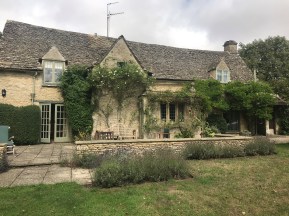 with Douglas Jay’s widow, Mary, in her beautiful cottage in Oxfordshire. Douglas was Battersea North’s MP from 1946-83. He married Mary, many years his junior, in 1972. We had a delightful dinner with family and old friends exchanging stories about “old Battersea characters”. Unfortunately, but inevitably, Mary is having to move into a more convenient, smaller, urban house. So, this was a kind of nostalgic goodbye to Causeway Cottage, seen here on the right.
- The next Planning Applications Committee
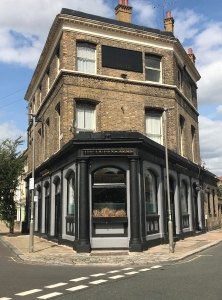 takes place on 22nd August and this time there really is nothing of great significance in Battersea – though I am very conscious that even the most minor application is really, really important to someone or some family. One item worth a mention is an application for the modernisation and re-opening (hopefully) of the Queen’s Arms, seen here on the corner of Robertson and St. Philip’s Streets, just off the Queenstown Road.
- But I will miss the Committee as on 22nd August I will be carrying the bags for my partner at a Conference in Bordeaux, from where we are going directly to Croatia for a couple of weeks. I have briefed my colleagues on my views on the committee, but inevitably at this time of the year some of us will be missing the evening.
My Programme for September
- There will be the Community Services Committee on 18th September and the Planning Applications Committee on 19th.
- In recognition of the major traffic and pollution problems facing all the world’s major cities and London in particular, there is going to be a Car-free Day organised through-out the capital on Saturday, 22nd. I cannot imagine that it will result in a wide observance across the whole city but we shall see!
- The last week of September will be dominated by the Labour Party Conference (and Brexit). Somehow, I cannot imagine that we will reach the end of September without very fundamental shifts beginning to take place in the political landscape!
Do you know?
Last month I asked “How many of you know the modern names of these three Battersea pubs: “The Cornet of Horse“, “The Prodigal’s Return” (I said “Son” so thanks to eagle-eyed Chris for that correction) and “The Eagle“? The answer is The Four Thieves in Lavender Gardens, The Draft House on the 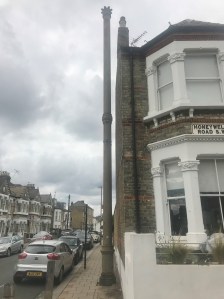 corner of Battersea Bridge and Westbridge Roads and The Magic Garden, Battersea Park Road, respectively. As a brief aside can I ask whether anyone knows the connection between Lavender Gardens, Henty Close on the Ethelburga Estate and the Cornet of Horse?
And as for this month let me ask: I took a photograph of this structure in Webbs Road, at the junction with Honeywell Road. It, is the pole, standing on the pavement and which is slightly higher than the house. Do you know what it is? What it is called? And just how many poles like this can WE find in Battersea?
Councillor Tony Belton’s Battersea May, 2017,Newsletter (#96)
- On the 5th April, I attended a Citizenship Ceremony with a difference. Since 2004 becoming a British citizen has involved a ceremony. This was the second I had been to and was a moving experience watching 30 or 40 new citizens from all over the world swearing allegiance to the crown and the UK. For those sceptics amongst us, who might have thought otherwise in a post-Brexit world, they included Irish, Italian and Portuguese – it was also a reminder of what a cosmopolitan city we live in.
- This ceremony was,
 however, different, because it was also the occasion when the Barbados (Bajan) High Commissioner came to present a certificate recording the contribution John Archer made to both Barbados and the UK. Archer, who lived in Brynmaer Road, Latchmere (see the blue plaque on no.55) was a Liverpudlian of Bajan origin, who in 1913 was elected Mayor of Battersea, the first black mayor of a major UK town and a reminder that London has a long tradition of being home to people from all over the world. He was a Latchmere councillor and I was invited as one of his successors. Here is a picture of the Commissioner with Wandsworth’s current Mayor.
- Three days later I went to the National Theatre to see Twelfth Night – what a disaster. You can read more about it at https://tonybelton.wordpress.com/ where you will find a review that I wrote. Suffice to say that the evening started with problems on the railway and continued through what I thought was a self-indulgent and rather unpleasant production of what is meant to be, in modern terms, a Rom-Com; enough said.
- The next day I went to Battersea Arts Centre for the much more pleasant occasion. It was the “significant” birthday of my friend, Jenny Sheridan, long-term editor of Battersea Society’s quarterly magazine, Battersea Matters. This was a far more successful evening.
- After her Easter break, Mrs May decided to surprise us all with the announcement of a General Election. For those of you not involved in politics, which is no doubt most of you, you may not be aware of what chaos and panic, fun and frantic activity, this involves. In our case Battersea Labour Party did not, but does now, have a candidate (Marsha de Cordova, a Lambeth, Clapham, councillor), agent (me!) or funding. Don’t take this as criticism as I doubt that many other parties or constituencies were in a very different position UNLESS they had a sitting MP. This state of affairs does mean, however, that the last fortnight has been fairly lively.
- With fortuitous good timing, the next day Battersea, Putney and Tooting Labour Parties had a joint fund-raising party at the Civic Centre at the Town Hall. The speaker was Keir Starmer, who is Labour’s spokesperson on Brexit. His speech was good, but perhaps more significantly he was very impressive when it came to the questions and answers.
- As it happened, I already had a date earlier that Wednesday evening at a book launch in the Fulham Road. A Battersea resident read my April Newsletter and was interested enough to write to me saying that “My [i.e. her] writing, about history-enforced exile and uprooting, …., is particularly relevant in
 these days of increasing jingoism and xenophobia, which are even leading to crimes in our streets”. Her letter included an invite to her book launch – Miriam Frank’s An Unfinished Portrait.
 - Miriam (pictured right) writes of her journey through war torn Spain (the Civil War, 1936-38) and Europe and then in Latin America, much of it with just her mother and a suitcase. The book is beautifully and lyrically written and is largely about coming to terms with her difficult relationship with her mother and how central that has been to her life. However, her words to me about xenophobia and the crime on our streets are particularly poignant given that since she wrote them we have had murders in Sullivan Close and Melody Road, both within a mile of Clapham Junction.
- There was a further incident in Tooting, which led to this response from the Borough’s Detective Chief Commander Peter Laverick. He said: “These events are unprecedented for Wandsworth and taken together over such a short period of time has increased the impact. We have had three tragic events over the last four weeks. I understand that people will be concerned but Wandsworth is safe [the statistics show Wandsworth to be the safest Borough in Inner London]. We are committed and are working very hard with the local authorities to tackle this sort of violence. On the whole, we are successful in doing so compared with the rest of London.”
- On the 7th April I went
 to the Quaker wedding of an old friend, Edmund Green to Eloise. It was a new experience for me, with the whole ceremony taking place in almost total silence, with their vows exchanged but directly between the two without any supervisory minister or vicar.
- My last newsletter must have had an appeal to authors! On the next day, I had coffee with another author, Camilla Ween, who is an urban planner and has written a book called Future Cities. Camilla is keen to help me (and the Council) improve the quality of the urban landscape and design in Wandsworth. As we talked of possibilities we came up with an interesting idea for environmental improvements in North Battersea, which we agreed to work on. We are both busy people but if, and I emphasise IF, we come forward with an interesting plan then you heard it first here!
- On 22nd the Council had a ceremony to commemorate the three Victoria Cross winners won in World War I, but I was not there because on the same day I attended the unveiling of a blue plaque on Northcote Lodge School, 26 Bolingbroke Grove. The plaque commemorated blind, great Battersea jazz pianist George Shearing’s time at school there. George was born in 1919 of working class parents. His father was a coalman, when coal was delivered by horse-drawn wagons, and his mother cleaned railway carriages, no doubt at Clapham Junction depot. He was brought up in Rawson Street, where there is now Rawson Court. He went to Sellincourt School for the blind and then on to Linden Lodge, now Northcote Lodge, where he learnt to play the piano. In 1947, he moved to the States, where he became the only British musician to hit the big time in jazz. You can hear his signature tune Lullaby of Birdland at https://www.youtube.com/watch?v=7zJnoQiIqDU. You can also read his autobiography, co-scripted by Alyn Shipton, in Lullaby of Birdland (2004).
- The irony is that
 the two old London County Council schools, which once gave blind kids an education and in Shearing’s case an international jazz career, are now (respectively) a private block of flats and an expensive private prep school. Two of the Northcote Lodge pupils entertained us with some jazz but next term they are off to Harrow and Sherborne. Good luck to them but still ironic: we need more state schools but we have spent the last 30 years privatising them!
 - One nice feature of the day was the dozen or so members of the Shearing family, who attended and some of whom are pictured here – looking remarkably like pictures I have seen of Shearing himself.
- On 24th April, I attended the Passenger Transport Liaison Group – often very interesting about rail and bus improvements but not particularly on this occasion.
- Two days later, I had the Planning Applications Committee.
 Two applications were of importance for Battersea. The first was an application from the Flower Stall (pictured here), which stands outside the main entrance to CJ Station. The officers recommended that we refuse the application for, what we, the Councillors, considered to be, purely technical reasons. We thought that if we stuck with the technicalities we’d become a laughing stock with the public. So, we approved the proposal and good luck to the flower-stall romantics.
- The second was a major application for 343 residential units, a 15-storey block and three others at nine storeys on the Homebase site, Swandon Way. Again, we councillors ignored the officers’ recommendations and turned down the application, on the grounds that the large and dense development would overwhelm “the Tonsleys” and result in massive congestion at Wandsworth Town station.
- At the same meeting, I also submitted a paper about the use of zinc in back and roof extensions.
 You may remember, from last month’s newsletter, the picture of a roof extension seen from Frere Street – one or two of you commented that they were not surprised that it was unpopular with neighbours. Well here is the same extension seen from Atherton Road. There is nothing that the Council could do in retrospect about the extension as built. However, the Committee agreed that the zinc addition was incongruous in a street, of properties largely built with London stock brick. We resolved, in future, to take more note of materials, when considering such future applications.
- On 27th April I went to a charity lunch in support of
 the Ammadiyya Muslim Community organised March for Peace on 14th May in Newham. The Ammadiyya community consists of 200 million people world-wide, who have their world headquarters in Putney, largely because the Community are on the receiving end of much persecution in many Muslim countries. The prejudice towards them is a tragedy, given that the Ammadiyyas are noted for their attempts to be peace-makers between the current warring religious factions in the Muslim world. Without notice, I was asked to speak and found myself, as a member of the opposition, rather ironically, welcoming them on behalf of Wandsworth Council and councillors!
- Earlier in the month, I visited the developing St. Peter’s Church
 in Plough Road and the new flats, recently finished and now largely occupied. Some of you have asked if and when the church is going to be completed; I was assured that they expect completion in late autumn this year.
 - It was a little difficult to tell what the church is going to be like but it is certainly very modern. As for the flats; they appear very smart with a fascinating view over York Gardens and the many, major developments taking place, as you can see, in North Battersea.
My Programme for May
- I am sure the month will be dominated, for me, by the June General Election but I do have a Council surgery on 6th May at the main library on Lavender Hill.
- On 15th May I have a meeting of the Heliport Consultative Committee and the day after there is the Planning Applications Committee. After that, on Wednesday, 17th May, there is the Annual Council Mayor Making evening – a very simple, formal evening.
- On 28th May, as part of the Wandsworth Heritage Programme, I am leading a History Walk from the Latchmere pub to Battersea Arts Centre, via a few historical sites. If you are thinking of coming then please do contact me nearer the date, by email, for details.
In my view, we in Battersea should, therefore, vote for the candidate most likely to argue (and vote) against Hard Brexit, whatever that is, and fight still for a Remain position. To be fair, the Lib/Dem candidate represents a party, which is committed to that position – strange given that it is so indecisive on almost every other issue! But the reality is that given the electoral situation in Battersea there are only two realistic winners: the Tory Party candidate, who is a member of the Government negotiating Brexit, and the Labour Party candidate, who is anti-Brexit and will take every opportunity to fight for our membership of a customs union and the open relationship we have had with the rest of Europe for 40 years. The choice seems simple enough!
Do you know?
Last month, I asked why are the York Road estate blocks, some soon to be demolished, named Inkster, Penge, Chesterton, Pennethorne, Holcroft and Scholey? I got no responses! Obviously too difficult or not very interesting to many of you but the answers are, I believe:-
- Chesterton House: G. K. (Gilbert Keith) Chesterton, was a writer, poet and literary critic (1874-1936), who moved into Overstrand Mansions, Prince of Wales Drive in the late 1890s.
- Holcroft House: Might be named after Thomas Holcroft (1745-1809), who was a radical Englishman, who travelled to Paris, during the French Revolution and probably knew ant-slavery campaigner William Wilberforce, but I have no definite evidence.
- Inkster House: Major Inkster was a serving officer in World War II, who was a member of Battersea Borough Council’s Housing Committee, when the York Road Stage 2 estate was being planned in the 1960s.
- Penge House: Simon Hogg tells me that In the nineteenth century Penge was, apparently, a detached hamlet of the parish of Battersea. He and I guess that the naming of Penge House comes from that connection – but I am not totally convinced!
- Pennethorne House: William Pennethorne, was a principal architect and designer of amongst many other things Battersea and Victoria Parks, as originally conceived in the 1860s.
- Scholey House: Might be named after the Lord Mayor of London (1812) who, I am told, was also the churchwarden in Battersea, but somehow I doubt it. Apart from anything else he was an East Londoner.

Promoted by Tony Belton on behalf of Marsha de Cordova at 177 Lavender Hill, SW11 5TE. Produced by Tony Belton at 99 Salcott Road, SW11 5DF
A Labour Party “Remain” Strategy for Wandsworth, 2018
It is clear that on the major issue of the day, the Labour Party’s position is, at least for now, an irrelevance. The country is set on a very difficult Brexit journey, which Jeremy Corbyn is not going to challenge in any serious manner. Regardless of his qualities or otherwise, he appears to take the view that There Is No Alternative; we are back to our old friend from the 80s, TINA!
If Mrs. May were to make the mistake of calling a General Election there could be no real external opposition to her except from out and out remainers in her own party. UKIP would not be the threat to Labour but the LibDems would be – almost regardless of the qualities or otherwise of their leader.
The 48% of us, who voted Remain would not be represented by anyone else. Is there, therefore, any serious argument against the Labour Party taking a strong and passionate “Pro-EU” position?
In a sense, whether it delivers an overall Labour majority in a General Election or not, it is the only path away from annihilation back to electoral respectability. My old friend, Mayor Khan, is sharp enough to see that for him in London it is advantageous to be as pro-European as he can be.
Likewise every Labour campaign in the 2018 London Borough Elections should be fought on a Pro-EU platform. Not only is London a “Remain” city, but it is also home to enough voting EU nationals in most boroughs to justify local platforms with a large element of “foreign policy”.
This tactic might be very uncomfortable for some, few Labour Brexiteers, but no more difficult than the current position is for the much larger Pro-EU majority.
I call on Wandsworth Labour to make an essentially Pro-EU platform the corner-stone of our local campaign for 2018, and I hope many other London Labour Parties follow suit. It would also, of course and crucially, have the benefit of putting the Brexit supporting Conservative party in the position of fighting an election in a Borough, with a 70+% majority Remain population. Who knows? But it is easy to imagine that in 12 months time it could be the Tories rather than Labour facing a major political dilemma.
 Tony Belton
 Tony Belton