Trade Unions – more power to their elbows
There can be little doubt that in the battle between capital and labour, the shift of power from capital to labour which characterised early post-war Britain, has gone into reverse. The apogee of union power was the moment of the collapse of the Ted Heath Government in February, 1974.
The unions had exercised great power in the fifties, when they did much to raise worker standards of living to unparalleled heights in a far more equal society than we see today. This also happened in the United States and in the rest of the English speaking world, especially Canada, Australia and New Zealand.
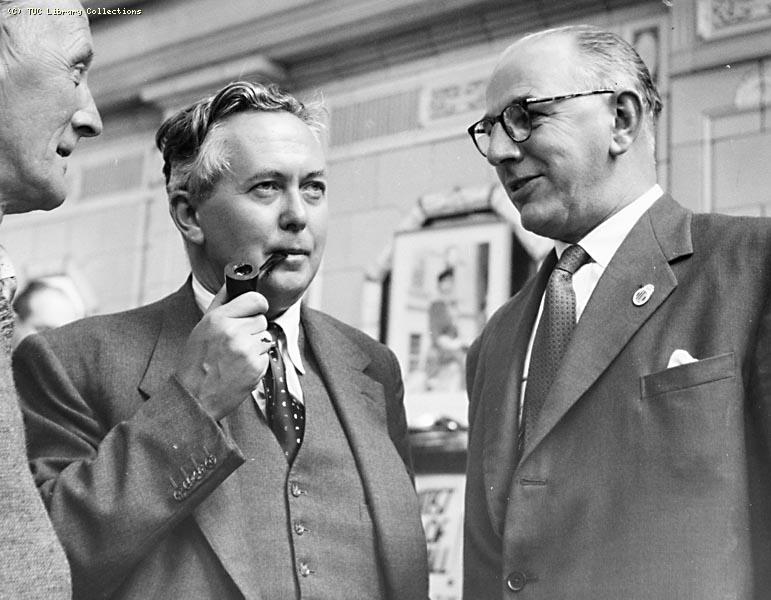 The unions did not get much credit for this achievement especially from the overwhelmingly hostile press, but they were generally recognised as a pillar of British society. One dramatic symbol of this rise was Harold Wilson’s promotion in 1964 of Frank Cousins, General Secretary of TGWU (Transport and General Workers’ Union), to be Minister for Technology, a post of high importance to the Government, focused as it was on the “White Heat of Technology”. (pictured right)
It was reasonable to expect that the unions were likely to become a long-term, central element of the corporate state – rather as they are in modern Germany, their historic role being to a considerable extent a product of British advisors in the immediate aftermath of World War II. Unfortunately the unions over-reached themselves and missed this historic opportunity, perhaps for all time.
Even in the sixties, Hugh Scanlon (AEU – Amalgamated Engineering Union) and Jack Jones (TGWU) were the media’s “Terrible twins”, as they exercised union power in many a disruptive industrial dispute. But more damagingly they also took on the politicians and thwarted Barbara Castle’s attempt to draw them into the corporate state through the mechanism of her policy white paper In Place of Strife.
There was little doubt that the trade union movement was a powerful voice in the land. So much so that one opinion poll in 1977 showed that 54% thought Jack Jones was the most powerful man in the country. But many others thought that unions should keep to “their proper role” of defending and strengthening workers’ rights and pay and conditions and not indulge in political activities. The battle over the trade union role in society was to be joined in earnest in the 1980s.
In 1973-74 the miners’ leader, Jo Gormley, had led the miners in a successful campaign for higher pay, which had ended with Labour’s General Election victory of February 28th. Ted Heath had gone to the country asking, “Who rules?” The country replied, “Not you mate” (The Tory Election Manifesto was called “Who Governs Britain?”). But an apparently great miners’ victory sowed the seeds of the unions’ downfall, most especially the NUM (National Union of Mineworkers). The unions arguably became complacent and expected favours from the incoming Labour administration. But by the time Thatcher became PM, the Tories were adamant that they would never be subject to union power again.
So when Thatcher decided to close mines and reduce the size of the mining industry, she set up quite deliberately the battlefield for a war against the miners. Unfortunately for the left, and I would argue for the country, the miners were now led by Arthur Scargill. He was keen to exercise power but had neither the native cunning nor the considered approach of Gormley. Scargill went into battle when British coal stocks were at a record high and British dependence on coal was declining as North Sea oil and gas was coming on stream. (It was ironic that at the same time as she was condemning trade unions in the UK, Mrs. Thatcher considered them to be a bulwark of freedom in communist Poland!)
The decline of union power had begun and has continued ever since, with New Labour almost as keen not to go back to the days of union ascendancy as the Tories.
But now we can see what a long-term disaster that decline has been for the majority of the workforce and for the country. Now neo-liberalism is in command. We have millions on zero hours contracts – not just working for exploitative private employers but also for local authorities, the NHS and the civil service. As a country, we “compete” for having the most flexible work-force, for having the weakest labour protection laws and for paying the lowest wages.
As a Councillor I know only too well the pressures on local authorities to put every task out to competitive testing or rather to the ruthless exploitation of labour. Once we had women, and they usually were women, providing home help and meals on wheels to pensioners, and working regular hours at trade union negotiated rates. Now we have temporary part-time workers, possibly paid at lower than legal minimum wages – many of whom are not paid for travel time between jobs. Just imagine what the salaried middle classes would make of not being paid for travel time between clients.
My colleagues are so beaten down by standard clichés such as “the users do not care who delivers the service, they only care about the quality of the service” that they just do not see that the logical end of this process is a low paid, low skilled, low spending labour force. Not many years ago Wandsworth’s Tory Leader provoked derision on the Labour benches when he claimed that the workers’ pay and conditions were no concern of his. Now his remark would pass without comment or criticism; it would be the statement of the obvious.
The Tories used to say that Labour only cared about the providers and not the consumers. If it was ever true, it is no longer, at least for the workers by hand – workers by brain, such as doctors, airline pilots, lawyers, still have their unions (and the Labour Party), or professional associations to look after them. But the workers by hand are left helpless against the neo-liberals. And they get little help from Labour, hence the party’s weakness amongst its traditional supporters.
But now – at last – the public at large are becoming more aware of the imbalance between labour and capital with large and growing campaigns for the “the living wage” and against zero hours contracts. The Labour party is in danger of being way behind public opinion.
The brightest of the capitalist class knows well that a low paid and low spending workforce is not of much benefit to them; they recognise, even if Tory politicians don’t, that the demand element of the economy cannot be ignored. Labour must campaign for higher wages, a doubling of the minimum wage, the end of internships, the death of zero hours’ contracts and a closer and healthier relationship with a vibrant trade union movement.
The trade unions in general are weaker today than they have been for a hundred years. We need them to be more powerful and to take a more active role in the guidance and direction of business in this country. We need works councils and trade union involvement in management, defined in law as it is in Germany. We also need fair but restrictive legislation on the right to strike – again Germany would be a good model. We need a workers’ movement, which is stronger than it is today. We need more power to their elbows.
Councillor Tony Belton’s Latchmere June Newsletter (# 50)
May highlights
1. You will recall that last month I wrote about Grant Road exit from Clapham Junction station being kept open and the installation of a temporary bus-stop opposite Battersea Park School. Well I am afraid that one reader tells me that the Grant Road exit has been open until 1 am for years and TfL have completely failed to install the temporary bus-stop. So much for boasting of achievements before they are delivered! But more seriously TfL is extremely unresponsive to us the public and our demands. I must continue to chase them up.
2. I did not mention it last month because it would have been tempting fate but on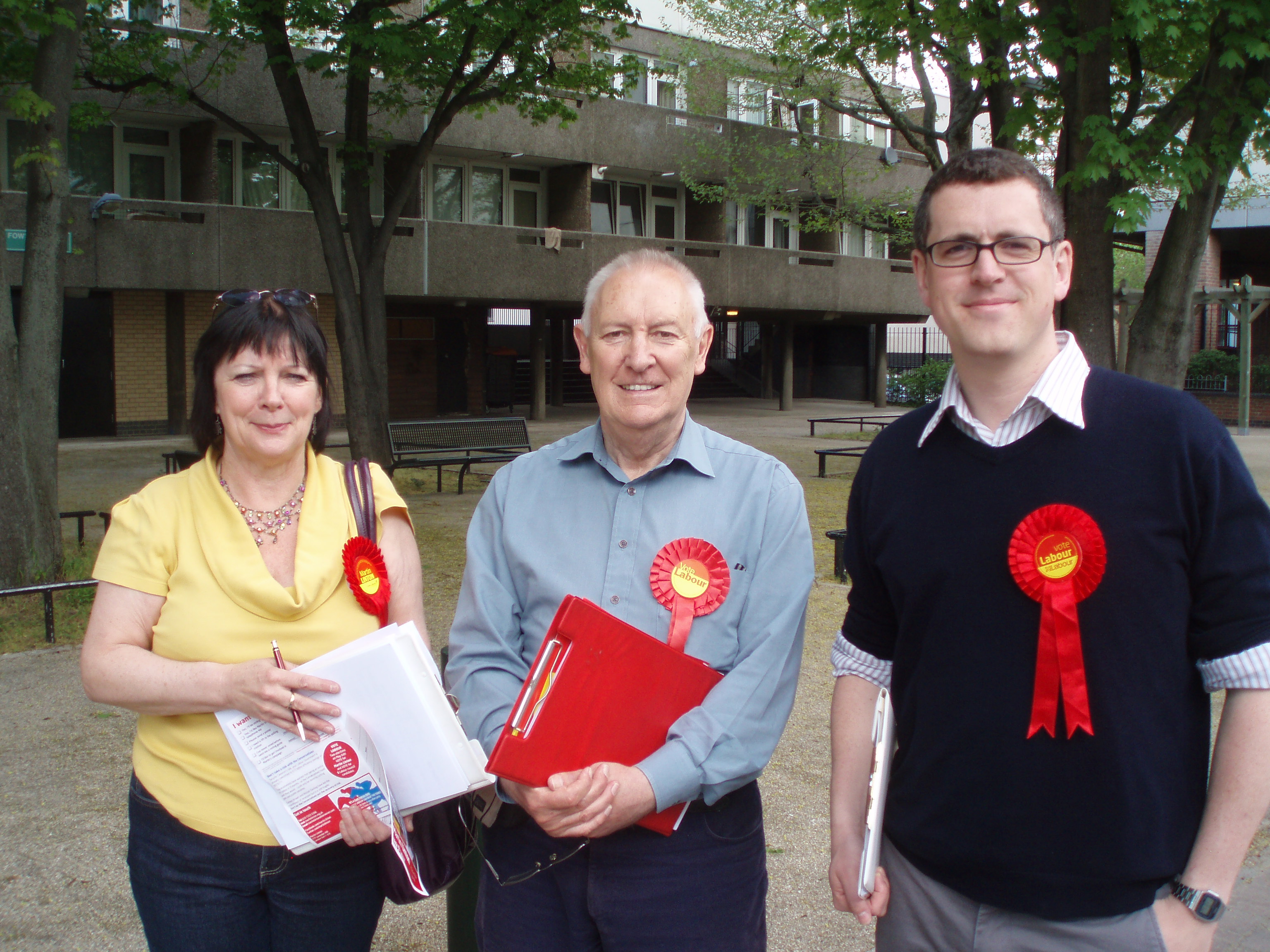 May 11th the Labour Party selected its candidates for next year’s Council election. I hope that you are as pleased as I am that we three, Simon Hogg, Wendy Speck and I were re-selected and will be standing as your Labour candidates next May 22nd. Here we are outside Fowler Court in May, 2010.
3. Do you know the Mercy Foundation? It is a newish charity, maybe two years old, established by and paid for by Victoria Rodney. It is situated behind the Prince’s Head on Falcon Road. It was established to provide IT classes for local people, who have not had the benefit of further and higher education. But it has also become a kind of drop-in centre for plenty of “difficult to reach” locals. Well on the last few Tuesday mornings I have been there and taught English to a class of largely Somali women. And last Tuesday two more volunteers dropped in. There are far worse things to do if you have any spare time!
4. I went to a guest lecture from the poet laureate at Roehampton University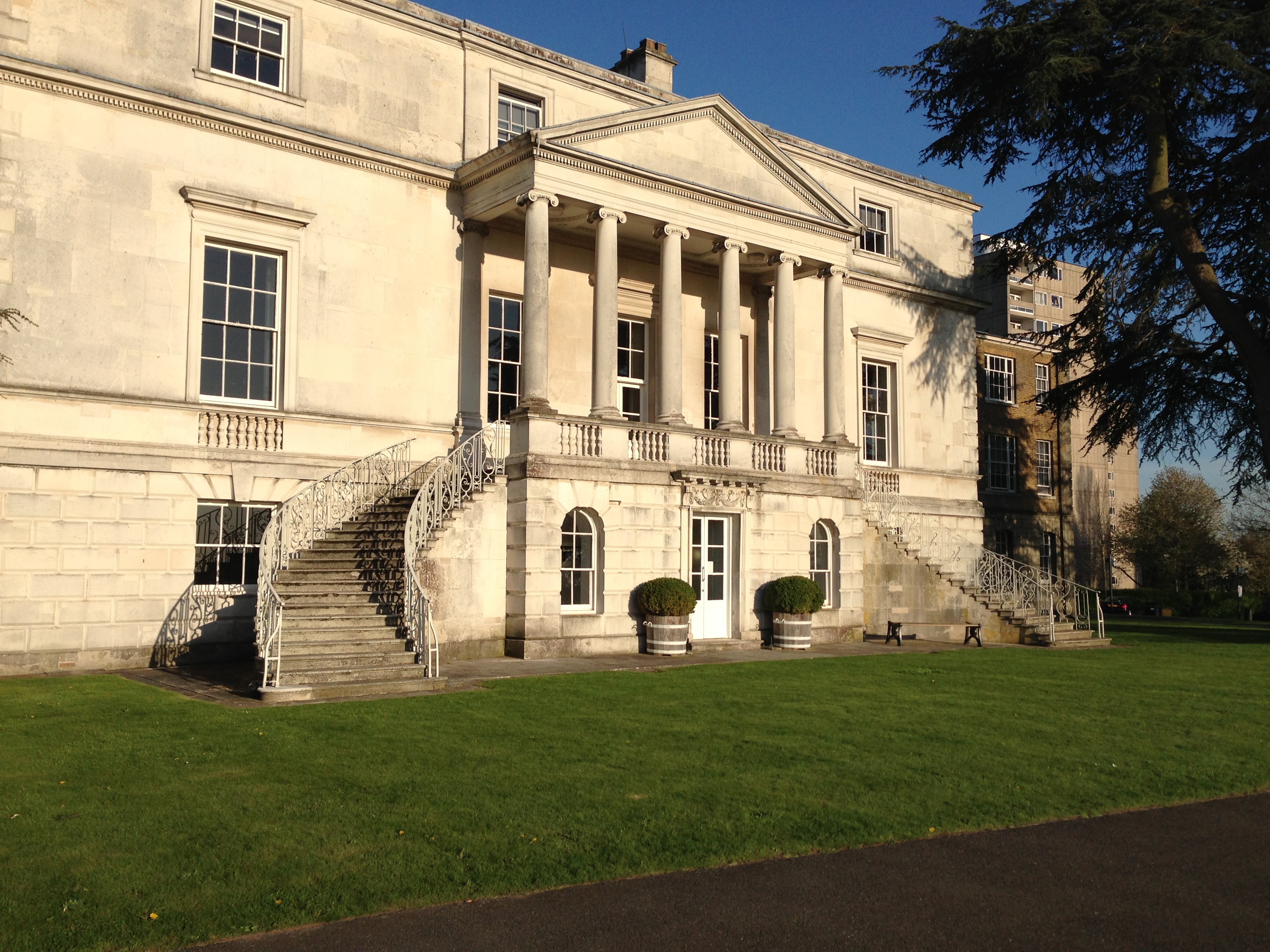 on 1st May. It was a wonderful evening in this terrible spring and the lecture was in a grand eighteenth century mansion, called Parkstead House, with a simply beautiful view over Richmond Park, even if the lecture was not quite my cup of tea. But what I did not know was that Parkstead House, pictured right, was where Gerard Manley Hopkins, the nineteenth century poet worked and studied.
5. To be honest there was not a lot to talk about in May indeed even May’s Planning Applications Committee on May 8th was low key. There were no Latchmere applications and indeed very few of anything other than very local significance.
My Programme for June
1. I am leading a history walk on 1st June at 11pm (not 2 pm as stated last month) as part of the Wandsworth Heritage Festival. It costs £10 per head and I guarantee that I will teach you something about the neighbourhood that you don’t know. Kids are welcome and, of course, free. We start on the corner of Albert Bridge Road and Battersea Park Road right opposite the Latchmere pub. If you are thinking of coming then please email me – nice to know the numbers to expect.
2. There is a Planning Applications Committee on the 6th June, which unfortunately is the same evening as the Police’s SNT (Special Neighbourhood Team) – so I will have to miss that.
3. We are going to try and hold a councillors’ surgery in the mosque next Friday or Saturday.
4. The Big Local Group is meeting on 10th June at the Wilditch.
5. I have the Housing Committee on the 19th June and Strategic Planning and Transportation Committee on the 24th.
Did you know?
About Elizabeth Braund, who died on 20th May at East Shallowford Farm.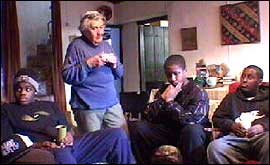 I didn’t know much about her either but I know a bit more now. In this picture Elizabeth is welcoming a visiting group of Battersea boys.
In May I paid a hurried visit to the Providence House prize winning. Providence House Youth Club is right next to the busy Falcon Road/Este Road bus-stop. It was started by Elizabeth in the early sixties at the time when the old north Battersea was being demolished and replaced by the many tall blocks so well known to us in Latchmere today.
Elizabeth knew that the wholesale demolition of communities, as well as old, bombed out slums, was likely to be very disruptive to society. This is why she put so much effort into developing the Club. Then she bought East Shallowford Farm on the edge of Dartmoor as a place to take Battersea kids down on the farm. It had to be Dartmoor because the Home Counties were she thought too tame and the youngsters needed just a bit of adventure and Dartmoor was the nearest wild place to London. In this rather indistinct picture she is welcoming some of the youth club members on a visit to the farm. You can read about it by looking up her name, or the farm’s, on the web.
And here are four club members admiring her picture at a recent event at the club.
Robert Musgrave of Providence House writes: “It is the end of an era for Providence House. Around 1960, Elizabeth Braund first started the youth work in the old Providence Chapel before today’s housing estates were built.
In 1970 she opened the present building on Falcon Road to consolidate the work with young people and families. In 1975 the new adventure to Dartmoor began, with the opening of East Shallowford Farm in 1976.
On Monday 20th May 2013, Elizabeth passed away at her home, East Shallowford, just 3 weeks short of 92 years. Her legacy is in the lives of countless Battersea and Wandsworth families.
It is the end of an era. A new era begins.”
Peter Ackhurst
- Peter by Brenda Holtam, 2011

Peter Ackhurst (7th March 1935 – 4th June 2013) died peacefully in his sleep on 4th June. Peter was born in Louis Trichardt township, Limpopo, South Africa on 7th March 1935. His early life was spent in the more hard-line Apartheid provinces of South Africa, the Orange Free State and the Transvaal but when he went to Rhodes University in the Eastern Cape his rather more liberal tendencies came to the fore, so that by the end of his student days he was the national secretary of NUSAS, the National Union of South African Students. This was not like being the Secretary of GB’s NUS. NUSAS was in conflict with Boss, the Bureau of State Security, the powerful, one might say thuggish paramilitary wing of state apparatus. Peter as the General Secretary of a students’ union was under suspicion and observation; he felt he had to get out but for a time he could not get a passport, but eventually the regime relented and Peter came to UK in 1955.
I knew a couple of white, anglophile SA students, who escaped from South Africa at about this time. Some had seen enough of politics and never raised another political fight of any kind but not Peter (or his near contemporary, also Putney resident, Peter Hain). He joined the Putney Labour Party (PLP) in 1963. It was good timing. The constituency had been Conservative since it was created in 1918 and it was part of the old Metropolitan Borough of Wandsworth, which had again been Conservative since its creation in 1900.
But then Hugh Jenkins won the Parliamentary seat in 1964 and a year later the Borough was merged with industrial, working class Battersea and for the first time Putney had both a Labour MP and a Labour Council. Seven years later Peter stood for the Council in the then fairly safe Labour ward of Fairfield. He was part of a team of young Labour Party activists, led by Putney agent and sitting councillor Ian McGarry, who not only worked to find seats for themselves in winnable wards, but together as a team to make sure that their friends and political allies were equally likely to get elected.
In May, 1971, Labour had a massive victory winning 54 of the 60 Council seats. And so began a very exciting and turbulent seven years, when the Motorway Box was defeated, a massive programme of housing construction was maintained, Wandsworth got a modern social services system and some semblance of a planning system. The Thames and Wandle walkways were begun; parks were built; the Battersea Arts Centre was created and many other bold initiatives taken.
But there was also the battle over Ted Heath’s Housing Finance Act, when Labour councils took on the Government over the ultimate control of council housing. The Government was bound to win. Labour Councils made the great mistake of taking on superior forces on a battlefield of the Government’s choosing. The radicals lost, resigned their posts, took them back again within a year, but had lost their enthusiastic innocence – and the balance between local and national government was destroyed, possibly never to be regained.
During this time Peter was Deputy Leader of the Council, 1972-75, Chair of the Highways Committee 1971-72 and Chair of Policy and Finance 1975-78. Putney parking schemes were for ever etched on his mind as an unwinnable fight.
Peter was a man of great charm with a lovely voice – he was always a delight at any social gathering, with a story or an argument for every occasion. He could be irascible and bad tempered but had the wit never to remember an argument the following day. His deafness became a bit of a social handicap in later life. He was a terrific and inventive cook and never seemed so much at home as when cooking for friends and an extended family in a Lake District cottage or his large kitchen diner in Holmbush Road.
One of his greatest gifts was his extended family. His wife’s first husband is as concerned about Peter’s kids as he, Peter, is for Annie’s children by her first husband. They all play and occasionally work together and there is no doubt that Peter has been the pivot of that family network.
Peter was a keen and gifted amateur artist; professionally an architect; a much loved boss who finished his career as a Director of (was it?) the Housing and Development Department of Hammersmith and Fulham Borough Council. He was full of plans, but usually found life too absorbing and full of diversions to give him enough time to convert them into reality.
He was a personal friend, and a holiday companion a dozen times when we played appallingly bad golf together and fought over bird sightings and then talked of the day over bibulous suppers and a cigar – or two.
I will miss him as will his wife Annie and children, Stephen and Gillian, and all of Annie’s family – and many others.
Faith, Fools’ gold – a modern disaster?
In today’s paper (The Observer, 26/5/13) a front page story shows a majority of Britons believe that we are bound for a clash of civilisations between the Moslem minority and the majority British indigenous population. One “civilisation” is characterised by faith and the other by a kind of secular broad Anglicanism.
A simplified historical analysis suggests that Europe was riven by religious wars in the sixteenth and seventeenth centuries, until they learnt better and slaughtered each other for nationalist and imperialist reasons instead. In Britain religious strife was the underlying cause of executions, conspiracies and murder let alone Civil War and regicide. Then in 1689 the Act of Toleration, allowing freedom of religious worship – even if at first only for most Protestants of whichever denomination, started a process of freedom for all religions, leading to the largely secular and tolerant society of late twentieth century Britain.
But even these islands suffered a little from religious intolerance. In twentieth century Ireland, the south saw the largely peaceful but very damaging emigration of the relatively affluent Protestant population; and much more notoriously in the north the so-called “Troubles” have destroyed lives and communities. And religious conflicts have often surfaced in cities such as Liverpool and Glasgow.
In Britain, one of the curious by-products of religious interests and a conservative society was, and is, the existence of so many C of E and Catholic schools, especially at the primary level. Originally a messy typically British compromise, to buy off church opposition to compulsory state education, it was a compromise never seriously questioned except by some of us on the left in the sixties.
Church schools remained a curious feature of this very secular society. They are even more of a curiosity when compared to the overwhelmingly secular, state schools and schooling system that reigns in far more religious countries, such as USA, France and Germany.
As it turns out the failure to resolve this clearly illogical policy left secularists, like me, in a weak position when faith resurfaced as an important feature in post-Thatcher years. The argument that C of E schools didn’t really matter as all they taught was a very secular kind of bible study and good manners was pathetic against the demand for equality from other religions.
Suddenly local education authorities had to create SACREs (Standing Advisory Council for Religious Education, Education Act, 1988). I was one of the members of Wandsworth’s first Sacre as a “protesting” humanist! And then came Tony Blair!
Under him, we got faith schools and now with the arrival of Govite free schools, a mechanism designed to create a thousand different types of school – what a Maoist Government we have! Suddenly just as religious strife hits our streets in more and more dramatic fashion, with bombs, knifings and vandalised mosques, we are creating separatist education. In Wandsworth, we have an Islamic primary school, a new Catholic secondary school on the drawing board, a new Anglican secondary school now a decade old, and just approved a new Jewish school.
Surely it is one thing to celebrate difference but quite another to cement separate development worthy of Ireland, South Africa or Palestine. It is surely time for us humanists to gang together with tolerant and sensible members of other faiths to defend and fight for secular education for all.
Social Media, Blogs and political parties
Ever since the 2008 Obama campaign it’s been a sine qua non of English speaking politicians that parties and individuals must have excellent social media skills. Go canvassing, run a street stall, kiss a baby but make sure you get the story on Twitter and the picture on Facebook. I hear plenty of rationalisations for this behaviour with my favourite being that it scares the Tories witless – we seem to have a low opinion of our opponents’ nerve and intelligence and a high opinion of just how newsworthy our stories are.
Which is not to say that I don’t think that social media has its role, but just as Facebook seems to have peaked already and lost some of its appeal, I suspect that Tweeting is going to calm down – after all admirer of Danny Blanchflower, the footballer as well as the economist, as I am I get fed up with his thoughts on sport, the weather and everything else tweeted 10 and 20 times a day.
Tweets seem to me to be superb campaigning and rallying cries designed for elections, announcements and dramatic events – not for everyday stuff like haircuts or canvassing. 99.9% of the tweets I have ever been responsible for announce that I have published another blog entry and that seems to me to be an ideal use.
But the Blog is, I think, of a different order. I am told, repeatedly that my blogs are too long, that people just won’t read them, that they are sometimes boring, but that isn’t the point. They are the modern version of the old essay, as written by essayists. Mine are for my benefit not primarily the readers. If you, dear reader, find one or two of them interesting then that’s great but primarily they provide a vehicle for my thoughts.
But whilst writing this, it occured to me that for a party politician this opens up a hatful of opportunities, and for parties a complex new problem.
For a century democratic politics has struggled with the problem of communicating with the electorate. This struggle has largely been “avoided” by the use of party labels. It has been impossible to speak to all the electorate, so we use short-hand. I am Labour, therefore, nice and caring. You are a Tory and, therefore, nasty but better at making decisions.
It is this facet that has led me to justify the party whip and party discipline. Indeed the most frequent use of the argument is in justifying party politics in local democracy. In local elections it is surprising to the professional politicians just how many voters think that there should not be any party politics at all.
And then along comes the blog. No longer is it possible for the party to control what the candidate says to the electorate; or really the whip to control the elected politiican and enforce the party line; or the Electoral Commissioner to monitor expenditure on elections.
Now I can publish my own maybe maverick views and get a level of support for them based purely and simply on my own persuasiveness and the extent of my readership; but so can all my councillor colleagues. What kind of challenge does this pose for party politics. That is, of course, difficult to say right now, but it is almost certainly going to be very profound.
In the States it appears as though the major parties virtually cease to exist for the four years between the national conventions with social media used by the leading candidates to grab funding and then encourage volunteer canvassers. The Tea Party appeared for a time to be the only active force between elections: a strange parallel with UKIP perhaps. Given the still falling membership of British political parties are we going to go the same way?
Thatcher and her Jewel in the Crown
One or two Tory friends have asked me for my thoughts on Mrs Thatcher particularly in the context of me being Leader of the Opposition in Wandsworth, the proclaimed Jewel in the Crown, when she became PM and for most of her time in office. So you can blame this piece – which obviously concentrates on a Wandsworth perspective and not the national one being covered in a million other places – on them.
First here is a short story about the 1982 Borough Election. Although 1986 was statistically the closest Wandsworth Borough Election (Labour won more votes, by a couple of hundred or so, but the Tories squeaked in by 31 seats to 30) for me 1982 was the real turning point. A month before Election Day a Labour victory was a certainty. Mrs Thatcher was as unpopular across the country as was “Chopper” Chris Chope, the Tory Leader of Wandsworth. And then in classic manner her two most famous enemies – the trade unions and Argentinian General Galtieri – jumped in to rescue Wandsworth’s Tories.
Wandsworth Tories had been struggling with the unions over improving refuse collection, which was riven by cronyism and archaic working practises. But there was no real will on the unions’ part to negotiate and so the Tories decided in late March 1982 to gamble on the then innovative policy of putting it out to tender. It might now seem to be a “no brainer” but at the time it was a bold step to take.
My heart sank a few days later when two local union bosses came to see me to announce, with obvious delighted self-satisfaction, that they were calling a strike in time for the election. They were a little taken aback by my negative reaction but not sufficiently to change their minds.
Then on 2nd April Argentina invaded the Falklands; on 2nd May the Argentinian light cruiser Belgrano was sunk by the British Navy and on the 4th HMS Sheffield was sunk by an Exocet missile. On the 6th May Wandsworth went to the polls and although the Tories lost a couple of seats they were back in by 33 seats to 27 with 1 Lib/Dem. In five weeks Mrs. Thatcher’s political career was forged, and you could say mine destroyed, as any hope of Labour winning in Wandsworth had gone with the wind.
This story captures two features of Mrs Thatcher’s career. First, it has to be acknowledged, her boldness and second the luck she had with her enemies, whether Scargill and Foot or Galtieri – these two features were not lacking in Wandsworth either.
Wandsworth’s Tories were bold to take on the unions, who in their turn were crass in their failure to recognise the limits both of their power and of their support. The unions still flush with their “success” in the 1970s did not understand that the public were prepared not to have their bins collected for a week or so if the Council was able to tough things out and to win the conflict.
The Tories were also bold to take on the GLC and the ILEA, though whether for good or ill is of course another matter. Although it is a very different animal, there was no opposition to Tony Blair’s decision to restore some form of city-wide Assembly, now the Mayor and the GLA. No, lack of courage is not a criticism that I would ever have made against Wandsworth’s Tories in the 1980s.
The Labour Party (me?) also made our mistakes, most particularly about council house sales (RTB). Labour councillor Nigel Morgan and I argued that straight opposition to sales was never going to work. We foresaw the consequential modern disaster of the lack of social housing and, therefore, argued that capital receipts should be used to build replacements. But this was a sophisticated position, which got lost in the ferocious and noisy national battle over the issue. Ironically our position is now accepted even by the current Cameron Government – Nigel, if you ever read this, get in touch. We were right and everyone else wrong!
The impact of RTB in Wandsworth has been dramatic. I would argue that it is a major feature in pushing Wandsworth up the wealth leagues of London Boroughs to the considerable benefit of some of the population and at a far greater cost to many of the others. Wandsworth is now one of the most harshly divided of all Boroughs with levels of deprivation in a few areas alongside some of the richest parts of the country.
Populist but heartless, bold and assertive but bullying and overbearing, are descriptions that are almost inter-changeable for Thatcher and Chope and the Wandsworth Tories in the 1980s.
Much of the national coverage focusses on the apparently inevitable long-term impacts of Mrs T. How she put the Gr8 back into Britain – you know the argument. It is the Tory line in Wandsworth too. I guess they would say that it is commanding the narrative. Hence Wandsworth was, in their mythology, sinking in the mire of the winter of discontent until they arrived to rescue it and make it the “Brighter Borough”. Wandsworth even has, in its way, its own Ted Heath: he was Dennis Mallam, Tory Leader through the 1970s and then dropped as soon as decently possible just prior to the Thatcher victory of ’79. Poor old Dennis! He was really wet. He wanted to build more council houses than Labour had done!
Well you don’t have to be very much on the left to have a very different narrative. One that concentrates on community and abhors the individualised “Loadsamoney” culture that is so publicly associated with Thatcherism. And again this division between communal values and rampant individualism is mirrored in Wandsworth, perhaps especially in Battersea where everyone knows how different life is depending upon which side of the tracks you happen to be – the mainline from Waterloo to the south west. Is it a complete coincidence that one of the worst scenes of violence in the riots of August, 2011, the Clapham Junction riots, happened on the very border between great wealth and great poverty?
There are other interesting parallels between Wandsworth and the country, which reflect the impact of both Thatcher and the Wandsworth Tories. Mrs T brought in “Big Bang”, hence liberating the City to become the bloated, dangerously over-powerful driver of the British economy. And, funnily enough, one of the biggest residential concentrations of bankers in the country is right here in Wandsworth, attracted by the once cheap housing that used to be the homes of industrial workers and the low rates/Community Charge/Council Tax. For the wastelands of the industrial north read the very large but completely obliterated industrial area of Wandsworth’s riverside – all now given over to expensive and rather barren flats, many of which are owned or rented not by Londoners and are left empty for long periods of the week and of the year.
So my Tory friends, what in summary is my reaction to the news of her death? To the fact of death – nothing much – but to her heritage. In 1979 GB was the most egalitarian it has ever been and now 33 years later we are at levels of inequality not seen since 1913. In 1979 we had a trade union movement that was clearly out of control but now we have one so palpably weak it is becoming a danger the other way, with the Tory right arguing for yet more “business friendly” rules and leading moves not to a high wage, high skill economy but to a dog-eat-dog, low pay and low skills economy.
In 1979 you Tories feared that we were the sick man of Europe (which we never were, of course) and had lost the respect, which you think other countries should show us. In 2013 we are the tax haven of choice for everyone from Russian pluto/kleptocrats to foot-loose business money. And yet, the mood and moment of the 2012 Olympics, so different and so unThatcherite, has gone far to show that their is another way – success through harmony.
For sure it is a complex heritage and clearly you, Tory friends, do not understand why not everyone does not see it your way. But until you do you will not even see the terrible damage she did to many regions of the country and to many people in all the regions.
Bedroom Tax – and as for the Lib/Dems?
I left out the Lib/Dems from my last blog re marginal constituencies – perhaps it’s because I come from Lib/Dem free Wandsworth but a reader pointed out that it has a potential impact on them too, so here is my analysis of top Lib/Dem marginals.
Of the top five marginal Lib/Dem:Labour seats three have majorities less than the number of households affected by the Bedroom Tax!
They are:
Norwich South; 310; 1973
Bradford East: 365: 1023:
Brent Central: 1345: 1057: majority greater
Burnley: 1818: 957: majority greater
Manchester, Withington: 1894: 2678
Bedroom Tax – the political impact on the Tories
What I did not say yesterday was that in 17 of the 20 tightest Tory:Labour marginals the number of households affected, and I mean households and not voters, is greater than the Tory majority in 2010.
The data is by constituency:
Constituency: Majority: Households affected
1. North Warwickshire: 54: 766
2. Cambourne and Redruth: 66: 454
3. Thurrock: 92: 1140
4. Hendon: 106: 680
5. Oxford and West Abingdon: 176: 572
6. Cardiff North: 194: 1067
7. Sherwood: 214: 804
8. Stockton South: 332: 1431
9. Lancaster and Fleetwood: 333: 555:
10. Broxtowe: 389: 581
11. Truro and Redruth: 435: 500
12. Newton Abbot: 523: 326: majority greater
13. Amber Valley: 536: 559
14. Wolverhampton South West: 691: 1396
15. Waveney: 769: 788
16. Carlisle: 853: 1181
17. Morecombe and Lunesdale: 866: 700: majority greater
18. Weaver Vale: 991: 1397
19. Harrogate and Knaresborough: 1039: 684: majority greater
20. Lincoln: 1058: 1155
One has to ask: Did they know what they were doing when they introduced this abomination and of course the resounding answer is NO.
Bedroom Tax – How Tory councillors fail to support their own constituents
Most of us are now well aware that the poorest in our community face a deluge of damaging benefit cuts on Monday, 1st April, including the vile Bedroom Tax. I will write another blog, another day about the vicious nature of this tax and just what it displays of Tory attitudes to council or social sector tenancies, but today I wanted to focus on the particular impact in Wandsworth.
The Guardian has just produced a very helpful map of where the impact is greatest and in its commentary says that the impact is counter-intuitive. I think that means that the journalist expected the hardest hit areas to be the great northern industrial cities. But in fact the worst hit single area of all is Wandsworth and the whole south east region including many of the most affluent parts are almost as hard hit. So whilst the “tax” for having one bedroom “too many” in Wandsworth is £912 per household per year, just down the road in Esther it is £851 and in Kensington it is £839.
This is because the tax is a function of the rent levels and with much lower rents in, say, Hull the impact on individual tenant households is rather less; actually it is £489 in Hull. But there are more than 2,000 households affected in each of the three Hull constituencies and only about 900 in each of the three Wandsworth ones.
Bizarrely this means that Wandsworth Tories have been aggressively promoting this vicious “tax”, which results in hitting their constituents harder than anywhere else in the country. It also means that they are supporting a policy, which is taking approximately £3.5 million out of the Borough’s economy. Knowing the area, as I do, this will cut living standards in Roehampton and Latchmere (the council flats on north-side of Clapham Junction station), where ironically the Council is now looking to invest £100 million precisely because of the under-privileged nature of the area.
Irony of ironies this is happening in the very same week as millionaires are getting £100,000 p.a. tax cuts and given that there are said to be 6,000 of them in the country, with Wandsworth’s share at least 35, what we see here is a Cameron/Osborne swap of money from the poor to the rich. And what do we know about the relative spending habits of rich and poor? Well for one the rich are more likely to spend some of their money in St. Tropez and Bermuda and much less likely to be spending it in the rundown shopping areas of Falcon Road and Danebury Avenue (the two main shopping streets in Latchmere and Roehampton).
I hate to think what Robin Hood would have made of it all but I can’t see how any Tory can be seriously surprised if we have many more civil disturbances – or at very least massive refusals to pay rent.
Affordable Housing Battersea Style
I want to tell a story about affordable housing Battersea style.
Sister’s Avenue is a road full of rather grand Victorian houses, including one Victorian block of Mansions, running from Lavender Hill through to Clapham Common. At some time during WWII a bomb clearly took out 20 or so houses on each side of the road at the Common end – plenty of evidence in Battersea at just how bad the Luftwaffe was at hitting Clapham Junction station.
In the 50s and 60s Battersea Borough Council built some pleasant and ordinary council houses, all gone right to buy, and a small 2 storey block of 6 flats. When Wandsworth Council (as it had now become) went Tory in 1978 they started an aggressive sales policy – by aggressive I mean that rather than just sell when a tenant expressed interest the Council ran sales fairs, gave prizes for landmark sales – the thousandth, etc. – and generally did their level best to stimulate sales.
79 Sister’s Avenue was the first of the block of flats to be sold in 1983 for £13,500. By January, 1989, all six flats had been sold at an average price of £17,950. Good luck you will say to then residents. Wandsworth had created 6 new affordable units for sale and resale – bully for Right-to-Buy and Tory policies.
By 2007 Robinwood Ltd, a property developer was sniffing around. The developer clearly saw an opportunity to increase the asset value. 2007 was a busy year and by the end of it all six flats were owned by Robinwood having bought them from the owners at an average price of £315,000 (NB for accuracy it should be noted that I do not know the price of one of the flats and so this is an average for 5 but there is no reason to think that the sixth would be substantially different).
Robinwood, or their agents, put in a planning application to build six large town houses. These six have just been completed and are on the market with Savills, the top people’s estate agency and the prices vary from £1.725 million to £1.925 million – checked out with Savills today, 13/3/13.
In 30 years we have gone from having 6 council owned flats, which by any standard would have been affordable at a rent of £20 per week (WBC average rent in 1983 was £20.12), to genuinely affordable private flats and now to luxury housing at nearly £2 million a shot.
The strange irony of this is that this tale works for both Tory and Labour Partys. For people of my persuasion it highlights the terrible divisions between the rich and the rest (the people living there were not the really poor) and what Tories have allowed to happen to the stock of affordable housing. It highlights the brutal callousness of Wandsworth Tories and displays why they are so contemptible in the eyes of many on the left.
For Tories it has helped to improve the Wandsworth environment ensuring that the rest of the housing in Sisters, and Battersea in general, continues on an upward curve; it has improved the housing stock; it has made Wandsworth a better place to live in. It highlights the head in the sand, conservative (small c) nature of Labour members.
Matching up these completely disparate views of life is the stuff of political controversy.
 Tony Belton
 Tony Belton