Councillor Tony Belton’s Battersea May, 2020, Newsletter (# 131)
- One extraordinary month follows another. I said that about
 March but again “What a month April 2020 turned out to be!”. Brilliant weather, day after day. The sunniest April on record and probably the warmest and driest, even if the last three days made an effort to catch up on the showers front.
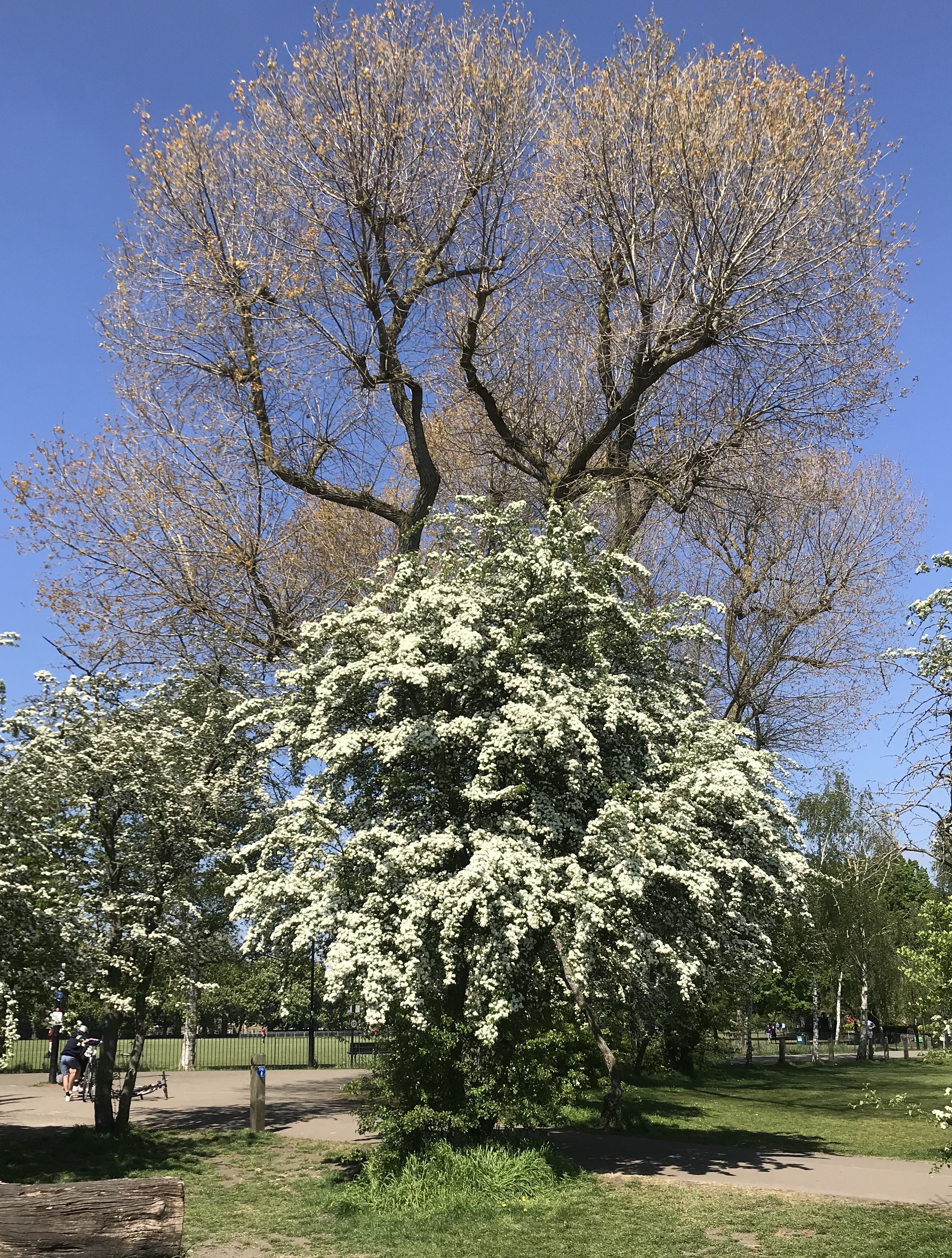
- I have sat in the garden for more hours in April, than in some years in the past, and noted what I am sure we have all noted. The birds seem to be singing more loudly every day, especially my local blackbird, who is glorying in not having to compete with the constant scream of jet engines on their way to Heathrow. Our bluebells are out in profusion and the apple blossom is at record levels. The air is as clear as has been seen in London, since, maybe, coal first started being widely used in the mid-eighteenth century.
- At times, it is difficult to remember that for many, many families April 2020 has also been the terrible month when a family member died before his/her time, leaving grieving sons and daughters, grandsons and granddaughters, husbands and wives.
- In my road, there is a weekly clapathon, or is it a clap-in, in honour of our NHS workers, from physicians and nurses, to cleaners and porters. This last week it was completed by a small concert when 6 and 9-year old neighbours played Judy Garland’s Over the Rainbow on a violin and a cello, accompanied by their mother on the piano. The audience of about 50 neighbours hardly had a dry eye between them.
- On April 4th Sir Keir Starmer was elected Leader of the
 Labour Party. He won the vote with 66% support from Party members. He immediately raised the morale of many in the party with his inaugural speech and has since taken immediate action to quash the ant-Semitic issue. His two performances in Prime Minister’s Questions, in neither case against the Prime Minister, have been forensic and “cool”, in exactly the way his critics describe as bloodless and I think of as precise and deadly. Over the months we will discover whether it is effective, though it looks good to me – and to you, I wonder?
- On April 23rd I took part in a virtual Planning Applications Committee. It was “broadcast” online and on the 28th I heard that the committee was viewed by over 550 people, making it probably the most broadly observed committee in Wandsworth history. The Council used Microsoft’s Team software to film the committee. Take a look: https://richmond.public-i.tv/core/portal/webcast_interactive/484556 but remember this, the first broadcast is a little slow to get underway!
- Virtual committees seem to me, on the basis of this experience (and a few other online meetings: Labour Party and Charity), to have both advantages and disadvantages when compared to the “real thing”. The advantages include clearer sound (and picture) as the camera and mike are within a yard of the speaker, whoever he/she may be. But on the other hand, neither participants of the meeting nor the audience can see all the other committee members and so it is more difficult to gauge the mood of the meeting. Some councillors have already predicted the end of formal committee meetings and I suspect that the crisis is inevitably going to result in a re-think of the traditional and now very dated Council Meeting. But I think that Councils, like Parliament, will find it very difficult to operate as in any sense a political forum without some kind of meeting of people, face to face. The political process relies as much on exchanges over a coffee or the bar as it does on formal debate in the chamber.
- As for the Planning Applications Committee’s real, standard business, it was dominated by applications relating to Battersea. As always, there were a number of smallish applications, which were significant, only to the applicants and their immediate neighbours. But one major one raised issues of general interest.
- The major application was for a “collective” living project with rooms for 500 residents, along with a hotel, restaurants and a number of collective facilities such as work space and studios. The developers intend to build this project on two sites, backing on to each other in Mendip and Chatfield Roads. It is undoubtedly an excitingly different style of life from the traditional flat and/or house. However, to my mind, it raised a slew of questions about collective living in a post-Covid times. But I was in a minority of one and the application was passed.

My Programme for May is completely unknown!
- We had all expected to spend much of May fighting in the GLA and Mayoral elections, but as you know they have been postponed for a year. Does that mean that the next Mayoral term will be only three years or will we simply lose a year from the next cycle? I imagine that the legislation was clear on this matter but I don’t know.
- May is usually an important year in the municipal year. It is both the end of the 2019/2020 year and the start of the 2020/2021 year and is, therefore, the month of annual meetings and elections of the Wandsworth Mayor and of the Leaders of the Council and the Opposition. But by general agreement that is all going to be postponed until at least later in the summer. We shall see.
- Most of the committees will also be postponed but having had one virtual Planning Applications Committee (PAC) last month, I am pretty certain that we will have another on 19th May, but apart from PAC, I suspect it will be a pretty quiet month!
Do you know the last time elections were postponed?
Elections were, of course, postponed during the two World Wars, although there were by-elections in the event of the death or resignation of MPs. But an election was postponed on at least one other occasion in my memory. Do you remember when that was and how long the postponement lasted? The fact that it has been almost entirely forgotten is perhaps a good omen for this occasion.
Remember, on this May Day, the International Labour Day all those front-line workers risking their lives to make our lives safer. And finally, look after yourself and your friends and families. Keep safe!
Councillor Tony Belton’s Battersea December, 2019, Newsletter (# 126)
- This November was going to be a quiet month, and so it started. Penny was in China on a Presidential tour for her 18th century historical society, including lectures in Shanghai, Nanjing and Beijing, so I got myself invited to a “drinks social” on 7th with Christine, dinner with Sarah on the 8th and the Providence House Fund Raising dinner on Saturday, 9th. This was only the second time that Providence House has tried a relatively expensive fund-raising dinner and there’s no question that this was a significant step up from 2018.
 The meal was exquisite, prepared and cooked by Hadas Hagos – quite a feat with a guest list of well over 100; the entertainment was provided by friends and members of Providence House, the largest and best youth club in Battersea.
- I went to St. Mary’s Remembrance Day Service on 10th November and then the “real thing” on 11th November in Battersea Park. The St. Mary’s Church service was very special and very moving. The front cover of the service programme had a photograph taken at the first
 Armistice Parade in Whitehall in 1919 – a new photo to me. The reading was from US Marine, Sergeant Jonathan Kirk Davis, on returning from combat to “home” – again new to me and very moving. And as for Canon Simon Butler’s own sermon, it managed to be moving but neither sentimental or jingoistic, to be full of religious feeling but totally acceptable both to an atheist like me, and I would have thought to those of different faiths. I am sorry to say that the following day’s service, organised by Enable on behalf of Wandsworth Council, was less successful. The presence of local school children was good and appropriate, but the format of the occasion is rather dated and needs review. The weather was, however, fantastic; very cold, very breezy, very autumnal.
- On 13th November I went, with Marsha de Cordova, to the Wandsworth Civic Awards Ceremony. I had a particular reason for going because my old friend (we met in 1967, I calculate) Ron Elam was receiving one. Ron has been a school governor for the best part of 50 years, including a long spell at Chesterton Primary. He kindly “blames” me for getting him started on this path – if so, then I did state education a service, as Ron has been a dedicated governor and also a constructive Ofsted inspector.
- On 16th we went to Newark, Nottinghamshire, for the week-end. Why Newark? Penny was chairing a public lecture given by fellow historian, Professor Norah Carlin, on petitioning during the Civil War (1640s) – the one which finished with the execution of Charles I. The petitions, which were essentially about what to do with the then constitutional crisis (sounds a bit like 2019!), and they came from all over the British Isles, very definitely including Ireland, and seemed to be targeted at a much more united set of kingdoms than exists today.
- After the lecture, we went to Newark’s
 Palace Theatre to see a production of Charles Dickens’ A Christmas Carol – a nice if slightly sanitised production featuring an unusually youthful Scrooge. What the unreformed Scrooge would make of today’s marketised Christmas one hesitates to speculate but safe to say that he would certainly have exploded “Bah! Humbug!” The next day, we had a quick tour of the town, which took in the Castle, which was destroyed in 1646, and a visit to the National Civil War Centre, before returning to Battersea.
 -
On the afternoon of 21st November, I attended a very special War Memorial at
 Christchurch
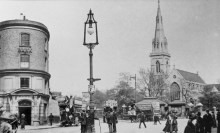
  Gardens. It commemorates civilians, who died in the Second World War, and is held in Christchurch Gardens, the site of the first V2 bomb to land on Battersea at the old Church exactly 75 years earlier on the afternoon of 21st November, 1944. The church was a grand nineteenth-century building; and I am afraid, that its relatively modern replacement lacks a similarly iconic presence!
- On Sunday, 24th November, I was
 invited to a key soccer match for all-conquering Battersea FC’s U13 team at the new Falcon Park all-weather pitch. Their opponents were an equally successful team from Lewisham and appropriately enough the result was a hard-fought 1-1 draw. Some Latchmere residents (and others) were unhappy with the installation of this “un-natural” pitch but, on a day when every other pitch in the Borough was water-logged, we three spectators were happy to see the match proceed. Marsha de Cordova is on my left and Queenstown councillor, Maurice McLeod on my right.
- A week later on 27th November, I had the Planning Applications Committee (PAC). There were several applications, which attracted interest and concern in Battersea. The first was for the use of the Thames slipway, next to St. Mary’s Church, as a launch-pad for the amphibious tour boats that can be seen on the Thames nowadays. This particular application was withdrawn but I am sure it will come back to the Committee in the near future. Two others were the redevelopment of the two industrial sites in Ferrier Street, next to Wandsworth Town station, and Jaggard Way, next to Wandsworth Common station. The Ferrier Street application included 102 residential units of which, forty-one are to be affordable, along with a modern replacement of the industrial units. This development was approved but only possible by providing the residential units in a 10-storey block, alongside the Station, just about opposite the Alma pub. The Jaggard Way application was, however, rejected because it was over-large and dominant next to the Common, despite the fact it included 72 residential units in four 4-storey blocks. I was unhappy with both decisions! The first, because I think a 10-storey block is too high to fit into the Old York Road environment; the second, because I did not consider four-storey blocks to be over-large for a site separated from the Common by a four-track railway line (though to be fair there was a specific objection about the unreasonable impact on one particular neighbour).
- On Friday, 29/11/19, we went to see a revival of A Day in the Death of Joe Egg. This iconic play of the 1970s was written by Peter Nichols, one of the lesser-known so-called “kitchen sink” dramatists. The synopsis, telling of a marriage under strain as husband and wife struggled to bring up a disabled adolescent daughter, was hardly encouraging – it didn’t look like the stuff of a great evening out. How wrong can you be? Sensational acting from Toby Stephens and Claire Skinner lit up a hugely sympathetic, humane and understanding work. The dialogue was very funny despite, or was it because of, the totally unsentimental script. It was not surprising to discover that the content was partly autobiographical. I will be doing a review on this play, which will be on https://tonybelton.wordpress.com/
- Finally, a word on the election. I know that for some Battersea residents this poses a really difficult question. What do Remain-inclined Tories do? And Labour folk concerned about Jeremy Corbyn’s “extremism”, or Lib/Dems who want a plague on both “major parties”, or Greens for whom the only priority should be climate change? But the only certainty in Battersea is that the winner will be either Labour’s Marsha de Cordova or Tory’s Kim Caddy. In 2017, Labour had 25,292 votes as opposed to the Tories 22,876, with the Lib/Dems back on 4,401 and the Greens 866. The only real impact vote switching could have in Battersea would be to the current Prime Minister’s benefit – is that the impact any doubtful voter really wants?
My Programme for December
- December is all about the General Election on Thursday, 12th!
- Not even the Planning Applications Committee, “the committee that never stops”, is meeting this month!
- Though, of course, there will be the usual round of Xmas parties and drinks. As for me, I will be having a quiet Xmas day, with Boxing Day in Winchester and then a few days in Bath, taking a swim or two in the hot mineral springs that have attracted tourists ever since Roman times.
Do you know?
Deferred this month: back again after the Election!
Councillor Tony Belton’s Battersea Newsletter, November, 2018 (#113)
- On 2nd October, I went to an Exhibition in the Brewer’s pub, opposite the Town Hall, of plans for the redevelopment of the Ferrier Street industrial site
 just by Wandsworth Town station. It interested me, because I played a large part in its development in the 1970s. Prior to then it had been a rundown area of terraced properties until the Labour Council of the time organised a vote of residents as to whether they wanted their housing “compulsorily purchased” by the Council or not. By a substantial majority, the residents, largely private sector tenants, voted for compulsory purchase. The end result was that they got re-housed by the Council and the Council became the owners of what became an industrial estate. Sold off in the early 2000s, the area looks likely to revert to mixed industrial and housing usage. For me, the startling thing is that I have lived through the complete life-cycle of a block of property from the first plans to demolition and redevelopment and now to the next set of plans, to be followed now by another demolition and re-development!
- As I said last month, on 5th October I went to Reykjavik, Iceland, to accompany my partner who was lecturing to an Icelandic historic society on “Meetings and Greetings in the Eighteenth Century”. We then spent a few days driving round the island. Many will know about the fish, the Northern Lights, hot geysers (the picture is of the active Strokkur Geyser), and volcanoes, and almost everyone will remember Iceland beating England in the 2016 European Championship. But, how many know that in the 2008 financial crash, the Icelandic stock market lost 95% of its value, the currency was devalued by 25%, and virtually every private business in Iceland went bankrupt. Ten years later, there is not much sign of any of that! So, how did such a small country manage to pull itself round?
- It isn’t physically very small but it has a population of only 320,000 – rather less than Wandsworth. After the crash, Icelanders had an important national debate and since then they seem to have pulled together in an impressive way – quite unlike Brexit-torn Britain. Having suffered from over-fishing and facing financial disaster, Icelanders seem to have decided as a national policy to concentrate on tourism! Of course, it’s not exactly Sun, Sea and Sand tourism, Costa Brava style, but rather rugged and wild, dramatic and exciting tourism with volcanoes, lava fields, dozens of waterfalls, geothermal pools, whale watching, bird and seal spotting, pony trekking, and mountaineering.
- When I got back, my first Council
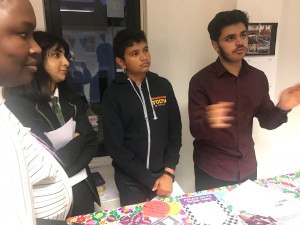 engagement was with a Wandsworth Youth Parliament seminar. During the course of the evening about 15 or 16 secondary school pupils from all of the Borough’s secondary schools both quizzed and challenged about 15 or 16 councillors from both the Tory and Labour Parties on such matters as policing, health and social services, education and housing. It was an entertaining and educative session.
- The next day, 17th October, I was off, rather unenthusiastically, to the Wandsworth Council Meeting. Council meetings have long ago had their whole heart and purpose ripped out of them. Nowadays they are so short – about one and a half hours after the obligatory prayers, questions and announcements – and so infrequent – about four or five a year – that they are no longer where council policy is decided. That is done on social media, or in secret, closed meetings. The Council meetings, themselves, are good for councillors to exercise their oratorical talents, but that’s about it. On this occasion, there were about ten maiden speeches, that is a councillor’s first speech in Council. Most of them were very good, BUT why would anyone go to the Council Chamber to listen to them unless they were relatives or part of the councillor club? These meetings really do need a re-think!
- The next night, 18th October, was the Planning Applications Committee, but there was not much of general interest to Battersea on the agenda, unless you live on Battersea Reach, where the development company,St. George’s, are in dispute with residents over car parking. I hope that things can be sorted amicably, but alas I have my doubts.
- On the morning of Saturday, 20th October
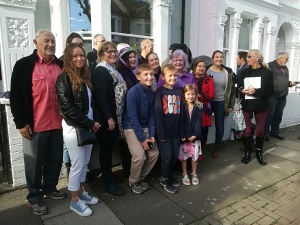 2018, I was wheeled out as the token man at the unveiling of a plaque to Caroline Ganley. I was delighted to be there, at 5 Thirsk Road, where Caroline lived for most of her life. See below (in Did you know?) for far more about Mrs. Ganley’s achievements. The picture shows some of Caroline’s grand-children and other relatives as well as the “unveiling party”.
- In the afternoon, my partner and I went on the European March. I have been on marches since the early Aldermaston days, marches
 to ban the bomb, to end the Vietnam war, to stop the abolition of the ILEA, against Apartheid, against Nursery Vouchers, even against the Pope’s visit to Britain (odd one that, but so be it) and most particularly against the Iraq War. Regardless of what the police and the BBC say, in my view, this was the biggest. The Iraq War protest was eventually upgraded, I seem to recall, to 1.3 million people – I think this one was even bigger. One interesting feature of the march was that there were virtually no organisational banners – no Trade Unions, no constituency Labour parties, no religious groups, just masses of people. (Despite that one crazy UKIP friend of mine actually believes that the European Parliament paid us all to turn up!)
- For me, the staggering feature of the political month, has been Labour’s almost total silence on Brexit. The Tories are, of course, in a complete funk, and yet somehow they retain their very small lead in the opinion polls. How can that be? All I can think, is that the lack of clarity on Labour’s part is making it very difficult for the public to decide, who to support. Do they support the Tories, who are making such a shambles of the whole thing? Impossible! Or do they support Labour, which has not yet summoned up the courage to give a lead – apparently not!
- It is still possible, I guess, to think that Corbyn and McDonnell are playing an absolute blinder, leaving the Tories out there to dry and not yet exposing the Labour Party’s own divisions. But, it is clear that whilst Party members are over-whelmingly “Remainers”, a sack full of MPs represent constituencies, that voted to leave – as some might say, horns of a dilemma! But how much longer can Corbyn sit on this particular fence? Surely, he has to plump before 29th March and if he doesn’t then, in my judgement, he will suffer for it.
- And talking of Brexit, on 26th October, my fellow councillor, Kate Stock and I, visited the Battersea Flower Centre to campaign for the
 London Living Wage (LLW). There we met John Schofield, who runs the Centre, and was proud to assure us that his dozen staff all earn, at least, the LLW. He was most interesting, however, when talking about how Brexit was already affecting him. He pointed out that the Netherlands was very important to his industry and that the devaluation of the pound relative to the Euro was already causing flower traders severe problems.
- On 28th October, we went to the Bread and Roses pub in Clapham Manor Street to hear Battersea Labour Party’s (BLP’s) own jazz band, Junction Jazz, not that they exactly brand themselves BLP’s band, but many of them live in Battersea and they do support BLP. They really are getting very good and have expanded their repertoire; I don’t know the correct jargon but, on this occasion, there was quite a lot of Miles Davis-style orchestration, which I did not recognise from previous performances. In the past they have had Rosena Allin-Khan, Tooting’s MP, as a guest singer. On this occasion, Martin Linton, Battersea MP 1997-2010, was a guest on the trumpet – and very good he was too.
- On 30th October, I joined the Housing Department staff, my Latchmere colleague, Councillor Kate Stock and Tory, Councillor Rodhri Morgan, Deputy-Chair of the Housing Committee, on a tour of the Latchmere and Wilditch Estates. It was pretty cold, and we made a few notes about litter, etc., but we saw no evidence of major problems.
- On the 31st I spent lunch-time at the National Opera Studio in Wandsworth, listening to songs performed by this year’s students – not quite as good as last year’s, I thought, but still an amazing free concert in the heart of the Borough.


My Programme for November
- On 1st November, I have my monthly meeting with MP, Marsha de Cordova, and the other six Battersea Labour councillors. I know that the agenda will include the future of the 19 bus and the drug rehabilitation centre on the Doddington Estate.
- The following day, we are going to Battersea Arts Centre to see a play about Chekhov’s First Play, a tragi-comedy (I am guessing) about the art of writing! It will be the first time that we have seen a performance at the Grand Hall, as it used to be called, since it burnt down – should be interesting.
- The Jewish Board of Deputies have invited councillors to a Jewish London: A Seminar for Councillors on 4th November. I assume that the Board of Deputies has become concerned about the growth of Anti-Semitism in Britain. In my experience, this is a first of its kind; several Wandsworth councillors will be in attendance.
- On the 5th November, no doubt with fireworks exploding all round us, I have a meeting of the Conservation Area Committee.
- A day later, I will play my first match as a member of the Battersea Chess Club (BCC) against Hammersmith Chess Club. What a club, BCC is! The oldest chess club in London, it numbers amongst its members a nine-year old rated as one of the top two players in his age group in the world. I used to play for my school team, many moons ago. This will be my first game since then!
- On the 7th I am having lunch with Leonie Cooper, Wandsworth and Merton’s Greater London Assembly Member or GLAM, as she jokingly likes to boast.
- On the evening of 10th November, I and other Labour councillors will be going to the Providence House annual fund-raising dinner.
- The day after, I will be at St. Mary’s to mark the centenary of Armistice Day, 1918.
- On the 13th November, Wandsworth’s Civic Awards will, as ever, be an occasion when the Borough notes and applauds the voluntary contributions made by many of our fellow residents.
- On 17th November, the London Summit takes place at the Guildhall. All London councillors are invited and the conference will be addressed by Ministers and the Mayor.
- November’s Planning Applications Committee will be on the 21st.
- On 22nd November, I am due to go to Waltham Forest to see that Council’s ideas on how to reduce car usage and to keep pedestrians away from the motor car.
Do you know?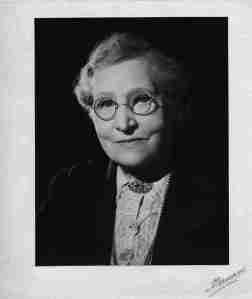
Last month, I asked what any of you knew about Caroline Ganley, pictured here. I am afraid that the only responses I got were from those I might call the “usual suspects”, including my friend Jeanne Rathbone, whose research is the basis of the following.
A very brief summary of the long life of Caroline Ganley would note that she lived from 1871-1966 and continuously from 1910 until her death at 5 Thirsk Road, where a plaque was unveiled on 20th October..
Ganley was elected to Battersea Borough Council in 1919, one of the first female councillors in the country. She was a stalwart of the Labour Party and of the Co-operative Movement, becoming in 1942 the first woman President of the London Cooperative Society.
In 1920, she was also appointed as one of the first female Justices of the Peace.
In 1945, Mrs Ganley was elected to Parliament as the MP for Battersea South, where she stayed until 1951. Most unusually for former MPs she returned as a Councillor to Battersea Borough Council in 1953, where she served until the Council was abolished in 1965.
One tribute to her at her death was that “Her mind was very acute and her ability to draw together the threads of the most rambling discussion was legendary. She was a great pioneer – the most outstanding woman the co-op has produced at a time when few women took part in public life.”
And my question this month is: Just what are these posts? What do they de-note? And how many of them do you know?
Councillor Tony Belton’s Battersea Newsletter, October, 2018, #112
- It’s now two months since I wrote about building control regulations and Mrs. Thatcher’s so-called reforms. Last month I said that I have had a heart-felt response on the subject. Two of you, however, thought I was criticising builders, which was certainly not my intention. But this last month I got yet another reply strongly supporting my criticism of the process and the rules. I quote it extensively, because I think it exposes the idiocy of having a regulatory regime, being subject to freelance inspectors, who are picked by builders. The quotation is as follows:-
- “I am an original owner of a flat in a block built in 2010, where we have had a major issue on fire safety. We flat owners have had to pay around £40,000 to make structural improvements to the block …, having been told by fire safety experts, and ultimately by London Fire Brigade under threat of enforcement order, that it did not meet fire safety regulations (I understand the words “we can’t believe a new block got through like this” were used)
- .……… it raised the question who signed off on the block, the answer being precisely your scenario of privately contracted building inspector engaged by the developer. I cannot express how inadequate their response was when we took the issue up with them. The particular fire safety point may have been signed off without the inspector ever actually having viewed the property.
- I suspect an endemic issue of private inspectors ‘waving through’ building sign offs, partly due to being paid flat fees which incentivise ‘light touch’ engagement, and partly being concerned not to raise issues which discourage repeat business from developers.
- Subsequently we have seen the appalling Grenfell tragedy. You refer to the “dreadful price” of the building control system, but building control concerns much more than cracked walls and damaged foundations. I wonder just how dreadful the price of this rancid system might yet be, scaled across the vast levels of development in London alone, blithely waved through by these shoddy operators.”
- Surely this quotation is proof enough that there is a problem, and Grenfell is a massive statement about how serious it is. We need fresh legislation to re-establish a simple regulatory regime, with an established, reliable and respected inspectorate – not a random set of freelance experts not subject to official validation.
- Ever been to Bordeaux? Not many of my friends have done anything more than pass through. It is actually worth a bit more than that.
 The fundamentally 18th century centre has been re-engineered around four or five brand new tram lines and is almost entirely pedestrianised. OK, it’s a relatively small city by London standards, but it was so pleasant walking around the town day and night, without having to dodge cars, or breathe their fumes, and to hear laughter and voices across the road. We went by train and then flew from Bordeaux to Croatia, where we stayed in the same fishing village that we have stayed in for five years – lots of swimming, reading Trollope’s The Way We Live Now and fish, fish for breakfast, lunch and dinner!
- Whilst I was away my fellow Labour councillors organised a public meeting about Wandsworth Council’s response to fire hazards in multi-storey tower blocks. It was held at the Alma pub and was a reaction to the apparent intention of the Council to install sprinkler systems in all 10+ storey blocks.
- It was an understandable reaction to Grenfell but it was essentially a knee-jerk one. For example, the Council did not suggest even the most cursory of inspections, when a moment’s thought might have suggested that Grenfell-style risks are much reduced where there are separate staircases at either end of blocks, such as on the Doddington estate, or where the construction method was traditional brick and mortar, such as Battersea Fields, or where cladding had or had not been used. Given also that it appears as though leaseholders could be charged up to £5,000 each for an installation they do not want and which may be of only dubious purpose, it is not surprising that there is a head of steam against the proposal.
- The meeting was held on Sunday, 2nd September, and was packed out with at least 100 tenants and leaseholders in attendance. It was chaired
 by the vastly experienced councillor and Wandsworth Greater London Assembly member Leonie Cooper, standing centre. The other four councillors on the platform as shown in this picture were Claire Gilbert (Roehampton), Maurice McLeod (Queenstown), Paul White (Tooting) and Angela Ireland (West Hill). Of these four, three were only elected in May, less than four months before this meeting. They organised and ran the whole meeting in what was quite an impressive baptism as it appeared to this “mature” councillor then sunning himself in Croatia. Well done to the team.
- On the 18th September I had the Strategic Planning and Transportation Committee, which had one of the lightest agendas I can ever recall. There was, however, an interesting paper on how to remould Battersea High Street, and especially the market, into a street just about worthy of the name. Unfortunately, I didn’t think the Council’s paper was up to the task (and it was amazingly expensive for what it proposed), but improvements to the High Street are now, as they say, on the agenda and I hope to see some exciting ideas coming forward.
- The next day, 19th September, I had the Planning Applications Committee. At first glance, there did not seem much of interest but further study proved otherwise. There was new detail on the mega-development of the old post office sorting office site in Nine Elms. The application from US company, Greystar, was for 894 BtR (Build to Rent) units. This was one of the first and definitely the largest appearance in the UK of the US housing product, BtR. Yes, I hate the phrasing too – “housing product” – Ugh!
- The Tory majority on the Committee were really proud that this new “product” should be coming to the Borough, making us a pioneer of a new, efficient, privately rented sector. For everyone’s peace of mind, I hope that they are right, but I suspect that corporate America invading our housing market is going to have similar impacts as Uber to taxi services, Amazon to high street shopping and PayPal to subscription services, etc. It will put pressure on our own landlords at the medium and top end of the market and in the end leave local authorities and housing associations to pick up all the pieces at the lower end of the market.
- The second interesting application was for a housing development on the site of the old Balham Bowls Club, Ramsden Road. I found this rather sad, because it meant the loss of a pub’s bowling green. I don’t know how many pubs in the country, let alone in Inner London, still have their own bowling greens (I know one in Suffolk), but I wouldn’t mind betting that this was the last in London – gone for ever.
- Meanwhile, in another interesting indication of how the market is moving, the Council has taken enforcement action against a property in Battersea being used as an Airbnb property. I haven’t come across this much but a fellow councillor in Tooting tells me that he is plagued with 100 or so Airbnb (or similar company) “hires” usually of private houses, which are being used as vice dens or party locations. I would be interested to know if any of you are experiencing similar problems associated with this trend, here in Battersea.
- I went back to my old college on 22nd September. About a dozen of us, from further back than I care to admit, met up for dinner and a drink or two. It was great fun, but it meant that I totally missed London’s Car Free Day and no one has mentioned it to me either – I guess that means it was a bit of a non-event, which is a shame. It becomes clearer by the day exactly what damage is being done to our environment (and our health) by the internal combustion motor car – a great pleasure but also a killer!
- I didn’t go to Liverpool for the Labour Party Conference but it appears to have gone rather better than many expected. Last month, I said that if Brexit is a disaster and if Labour hasn’t had the courage to take a stand on the issue, then the Labour Party will pay a heavy price. I suspect that Keir Starmer has created enough space, just about, for Labour to avoid that trap and come out of this sorry saga in not too bad a shape. How come he doesn’t get mentioned as being the next Leader? OK, not being a woman is a handicap, but not even getting a mention!
- I suspect that there are quite a few Tories, who rather desperately hope to leave their Conference in Birmingham in as good a shape!
- On the 27th September, I went to the pretentiously named Village Hall, Battersea Power Station, to hear Dorian Gerhold talking about
 the history of industrial Wandsworth. He gave a broad sweeping description of the many major industrial plants and processes that have developed in Battersea, from the first major railway in Britain (horse drawn trucks), Battersea enamels, early aircraft manufacturing and copper smelting techniques to the UK’s busiest railway junction and the Power Station.
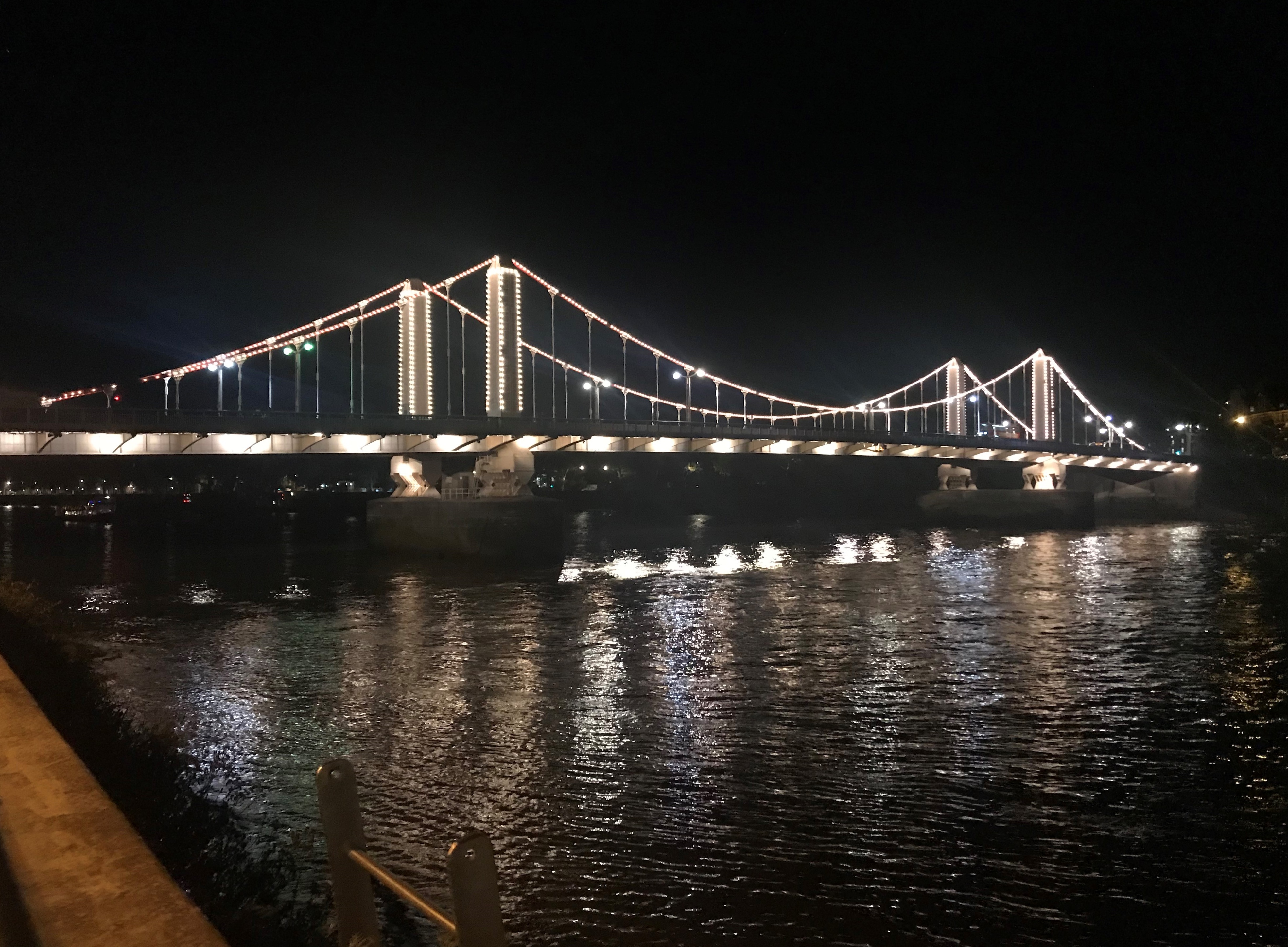
- I say the “pretentiously named Village Hall”, because of course, whatever the Power Station development becomes, it can never really be a village. I have never made any pretence of liking much of what has gone up in the Nine Elms area, but many in the Council’s planning hierarchy, official and political, are very proud of most of the developments. Of course, getting the US Embassy and Apple to move in are major triumphs, which cannot be ignored. So, putting jaundice and prejudice to one side, I ask myself, and some of you, do you see any really valuable and innovative developments? And, even if you do, are those developments worth the unremittingly Alphaville kind of atmosphere of the place? I would be interested in your views – one thing one can say for the development, however, is that it has opened up the riverfront – here is Chelsea Bridge,
 more or less from the Village.
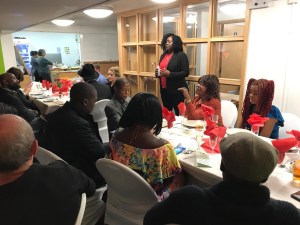
- On Saturday, 29th September, I went to a dinner in commemoration of the life of Sally-Ann Ephson, a Labour councillor in Queenstown, who died two years ago after suffering for many months from Sickle Cell Anaemia. The dinner was both a tribute to the brave Sally-Ann and a fund raiser for the Sickle Cell Society, a ferociously painful and merciless condition. The picture is of our guest speaker, Battersea MP, Marsha de Cordova.



My Programme for October
- The first week of October will be dominated by the Tory Party Conference – not something that I would normally highlight but something makes me think that this particular week could be of major significance for all our futures – ho, and just might provide a few laughs!
- If you follow my newsletters closely then you will know that I accompany my partner to many of her lectures, hence you will not be totally surprised that on 5th October, we are off to Reykjavik, Iceland. That will be a new experience – especially if we are lucky enough to see Aurora Borealis – the Northern Lights!
- There will be a Council Meeting on the 17th October and the Planning Applications Committee on the 18th.
- On 20th October a plaque to Caroline Ganley will be unveiled at 5 Thirsk Road at 11 a.m. This is part of Battersea Society’s plan to install as many commemorative plaques to women as we already have to men. Why does Mrs Ganley deserve a plaque? See below.
Do you know?
Last month, I asked as an aside whether anyone knew the connection between Lavender Gardens, Henty Close on the Ethelburga Estate and the Cornet of Horse? Two of you did, the connection being one G A Henty, who wrote a phenomenal number of books, 100+, either for children or adventures about the British Empire. He lived in Lavender Gardens and drank at the Cornet of Horse (now named the Four Thieves). Surprisingly enough, Henty Close on the Ethelburga Estate was also named after him. I think that one can imagine the style and values of his books by saying that one of my readers thought her comments wouldn’t get through the censors and the other, remembering books she read at the age of eight, thought they were rattling good yarns!
But my main question was about the photograph on the right, which I took in Webbs Road. This got the most enthusiastic response that any of my questions have provoked.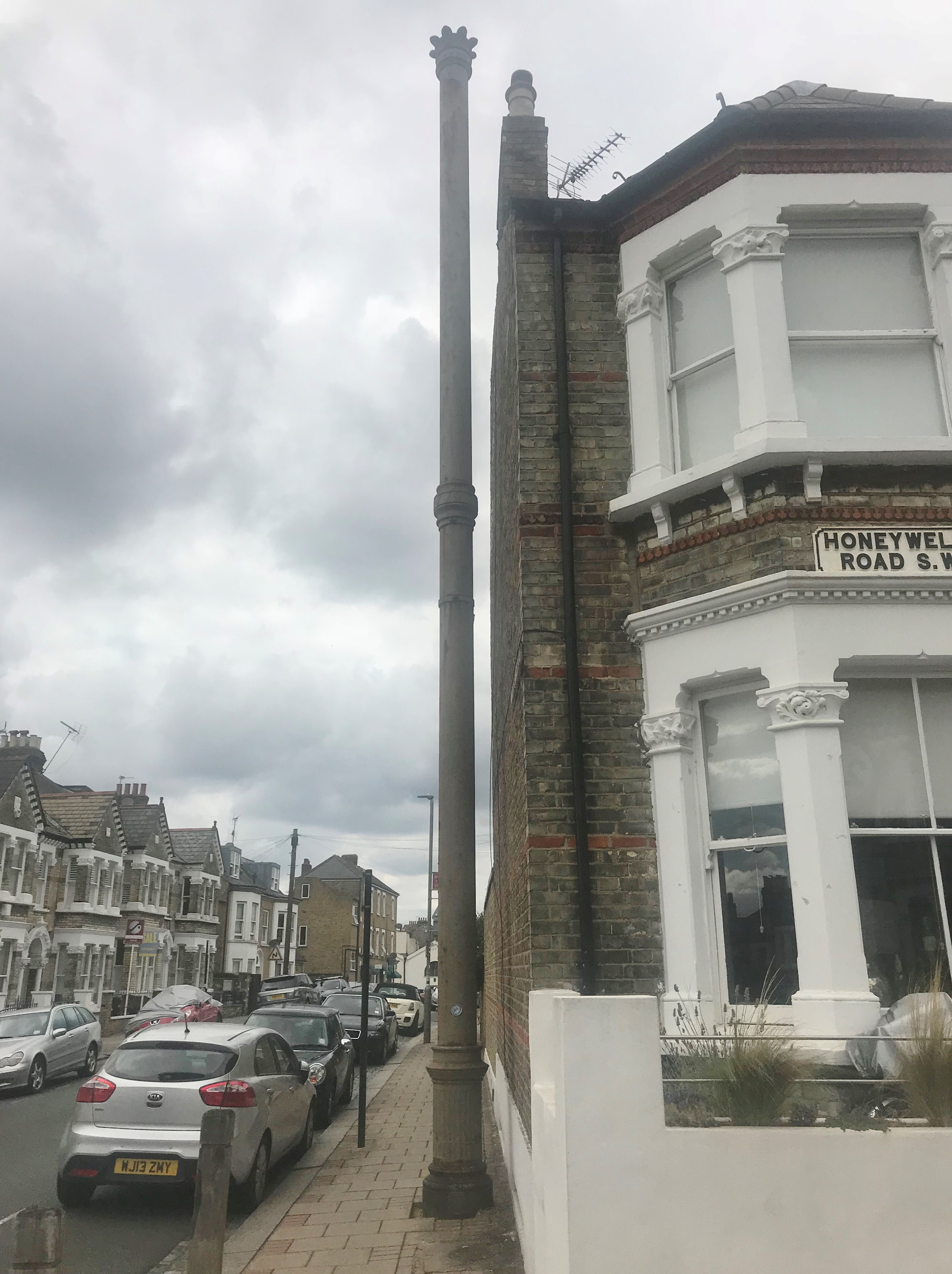 What is it about bodily functions that interests the human so much?
The answer is that it is a “stink pipe” or as one person said a “stench pole”, installed by the Victorians to take the stench out of the sewerage system and expel it high into the sky. There are hundreds of them on our streets and most of us never notice them. There are about four on Bolingbroke Grove alone. One respondent sent me the addresses of three websites devoted to mapping and photographing them and yet another tells me that they were exported to Sydney, Australia, where they can also still be found. Here is just one of the websites: http://stinkpipes.blogspot.com/
 So, to this month’s question: Caroline Ganley is having a plaque unveiled to her next month. Ganley Court is a fairly unremarkable Council block on the Winstanley Estate, which was named after her. Here she is, on the left, but who was she and why is she worth commemorating?
Councillor Tony Belton’s Battersea September, 2018, Newsletter (# 111)
- Last month I wrote about building control regulations and their implementation in England and Wales, since Mrs. Thatcher’s so-called reforms (I suspect the rules may be a bit different in Scotland). I don’t think that I have had such a heart-felt response on any other subject. Clearly, many residents find the whole process of neighbour-building works both stressful and sometimes expensive
.
- I had building works next-door to me last year and, although I have absolutely no complaints about the standard of works, my garden was unusable in 2017. Thank goodness that last summer was not a scorcher like 2018. Equally, I’ve had friends, who have complained particularly about the 24-hour 7-day a week pumping one often gets with basement extensions. It does seem to me that, as a country, we need to re-consider legislation about both the regulation of standards and nuisance control during construction.
- Unsurprisingly August has been very quiet in Council terms, so I thought I might indulge myself in a bit of politics – for a change. But first, I did have a couple of visits one from a British student and another from a foreign journalist. It’s a minor pleasure of the job of being a Councillor that people do ring me, from time to time, and ask for interviews about how local government works in this country. The trouble is that, like most people, the more I know the more I realise that I don’t know!
- To politics and the issue of the EU, about which a number of people have asked me to come clean on my views, and I must stress they are my personal views! Of course, one answer is to say that Brexit or the EU is not an issue for a local councillor and, of course, in one sense that is right. Yet I am not surprised that some of you want to know what the person you voted for only a few months ago, thinks on this massive issue. (If you are not interested on more about Brexit, then skip to paragraph 10).
- First, I voted in the Referendum to Remain and if we have the chance again, I will do so again. A couple of years ago, I certainly had some pleasure, in discussions with friends, being the Devil’s Advocate and one or two maybe thought I was going to vote Leave. I regret it, if I persuaded anyone to switch their vote, but I rather doubt that I did. However, despite voting “remain” I thought then and still do that the “Remainers” have to face some issues. For example, the EU does not appear to be very democratic – despite the Euro-elections. Perhaps it is impossible to make an organisation with 500+million people feel democratic but either more effort has to be made or the EU should operate through national governments. The present European Parliament does not have much credibility and, I suspect, is not sustainable in its present form.
- In addition, it does appear as though the Euro currency is and has been a terrible mistake, which somehow the Eurozone has to reform or end as soon as possible. In hindsight, it seems ludicrous to have tied Greece and Southern Italy to the same exchange rate as Bavaria and Brussels; Andalucia and Portugal to the same economic conditions as Berlin and Paris. Clearly, what has worked for Germany has been massively destructive for Greece. Some reforms to the EU are essential and its current settlement should be no more cast in stone than any constitutional arrangement anywhere.
- But it’s not the Remain argument that exercises me most but rather the Brexit case. I have many objections to the Brexiters’ arguments. For a start it means taking a terrible risk with all our lives and livelihoods on the basis of the assurances that we have had so far, which in essence amount to no more than a promise “That it will be alright on the night”. Especially given that almost every expert believes we will be worse off after Brexit than before. (I know that Michael Gove suggested that we should ignore experts, but in most fields, from brain surgery to plumbing, flying to engineering, I prefer to have experts on my side rather than against).
- There are, of course, the nostalgic Brexiters, the Imperial Brexiters, the Little England as well as Great Britain Brexiters, invariably from the right of the political spectrum. But what about the left-wing Brexiters, the inheriters of the Tony Benn legacy; those who see the EU as a capitalist plot? I would ask them to give us the answer to three particular questions:-
- How do you tackle the ecological issues facing the world without supra-national organisations?
- What possible democratic power do you see standing up to global capitalism and perhaps particularly Californian-based global capitalism? Surely not the UK on its own; just possibly the EU can.
- In a world dominated by international business, how can workers’ rights and pay levels be protected unless, ultimately, on at least a continental basis?
- Clearly, there are a thousand problems
 involved in stopping Brexit but if Brexit is a disaster and bad for Britain then the Labour Party will pay a heavy price, if it hasn’t had the courage to take a stand on the issue. Enough said, but I suspect we will be coming back to this issue before too long.
- On 3rd August, we went to see Oscar Wilde’s “The Importance of Being Ernest”. You will have noticed that in the last few months, I have been to all the Oscar Wilde plays. In his brilliantly witty way Wilde certainly has a very particular take on gender politics at the turn of the nineteenth and twentieth centuries. But I am afraid that I was disappointed with this production of his most famous play. The text is witty enough without being coated in extra layers of somewhat dubious gender and race politics.
- I was also asked, along with fellow Councillor Kate Stock, to be part of a panel of judges in a competition being run by the Battersea Summer Project at Providence House Youth Club. The Project does a great job, which is much appreciated by many kids (and no doubt parents) providing sports, hobbies and occupations for the young people of Battersea, but I think this particular competition needs a bit of re-thinking if it is to become a regular event.
- On 18th-19th August we spent the week-end
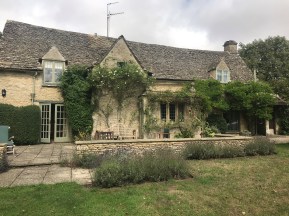 with Douglas Jay’s widow, Mary, in her beautiful cottage in Oxfordshire. Douglas was Battersea North’s MP from 1946-83. He married Mary, many years his junior, in 1972. We had a delightful dinner with family and old friends exchanging stories about “old Battersea characters”. Unfortunately, but inevitably, Mary is having to move into a more convenient, smaller, urban house. So, this was a kind of nostalgic goodbye to Causeway Cottage, seen here on the right.
- The next Planning Applications Committee
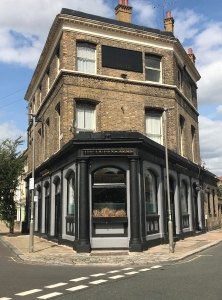 takes place on 22nd August and this time there really is nothing of great significance in Battersea – though I am very conscious that even the most minor application is really, really important to someone or some family. One item worth a mention is an application for the modernisation and re-opening (hopefully) of the Queen’s Arms, seen here on the corner of Robertson and St. Philip’s Streets, just off the Queenstown Road.
- But I will miss the Committee as on 22nd August I will be carrying the bags for my partner at a Conference in Bordeaux, from where we are going directly to Croatia for a couple of weeks. I have briefed my colleagues on my views on the committee, but inevitably at this time of the year some of us will be missing the evening.
My Programme for September
- There will be the Community Services Committee on 18th September and the Planning Applications Committee on 19th.
- In recognition of the major traffic and pollution problems facing all the world’s major cities and London in particular, there is going to be a Car-free Day organised through-out the capital on Saturday, 22nd. I cannot imagine that it will result in a wide observance across the whole city but we shall see!
- The last week of September will be dominated by the Labour Party Conference (and Brexit). Somehow, I cannot imagine that we will reach the end of September without very fundamental shifts beginning to take place in the political landscape!
Do you know?
Last month I asked “How many of you know the modern names of these three Battersea pubs: “The Cornet of Horse“, “The Prodigal’s Return” (I said “Son” so thanks to eagle-eyed Chris for that correction) and “The Eagle“? The answer is The Four Thieves in Lavender Gardens, The Draft House on the 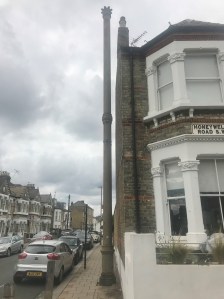 corner of Battersea Bridge and Westbridge Roads and The Magic Garden, Battersea Park Road, respectively. As a brief aside can I ask whether anyone knows the connection between Lavender Gardens, Henty Close on the Ethelburga Estate and the Cornet of Horse?
And as for this month let me ask: I took a photograph of this structure in Webbs Road, at the junction with Honeywell Road. It, is the pole, standing on the pavement and which is slightly higher than the house. Do you know what it is? What it is called? And just how many poles like this can WE find in Battersea?
Councillor Tony Belton’s Battersea July, 2018, Newsletter (# 109)
- First a couple of outstanding matters that I know will concern some of you. I have heard nothing further about the 14-storey development so many of us dread, at the corner of Culvert and Battersea Park Roads. As far as I know the building works still await the resolution of contractual matters.
- Secondly, I still haven’t heard of a definite resolution to the “flooding lift” problems that affect Clark Lawrence, Shaw and particularly Sendall Courts – hopefully they are all working satisfactorily now, but please let me know if they are not.
- The first June in the four-year cycle of any Council (this one being 2018-2022) is always an unusual time. We have had apparently endless induction meetings and annual meetings, and to cap it all we have new technology to cope with as the Council has supplied us all with new laptops. That may sound good to you all, but the main motivation is the Council’s desire to eliminate paper and get us all to work online, hence saving the Council money, particularly on postage. OK, even great, I can hear many of you say. However, in my case at least, this change does not complement my present way of working but merely duplicates and complicates it all. I can hear you say, even now, something about old dogs and new tricks!
- On Saturday, 2nd June, I visited the Share Centre’s Garden in the grounds of Springfield Hospital. The Centre,
 based in Altenburg Gardens Battersea, is devoted to providing, in the words of its website “training and employment support for disabled people”. Gardening is of acknowledged therapeutic benefit and the Centre put on a good show much enjoyed by, from the left, Councillor Fleur Anderson, me, my partner Penny and Share Centre Director, Annie McDowell, pictured here.
- On 3rd June, we went to the National
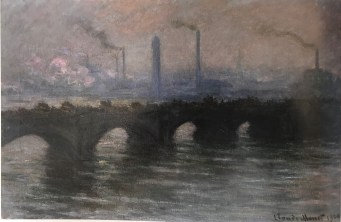 Gallery to see the Monet & Architecture Exhibition. For art lovers I fully recommend a visit and for those, not so far interested, then this would be a great start. Monet’s painting of Waterloo Bridge and the South Bank as they appeared from the Savoy Hotel in 1900 gives just some idea of what industrial smog in London was like 120 years ago.
- The next day, 4th June, I was at Christ Church, at the junction of Cabul and Battersea Park Roads, to hear a presentation of the
 Battersea Society’s “War Comes Home” oral history by Carol Rahn. The Church Hall was packed with well over 100 people in the audience. The presentation was the culmination of work done by Carol, Jenny Sheridan and Sue Demont. Their research was based on interviews with residents, who had memories of life in Battersea during and immediately after war-time bombing. By definition most of those were over 80 years old and some of them were there on the 4th. It was a brilliant presentation and if anyone wants a copy of Demont’s associated booklet The Bombing of Battersea, then let me know. The picture shows Carol Rahn telling the story.
- On the 5th June, I visited Deliveroo’s Battersea kitchens. Hidden in industrial Battersea between all the rail-tracks, they were a fascinating example of new technology applied to an ancient trade – the restaurant business. The way it works is that there are half a dozen efficient, modern kitchens in one factory, serviced by one delivery network and one chain of suppliers but with, of course, different chefs and different cuisines. Like many people concerned about working conditions in the so-called “Gig Economy”, I asked questions about Deliveroo’s employment practises. Whilst I was not totally re-assured, it was good to hear that they now have a £10 million insurance scheme to provide some assistance in the event of their deliverers not being available for work or suffering industrial injuries – including from traffic accidents. Deliveroo demonstrated to me that it is beginning to respond to proper political pressures.
- One of the compensations for working at the
 Town Hall is that it is so very near the National Opera Studio, near the Southside shopping centre, Wandsworth. The Studio puts on lunch-time concerts at the conclusion of every academic year. This year’s concert was on 6th June. The stars are, of course, the students who come from all over the world to be trained in Wandsworth. Here are Bechara Moufarrej and Emyr Wyn Jones singing a duet from Bizet. They and all the others at the concert were fabulous and, as you can see, the concert is in a very “intimate” setting. It is well worth a visit to any music lover and especially for those who like to spot a future operatic star.
- On Friday 8th June, we went to Wilton’s Music Hall, Whitechapel. If you have not been and, like going to the theatre, this really is an unusual “must”. The only old fashioned nineteenth-century music hall left standing in London, it is an event in itself, but we went there to see Sancho, a monologue by Paterson Joseph.
 Paterson, a black British actor, wrote this work about Charles Ignatius Sancho. He was born in about 1729 in Columbia and died in 1780 in London. It was not known whether he was, at first, a slave but by the time of his death he had been painted by his friend, the famous artist Gainsborough and he counted famous actors and artists amongst his best friends. He was the first black man, that we know of, to vote in a British General Election. He voted for Charles James Fox, a famous abolitionist (of slavery) in a Westminster election. The play was witty, subtle and clever. It was acted in a one-man tour de force by Paterson, himself.
- And so, on 12th June to, of all things, the North East Surrey Crematorium Board. Way back before the merger of the old Battersea and Wandsworth Borough Councils into the modern Wandsworth Council, Battersea bought 120 odd acres of land in rural Morden. They recognised that there would be a shortage of land for burials and decided to buy some relatively cheap, out-of-town land. The Board, which has members from Wandsworth, Merton and Sutton Councils, meets at the Crematorium or, more usually, Sutton Council offices. It was a fascinating morning including a tour of the ovens and explanations of what happens to non-human body parts, such as artificial knees, heart pacemakers, etc., but perhaps not for the faintest of hearts!
- The following day, 13th June, I met people from Battersea Power Station. The main purpose was to get an update on current developments and to lobby for a re-instatement of the 250 affordable units that were cut from the development plans earlier this year – no movement yet. But as a by-product of the visit I happened to see one of the Peregrine Falcons that have nested in the Power Station for 18 years and have fledged 32 juveniles. In 2013 the Peregrines were encouraged from their nesting site on the Power Station to a tower crane in order that restoration works could commence.
 Their most successful breeding seasons have been on the purpose-built tower. This year they have again been successful, fledging one juvenile, known on site as ‘ Solo’. A male, he is currently learning his trade from the adults. Black Redstarts are also again on site so two rare species grace the Power Station, a unique occurrence in London for both species and even more so with regeneration taking place. The picture of Solo is taken by the site ornithologist David Morrison, an outside expert and occasional consultant.
- On the 15th June, we went to the Vaudeville Theatre to see Oscar Wilde’s play The Ideal Husband. Witty and acerbic as ever, I discover that Wilde was far more of a feminist than I had previously realised, although given his sad story as a much-abused homosexual perhaps I should use a different word than feminist. But, in any event, this was great fun beautifully acted by, amongst others, Edward Fox (the Jackal in the Day of the Jackal) and Susan Hampshire.
- On Sunday, 17th June, as part of the
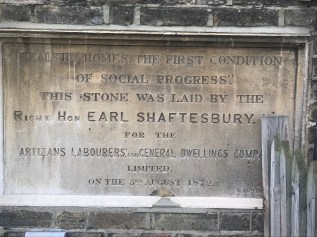 Wandsworth Heritage Festival, I led a small group on my history walk from the Latchmere pub to Battersea Arts Centre, via the Park, the Latchmere and the Shaftesbury Estates. We passed this foundation stone, deeply hidden and unannounced in Grayshott Road. Does anyone know it? If not then keep an eye open for it if you are ever walking along Grayshott.
- The Community Services Committee was held on 21st June. Two items were of particular interest to some parts of Battersea; one was the declaration of Public Space Protection Orders with regards to the Falcon Road area and the Patmore and Carey Gardens estates. These orders give more powers to the Council and the police to control the public drinking of alcohol. The second was an item proposing that there should be NO change to the controlled parking zone in Little India. I know that the second decision is unpopular with some residents but it was based on a public consultation carried out by the Council, and the majority answered with a “no change” verdict.
- June’s Planning Applications Committee was on 26th. The largest and most interesting application concerned a large site in Tooting High Street, but there was also one small application for two 3-bed houses on the highly contentious garden site of the old Prince of Wales pub, on the corner of Battersea Bridge Road and Surrey Lane. The Prince of Wales pub is, I am afraid, lost for good.
- On the 28th June there was a Finance and Corporate Resources Committee. I am not a member of this committee and don’t usually report on it. But this meeting forecast that next year the Council is going to have to find savings of £12 million and the year after of another £22 million. The Government’s suicidal attacks on local government seem endless and endlessly self-defeating. Amongst many other costs bed-blocking in our hospitals is bound to rise as social care in the community, especially for the elderly, gets hammered!
- On the 29th June I attended two events, the first at the Arts Centre and then at the Friends’ Meeting House in Wandsworth High Street. The first was to mark the retirement of Phil Jew, Director of the Wandsworth’s Citizens Advice Bureau. Phil has been the Director for the last very tough five years at the Bureau. In these years of so-called austerity (I think it has been of unnecessary dogma imposed by the Tory party – but that’s another story), the Bureau has been dealing with large cuts to their funding base and increasing demands as Tory cuts bite.
- The second was the Annual Meeting of the
 Wandsworth Historical Society, where we heard a fascinating presentation about Edward Foster, a Wandsworth resident, who won a VC (Victoria Cross) in April, 1917, for his bravery in capturing a German machine gun emplacement during the First World War. This incident took place near the small French village of Villers-Plouich, where it is commemorated in a town square, called Place de Wandsworth! Ted Foster himself became quite a famous veteran. Standing at well over 6 feet he was known as the “Gentle Giant”.
- In early June commuters and passers-by were surprised
 and delighted by the visit of Shallowford Farm to Falcon Road. Farm animals, sheep, chicken, ducks, and tractors appeared in the Providence House car park. The chicken and ducks revisited on 30th June at the Falcon Festival, which this year was bigger and better than ever. The farm is on the eastern edge of Dartmoor and is a joint venture with Providence House. It will be well known to many Battersea residents as Providence House youth club runs many regular residential outings to the farm. The picture is of our M.P., Marsha de Cordova, on board one of the tractors.
- On the evening of 30th June, we took our niece and her husband to the Royal Opera House to see Puccini’s La Bohème. It was meant to be grand opera and grand it certainly was but it was also highly political, positioning the harsh conditions faced by the poor bohemian students against the opulence of bourgeois Paris. It was a suitable end to a month which began with a visit to Wandsworth’s Opera Studio and finished at Covent Garden.
- Finally, this may all sound like fun social events but, like every other month, I also had half a dozen other meetings about ward and party business, which were all necessary but hardly of great public interest – so I don’t report on them!
My Programme for July
July looks like a quiet month with only the Council Meeting on 11th July and the Planning Applications Committee on the 19th.  I will have to come back from Devon for that as I have a week booked up in Devon in mid-July. And at present that is that for July.
Do you know?
You may remember that I asked last month whether I should stop this feature as I thought it might be getting a bit stale! But, by popular request, here it is back again!
Park South is the name of this privately-owned tower block on Battersea Park Road. But before it was sold by the Council it was known as what exactly? And who or what was that in memory of and why?
Councillor Tony Belton’s Battersea June, 2018, Newsletter (# 108)
- First things first. I was delighted
 and honoured to be re-elected as one of your three Latchmere councillors at the Wandsworth Borough Election of May 3rd, along with my fellow Labour colleagues, Simon Hogg and Kate Stock – they are the kids in this picture of the three of us!
- The three of us got around and about 2,500 votes, compared to just under 1,000 for our main rivals, the Tory candidates. This represented a swing to Labour of just under 9%, which was very much in line with similar swings in Battersea. For those of you interested in elections, the impact of campaigning and other slightly nerdy electoral matters, look out for an entry I intend to make shortly on my blog at https://tonybelton.wordpress.com/. If you wish to see the Latchmere results, or indeed any Wandsworth results, in detail then you can at http://www.wandsworth.gov.uk/info/200327/election_results/2327/2018_borough_council_election_results_-_3_may/9
- Immediately after the election councillors, are faced with seemingly endless inductions into being a councillor, the latest and most interesting one being the induction to our role as Corporate Parents, held on 30th You may well ask what that means and, as it is such a new role (under 10 years), I am not clear that there is an absolute definition. However, the Government decided that, in default of their own “positive” parents, children in Council care should be able to look to the Council, and councillors, as Corporate Parents.
- I have my doubts about this role. I have little doubt that in some ways, and in individual cases it works. Some councillors devote considerable time and effort to supporting so-called looked after children, many of whom appreciate it very gratefully. However, it is impossible to imagine MPs imposing a similar role on themselves for at least four reasons. First of all, they are not trained social workers and nor are we. Secondly, they would claim to be too busy – so what makes them different from councillors? After all many councillors already do a full-time job. Thirdly, it implies that we, councillors, are all part of one big happy family working as a team, when, clearly, we have very strong political differences about issues such as funding and housing, which have massive implications for so-called looked after children. Fourthly, it purports to give councillors a moral and legal responsibility, which they are in no way able to implement and which I doubt could ever be maintained in court. Actually, it is in danger of being a sham, another way of passing on the responsibilities of a state, not prepared to fund public services with decently higher levels of taxation. Of course, MPs would never think of imposing such an impossible burden on themselves: they are after all, a breed apart!
- On the 10th May, I spoke at David Lewis’s funeral in
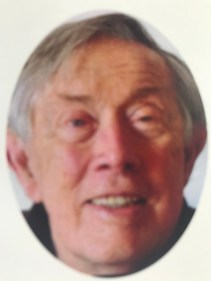 St. Mary’s, Battersea. David was the Battersea Society’s foremost planning expert and he and I, as Labour’s lead on planning in the Council, had many interests in common. I first met him at secondary school in the fifties and I have lived near him in Battersea since the sixties. David lived his civic values. He was the most assiduous and industrious local champion of the environment both here and in North Wales. One early campaign of his (and his wife’s, Christine), I recall was to “save” Albert Bridge from possible demolition and replacement with a larger and stronger new bridge, capable no doubt of taking a motorway load of traffic up Albert Bridge Road. It’s a pleasure to say he won that campaign and that I played a very small part in that winning campaign! David, RIP.
- Two days later, another old friend invited me
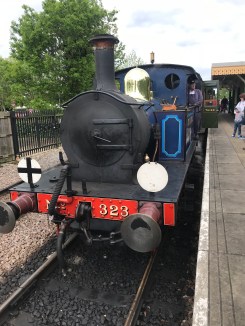 and my partner for a day’s outing on the Bluebell Line from East Grinstead to Sheffield Park. I had never been there despite knowing Sussex pretty well. The steam train runs 12 miles through bluebell woods, which though perhaps a week past their best on 12th May were still spectacular. The line was constructed following the 1877 Act of Parliament and was “finally” closed after legal and parliamentary disputes in 1958. The Bluebell Railway Preservation Society was founded in 1959 and has been running the service ever since. Sheffield Park, at one end of the line is a country house and Arboretum – unfortunately it rained on 12th May but it was still an enjoyable trip.
- You may remember that last
 month I wrote about “the world premier of Winstanley Stories, a film made by Falconbrook Primary School’s pupils”. Well on 13th May I talked about the film and the making of it to a small group organised by “Sound Minds” at the Battersea Mission Sound Minds had an art photographer, who took this from outside the building and through the window! It was very enjoyable, with active participation form some of the younger members of the audience but I wish more people had been able to be there. Once again may I recommend that you have a look at this film about the Winstanley and York Road estates on YouTube http://www.winstanleystories.org.uk/film.html.
- On the 16th May we had the Annual Council Meeting, when the Mayor for the coming year is elected and also the Leader of the Council and membership of the Council’s various committees. The Mayor is Councillor Piers McCausland, not in my view a brilliant choice. That may not be a very politic thing to say but his, shall we say, eccentricity makes him an idiosyncratic selection by the majority Tory councillors. My friend and colleague, Simon Hogg, was re-elected Leader of the Labour councillors. Simon is NOT a pushy, boastful type of leader. He works hard encouraging all 26 of us councillors to take up very active roles. He operates in a quiet, restrained fashion, which gets some criticism but which, I think, gets increasingly appreciated over time.
- On 22nd May fellow councillor, Leonie Cooper, and also Greater London Council member held a reception at City Hall. It was good to have a chat with various new and old friends from all over London, and be reminded of the view from City Hall’s front door!
- The May meeting of the Planning Applications Committee was on the 24th, but, once again, there was little of note, at least, for Battersea. BUT several of you have asked me what is happening as regards the tower block “threatened” for the pocket site at the corner of Battersea Park Road and Culvert Road. Like some of you, I had noticed that all construction activity had stopped there. And, like you, I had hoped that some wiser heads just might have
 prevailed. So I made enquiries. However, the planning officer tells me that there is a requirement to sign a deed of covenant, which must be done by 23rd July and one party to the deal has not yet signed up. The contractual haggling that may or may not be happening behind the scenes is not a planning matter, even though you might think it should be. Hence all I can say is that there are, presumably, some kind of contractual negotiations going on behind the scenes, which could go on for another 7 weeks before preventing the current approved application from proceeding. Let’s hope that this over-development gets stopped by current market conditions!
- When I got back from David Lewis’s funeral,
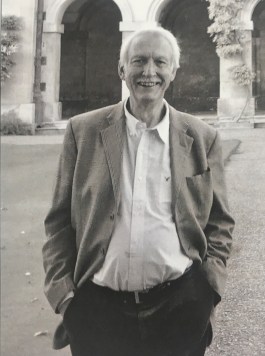 see para 5 above, I received an email telling me that one of my biggest college buddies had died that day. I attended Tony Renton’s funeral on 31st Apart from spending 3 years at college with Tony, I also shared my first two flats in London with him and a couple of others. He was a brilliant polemicist and a fantasist, a gambler, not with money perhaps but with life, which he certainly lived extravagantly and to the full. Pity about the waist-line though (, but who am I to talk?) – he used to be so thin but the twinkle in the eye and the extrovert personality are still there. Tony, RIP.
- Meanwhile, I did have some housekeeping to do. For my pains, I have had to finalise and get signed off all the statutorily required election expenses for all 21 of the Battersea Labour candidates at the election. That amounted to over 1,000 sheets of 16 statutory forms, many of them identical for candidate 1 to 21, all of which will probably disappear into a town hall vault, never to be seen again!
- And finally, I tried to maintain my sanity by, with my partner, completely revamping our back-garden – and that has been good.
My Programme for June
- On Saturday, 2nd June, I hope first to go to the Share Community’s Garden Centre, in the grounds of Springfield Hospital, both to buy plants for my garden but also to support the Share Community’s work on behalf of disabled people. And later I plan to go to York Gardens for the summer event there.
- On Sunday morning, 3rd June, I will be off to the National Gallery to see the Monet exhibition, which I expect to be a beautiful display of French Impressionist art.
- On 4th June at 6.30 I will be in Christ Church, on the corner of Candahar, Cabul and Battersea Park Roads, to hear an oral history of War Comes Home. This will be presented by Carol Rahn of the Battersea Society and will include the reminiscences of Battersea residents, who lived here during the Blitz. All are welcome – do go.
- Did you know that we have a Deliveroo processing centre here in Battersea? I must say that I didn’t. But councillors have been invited to visit and I am going on Tuesday, 5th June. I certainly want to question them on their employment practises and their safety records.
- The National Opera School in Wandsworth High Street is giving a free lunch-time concert on 6th June and I certainly hope to be there.
- On 8th June I am going to Wilton’s music hall to see Sancho: An Act of Remembrance – a play about an eighteenth-century African, who campaigned against the slave trade. If you have never been to Wilton’s, which is close by Tower Bridge, then you ought. It is a recently restored nineteenth-century music hall – very atmospheric!
- On 9th and 23rd June I have councillor’s surgery at Battersea Central Library.
- The North East Surrey Crematorium Board meets on 12th June and after 40+ years as a councillor, I get to go to my first ever meeting of it – the Crem as it is called – the whole of human life, as they say!
- I have a Community Services Committee on the 21st June and the Planning Applications Committee on the 26th.
- Finally, on 30th June, we have the Falcon Road Festival, which I expect to be great fun.
Do you know?
Last month I asked, “Who was Chesterton? And what was he to Battersea or Battersea to him? And what else in Battersea is named after him?
I was surprised that not one of you responded. It was pretty easy so Why? Has the format got stale? Should I do something else instead? Who votes to retain Do you Know?
Meanwhile G. K. Chesterton or Gilbert Keith Chesterton (1874-1936) was a prolific author of novels and detective stories, whose fame has declined a lot since the early twentieth century. Possibly because he was really an essayist, a commentator, an eccentric wit. Chesterton lived in 60 Overstrand Mansions, Prince of Wales Drive and in one amusing essay he compared a flooded North Battersea to “a vision of Venice”. If he had lived a century later he would probably have been a TV journalist, or a Newsnight presenter.
My partner has written a brief essay on him in the Battersea Society’s “Battersea Matters”. I would be happy to copy to anyone interested.
Of course, Chesterton Primary School is named after him as indeed is Chesterton Close, just behind Wandsworth Police Station, Chesterton House in the York Road estate and the Old Chesterton Building in Battersea Park Road.
Councillor Tony Belton’s Battersea May, 2018, Newsletter (# 107)
- In the weeks before the May 3rd Borough Election, there was very little Council activity, except for preparing for and fighting the election itself, hence this is going to be a short newsletter! I could, of course, try to persuade you all to vote for me and my two Latchmere colleagues Simon Hogg and Kate Stock, but I won’t insult your intelligence by thinking I could change your vote in the last couple of days. Instead as usual I will continue with my normal monthly diary.
- On April 1st my partner and I went to Tate Modern
 to see the Modigliani Exhibition. The first thing that struck me was the speed and scale of change in Blackfriars. The Blavatnik extension to the Tate has been open nearly two years but this was the first time that I’ve had a close look at it! To say the least it’s striking – it also blends well with the old Bankside Power Station, which is now the Tate Modern.
- As for Modigliani, he was extremely popular fifty years ago but not so much today. Perhaps, at least to the casual observer, he appears a bit effete. Certainly, I am sorry to say, of his famous nudes that I thought “once, you’ve seen one then you’ve seen them all”. They were elegant, sensual, ample and well-proportioned but curiously passionless, empty vessels. Didn’t work for me.
- On the 6th we decided to visit two of the buildings that won some of the Wandsworth design awards, which I mentioned last month. The first was for dinner at the Earlsfield pub, built effectively into the wall of the station – we liked it – and then over the road to the Tara Arts Centre for an evening of Indian music, the Easter Ragas. The Tara Arts Centre is a small performance space, converted from a Victorian terrace, right alongside the mainline railway. I definitely recommend a visit.
- The “Indian” music was simply
 stunning – apparently a fusion of “Persian, Arabic, Turkish and Indian musical traditions”. It was, in the words of the MC, the music for whirling Dervishes – the “Whirling Dervishes” were a Turkish Sufi cult, who achieved notoriety in Victorian England. At the concert, the outstanding performer was Abi Sampa, her singing and the intensity of her presence and of her band bowled over the whole audience.
- The April meeting of the Planning Applications Committee was on the 18th, but, to be honest, there was little of note, at least, for Battersea.
- Last month, I said I would represent the Labour Party, on the 24th, at the Battersea Society’s election hustings meeting in York Gardens Library Hall.
 In fact, Wandsworth Labour Leader, and fellow Latchmere councillor, Simon Hogg, second from right, took the role. Thanks to the Society for staging the hustings but, I thought that the meeting, with an audience of only 40, was a bit flat. The fact is that it was a very polite, very quiet audience; nor was it very representative of much of the local Latchmere population. The evening could have done with a little more “edge”.
- To City Hall on 27th April, to a meeting
 of ACAN, the African Caribbean Alumni Network. As I said, last month, you might well be surprised at that (as indeed, I was when I received the invitation). But it follows from my contribution to a Black Lives Matter debate held last summer at the University of East Anglia (UEA) in Norwich.
- It was a meeting for about 200 black graduates (I was the only white person in the hall) and as such it was absolutely fascinating. These young graduates were a very impressive group, very angry about the current outrageous “Windrush scandal”, very ambitious for the future of themselves and their peers, very positive about how they were going to play a major part in British society. Good luck to them all. We will all benefit from their energy and their positive attitude.
- The following day, the 25th, off to the Battersea Arts Centre to see the world premier of Winstanley Stories, a film made by Falconbrook Primary School’s pupils with, I suspect, quite a lot of assistance from producer Matthew Rosenberg. I thought that he/they did a brilliant history film of both the Winstanley and York Road estates. It can be seen at http://www.winstanleystories.org.uk/film.html, which I whole-heartedly recommend to anyone who has the technology.
- And now on to May 3rd, election day. However,
 I can’t let this “old” Council pass without saying a very fond farewell to Councillor Wendy Speck. Wendy has been a Latchmere councillor since May, 2010. Many of you will know her well because Wendy was and still is active in many ways. She was Chair of Governors of Chesterton School and a Governor of Ernest Bevin School, Tooting and a regular at most Big Local events.
- Wendy is chair of St Walter St John Educational Trust and intends to continue in that role. Wendy is also a trustee of Wand Youth Club and of Wandsworth Community Safety Trust. Before being a councillor, she was for 9 years a head of primary schools in Newcastle and Islington. One little known fact is that she has an Anglo-Byelorussian background and is still a mean Cossack dancer. I’ll miss her as a Council colleague.

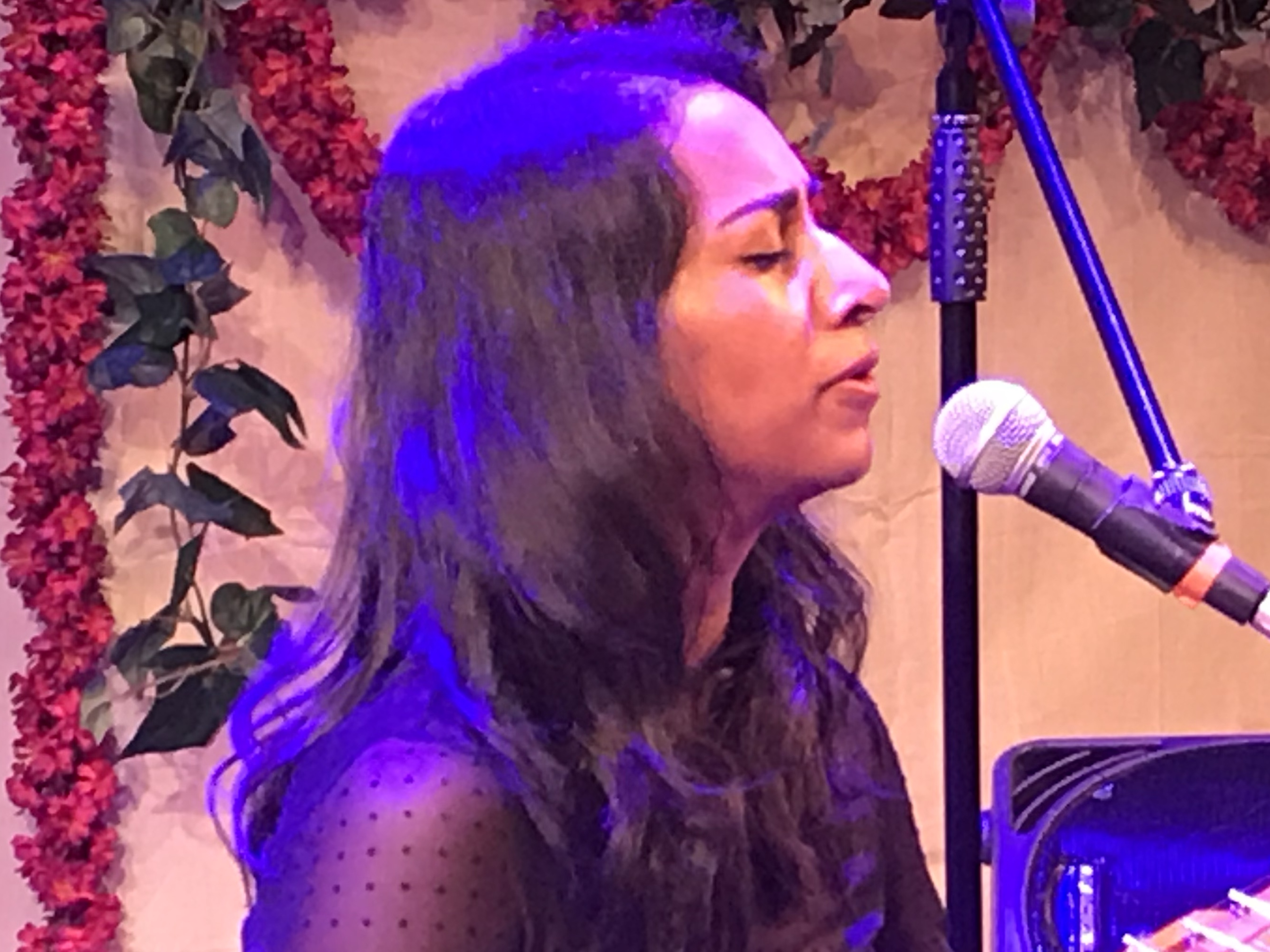

My Programme for May
Well, the future disposition of Wandsworth Council is very much in your hands, you – the electorate. If Labour wins then, I will be very busy and will be happy to report on what it is like being in a majority party! But if we do not win, then my newsletter will be more of the same.
Do you know?
Last month I asked: Where and when was this photo taken? And do you know the current use of the church on the left-side of the road?
Easy, but I think the most knowledgeable and accurate answer came from Sue, who I will quote in full.
“It’s St. Paul’s Church, St John’s Hill, looking east towards the Junction and likely to be 1920s because of (the woman’s) cloche hat…Church became Louvaine Area Residents’ Association HQ (LARA) when made redundant – and was used for Battersea LP meetings! – but is now apartments. St Paul’s started life as the daughter church to St John’s, Usk Rd but the latter struggled to sustain its congregation even before it was destroyed by a V2 in 1945 and, in any case, by the 1930s the parish had been reorganised and renamed St Paul’s. It was subsequently combined with St Peter’s, Plough Rd, which despite having had its building demolished twice, is now the only surviving Anglican congregation of the three – hopefully the new church in Plough Road will open soon for them.“
And this month, my questions are inspired by Wendy Speck’s retirement and her governorship of Chesterton Primary School. They are simply:
-
-
-
-
- Who was Chesterton?
- What was he to Battersea or Battersea to him?
- What else in Battersea is named after him?
-
-
-
Councillor Tony Belton’s Battersea April, 2018, Newsletter (# 106)
- On 7th March, Wandsworth’s Mayor Les McDonnell and I presented certificates to Mercy Foundation students of English. The Foundation is organised and very
 considerably financed by Victoria Rodney; she is the driving force behind the Foundation, which is in effect a one-woman voluntary organisation. Her main objective is to improve the life chances of many of the, frankly, poorer and less educated people of Battersea. Her clients come from all over the globe, with on this occasion, graduation certificates awarded to a couple from Portugal, a man from Afghanistan, a Bulgarian woman and a dozen others, largely from eastern Europe.
- However, Victoria surprised me by finishing the awards with a certificate for me(!) and my contributions to the Foundation’s efforts – very nice of her but apart from helping in a few simple English conversational classes and helping her to apply and win grants, I don’t think I have done that much to deserve a certificate.
- Later, the same day, we had the last Council Meeting before the Borough Election. It was the usual pre-election antics, but with one outrageous ploy played by the Tory majority, the like of which I haven’t seen in 40+ years of Council meetings. The Tories, without giving any notice or any apparent thought and certainly without due notice, moved a motion about spending an extra £10 million on Council services. This tactic was absolutely outside Council rules, but they avoided censure by using the weasel words, that they would “investigate” spending the money. In other words, the motion meant nothing. But it didn’t stop the Council producing a Council press release the next morning, giving the appearance of making £10 million available for local services – talk about playing politics on the rates! Although I suppose that this resolution does, at least, demonstrate that even the Tories recognise that austerity has gone too far.
- On March 9th, I went to the funeral of ex-Councillor Gordon Passmore. Gordon was a bit out of the ordinary as a councillor. He was elected as a councillor
 to the old Metropolitan Wandsworth Borough Council in 1960 and on nine occasions to the new London Borough of Wandsworth (1964, 68, 74, 78, 82, 86, 90, 98 and 2002). His long service as a councillor included leadership in a myriad of roles, most notably finance and planning. He and his wife, Shirley, were also for many years the driving force of the Wandsworth Society.
- However, the most extra-ordinary episode of his life was his war experience. He was called up to the Fleet Air Arm, aged 18, on December 7th 1941, the day Pearl Harbour was bombed. He was a gunner starting in a biplane. He flew over 230 sorties, about one in every four days, in the North Atlantic, the Mediterranean, the Indian Ocean and finally, in 1945, off Japan. On 6th June 1945, he was shot down in the Pacific and spent several hours “in the drink” until he was picked up by a Royal Navy destroyer. He was a hard-line Tory councillor, but polite and decent with it, and I suspect his wartime experiences gave him a broader outlook than some of his colleagues. Gordon Passmore was a quiet, mild-mannered man – very different from most of today’s Tory councillors.
- On 12th March, I went to Preston to hear a debate about the Preston Model, which has been much touted in the
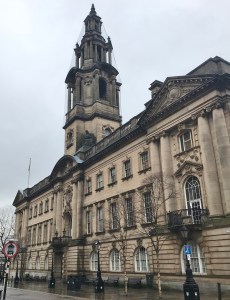 local government press as an exciting new way to organise services so at to avoid some of the enormous cuts being imposed on local authorities. I was not over-impressed, but largely because I doubt that the methods used in one medium-sized, essentially self-contained town of 114,000 people, would work for Wandsworth’s third of a million embedded in a vast metropolis. However, on a typically (for this March) cold and wet afternoon, I did have an hour to spare in Preston Town Centre and as ever, up North, was over-whelmed by the nineteenth-century grandeur of the centre, clear I hope even in this rainy picture of the court house.
- Earlier in the month, Harris Academy, in Battersea Park Road, asked our MP, Marsha de Cordova, and me to be two of the five-strong panel of judges for
 a fun competition being run for Year 8 students. The competition was held on 15th March, between six teams of kids. They had been asked to devise a presentation on behalf of a charity, local or national, with the prize of £1,000 being given to the successful charity. The teams were inventive. The presentations included songs, poems, rap and speeches. The winners were the group advocating Cancer Support. Marsha presented the winners’ cheque.
- On the 16th the Wandsworth Design Awards were presented at Roehampton University. The first prize went to the design team who created Roehampton University’s own Chadwick Hall students’ accommodation.
 I mentioned this in my February edition of this newsletter (#104), but here is a reminder of Chadwick Hall. The presentations were made in the “Portrait Room”, one of the University’s grandest rooms. As this part of the University had been a women’s college it was not surprising that most of the grand portraits were, indeed of women. But, nevertheless it was striking that these imposing nineteenth-century portraits were nearly all of women, and made me reflect on what an incredibly male dominated history tale we tell.
- On Monday, 19th March, I had the Passenger Transport Liaison Group. There were two items of real interest to Battersea. First, on the railways, it was reported that there have been more than 7,000 respondents to the consultation on the proposed new rail timetables. The new timetables are part of an ambitious expansion programme with longer trains and platforms, and increased capacity right across the system. However, to allow a greater number of services on the Reading lines out of Clapham Junction, there was a proposal to cut as many as half the trains stopping at Queenstown Road railway station. The reaction was antagonistic – so antagonistic that I feel certain the planners will re-consider! (PS I have heard today, 4/4/18, that these cuts have been postponed awaiting further consideration).
- There were also interesting developments on the bus front. Mayor Sadiq Khan announced that, by 2020, all London’s buses will be of the
 new, cleaner, non-polluting variety and secondly that two new Chariot bus services will be confirmed. One is the Battersea Bullet, from Battersea Park to Kennington station, and the other the Wandsworth Wanderer, from the Wandsworth river-front to Clapham Junction. The American Chariot pictured here is ordered online. I must confess that I haven’t even seen one, although the service was meant to have started by now. Have any readers tried the booking system or actually ridden on one?
- On Tuesday, 20th March, I had another meeting of Wandsworth’s Labour Shadow Cabinet. Again, we discussed our draft manifesto, which will be published in the next few days – see last month’s newsletter for my comments on the importance of manifestos in the political process.
- The March meeting of the Planning Applications Committee was on the 22nd. There were several planning applications of importance to Battersea. There was one from St. George, the Battersea Reach property development company. The application was designed both to cut some and privatise more of the underground parking spaces at the giant riverside development. It clearly would have affected the residents of Battersea Reach but it would also have increased the pressure on parking in Petergate and Eltringham Street. The Committee unanimously rejected the application.
- Another application was for a 10-storey tower block in Havelock Terrace, which would have light industrial uses on the first three floors and offices on the upper floors. The block would be hard up against the railway tracks and away from residential units; it also looked rather an attractive building – supported unanimously.
- But by far the most important application was the first of many relating to the Winstanley/York Road Regeneration Project. The application comprised of three separate buildings, from 6 to 20 storeys in height. One of the buildings is designed to house jointly a school and a chapel; another is for 46 council homes in a six-storey block at the junction of Grant and Plough Roads; the third is for 93 private residential units in a 20-storey block at the junction of Grant and Winstanley Roads.
- This application posed three problems for me, in particular. First, I am not happy with the proximity of the six-storey block to Time House. Secondly, I am opposed to the march of 20+-storey blocks across North Battersea, especially when all the units in this block will go to the private sector. However, I am committed to trying to improve the environment and the housing conditions of the people, who live on the York Road and Winstanley Estates. To do that, the Council needs to re-locate the Thames Christian College and the Battersea Chapel and to build council properties to allow relocation of residents. But in addition, income received from the private block is required to pay for the re-construction, and, if we are to have 20-storey blocks for sale then having one almost on top of Platform 1 of Clapham Junction station seems the best place to do it. I am sure that I will be coming back to this project on many occasions before it is completed.
- On the 26th March, I attended a meeting of Battersea United Charities (BUC), united because it is the marriage of several small charitable bequests and possibly best known for its Christmas Day dinner party for pensioners from all over the Borough. BUC makes small grants to individuals in training, to primary schools for holiday trips and to voluntary groups providing services for any number of Battersea people. On this particular occasion, we agreed to support, through a small grant, the visit of a Devon farm, with associated livestock, to Falcon Road – keep a look-out for sheep pens outside Providence House! If you have plans and needs of your own and feel a small grant would help, then let me know and we can discuss whether BUC might help.


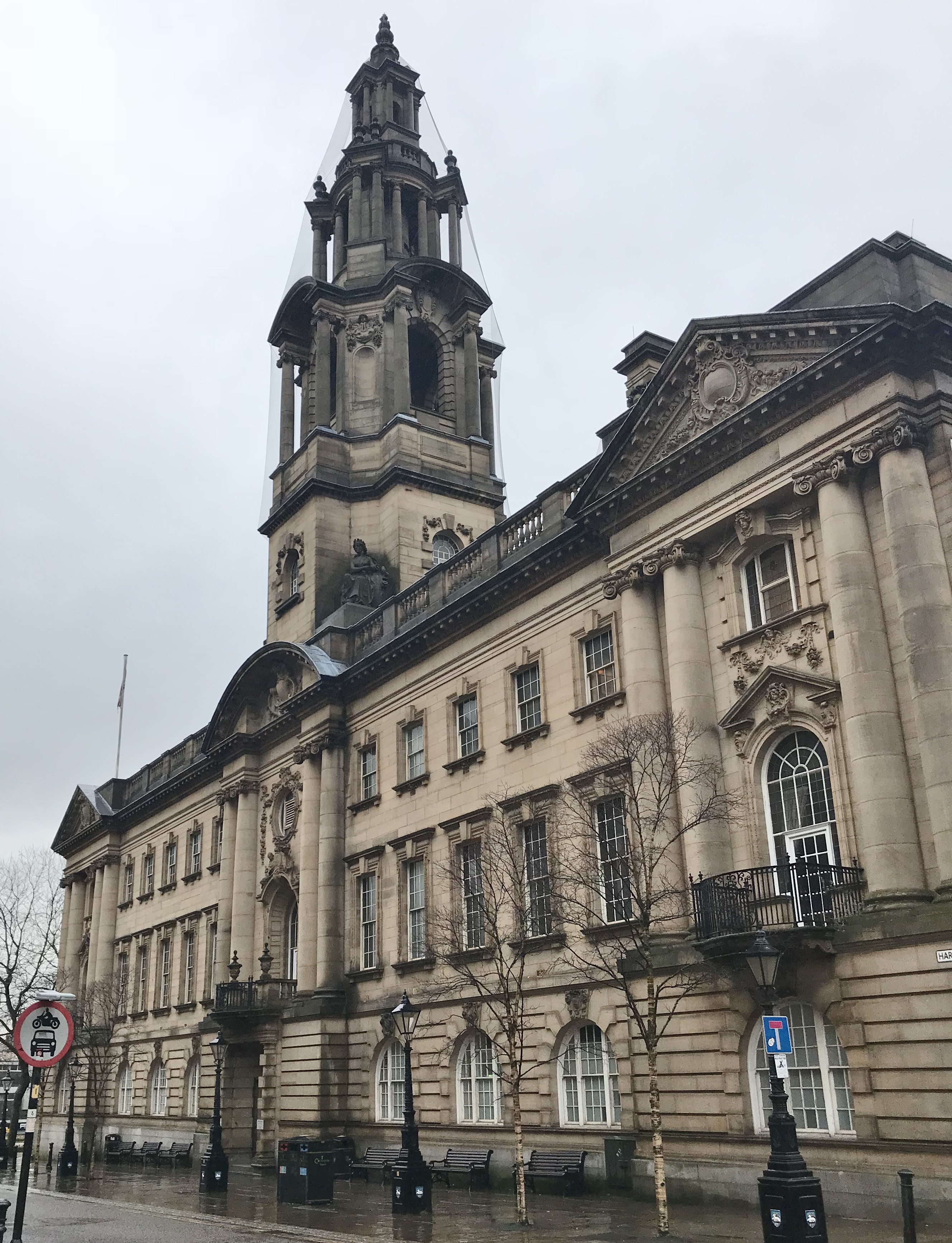

My Programme for April
-
- The Planning Applications Committee will meet on the 18th April.
- On the 24th I will be representing the Labour Party at an election-hustings meeting organised by the Battersea Society in York Gardens Library.
- On 27th April, I have been invited to attend a meeting of ACAN, Afro-Caribean Nation councillors, at City Hall. You might well be surprised at that and I was when I received the invitation! I can only imagine that it is because last year I spoke at a Black Lives Matter debate at the East Anglia University in Norwich.
- Finally, on 28th April, I have the Council organised surgery to run at Battersea District Library. It will be curious to do that with only five days left before the Council Election on May 3rd.
- Preparing for that election will clearly take up much of the rest of April!
Do you know?
Last month, I used 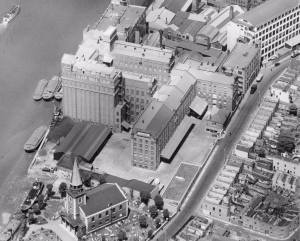 this picture and asked, “What was the connection between it and Britain’s greatest engineer, Isambard Kingdom Brunel (1806 – 1859), who built the Rotherhithe Thames Tunnel, the Clifton Suspension Bridge, most of the Great Western railway and the first iron ship?”
I also said that the connection might just have appeared right at the top of this picture. To my surprise, quite a few of you knew there was a connection, but disagreed about the exact nature of the connection. Actually, his father had a sawmill near to the current Battersea Bridge and a factory, where he made army boots used in the Napoleonic Wars. Isambard, who worked very closely with his father on many major projects, was a regular visitor. Congratulations to those that got that right.
Thanks to Christine Eccles and Battersea Memories for this one. Pretty easy, I know, but I like the picture: Where and when was this photo taken? And do you know the current use of the church on the left-side of the road?
Councillor Tony Belton’s Battersea March, 2018, Newsletter (# 105)
- February was a short and quiet month, which will
 probably be best remembered for the brutal way it ended: with the coldest winter snap we’ve suffered in years. Still, it had the occasional compensations, such as my walk on Wandsworth Common near Bolingbroke Academy on the 28th.
 - Back to the beginning, on 7th February we had the Council Meeting but, as I have said before, this does not have the civic significance that it had when I first became a councillor. Indeed, the only discussion of any interest was the technical background to the March decision on Council Tax, which essentially signalled that there are not going to be any really unpleasant surprises when the Council Tax bills come out later this month. If you are interested in my views on local taxation then go to https://tonybelton.wordpress.com/
- February 8th was the centenary of the reform which gave the vote to almost all British women over the age of 30. Wandsworth Labour produced an electronic leaflet to commemorate the occasion, starring women “we knew” personally, who won the right to vote and were directly involved. One was Nellie Florence Belton, my nan who is on the left, with baby Nen, my aunt, and grandfather, Ernest. The script tells of how Nellie gloried in taking a lift to the polling station in a white, open-top Rolls Royce, driven by the Tory MP. But, thanks to the secret ballot, she did not have to tell him that she had voted Labour.

- On Friday, 9th February, I had the pleasure of going to a small theatre in Barnes to see a farce, called Liberty Hall, which was written by an old Battersea friend of mine, Robin Miller. Robin is an actor, who has now turned to writing plays. This was her second, the first being a murder mystery called Murder on Cue. Appropriately for a farce, the plot was truly farcical but the characters were all credible and their reasons for coming on stage and leaving it were nearly always coherent. The script was funny and everyone ended up with the partner they deserved. I haven’t seen Murder on Cue but, on the basis of this play, I do hope Robin will write more plays and, perhaps, get them produced “up Town”.
- Two days later my partner and I went to the Clapham Picture House to see Three Billboards Outside Ebbing, Missouri. It is billed as a “black comedy”, but it is so searingly black, so piercingly bitter and so tough that it is difficult for me to think of it as a comedy in any sense at all. I thought it was brilliant but there is another view – see my blog. Go and see the film and let me know your views. It is coolly directed by an Englishman, Martin McDonagh, and brilliantly acted particularly by the lead, Frances McDormand.
- On Sunday 11th, we went off to the National Portrait Gallery to see the exhibition of Cézanne portraits. Picasso said of Paul Cézanne that he
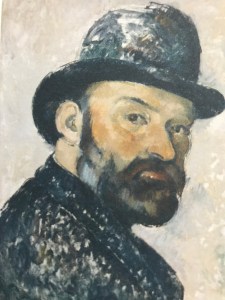 “was like the father of us all” and of course his most famous landscapes of Provence and the south east of France are major works in the Impressionist portfolio, but I must say his portraits did not grab me. I thought that this self-portrait was an exception to my rule that his portraits revealed very little about character. But it is never a waste of time going to the National Portrait Gallery because it has a restaurant with one of the best views of London, even if the food is not cheap. The Tudor room, next to the restaurant, is also a delight, especially with its paintings on wood of Tudor high society from Elizabeth l down – many by unknown painters.
 - On the following Tuesday, I had another meeting of Wandsworth’s Labour Shadow Cabinet. We discussed how the election campaign is going and where and when to apply our resources. We assumed that the Tories will, in the build up to May 3rd, spend more money than we can afford, but that we will have far more canvassers. Then we had a presentation from our advisors before moving on to further discussions about the manifesto. I guess some will think that writing a manifesto is a simple, ten-minute job – not at all.
- The first use of a Manifesto in British political history is Sir Robert Peel’s 1834 Tamworth Manifesto. With the Tory Party, in a very poor position, Peel decided it was essential to make a statement about the party’s purpose and objectives. Ironically, he did not win the subsequent election, but he did set a standard, which every political party has felt it necessary to follow. The Manifesto is not just “a piece of paper”, but a statement of a party’s aims and objectives, against which the party can (and should) be judged – at least until the next election and the next manifesto. It is, therefore, far more important than the fact that very few of the public actually read manifestos. It is a work still in progress.
- On 20th February, the Grants Committee made various grant awards to voluntary organisations across the Borough. I am not a member of this committee and don’t know the detail but, between us, my colleagues, Simon Hogg, Wendy Speck and I, have nominated and supported the second highest number of successful grant applications in the Borough. The range of plans and suggestions are amazing. This round included grants to aid the teaching and learning of IT skills at the Mercy Foundation, Falcon Road; a food waste project, the brainchild of Providence House youth club and the Venue in Park Court; and, most excitingly, the teaching of circus skills!
- The February meeting of the Planning Applications Committee was on the 22nd and, unlike last month, it was a fairly low-key affair, with no application of anything other than very local significance. However, it was announced, at the same time, that Peabody Housing Association have gone into partnership with Battersea Power Station to provide 386 socially rented homes in Nine Elms. This is nowhere near the number of “affordable” houses that should be delivered on site but it is good news that such a reputable Association as Peabody has been selected to deliver the ones that do come.
- Twice during the month, I had meetings about the developments in the so-called Winstanley Regeneration project, the second being with the Design Review Panel on 23rd February. This was strictly about the project from a design and architectural point of view and I was simply an observer as the “independent” review panel quizzed the architects/designers. It was instructive to hear experts talking about designing and delivering a major new development. The other meeting was more generally about the shape and form of the plans as they develop and I am becoming a little concerned about it. There appears to be a kind of “mission creep” going on, with the towers on York Road getting higher and higher and the density in other parts of the estate rising but without sufficient social gain. After the May 3rd election, this project may need a thorough review.
- I was back to the Vaudeville theatre on the evening of 23rd to see Oscar Wilde’s Lady Windermere’s Fan. It was typical Wilde, a brilliantly funny comedy about the English upper class; but, if you stop and think about his plays, he is also very much a feminist. His men are usually hopelessly feckless, rather silly, not exactly evil but more than a little irresponsible. His women know the score and understand the inevitable ironies and tragedies of life. I now realise that Wilde’s plays are rather more serious than I had thought.
- On 25th February I led a history walk from the Latchmere pub, round the Latchmere estate to Battersea Square and along
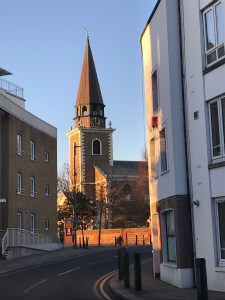 the riverfront to Battersea Park. It was for my partner’s group of Japanese students in an Anglo-Japanese exchange visit. Here is a frozen group of students on the steps of St. Mary’s and, what I consider to be, a simply beautiful and brilliant picture of the church in the setting sun, from the Square
 - On the 27th, I went to a memorial service for Mary Turner (1938-2017). She was born in Tipperary, Ireland; came to Britain as a young woman; worked
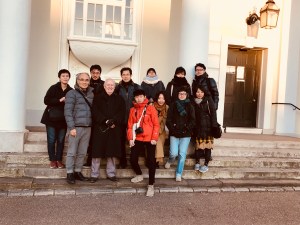 her way up from being a “dinner lady” to being President of the GMB and, in 2004, appointed Chair of the Labour Party. I had had only a very brief acquaintanceship with Mary at the Party Conference, but her warmth and enthusiasm, which is obvious from this picture, was utterly charming.
 - But let’s be honest, it was also a great opportunity to go to St. Paul’s and take in the grandeur of the surroundings, not as a tourist but as a participant in
 a service.
 - Finally, on the 28th I was crazy enough to go to Wembley to see my team, Spurs, beat Rochdale 6:1. Of itself that is hardly worth a mention but for two things: first the game was played in a snow-storm (and that was why it was crazy) and secondly it involved the highly contentious use of the VAR (video assisted referee) system. For what it’s worth my own view is that VAR is here to stay, that it has to get better and faster than it was on Wednesday, but, also that soccer will lose something as a result: VAR depends upon review and re-consideration, when soccer is about pace and non-stop action. Rugby is well suited to VAR, but soccer, I am afraid, is not. I was obviously pleased with the result and look forward to further victories in 2018!
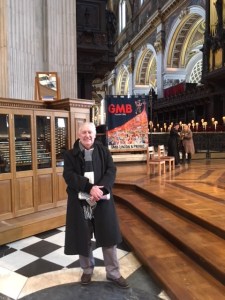
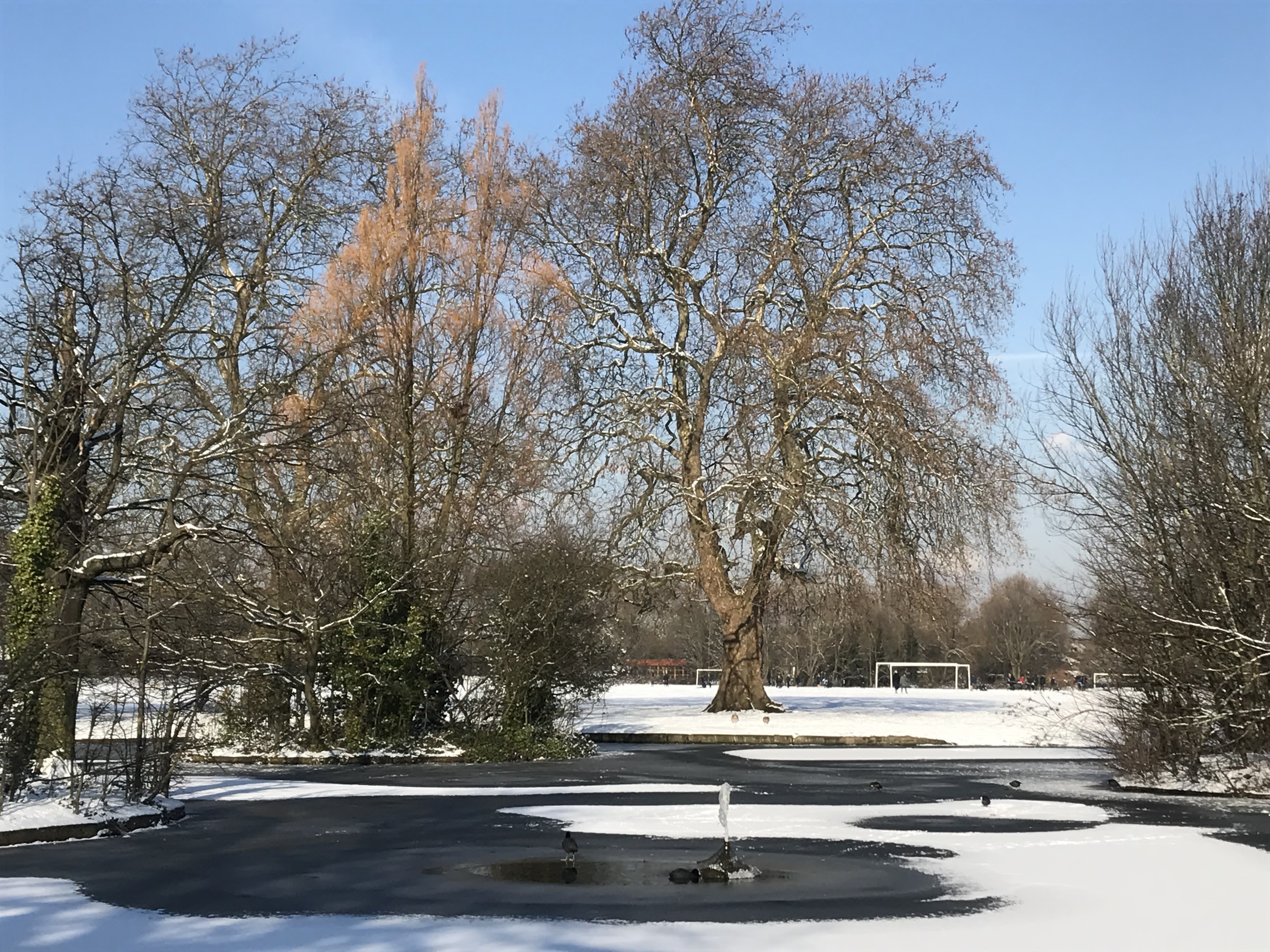


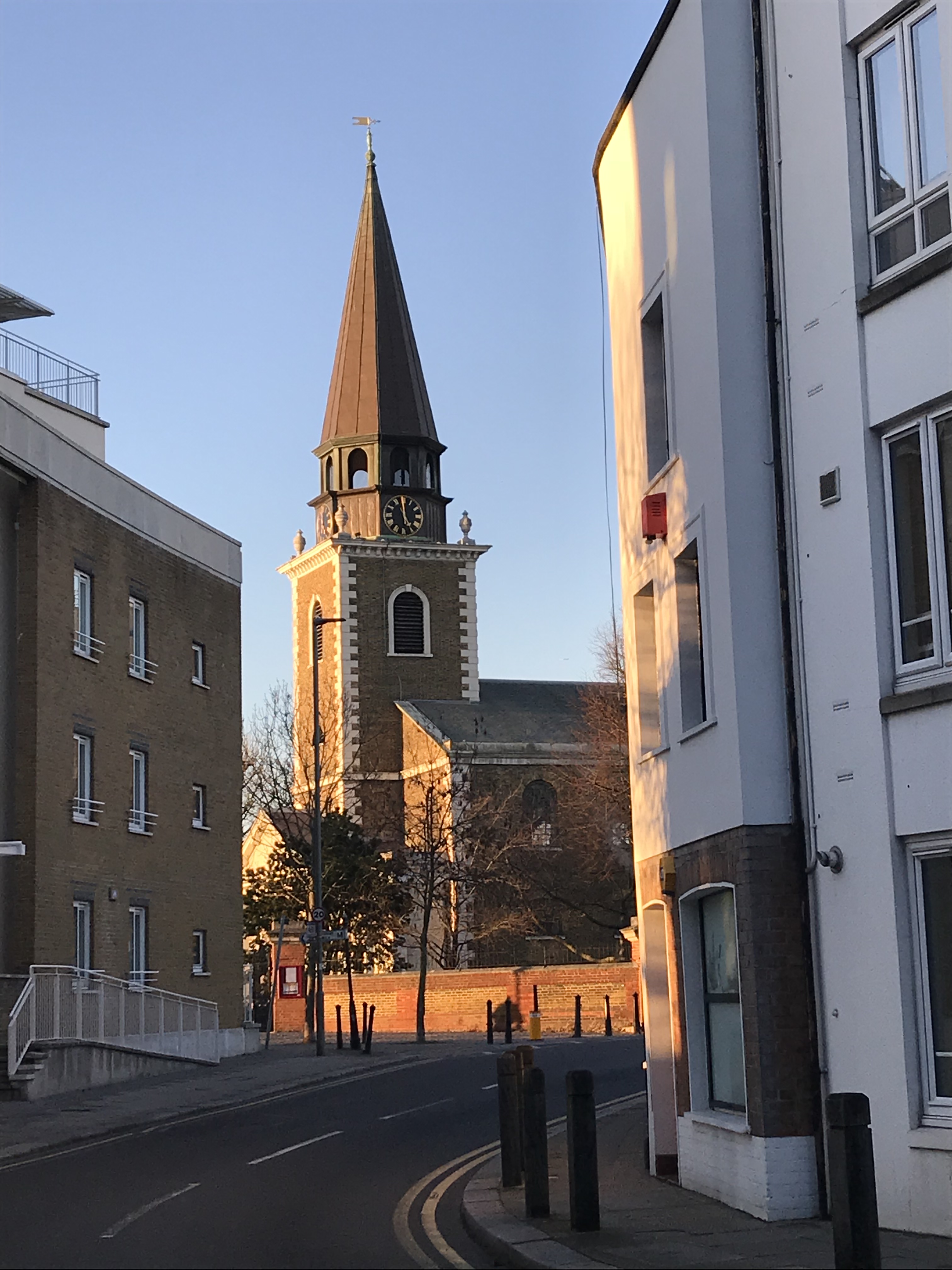


My Programme for March
- The Conservation Area Advisory Committee meets on 6th March. The applications being considered are not of wide significance but it is interesting to note that they include three Victorian pubs, all under threat. They are the Prince of Wales in Battersea Bridge Road, the Queen Arms in St. Philip Street and the Bedford, on Bedford Hill.
- On 7th March there is the Council Tax setting Council Meeting. It will also be the last Council meeting before the May 3rd Borough Election and hence there is bound to be much boisterous and largely juvenile party sledging – but it won’t do any harm and “boyz will be boyz” as they say.On the 8th there will be a Wandsworth Business Forum at the Grand in Clapham Junction.
- On the 9th there will be Gordon Passmore’s funeral at St. Ann’s Church, St. Ann’s Hill. Gordon was a Tory councillor, largely for Putney ward from 1964-1971 and for Northcote ward from 1974-2006. Unlike many Tory councillors, he was not a hard-line Thatcherite but from an older more community-based tradition. I will be going.
- On 15th Harris Academy, previously Battersea Park School, are holding a “First Give” award for students, where they are competing to win a prize for the best presentations in support of favourite charities. The school has asked me to be one of the panel of judges – sounds fun.
- On that evening there is also the police’s Special Neighbourhood Team. I have missed this panel recently, because of clashing commitments, and so must make a big effort to be there.
- The Planning Applications Committee will meet on the 22nd.
Do you know?
Last month, I used this picture and asked:
- Where? When? How?
- How many things can you name that are still there and what are they?
- And can you name what is there now?
Many of you replied – correctly. It was after all fairly easy but the answers are:-
- St. Mary’s Church is at the bottom and Battersea Church Road runs from the bottom to about 2 o’clock. I am not sure of the date but judging by the kind of traffic that one can see I would guess it was taken between 1945-1960 from a helicopter.
- Well, the church obviously but also the houseboats on the river. And, of course, the roads. It is also possible that a couple of the old houses on Battersea Church Road might be there above Bolingbroke Walk.
- And now there is the Montevetro building, the Morgan’s Walk development and in the bottom right the Somerset estate.
And this month’s question:
Britain’s greatest engineer, Isambard Kingdom Brunel (1806 – 1859), who built the Rotherhithe Thames Tunnel, the Clifton Suspension Bridge, most of the Great Western railway and the first iron ship, has a little-known connection with Battersea. As it happens, the connection might just have appeared right at the top of this picture. Does anyone know what the connection might be?
 Tony Belton
 Tony Belton
