Councillor Tony Belton’s Battersea December, 2019, Newsletter (# 126)
- This November was going to be a quiet month, and so it started. Penny was in China on a Presidential tour for her 18th century historical society, including lectures in Shanghai, Nanjing and Beijing, so I got myself invited to a “drinks social” on 7th with Christine, dinner with Sarah on the 8th and the Providence House Fund Raising dinner on Saturday, 9th. This was only the second time that Providence House has tried a relatively expensive fund-raising dinner and there’s no question that this was a significant step up from 2018.
 The meal was exquisite, prepared and cooked by Hadas Hagos – quite a feat with a guest list of well over 100; the entertainment was provided by friends and members of Providence House, the largest and best youth club in Battersea.
- I went to St. Mary’s Remembrance Day Service on 10th November and then the “real thing” on 11th November in Battersea Park. The St. Mary’s Church service was very special and very moving. The front cover of the service programme had a photograph taken at the first
 Armistice Parade in Whitehall in 1919 – a new photo to me. The reading was from US Marine, Sergeant Jonathan Kirk Davis, on returning from combat to “home” – again new to me and very moving. And as for Canon Simon Butler’s own sermon, it managed to be moving but neither sentimental or jingoistic, to be full of religious feeling but totally acceptable both to an atheist like me, and I would have thought to those of different faiths. I am sorry to say that the following day’s service, organised by Enable on behalf of Wandsworth Council, was less successful. The presence of local school children was good and appropriate, but the format of the occasion is rather dated and needs review. The weather was, however, fantastic; very cold, very breezy, very autumnal.
- On 13th November I went, with Marsha de Cordova, to the Wandsworth Civic Awards Ceremony. I had a particular reason for going because my old friend (we met in 1967, I calculate) Ron Elam was receiving one. Ron has been a school governor for the best part of 50 years, including a long spell at Chesterton Primary. He kindly “blames” me for getting him started on this path – if so, then I did state education a service, as Ron has been a dedicated governor and also a constructive Ofsted inspector.
- On 16th we went to Newark, Nottinghamshire, for the week-end. Why Newark? Penny was chairing a public lecture given by fellow historian, Professor Norah Carlin, on petitioning during the Civil War (1640s) – the one which finished with the execution of Charles I. The petitions, which were essentially about what to do with the then constitutional crisis (sounds a bit like 2019!), and they came from all over the British Isles, very definitely including Ireland, and seemed to be targeted at a much more united set of kingdoms than exists today.
- After the lecture, we went to Newark’s
 Palace Theatre to see a production of Charles Dickens’ A Christmas Carol – a nice if slightly sanitised production featuring an unusually youthful Scrooge. What the unreformed Scrooge would make of today’s marketised Christmas one hesitates to speculate but safe to say that he would certainly have exploded “Bah! Humbug!” The next day, we had a quick tour of the town, which took in the Castle, which was destroyed in 1646, and a visit to the National Civil War Centre, before returning to Battersea.
 -
On the afternoon of 21st November, I attended a very special War Memorial at
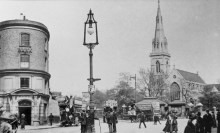 Christchurch
  Gardens. It commemorates civilians, who died in the Second World War, and is held in Christchurch Gardens, the site of the first V2 bomb to land on Battersea at the old Church exactly 75 years earlier on the afternoon of 21st November, 1944. The church was a grand nineteenth-century building; and I am afraid, that its relatively modern replacement lacks a similarly iconic presence!
- On Sunday, 24th November, I was
 invited to a key soccer match for all-conquering Battersea FC’s U13 team at the new Falcon Park all-weather pitch. Their opponents were an equally successful team from Lewisham and appropriately enough the result was a hard-fought 1-1 draw. Some Latchmere residents (and others) were unhappy with the installation of this “un-natural” pitch but, on a day when every other pitch in the Borough was water-logged, we three spectators were happy to see the match proceed. Marsha de Cordova is on my left and Queenstown councillor, Maurice McLeod on my right.
- A week later on 27th November, I had the Planning Applications Committee (PAC). There were several applications, which attracted interest and concern in Battersea. The first was for the use of the Thames slipway, next to St. Mary’s Church, as a launch-pad for the amphibious tour boats that can be seen on the Thames nowadays. This particular application was withdrawn but I am sure it will come back to the Committee in the near future. Two others were the redevelopment of the two industrial sites in Ferrier Street, next to Wandsworth Town station, and Jaggard Way, next to Wandsworth Common station. The Ferrier Street application included 102 residential units of which, forty-one are to be affordable, along with a modern replacement of the industrial units. This development was approved but only possible by providing the residential units in a 10-storey block, alongside the Station, just about opposite the Alma pub. The Jaggard Way application was, however, rejected because it was over-large and dominant next to the Common, despite the fact it included 72 residential units in four 4-storey blocks. I was unhappy with both decisions! The first, because I think a 10-storey block is too high to fit into the Old York Road environment; the second, because I did not consider four-storey blocks to be over-large for a site separated from the Common by a four-track railway line (though to be fair there was a specific objection about the unreasonable impact on one particular neighbour).
- On Friday, 29/11/19, we went to see a revival of A Day in the Death of Joe Egg. This iconic play of the 1970s was written by Peter Nichols, one of the lesser-known so-called “kitchen sink” dramatists. The synopsis, telling of a marriage under strain as husband and wife struggled to bring up a disabled adolescent daughter, was hardly encouraging – it didn’t look like the stuff of a great evening out. How wrong can you be? Sensational acting from Toby Stephens and Claire Skinner lit up a hugely sympathetic, humane and understanding work. The dialogue was very funny despite, or was it because of, the totally unsentimental script. It was not surprising to discover that the content was partly autobiographical. I will be doing a review on this play, which will be on https://tonybelton.wordpress.com/
- Finally, a word on the election. I know that for some Battersea residents this poses a really difficult question. What do Remain-inclined Tories do? And Labour folk concerned about Jeremy Corbyn’s “extremism”, or Lib/Dems who want a plague on both “major parties”, or Greens for whom the only priority should be climate change? But the only certainty in Battersea is that the winner will be either Labour’s Marsha de Cordova or Tory’s Kim Caddy. In 2017, Labour had 25,292 votes as opposed to the Tories 22,876, with the Lib/Dems back on 4,401 and the Greens 866. The only real impact vote switching could have in Battersea would be to the current Prime Minister’s benefit – is that the impact any doubtful voter really wants?
My Programme for December
- December is all about the General Election on Thursday, 12th!
- Not even the Planning Applications Committee, “the committee that never stops”, is meeting this month!
- Though, of course, there will be the usual round of Xmas parties and drinks. As for me, I will be having a quiet Xmas day, with Boxing Day in Winchester and then a few days in Bath, taking a swim or two in the hot mineral springs that have attracted tourists ever since Roman times.
Do you know?
Deferred this month: back again after the Election!
Councillor Tony Belton’s Battersea November, 2019, Newsletter (# 125)
- First a brief note about my email address. On 10th October, BT abruptly ended my btconnect.com email, because I am not a business! So, 1) I do not have access to any of my past correspondence unless I “saved” it and may have lost your email address, 2) I may also have completely missed recent emails, so please forgive me if I haven’t replied to you and 3) my email address is now tonybelton99@gmail.com.
- On 1st October I was invited to talk to an
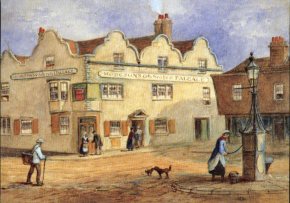 audience of Battersea residents, invited by Big Local, on The History of Battersea, 1800-2019. There were about 50 people there, from the local estates, Providence House, the Katherine Low Settlement (KLS), the Battersea Society and the Rotary Club amongst others. I really enjoyed the illustrated talk and the audience seemed to enjoy it too. If you would like to hear my views on the social history of the nineteenth and twentieth centuries, then I would be game to repeat it.
- The following day, 2nd October, I went to the KLS Annual General Meeting. KLS makes a point of keeping the business down to just a few minutes, which can surprise those of us, who come from a political background! Instead, KLS concentrates on socialising or as we say nowadays, networking. For those of you, who do not know KLS, it is a brilliant organisation, which runs social and learning events for, in particular, the young and the elderly of Battersea. The community spirit is great. Fellow Councillor Fleur Anderson works for KLS in a community support role and, at present, she is fighting to win the Putney Parliamentary seat for Labour in the next General Election. If she wins, then she will be sorely missed, but if she does not, she is not going to suffer for a lack of things to do at KLS.
- On Friday, 4th October, I went to the
 twelfth century St. Peter’s Church on Hayling Island, normally something I would enjoy but on this ocassion it was, sadly, for the funeral of my old friend, Peter Taylor, except, at the age of 39, the last thing he was, was old. Some of you may remember that he stood as a councillor for Queenstown in the Borough Election of 2010. He was also the Secretary of the Battersea Labour Party for some years. Peter will be remembered by those, who knew him well, for his very dry sense of humour, his sociability and his enormous breadth of knowledge, especially of recondite political facts.
- On 5th October I went to
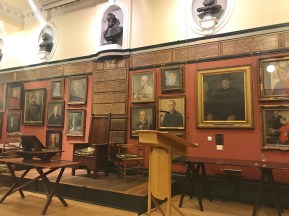 the Art Workers Guild in Queen Square, Bloomsbury. I was there to mark the 60th anniversary of the 60th year of the Poetry Magazine at the invitation of a college friend, Timothy Adès. We heard eight poets eloquently reading a selection of their poems. The interior of the guild’s hall was a splendid throw-back to the nineteenth century; and the event was suitably celebratory.
- The next day, we went to the Silver Sunday
 tea dance in the Town Hall’s civic centre. It was a great success and much appreciated by some 100+ dancers. It was not exactly Strictly Come Dancing standard, but many of the participants have clearly spent many an evening at the old Hammersmith or Wimbledon Palais. It was fun to see people showing their prowess at ballroom dancing as well as jive and cha-cha – and we had a go too.
- Last month I said that on 9th October I would be going to the Corporate Parenting Panel. As it happens, I did not go, largely because I think it is an almost total waste of time. The Panel was a “Tony Blair” initiative to try and resolve some of the issues that Britain has in providing for our most disturbed children and young people. Being taken into care is almost always a last resort and is usually a predictor of low educational qualifications, poor job prospects and a difficult life. Blair, perhaps in desperation, tried to resolve this problem by making all members of local authorities (that is councillors) corporate parents with all the responsibilities of parents. But in reality, what kind of real parenting can 60 councillors do, if and when they have no control over the budget and virtually no contact with the young people concerned? Not for one minute do I decry the work and the effort put into corporate parenting by some people like ex-councillor Kathy Tracey, but giving responsibility without power to 60 disparate councillors is, in fact, giving responsibility to no-one. Corporate Parenting needs to be re-thought.
- The next day, I had lunch with 50 or so “mature” members of the 07 Club. To be a member one had
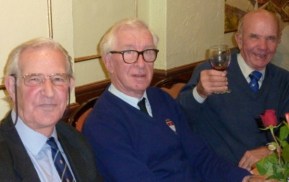 to have worked for one of London’s local government organisations, such as the London Fire Brigade or the City of London. Most of us had, however, worked for the Greater London Council, and the Club had originated in its predecessor the London County Council in 1907. I wouldn’t want to pretend that it was a totally sober event, though one of my old friends, who I have known since the 1960s, rather incredibly combines coming from rural Ireland and being a lifelong teetotaller! Ned is the middle one of these three.
- I caught an early flight from Stansted
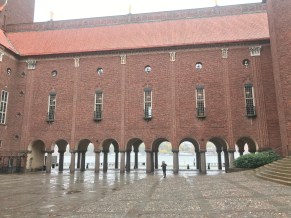 to Stockholm on Friday, 11th My partner, Penny Corfield, had been invited to give a keynote lecture to the Swedish Eighteenth-Century Society and I joined her for the Conference dinner and a pleasant weekend in Stockholm. The weather was largely bright and sunny but not on the day when we went to see the iconic Civic Hall, where the Nobel Prize dinner is held every year. It looks splendid, even in the rain, with its mix of Nordic and Venetian architecture, so suitable for its waterfront site.
- On Wednesday, 16th October we had only the fifth Council Meeting of the year. There were some good speeches on food poverty, housing, private education and policing. Essentially, each of these “problems” comes down to the one issue: the widening gap between the comfortably well off and the poor. Wandsworth has one of the greatest disparities between rich and poor in the country. Not, I am afraid, that the Council Meeting is as relevant to these issues as it once was; after all, it was only the fifth meeting of the year and one of the others was totally ceremonial!
- Like many other fans, I was up
 early on 19th October to see the Rugby World Cup Quarter-final in Japan between England and our old friends and enemies, the Australians. It was a tense and exciting match, if not quite a great game. England appears to have a very strong and powerful pack, with a starring role being played by Kyle Sinckler, known as the “Tooting Tank”. Sinckler, who went to Graveney School, joined the Battersea Ironsides Club and played his early rugby in the Burntwood Lane sports club. Here he is shown triumphant, having scored England’s first try in the game, which England won 40-16.
- I had the Planning Applications Committee (PAC) on 24th There was not one application of major significance, although every application is, of course, important to both the applicant and the objectors, if any.
- On the Friday, we went to see Judy,
 the film about the life of Judy Garland. An accurate historical account of the life and loves of the Hollywood mega-star, it was not, BUT ….. It was, however, a vehicle for a superb performance by Renée Zellweger, shown right playing the part. The comic (and musical) star, probably best known in the UK for Bridget Jones’s Diary (2001) and its sequels, proved beyond doubt that she really is a great actor. The film also made it very clear that some Hollywood moguls viciously exploited their young, and possibly their not so young, actors mercilessly.
- And then England really turned on the style with a simply pulverising performance in the Rugby World Cup Semi-Final with a 19-7 victory over the New Zealand All Blacks, with the Tooting Tank starring once again. Now all they need to do is finish the job by beating South Africa in the November 2nd Final.
- I can’t let the month go by without recording my current thoughts on the political crisis that we face. In some optimistic moods, I like to think that Brexit will simply disappear into history. But, at other times, I have the more pessimistic view that the British Isles will soon break-up into its four separate entities of Ireland, Wales, Scotland and England. If that were to happen, then I suspect that Ireland and London will both manage quite well (Ireland because, most of the island, has had 100 years of getting used to standing on its own feet; London because of its sheer size and economic power), but I would expect a rockier future for other parts of the UK. Anyhow, we shall see!
- On Tuesday 29th, the Boundary Commissioners published their proposals for Wandsworth’s new ward boundaries and immediately after that it became clear that the major political parties had decided to have a General Election on 12th First things first: the ward boundaries. The published proposals are for public consultation, which thanks to the Election decision, might be for a slightly extended period. For those of you, who want to see the details, look up https://consultation.lgbce.org.uk/. The commissioners have brought forward interesting proposals, which would result in the disappearance of some old names, such as Latchmere and St. Mary Park and their replacement by Falconbrook and Riverside. Personally, I don’t much like Riverside; it may be descriptive but it’s hardly specific – there must be hundreds of Riversides up and down the country! But many of us won’t be too worried about the nomenclature but much more about the political implications. Everyone is invited to comment on the boundaries and/or the names.
- As to the General Election, my main hope is that it will exorcise us of the poison that the Referendum and Brexit has imposed on the country for the last three years. However, I rather fear not, as all the indications are that we will still be dealing with all the ramifications from Brexit for at least another decade – now there’s a gloomy thought!
- Stop Press. On 30th we heard that the
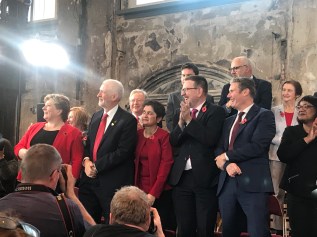 national Labour Party had decided to launch its General Election campaign in Battersea Arts Centre on the 31st. At the launch, our MP, Marsha de Cordova, introduced Jeremy Corbyn, who in turn launched the Election campaign. Marsha was as enthusiastic and engaging as ever, Corbyn was inspirational – not something one could always say but there is no doubt that he comes to life during election campaigns; he is literally transformed from his performances in the House of Commons. My picture shows some of the Shadow Cabinet on the stage at the Arts Centre.
My Programme for November
- On 9th November I will be going to the Providence House fund-raising dinner, where I am sure we will be entered by an interesting youth club show.
- The next day I will be attending the Remembrance Day Service at St. Mary’s Church, and on the 11th the traditional open-air Remembrance Day Service in Battersea Park.
- On that same evening, I have the Strategic Planning and Transportation Committee.
- On 23rd I hope to attend the London Summit at the Guildhall in the City. Every councillor in London has been invited and we will discuss the issues of the day BUT probably not Brexit.
- The Planning Applications Committee, “the committee that never stops”, is on 27th
Do you know?
Last month I asked
- Where was the Portsmouth and Southampton railway’s first London terminus? The answer is Vauxhall.
- When was Waterloo station opened as a replacement for the first terminal; 1848, although it was never intended to be a terminus with the original meant to cross the Thames and terminate in the City, and
- When did the last steam train puff its way out of Clapham Junction? 1967.
This month: my question is Do you know many films were shot at least partly in Wandsworth? I know of some; I’ll list them next month but how many can you add. And I’ll start with an easy one we have all seen Love Actually, but which was the Wandsworth scene and where was it shot?
Councillor Tony Belton’s Battersea July, 2018, Newsletter (# 109)
- First a couple of outstanding matters that I know will concern some of you. I have heard nothing further about the 14-storey development so many of us dread, at the corner of Culvert and Battersea Park Roads. As far as I know the building works still await the resolution of contractual matters.
- Secondly, I still haven’t heard of a definite resolution to the “flooding lift” problems that affect Clark Lawrence, Shaw and particularly Sendall Courts – hopefully they are all working satisfactorily now, but please let me know if they are not.
- The first June in the four-year cycle of any Council (this one being 2018-2022) is always an unusual time. We have had apparently endless induction meetings and annual meetings, and to cap it all we have new technology to cope with as the Council has supplied us all with new laptops. That may sound good to you all, but the main motivation is the Council’s desire to eliminate paper and get us all to work online, hence saving the Council money, particularly on postage. OK, even great, I can hear many of you say. However, in my case at least, this change does not complement my present way of working but merely duplicates and complicates it all. I can hear you say, even now, something about old dogs and new tricks!
- On Saturday, 2nd June, I visited the Share Centre’s Garden in the grounds of Springfield Hospital. The Centre,
 based in Altenburg Gardens Battersea, is devoted to providing, in the words of its website “training and employment support for disabled people”. Gardening is of acknowledged therapeutic benefit and the Centre put on a good show much enjoyed by, from the left, Councillor Fleur Anderson, me, my partner Penny and Share Centre Director, Annie McDowell, pictured here.
- On 3rd June, we went to the National
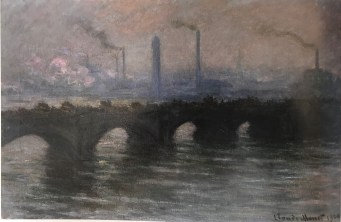 Gallery to see the Monet & Architecture Exhibition. For art lovers I fully recommend a visit and for those, not so far interested, then this would be a great start. Monet’s painting of Waterloo Bridge and the South Bank as they appeared from the Savoy Hotel in 1900 gives just some idea of what industrial smog in London was like 120 years ago.
- The next day, 4th June, I was at Christ Church, at the junction of Cabul and Battersea Park Roads, to hear a presentation of the
 Battersea Society’s “War Comes Home” oral history by Carol Rahn. The Church Hall was packed with well over 100 people in the audience. The presentation was the culmination of work done by Carol, Jenny Sheridan and Sue Demont. Their research was based on interviews with residents, who had memories of life in Battersea during and immediately after war-time bombing. By definition most of those were over 80 years old and some of them were there on the 4th. It was a brilliant presentation and if anyone wants a copy of Demont’s associated booklet The Bombing of Battersea, then let me know. The picture shows Carol Rahn telling the story.
- On the 5th June, I visited Deliveroo’s Battersea kitchens. Hidden in industrial Battersea between all the rail-tracks, they were a fascinating example of new technology applied to an ancient trade – the restaurant business. The way it works is that there are half a dozen efficient, modern kitchens in one factory, serviced by one delivery network and one chain of suppliers but with, of course, different chefs and different cuisines. Like many people concerned about working conditions in the so-called “Gig Economy”, I asked questions about Deliveroo’s employment practises. Whilst I was not totally re-assured, it was good to hear that they now have a £10 million insurance scheme to provide some assistance in the event of their deliverers not being available for work or suffering industrial injuries – including from traffic accidents. Deliveroo demonstrated to me that it is beginning to respond to proper political pressures.
- One of the compensations for working at the
 Town Hall is that it is so very near the National Opera Studio, near the Southside shopping centre, Wandsworth. The Studio puts on lunch-time concerts at the conclusion of every academic year. This year’s concert was on 6th June. The stars are, of course, the students who come from all over the world to be trained in Wandsworth. Here are Bechara Moufarrej and Emyr Wyn Jones singing a duet from Bizet. They and all the others at the concert were fabulous and, as you can see, the concert is in a very “intimate” setting. It is well worth a visit to any music lover and especially for those who like to spot a future operatic star.
- On Friday 8th June, we went to Wilton’s Music Hall, Whitechapel. If you have not been and, like going to the theatre, this really is an unusual “must”. The only old fashioned nineteenth-century music hall left standing in London, it is an event in itself, but we went there to see Sancho, a monologue by Paterson Joseph.
 Paterson, a black British actor, wrote this work about Charles Ignatius Sancho. He was born in about 1729 in Columbia and died in 1780 in London. It was not known whether he was, at first, a slave but by the time of his death he had been painted by his friend, the famous artist Gainsborough and he counted famous actors and artists amongst his best friends. He was the first black man, that we know of, to vote in a British General Election. He voted for Charles James Fox, a famous abolitionist (of slavery) in a Westminster election. The play was witty, subtle and clever. It was acted in a one-man tour de force by Paterson, himself.
- And so, on 12th June to, of all things, the North East Surrey Crematorium Board. Way back before the merger of the old Battersea and Wandsworth Borough Councils into the modern Wandsworth Council, Battersea bought 120 odd acres of land in rural Morden. They recognised that there would be a shortage of land for burials and decided to buy some relatively cheap, out-of-town land. The Board, which has members from Wandsworth, Merton and Sutton Councils, meets at the Crematorium or, more usually, Sutton Council offices. It was a fascinating morning including a tour of the ovens and explanations of what happens to non-human body parts, such as artificial knees, heart pacemakers, etc., but perhaps not for the faintest of hearts!
- The following day, 13th June, I met people from Battersea Power Station. The main purpose was to get an update on current developments and to lobby for a re-instatement of the 250 affordable units that were cut from the development plans earlier this year – no movement yet. But as a by-product of the visit I happened to see one of the Peregrine Falcons that have nested in the Power Station for 18 years and have fledged 32 juveniles. In 2013 the Peregrines were encouraged from their nesting site on the Power Station to a tower crane in order that restoration works could commence.
 Their most successful breeding seasons have been on the purpose-built tower. This year they have again been successful, fledging one juvenile, known on site as ‘ Solo’. A male, he is currently learning his trade from the adults. Black Redstarts are also again on site so two rare species grace the Power Station, a unique occurrence in London for both species and even more so with regeneration taking place. The picture of Solo is taken by the site ornithologist David Morrison, an outside expert and occasional consultant.
- On the 15th June, we went to the Vaudeville Theatre to see Oscar Wilde’s play The Ideal Husband. Witty and acerbic as ever, I discover that Wilde was far more of a feminist than I had previously realised, although given his sad story as a much-abused homosexual perhaps I should use a different word than feminist. But, in any event, this was great fun beautifully acted by, amongst others, Edward Fox (the Jackal in the Day of the Jackal) and Susan Hampshire.
- On Sunday, 17th June, as part of the
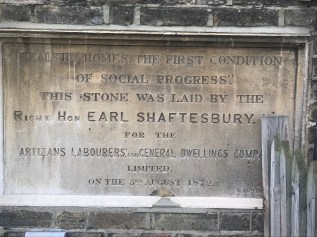 Wandsworth Heritage Festival, I led a small group on my history walk from the Latchmere pub to Battersea Arts Centre, via the Park, the Latchmere and the Shaftesbury Estates. We passed this foundation stone, deeply hidden and unannounced in Grayshott Road. Does anyone know it? If not then keep an eye open for it if you are ever walking along Grayshott.
- The Community Services Committee was held on 21st June. Two items were of particular interest to some parts of Battersea; one was the declaration of Public Space Protection Orders with regards to the Falcon Road area and the Patmore and Carey Gardens estates. These orders give more powers to the Council and the police to control the public drinking of alcohol. The second was an item proposing that there should be NO change to the controlled parking zone in Little India. I know that the second decision is unpopular with some residents but it was based on a public consultation carried out by the Council, and the majority answered with a “no change” verdict.
- June’s Planning Applications Committee was on 26th. The largest and most interesting application concerned a large site in Tooting High Street, but there was also one small application for two 3-bed houses on the highly contentious garden site of the old Prince of Wales pub, on the corner of Battersea Bridge Road and Surrey Lane. The Prince of Wales pub is, I am afraid, lost for good.
- On the 28th June there was a Finance and Corporate Resources Committee. I am not a member of this committee and don’t usually report on it. But this meeting forecast that next year the Council is going to have to find savings of £12 million and the year after of another £22 million. The Government’s suicidal attacks on local government seem endless and endlessly self-defeating. Amongst many other costs bed-blocking in our hospitals is bound to rise as social care in the community, especially for the elderly, gets hammered!
- On the 29th June I attended two events, the first at the Arts Centre and then at the Friends’ Meeting House in Wandsworth High Street. The first was to mark the retirement of Phil Jew, Director of the Wandsworth’s Citizens Advice Bureau. Phil has been the Director for the last very tough five years at the Bureau. In these years of so-called austerity (I think it has been of unnecessary dogma imposed by the Tory party – but that’s another story), the Bureau has been dealing with large cuts to their funding base and increasing demands as Tory cuts bite.
- The second was the Annual Meeting of the
 Wandsworth Historical Society, where we heard a fascinating presentation about Edward Foster, a Wandsworth resident, who won a VC (Victoria Cross) in April, 1917, for his bravery in capturing a German machine gun emplacement during the First World War. This incident took place near the small French village of Villers-Plouich, where it is commemorated in a town square, called Place de Wandsworth! Ted Foster himself became quite a famous veteran. Standing at well over 6 feet he was known as the “Gentle Giant”.
- In early June commuters and passers-by were surprised
 and delighted by the visit of Shallowford Farm to Falcon Road. Farm animals, sheep, chicken, ducks, and tractors appeared in the Providence House car park. The chicken and ducks revisited on 30th June at the Falcon Festival, which this year was bigger and better than ever. The farm is on the eastern edge of Dartmoor and is a joint venture with Providence House. It will be well known to many Battersea residents as Providence House youth club runs many regular residential outings to the farm. The picture is of our M.P., Marsha de Cordova, on board one of the tractors.
- On the evening of 30th June, we took our niece and her husband to the Royal Opera House to see Puccini’s La Bohème. It was meant to be grand opera and grand it certainly was but it was also highly political, positioning the harsh conditions faced by the poor bohemian students against the opulence of bourgeois Paris. It was a suitable end to a month which began with a visit to Wandsworth’s Opera Studio and finished at Covent Garden.
- Finally, this may all sound like fun social events but, like every other month, I also had half a dozen other meetings about ward and party business, which were all necessary but hardly of great public interest – so I don’t report on them!
My Programme for July
July looks like a quiet month with only the Council Meeting on 11th July and the Planning Applications Committee on the 19th.  I will have to come back from Devon for that as I have a week booked up in Devon in mid-July. And at present that is that for July.
Do you know?
You may remember that I asked last month whether I should stop this feature as I thought it might be getting a bit stale! But, by popular request, here it is back again!
Park South is the name of this privately-owned tower block on Battersea Park Road. But before it was sold by the Council it was known as what exactly? And who or what was that in memory of and why?
WHAT’S HAPPENING TO COUNCIL TAX? DON’T SWITCH OFF – IT’S IMPORTANT!
The UK’s system of funding for local government* is in a mess – and getting rapidly messier. Let me explain why. Take the current budget forecasts for Wandsworth Council. They have become byzantine. One line in the forecast for the financial year 2018-19 2018 shows that the Council has been allocated a £12.9 million grant known as the New Homes Bonus Funding (NHBF). Extraordinarily, ten years ago no one would have known what this acronym meant. Yet now it is closely matched by an estimated income of £11.9 million from the equally bizarrely named Improved Better Care Fund (IBCF). Each of those separate sources of income is almost as large as the traditional Revenue Support Grant; and from next year onwards, they are forecast to be larger.
The New Homes Bonus Funding was intended to incentivise local authorities to build homes. In Wandsworth it has been so successful that the Council has the second highest level of NHBF grant in the UK, after Tower Hamlet’s massive £20.7M. By contrast, Wandsworth’s linked* Borough of Richmond receives £2.2M from this fund; and Wandsworth’s neighbours Merton and Lambeth £2.4M and £9.7M respectively, approximately a tenth and less than half of Wandsworth’s.
Is there any real rhyme or reason about this state of affairs, other than it being a reflection of the amount of available building land? And does anyone think that the current explosion of development in either Wandsworth or Tower Hamlets is sustainable in the longer term?
If the new system has incentivised anything, it has incentivised local authorities to give planning permissions for larger, higher and more dense developments. Developments that are notorious not as homes but as ghost towers, safety deposit boxes for funds often of dubious origins and designed to gain speculative profits for their usually foreign owners. Developments, moreover, that are unpopular with most of the local residents who live nearby; and which are not doing anything to resolve London’s urgent need for low-cost accommodation.
Meanwhile, the Tory Government continues to reduce the Revenue Support Grant (RSG) each year, as indeed it said it would. Its ultimate aim is to end central government financial support for local government. However, the policy has already run into predictable problems. For example, financially-strapped Councils are struggling to carry out their statutory duties with disastrous consequences for the provision of social care. To compensate, the government has had to introduce and now increase grants from a new Improved Better Care Fund (IBCF).
This is, of course, a misnomer since the fund provides neither an improved nor a better service than the care system as it had already operated under the Revenue Support Grant. It is, however, specific, tied funding from central government, targeting one specific service. That outcome is precisely what local government had repeatedly said that it did not want, because it implies much more, and more specific, centralised control. Ear-marked funding means that there is no scope for sensible local adjustments to changing patterns of need – and no scope for local decision making. That’s a sorry state of affairs that – in theory – the Tory government says that it too does not want.
As part of setting local Councils ‘free’, the Tories now offer Councils control of the local Business Rates, the property tax paid on all commercial and industrial businesses within a Council’s boundaries. Yet the funds raised from such a source are wildly unequal across Britain. It therefore leaves Council income disastrously at the mercy of the rise and fall of business activity, which is almost totally defined by geography and geology, i.e. how near to London, or to North Sea oilfields, or to major commercial hubs each particular authority happens to be.
So the Tory government has introduced a Business Rates ‘top up’ scheme. In Wandsworth’s case, in 2018/19 the top-up of £35.650M is very slightly more than Business Rates themselves at £35.594M. So, what does this manoeuvre mean? It is actually a rate equalisation grant, designed to balance what would have been the massive inequalities of a few Councils in the midst of property booms having money to spend, whilst most Councils elsewhere are desperately short of funds – in practice Councils are no more “free” of central allocation than they ever were.
At the same time as all these muddling interventions from central government, the real local tax, the Council Tax, becomes less and less significant. Both major parties are absolutely aware that, at less than 10% of the budget, its impact on Council finances today is minimal. Both parties also know that the legal scope for raising Council Tax is very close to zero. In Wandsworth, that state of play won’t stop the majority Tory party from running scare stories about Labour’s alleged profligacy and the risk of Council Tax rises. However, such accusations will be shadow boxing, while Councils everywhere lose money, lose any semblance of local autonomy, and carry the can for failing services, which are actually failing for lack of either proper or reliable funding.
The irony is, of course, that the historic system of Domestic Rates, levied on housing property values, which was the traditional way of raising money for local government, was beautifully designed to tackle a modern-day curse – under-occupation. That is, to raise reasonable (not outrageous) sums of money from people in very large properties who otherwise pay hardly anything in local rates. When under-occupation is detected in the state sector, it is brutally both controlled and penalised by forcing council tenants to pay the notorious Bedroom Tax. Introduced by the Tories in 2013, it was described as removing the ‘Spare Room Subsidy’ (i.e. ending the so-called subsidy from the state to tenants who had under-used rooms).
Yet, in the private sector, under-occupation is neither controlled nor penalised. The result is not just that half of the British population live in spacious luxury and vote for penalising the poor but also that Britons live in the country with the lowest taxes on private housing in the world, outside of mini-statelets like Monaco. Exactly, of course, the reason why in 1989-90 Thatcher abolished Domestic Rates in favour of the failed Community Charge (Poll Tax).
Remember that? Since then successive governments have struggled to find a reliable and fair basis for funding local government. This current Tory administration is lurching from expedient to expedient. The system is becoming ever more byzantine – and under-funded.
So, whilst the British people want and expect first-world standards and services, they have been simultaneously encouraged to expect third-world levels of taxation. The result is that Britain gets aircraft carriers without any aircraft; a health service once admired across the world but now financially on its knees; an education system collapsing under the weight of failing and corrupt out-sourced academies; a probation service run by unaccountable, monopolistic out-sourced companies who cannot even deliver basic security; a costly railway system heartily loathed by its customers; and a political system which holds out promises of services which it cannot deliver.
It’s a genuine tragedy that, amidst these massive challenges, local democracy is being threatened as never before. Local government finances, and therefore essentially local government itself, have been nationalised to within an inch of their life. But the resultant byzantine system simply doesn’t work. It doesn’t work for local Councils or for the central government – or for the voters.
Council finances need proper reform. The system needs to return to something like domestic rates – which need regular revaluing, to take account of changing property values – and a modest degree of rate equalisation between wealthy and poor regions. It’s not rocket science. It’s the lifeblood of local democracy.
∗ This the Text of a speech that was prepared for delivery at Wandsworth Borough Council Meeting on 7 February 2018 but not delivered.
∗ The administrative systems of Wandsworth and Richmond Borough Councils have been merged since 1 April 2017.
Why throw money at the Town Halls to resolve the financial crisis?
In my last blog I suggested that the Government should use local authorities to kick start the economy. There are many advantages to using local authorities rather than very large infrastructure schemes like HS2, Hinckley Point nuclear power station, Trident replacement or even the Olympic Games.
Many of these very large capital projects are politically contentious and sometimes very slow to have an impact. Most get bogged down in expensive public enquiries and a proportion probably won’t come off. What is more much of the early expenditure is spent on highly paid staff, such as lawyers, architects and designers and not construction and support staff. An equivalent £1billion spread amongst Britain’s 500 plus local authorities would, on the other hand, have an almost immediate impact.
£10 or £20 million given to my local authority, Wandsworth, could be used to buy every school pupil a laptop or to implement 10 or 20 small, local environmental improvements. I think we would have little problem in spending most of it within a couple of years, with an immediate small but significant local economic impact. Such a nation-wide scheme might, of course, include some silly, vanity projects and some failures but nothing as disastrous and costly as failed and useless mega-projects. What is more such a scheme could easily be targeted to, say, the local authorities in the poorest parts of the country, with the highest unemployment rates or the worst health statistics.
I see William Keegan in the Observer (7th August 2016) agrees with me about using local authorities to kick start the economy, though I must confess I am more one of his disciples than the other way round!
A similar suggestion comes from one of today’s great iconoclasts, Simon Jenkins. He suggests that the simplest solution would be to throw money directly at people. His suggestion reminds me of Alistair Darling’s scrappage scheme, which gave people £2,000 to car owners to scrap their old car and buy a new one. But Jenkins’ idea is more open-ended, in that people could spend on clothing, food or, and here’s the rub, foreign holidays – I have nothing against foreign countries, of course, but, if one is trying to kick start the UK economy then giving it all to Benidorm seems rather pointless.
The problem with Jenkins’ idea is, it seems to me, that it is not targeted to those most in need and there would, I think, be considerable difficulty in targeting, say, the lower paid or the unemployed. It is an interesting idea and gets round Jenkins’ perennial scepticism about bureaucracy. But the time of local democracy has come (again). Think of Joseph Chamberlain in Birmingham in the 1880s or John Burns in Battersea in the 1900s, think of Attlee and McMillan boosting council house building in the 1940s and 1950s.
Boosting the local economy means boosting local democracy and society. Forget quantitative easing, which goes to the banks; forget big vanity projects, over-budget, over-time; think local – NOW.
Austerity in the Town Halls; Recession out there for working people
Today the Bank of England took crisis action by lowering interest rates to 0.25% and throwing money at the business heights of the economy. Will it work? Cutting rates to 0.5% seven years ago didn’t. Nothing, Osborne did, really changed the equation.
What would work immediately, however, would be to take the heat off public expenditure. What do I mean?
Well right now Wandsworth and Richmond-upon-Thames are cutting service levels and reducing the number of jobs right here in south west London under pressure from this Government’s cuts in local government grants; 400 jobs to be precise. And all because the Tory party has an ideological commitment to reducing the size of the state – whatever that means.
The same thing, and worse, is happening in every local authority across the country. Similar cuts are happening in many more public sector organisations.
Meanwhile what do the councillors do? Well, all of us were under great pressure to vote for the jobs cuts. The majority (Tory) party councillors voted for the cuts because they cannot face opposing “their” government and the minority (Labour) councillors are not in a position to defy the government and are “scared” of being accused of voting for an increased Council Tax.
I’ve been around long enough to remember when the Ted Heath Government (1970-74), the Thatcher Government (about 1982-86) and the first Tony Blair Government (1997-2002) faced similar economic crises. What did they do? They threw money at local government with orders to spend, spend, spend in an attempt to kick-start the economy.
The public sector turned out to be far more effective than throwing money at the banks; that was tried in 2009 and it didn’t work.
Just when will Teresa May take the same kind of actions and just how silly will the cuts of 2010-16 look when that happens?
Is it Clapham or Battersea?
A jokey addendum to the court case featured in my last blog is that the Crown described Curry’s as being in Clapham’s high street. Judge Darling, obviously a south Londoner, questionned this and the two of them did an elaborate dance of misunderstandings. Whilst the judge retired to consider his verdict I pointed out to the Crown prosecutor that Clapham High Road was the best part of a mile away and that Curry’s was actually in Battersea’s main, if not High, street.
When the Judge returned the prosecutor jumped up, apologised for his lack of knowledge of the geography of south London and asked for the record to be put straight. Judge Darling told him that was exactly what he had been trying to tell him but that his ignorance would be forgiven. In future I will have all those guilty of this heinous sin up in front of Judge Darling!
 Tony Belton
 Tony Belton