Councillor Tony Belton’s Battersea September, 2018, Newsletter (# 111)
- Last month I wrote about building control regulations and their implementation in England and Wales, since Mrs. Thatcher’s so-called reforms (I suspect the rules may be a bit different in Scotland). I don’t think that I have had such a heart-felt response on any other subject. Clearly, many residents find the whole process of neighbour-building works both stressful and sometimes expensive
.
- I had building works next-door to me last year and, although I have absolutely no complaints about the standard of works, my garden was unusable in 2017. Thank goodness that last summer was not a scorcher like 2018. Equally, I’ve had friends, who have complained particularly about the 24-hour 7-day a week pumping one often gets with basement extensions. It does seem to me that, as a country, we need to re-consider legislation about both the regulation of standards and nuisance control during construction.
- Unsurprisingly August has been very quiet in Council terms, so I thought I might indulge myself in a bit of politics – for a change. But first, I did have a couple of visits one from a British student and another from a foreign journalist. It’s a minor pleasure of the job of being a Councillor that people do ring me, from time to time, and ask for interviews about how local government works in this country. The trouble is that, like most people, the more I know the more I realise that I don’t know!
- To politics and the issue of the EU, about which a number of people have asked me to come clean on my views, and I must stress they are my personal views! Of course, one answer is to say that Brexit or the EU is not an issue for a local councillor and, of course, in one sense that is right. Yet I am not surprised that some of you want to know what the person you voted for only a few months ago, thinks on this massive issue. (If you are not interested on more about Brexit, then skip to paragraph 10).
- First, I voted in the Referendum to Remain and if we have the chance again, I will do so again. A couple of years ago, I certainly had some pleasure, in discussions with friends, being the Devil’s Advocate and one or two maybe thought I was going to vote Leave. I regret it, if I persuaded anyone to switch their vote, but I rather doubt that I did. However, despite voting “remain” I thought then and still do that the “Remainers” have to face some issues. For example, the EU does not appear to be very democratic – despite the Euro-elections. Perhaps it is impossible to make an organisation with 500+million people feel democratic but either more effort has to be made or the EU should operate through national governments. The present European Parliament does not have much credibility and, I suspect, is not sustainable in its present form.
- In addition, it does appear as though the Euro currency is and has been a terrible mistake, which somehow the Eurozone has to reform or end as soon as possible. In hindsight, it seems ludicrous to have tied Greece and Southern Italy to the same exchange rate as Bavaria and Brussels; Andalucia and Portugal to the same economic conditions as Berlin and Paris. Clearly, what has worked for Germany has been massively destructive for Greece. Some reforms to the EU are essential and its current settlement should be no more cast in stone than any constitutional arrangement anywhere.
- But it’s not the Remain argument that exercises me most but rather the Brexit case. I have many objections to the Brexiters’ arguments. For a start it means taking a terrible risk with all our lives and livelihoods on the basis of the assurances that we have had so far, which in essence amount to no more than a promise “That it will be alright on the night”. Especially given that almost every expert believes we will be worse off after Brexit than before. (I know that Michael Gove suggested that we should ignore experts, but in most fields, from brain surgery to plumbing, flying to engineering, I prefer to have experts on my side rather than against).
- There are, of course, the nostalgic Brexiters, the Imperial Brexiters, the Little England as well as Great Britain Brexiters, invariably from the right of the political spectrum. But what about the left-wing Brexiters, the inheriters of the Tony Benn legacy; those who see the EU as a capitalist plot? I would ask them to give us the answer to three particular questions:-
- How do you tackle the ecological issues facing the world without supra-national organisations?
- What possible democratic power do you see standing up to global capitalism and perhaps particularly Californian-based global capitalism? Surely not the UK on its own; just possibly the EU can.
- In a world dominated by international business, how can workers’ rights and pay levels be protected unless, ultimately, on at least a continental basis?
- Clearly, there are a thousand problems
 involved in stopping Brexit but if Brexit is a disaster and bad for Britain then the Labour Party will pay a heavy price, if it hasn’t had the courage to take a stand on the issue. Enough said, but I suspect we will be coming back to this issue before too long.
- On 3rd August, we went to see Oscar Wilde’s “The Importance of Being Ernest”. You will have noticed that in the last few months, I have been to all the Oscar Wilde plays. In his brilliantly witty way Wilde certainly has a very particular take on gender politics at the turn of the nineteenth and twentieth centuries. But I am afraid that I was disappointed with this production of his most famous play. The text is witty enough without being coated in extra layers of somewhat dubious gender and race politics.
- I was also asked, along with fellow Councillor Kate Stock, to be part of a panel of judges in a competition being run by the Battersea Summer Project at Providence House Youth Club. The Project does a great job, which is much appreciated by many kids (and no doubt parents) providing sports, hobbies and occupations for the young people of Battersea, but I think this particular competition needs a bit of re-thinking if it is to become a regular event.
- On 18th-19th August we spent the week-end
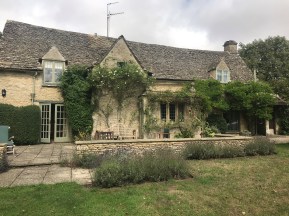 with Douglas Jay’s widow, Mary, in her beautiful cottage in Oxfordshire. Douglas was Battersea North’s MP from 1946-83. He married Mary, many years his junior, in 1972. We had a delightful dinner with family and old friends exchanging stories about “old Battersea characters”. Unfortunately, but inevitably, Mary is having to move into a more convenient, smaller, urban house. So, this was a kind of nostalgic goodbye to Causeway Cottage, seen here on the right.
- The next Planning Applications Committee
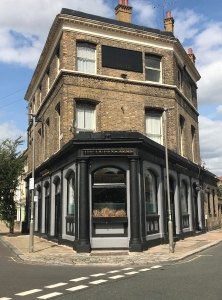 takes place on 22nd August and this time there really is nothing of great significance in Battersea – though I am very conscious that even the most minor application is really, really important to someone or some family. One item worth a mention is an application for the modernisation and re-opening (hopefully) of the Queen’s Arms, seen here on the corner of Robertson and St. Philip’s Streets, just off the Queenstown Road.
- But I will miss the Committee as on 22nd August I will be carrying the bags for my partner at a Conference in Bordeaux, from where we are going directly to Croatia for a couple of weeks. I have briefed my colleagues on my views on the committee, but inevitably at this time of the year some of us will be missing the evening.
My Programme for September
- There will be the Community Services Committee on 18th September and the Planning Applications Committee on 19th.
- In recognition of the major traffic and pollution problems facing all the world’s major cities and London in particular, there is going to be a Car-free Day organised through-out the capital on Saturday, 22nd. I cannot imagine that it will result in a wide observance across the whole city but we shall see!
- The last week of September will be dominated by the Labour Party Conference (and Brexit). Somehow, I cannot imagine that we will reach the end of September without very fundamental shifts beginning to take place in the political landscape!
Do you know?
Last month I asked “How many of you know the modern names of these three Battersea pubs: “The Cornet of Horse“, “The Prodigal’s Return” (I said “Son” so thanks to eagle-eyed Chris for that correction) and “The Eagle“? The answer is The Four Thieves in Lavender Gardens, The Draft House on the 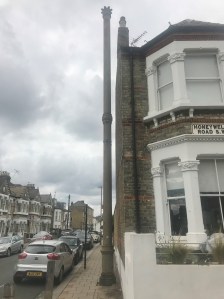 corner of Battersea Bridge and Westbridge Roads and The Magic Garden, Battersea Park Road, respectively. As a brief aside can I ask whether anyone knows the connection between Lavender Gardens, Henty Close on the Ethelburga Estate and the Cornet of Horse?
And as for this month let me ask: I took a photograph of this structure in Webbs Road, at the junction with Honeywell Road. It, is the pole, standing on the pavement and which is slightly higher than the house. Do you know what it is? What it is called? And just how many poles like this can WE find in Battersea?
My Country: a work in progress
We went to see this “play” at the National Theaatre on, ironically, St. Patrick’s Day. I say ironically, because we saw a play about the lack of clarity about what it means to be British on a day associated with the very established and internationally recognized identity of one of our constituent “parts”, the Irish.
I am sure that I could find some definition of “a play”, which My Country did not fulfill. In some sense, there were no personal relationships portrayed; there was no action; there was no plot; there was no drama. Yet, in another way, what could be more dramatic than the possible internal collapse of a great country? How could that story not be a plot? Who could say that Brexit and the state of the UK does not constitute action? And whatever happens in these most unpredictable times, the aftermath of Referendum Day will continue to have a massive impact on the relationships of nearly 70 million people.
The play is an anthology of quotes from Britons about the build up to and the fall-out from Referendum Day, 23 June 2016. Quotes from the great and the good, bad and the ugly (Cameron, May, Corbyn, Johnson, Gove and many more starred) and quotes from the people, the people from London-Derry, Edinburgh and Glasgow, the North-East, Leicester, Gloucester, Salisbury and Merthyr are masterfully crafted by Poet Laureate Carol Ann Duffy into a passionate cry for something, but what? Sanity, cohesion, belief, faith, rationality?
I have seen it said of this work that it demonstrates mean, unpleasant, nations(s) retreating into a pessimistic dystopia. I don’t think that’s right. Its rather about a people flailing around blind and lost, without common purpose or direction. That at least was my impression. There was no commonality in almost anything debated, and a lot was at least mentioned. On the other hand there was plenty of wit, humour and nostalgia, but overall there was no sense of purpose or unity; in that sense the play was extremely depressing.
Is it possible that in a lifetime, as it happens almost exactly my lifetime, the UK could go from a nation that will forever be remembered for its finest hour to one totally lost in a world, rapidly gravitating towards continental entities built around smaller regional units? Or is it that Duffy had a peculiar ability to extract from the evidence a story that corroborated her feelings and attitudes, whilst another author could equally assemble a positive, clear picture of where we are going and how, say a picture of close relations with the EU, even the restoration of our role in the EU, and a renewal of a United Kingdom?
This was a confusing evening, stimulating a myriad of thoughts and emotions, not a restful, comforting one. I highly recommend it – if you wish to be provoked. The last show at the National Theatre is tomorrow, 22nd March, but then it goes on tour throughout the UK, returning to Stratford in the east end. For details see: http://www.nationaltheatre.org.uk/shows/my-country-uk-tour
A Labour Party “Remain” Strategy for Wandsworth, 2018
It is clear that on the major issue of the day, the Labour Party’s position is, at least for now, an irrelevance. The country is set on a very difficult Brexit journey, which Jeremy Corbyn is not going to challenge in any serious manner. Regardless of his qualities or otherwise, he appears to take the view that There Is No Alternative; we are back to our old friend from the 80s, TINA!
If Mrs. May were to make the mistake of calling a General Election there could be no real external opposition to her except from out and out remainers in her own party. UKIP would not be the threat to Labour but the LibDems would be – almost regardless of the qualities or otherwise of their leader.
The 48% of us, who voted Remain would not be represented by anyone else. Is there, therefore, any serious argument against the Labour Party taking a strong and passionate “Pro-EU” position?
In a sense, whether it delivers an overall Labour majority in a General Election or not, it is the only path away from annihilation back to electoral respectability. My old friend, Mayor Khan, is sharp enough to see that for him in London it is advantageous to be as pro-European as he can be.
Likewise every Labour campaign in the 2018 London Borough Elections should be fought on a Pro-EU platform. Not only is London a “Remain” city, but it is also home to enough voting EU nationals in most boroughs to justify local platforms with a large element of “foreign policy”.
This tactic might be very uncomfortable for some, few Labour Brexiteers, but no more difficult than the current position is for the much larger Pro-EU majority.
I call on Wandsworth Labour to make an essentially Pro-EU platform the corner-stone of our local campaign for 2018, and I hope many other London Labour Parties follow suit. It would also, of course and crucially, have the benefit of putting the Brexit supporting Conservative party in the position of fighting an election in a Borough, with a 70+% majority Remain population. Who knows? But it is easy to imagine that in 12 months time it could be the Tories rather than Labour facing a major political dilemma.
 Tony Belton
 Tony Belton