Councillor Tony Belton’s Battersea March 2022, Newsletter (# 153)
- The February Council Meeting was held on February 2nd and I didn’t go! For the fifty years I have been a councillor, I could barely imagine writing that sentence. I have gone to Council Meetings because it is my job/duty as a councillor and because Council meetings are, or were, important – and, it must be said, I enjoy the cut-and-thrust of political debate. But now, the way that governments (Labour as well as Tory) have changed their relationship with local authorities, means that very, very few decisions need to go to the main Council meeting. Consequently Council Meetings, as part of the local government process, have been degraded, which makes them more and more of a show, a place to play at politics, a place where politics becomes part of the show and so much less important, and less interesting, than they used to be. So although my “excuse” for absence was the constraint of “social distancing”, I didn’t really mind!
- The February Planning Applications Committee (PAC) was on Tuesday, the 22 Ironically, I was unable to attend – ironically because after several months with little of general interest, this PAC had several very large applications of great significance to north Battersea, and of particular interest to me.
- The largest of these applications was for the corner site at Culvert and Battersea Park Roads. I know that many residents in Castlemaine and
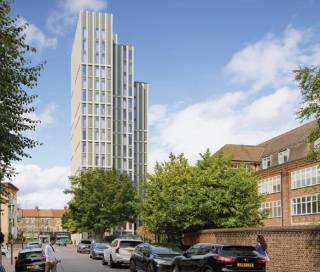 Culvert Road, in Brynmaer and Battersea Park Roads were strongly opposed to this application, as indeed was I, when it first came to committee in 2018. As far as I am concerned there were, and are, only two things to be said in favour of the application. The first is that the blight on the site will be removed and the second is that the school should at long last get its new sports hall. However, in my opinion the community will regret having a new 18 storey building – as pictured here, 56 metres/184 feet high, on Battersea Park Road. Most of the building will house 213 shared living units, which is now becoming quite a fashion amongst large development companies. I have no doubt that the 213 living units will bring some business to this part of Battersea Park Road but: will this be sufficient to justify the over-looking? I certainly was against the application and will continue to be so until it is built.
- A second application was for 12-20 storey blocks of student residential units and office and enterprise business at Palmerston Court and Flanagan’s pub, opposite the Dog’s Home. It will be part of the substantial change taking place in the Battersea environment, but in this case it fits well with the many railways running at about 5th floor level amd other recent high-level developments.
- A third application for an 8-13 storey development of self-storage units along with 131 residential units in Mendip Crescent at its junction with
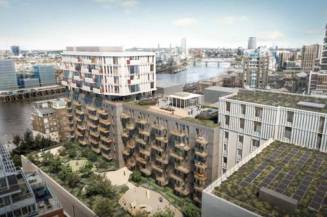 Battersea Park Road was recommended for approval by the planning officers but was rejected unanimously by the committee. The committee felt that the residential units did not provide a good mix of dwelling sizes and that the preponderance of self storage units did not allow for a sufficiently wide range of employment possibilities. It is by no means unique for the Committee to over-turn the officers’ recommendation but on large schemes like this it is certainly very unusual – it couldn’t be that the imminent election had any undue influence, could it?
- And yet another significant application was for the change of use of the Crowne Plaza Hotel, right next to the Heliport, to a 96 bedroom care home facility. Superficially, placing a care home right next to the Heliport does not look like an appropriate mix, but as I wasn’t actually there to hear the debate, I find it difficult to assess.
- On the 22nd February, we all woke up to the most shocking story of many people’s lifetime: the Putin attack upon Ukraine. The ramifications are currently unknowable, and of course unpredictable, but I think we can all agree: that the position of Russia in the world has changed for the worse: that President Volodymyr Zelenskyy of the Ukraine has achieved unsought for world fame and achieved favourite’s status for the Nobel Peace Prize by showing admirable courage and consistency: that NATO will rapidly strengthen its military strength, will take urgent steps to wean itself off Americam dominance, and become much more powerful than Putin’s worst fears: that the UK’s decision to leave the EU looks not only economically but now also strategically disastrous: that life for Ukrainians has got threateningly worse, but that in the longer term Russians are likely to be the most damaged by Putin’s hubristic folly. And worst of all: his folly will only lessen humanity’s chance to overcome the climate crisis.
- News of Robert Molteno’s death was a profound shock to many. Robert was always so active and fit. And on 27th February upwards of 300 friends and relatives packed St. Mary’s Church to hear moving and often very funny tributes to a life well and truly lived. I didn’t know the half of it – no, the tenth of it! Brought up in South Africa, which he did not, unsurpringly, find congenial; then teaching in Zambia, where he ended up imprisoned for two months (solitary, apparently) because he was too outspoken about the regime; a career spent in publishing in London, mainly books about “third world” countries written by authors from the particular country, and then in his post-retirement Third Age, he became an inspiration and driving force behind the “Living Streets” movement. Robert had an exciting and varies life, well-lived. RIP, Robert Molteno.
My programme for March
- March 5th-6th a short week-end on the Mumbles, South Wales, for a college friend’s 80th!
- March 9th, the Annual Council Tax setting meeting.
- March 10th, North East Surrey Crematorium Board.
- March 11th, Wandsworth Councl’s very own launch of the Queen’s Jubilee Year.
- March 17th, Battersea Society Annual General Meeting.
- March 21st, Battersea United Charities.
- March 23rd, Planning Applications Committee.
Dd you Know?
Last month I asked if any of you recognised Leo and where and why he was living in Battersea. A couple of people did know and told me not only where Leo lives, but they also had an explanation for his arrival in Battersea.
Leo lives at 12 Macduff Road. Roy knew that; well done Roy. But I didn’t think your explanation for Leo’s presence in Macduff Road was as credible as someone else’s. BUT, unfortunately I seem to have lost that email. If you were the one, then please remind me and I will enlighten people next month!
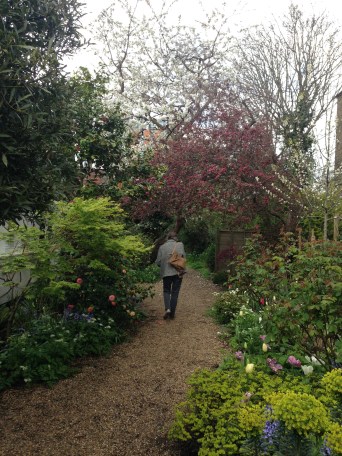
And this month?
Where in North Battersea would you be if this was your walk to your very own front door?
Councillor Tony Belton’s Battersea February 2022, Newsletter (# 152)
- Maureen Larkin died on 4th January, aged 89.
 Amazingly she died in the very house, in Knowsley Road, where she was born on 10th October 1932. Her daughter, Terry, wrote to me, saying that her mother and I “did go back a long way together, and Mum was thrilled and honoured to receive her Civic Award in 2010 following your nomination”.
-
- When I first met Maureen she was part of the organising team for the legendary Poyntz Road Triangle summer street parties. She was the first to invite the Mayor and to arrange for the presence of police cars and s fire engine – all very popular with the local kids.
- The first of these parties was, Terry tells me, organised for the Queen’s Silver Jubilee in 1977 and it continues to this day, 45 years later. The parties always had a barbecue, and plenty of party grub and they always ended with a disco.
- Maureen’s Battersea connection runs deep. Her mother, Lily, moved into the house in Knowsley Road during the First World War. She and her husband, a Battersea man of course, had two daughters, Monica and Maureen. Maureen was born upstairs in the front bedroom.
- Eighty-nine years later, Terry writes, “she died peacefully in her sleep where she always wanted to be, in the same house, with her daughter and granddaughter by her side”.
- Terry reminds me that the Poyntz Road Triangle, between the two bridges on Latchmere Road and the railway lines, was threatened with demolition for a time in the 1970s. She claims it was for slum clearance but in Sue Demont’s very informative article in the current issue of Battersea Matters, there is a very different version of the story, a version which accords with my memory. Sue’s very informative map shows that Abercrombie Street and Knowsley Road were absolutely on the line of the Government’s planned Ringway 1 – all part of the giant Motorway Box planned for London in the 60s. The road plans were the cause of many, many political arguments and campaigns until well into the 80s.
- Indeed, for everyone interested in anything to do with Battersea and its history this edition of Battersea Matters (Jan 2022) is spectacularly good: beg, borrow or steal a copy to read about: Battersea’s lesser-known parks; St Mary’s Cemetery on Bolingbroke Grove; the infamous 1907 Brown Dog Riots; my obituary of Brian Barnes; and many other titbits.
- On 14thJanuary, I had a guided tour of
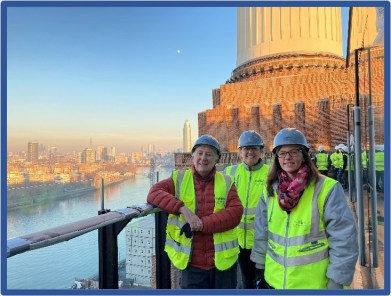 Battersea Power Station. It was the first time I’d been there for a detailed visit for about a year. Inside the Power Station itself, there are some spectacular sights, such as the two main turbine halls and the command room. We can expect a grand opening of the Power Station, for public access, later this year, when the expectation is that it will become, overnight, one of the Borough’s six town centres. There will be many, including me, who think it a tragedy that so little attempt was made to make the development more affordable for ordinary people; but I urge everyone to take a trip to the Power Station for the opening or soon thereafter.
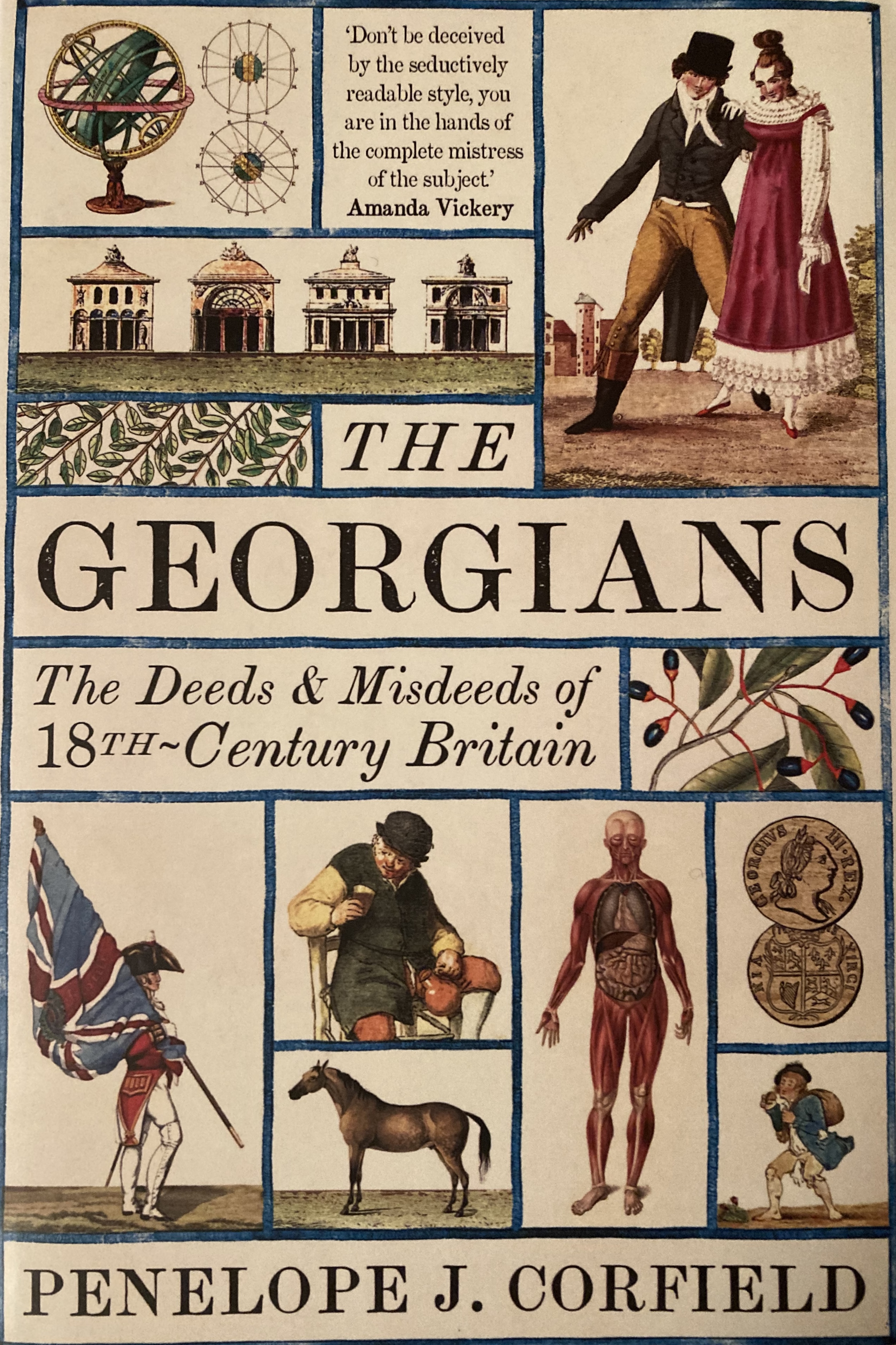
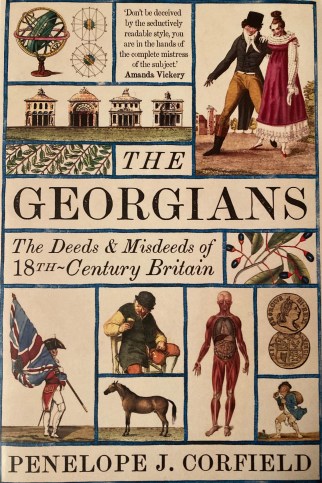 This newsletter is unusually focused on literary events and one I have to include is the publication of my partner’s book, The Georgians: The Deeds and Misdeeds of 18th Century Britain. I must say it has had spectacularly good reviews, the pithiest being in, of all places, the Daily Mail, where the age of the Georgians was said to have “Splendid houses…shame about the teeth: The Georgians had terrible hygiene, but beautiful architecture”. To be fair to the Georgians they had just discovered cheap and plentiful cane sugar … and more controversially were getting rich on African slavery – you can read more about all that and more in Penny’s book – blatant plug!
- The January edition of Private Eye also has a Wandsworth/Battersea story about the Council’s £60,000 cut in grant to Battersea Arts Centre. The Eye got at least some of the story from a speech, which I made in a Council meeting in December and the Eye concluded that the Council “tried to camouflage its decision with weasel words, claiming that this isn’t a funding cut but a ‘change in strategy”, and who am I to argue with the Eye? I must say that I admire the Eye’s capacity for information gathering. I did not report this small item of Council business but someone did.
- The Planning Applications Committee on 25th January really was a non-event as far as Battersea was concerned! There were, in fact, three Battersea applications – but only about varying the details on previously agreed applications. One was the large residential development on the site of the old gasometer next to the Dogs’ Home; another on the shop development where the Prince of Wales pub used to be; and the third about air conditioning units at the Chesterton Centre – a committee for the specialists!
- On Friday 28th Penny and I finally decided to break our Covid-induced lockdown and went to the Clapham Picturehouse to see Kenneth Branagh’s film Belfast. I had read one review, which described it as a nostalgic trip down memory lane, in tribute to the city he loved. I was particularly interested as I have a mild acquaintance with Belfast and Ulster and we have friends who live there. I must say, though that the reviewer cannot have seen the film we saw. It was dark, even the cinematography was dark (it was in black and white). I am not sure that the sun came out at any time during the film; more significantly it explored a brutal gang culture but not about drug money or gambling or prostitution, but between two distortions of Catholicism and Protestantism, or in the local jargon between the Micks and the Prods. It is a great film but not exactly fun and thrills for a Friday night. If you have seen it, what do you think?
- On Saturday, 29thJanuary, Wandsworth Labour
 Leader, Simon Hogg, launched Labour’s Borough Election Campaign, 2022. The launch took place in King George’s Park and was attended by about 100 people. The picture shows London Mayor, Sadiq Khan, with the Borough MPs, Tooting’s Rosena Allin-Khan and Putney’s Fleur Anderson clearly amused by the point Battersea’s Marsha de Cordova is making. It was a good session – energising for all our candidates.
- The following day Penny and I went to Ham Land, on
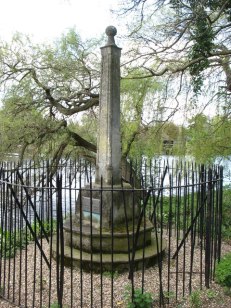 the Thames Bank between Kingston and Richmond. I have lived in this area of London for most of my life but had never before been there! This small column marks the inner boundary of the Port of London Authority’s territory: the sea boundary is at Leigh-on-Sea. Because Ham Land is cut off by the bend of the river and Richmond Park – and because there is no bridge across the river, except the pedestrian crossing at Teddington Lock – Ham Land is, for London, quiet, deserted, and attractive. I recommend it for anyone who wants to avoid the crowds in Richmond Park!
- Finally, it was a shock to hear of the death of Robert Molteno on 31stJanuary, especially given his relative youth and his apparent good health. Many will know of Robert’s work in making our streets safer; about his campaigning on behalf of better public transport, and more consideration for pedestrians and cyclists. Robert was always so concerned and involved in Battersea life; he was also courteous, determined and optimistic; he will be much missed.
My Programme for February
- There is a Council Meeting on 2nd February, of which a little more next month.
- I hope to be at a Battersea Society presentation
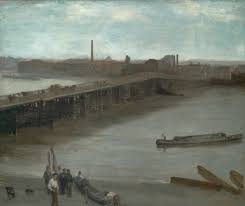 on Whistler on 9th Whistler was an American painter (1834-1903), who spent most of his life in the UK. He was, I suppose, an impressionist. He spent much of his time in Chelsea, from where he painted many Thames-scapes and pictures of Battersea Bridge, like this one. It should be fascinating.
 - There is a Labour Shadow Cabinet on 10th February, which will be interesting given the proximity of the Borough Election on May 5th.
- The Planning Applications Committee will be on 22nd.
- The Strategic Planning and Transportation Committee is on 24th February, which will be good for me as it will be the first time, I have been on one of the main working committees of the council for a few years.
Did you Know?
Last month I asked, what do you think was the first thing we did immediately on taking control of Wandsworth Council to defy the then Education Secretary, “Margaret Thatcher Milk-Snatcher”? Actually quite a few of you did know that, along with a sizable  group of other Labour local authorities, we decided to provide free school milk out of the Council’s own resources. Given the very tight central government controls on local spending, it would be much more difficult to do that today!
And this month?
How many of you recognise this lion and can place him in Battersea? I don’t know what he is doing there or indeed why? He is at about hip level and he is in a very normal, even average, Battersea terrace street. Can you name the street and house number, where Leo lives? And better still does anyone know how and when he got there? I don’t know that.
Councillor Tony Belton’s Battersea January 2022, Newsletter (# 151)
- Happy New Year. I hope that you had
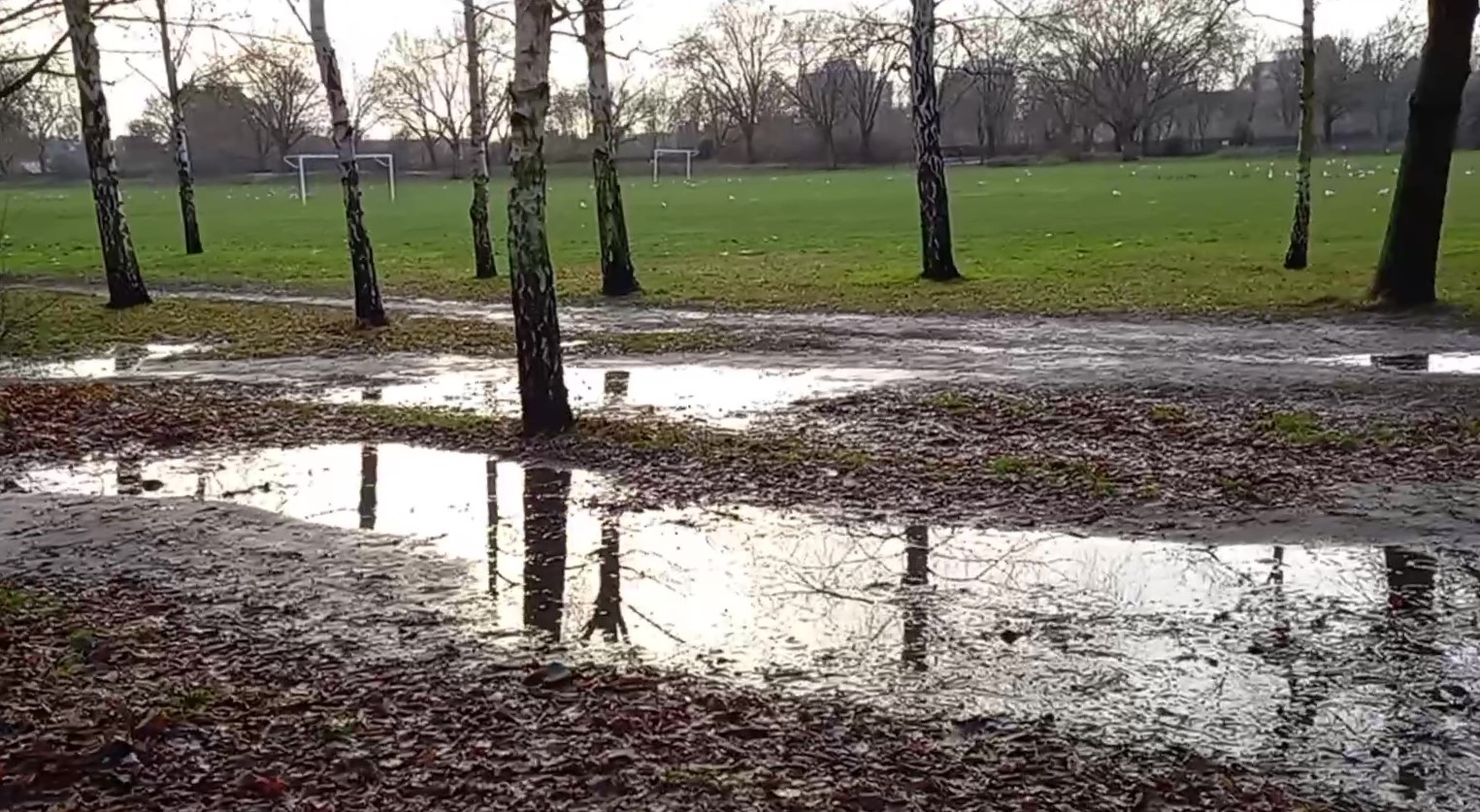 a great Xmas though I wouldn’t mind betting that it was one of the quietest that you have ever had. Mine certainly was! Penny and I watched old film favourites like Some like it Hot and had some nice walks in the park and on the common: this is Wandsworth Common after the inevitable and remorseless rain.
 - On 2nd December I went up to town for the first time since forever, to have a Xmas get-together with my old soccer mates. We played in the 60s and 70s. I was what we then called an inside right. I relied on pace, over 10 yards, stamina and a good reading of the game. I can only recall two goals I ever scored from outside the goal area, and, believe it or not, one of those was a header! There were about 15 of us – a party of septuagenerians and octogenerians – really wild.
- I had a meeting of the North-East Surrey Crematorium Board on 7th December at Sutton Town Hall. You will not be surprised to hear that in this Covid year the income from cremations is higher than had been estimated. However, the extra income has enabled the Board to invest in two air purifiers for the two ovens – perhaps an extreme version of just how clouds can have silver linings. The Crem will be one of the first in the UK to be so equipped – though, of course, they are standard in Sweden; a further example of how Scandinavian eco-standards are so much higher than ours.
- You may recall from last month’s newsletter that Labour
 won the Bedford by-election by just one vote. Consequently, it was no surprise that the Wandsworth Labour Party was in turbulent mood. What, however, was surprising is the speed and decisive nature of the councillors’ response. We, Labour councillors, quickly concluded that it was too much to expect one person to be both the Leader of Labour members on the Greater London Assembly and the Leader of Labour councillors on Wandsworth Council. And, so on 12th December, we elected Simon Hogg as Leader of Wandsworth’s Labour councillors.
 - I had two major regrets in December, and they were missing the party/celebrations of Robert Musgrave’s retirement from Providence House and Donna Barham’s from the Kambala Residents Association. Robert has been the inspiration and lynchpin of Providence House, surely the largest and most successful youth club in Battersea; whilst Donna (second from left in this Kambala party) has created the Residents Association and the Kambala Cares catering group. Unfortunately, both events took place in mid-December, just as the latest phase of Covid struck, and by then I had decided to be super-cautious.
I did, however, venture out very cautiously to play chess for Surrey County against Essex – it may sound grand but it was at a fairly low grade. My grade is much lower than when I was at school but then I was in practice, which I am not now. So I was pretty pleased when I recovered from a poor opening (a pawn down) to offer my opponent a draw, which he accepted. However, when later reviewing the game, I realised that I had manoeuvred myself into a winning position – how really annoying! Especially as Surrey lost by one point and it could have been a draw!- The full Council Meeting was held on 15th I made a speech about the Council cutting its funding of the Battersea Arts Centre by £60,000. It was the first speech I’d made in Council since the Borough Election 3.5 years ago! That sounds as though I have not been doing my job as a councillor, but that has been pretty well inevitable given the reduction in the number and length of Council Meetings and the restrictions brought in because of Covid. There really is a democratic deficit opening up in local government!
- On 16th December I was at the December Planning
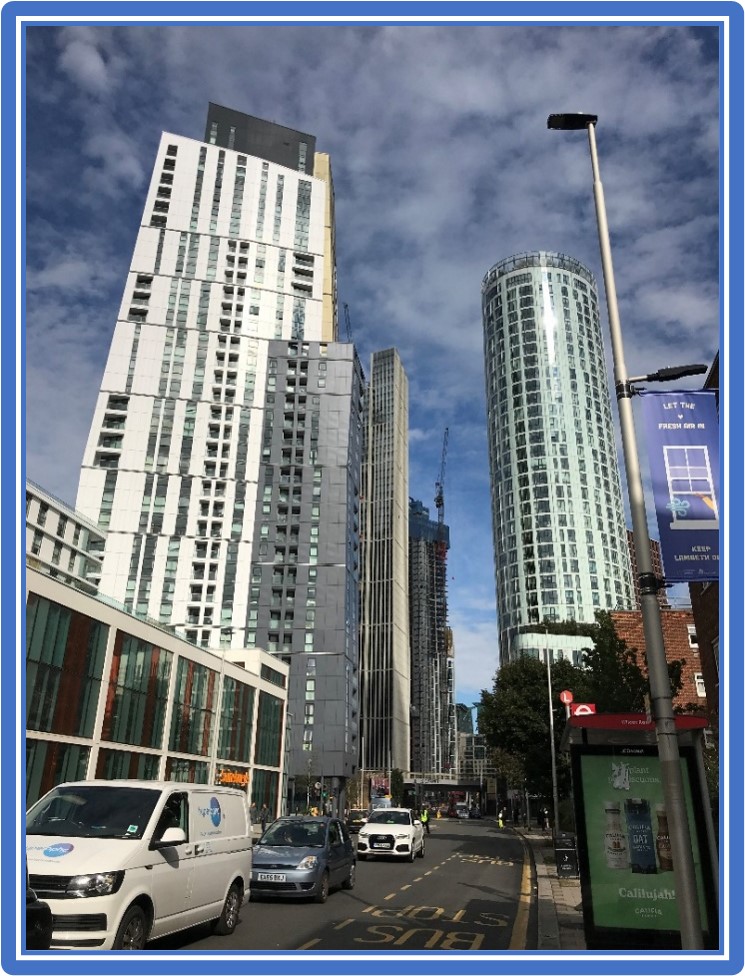 Applications Committee. It was strange being at a meeting, with the participants separated from each other by plastic barriers – rather like the way we are all separated from the bus driver. (Why won’t the Government allow us to run these meetings online? We have the technology and the public health case is made by all, including the Government). The agenda was also strange. It marked the inexorable march of giant blocks from Vauxhall into Battersea – this time a 21 storey block in Yelverton Road, more or less where the Chopper pub used to be 10 years ago. I seem to be the only councillor consistently voting against tower blocks at a time when I know many (most?) of the public dislike them. The picture is of the Vauxhall (east end) of the Wandsworth Road, by the Nine Elms Sainsbury’s.
- I spent some of today (31/12/21) reviewing the last year
 and some of the stories I have covered in this newsletter this year. They included Trump’s assault on American democracy; the notorious Sky Pool pictured here and visible from Nine Elms Lane (if you look closely you can just make out a swimmer a quarter across from the right); me being stuck in a lift in Sporle Court; the new homes built in the Winstanley Regeneration; and the XR protests about it; Zoom meetings; and growing concerns about the climate crisis; and of course COVID. Quite a year.
 - I have written an appreciation (see https://tonybelton.wordpress.com/) of Brian Barnes (20/8/44-28/11/21), the painter, for the Battersea Society magazine Battersea Matters. One reader said that I was generous and that “Tony and Brian didn’t always see eye to eye (putting it mildly!)” We certainly did not see eye to eye, nor were his political achievements anything other than minimal. But he certainly did create some great street art with much community engagement.
My Programme for January
- Given omicron, it is probably rash to predict any future appointments, beyond a couple of days, but I think I can guarantee that the January Planning Applications Committee will be on 25th.
- It is also pretty safe to say that we councillors will be gearing up for the Council’s election on 5th May – now a mere four months and a few days away.
- 22nd January is the publication day for Penny’s great book on The Georgians (or very roughly eighteenth-century Britain, including Ireland, Scotland and Wales and not just England). It is being published by Yale University Press and it certainly looks impressive.

Did you Know?
Last month I asked, whether any of you knew what was on the site of Foxton’s, next to the Battersea Arts Centre, in the 1940s. A few of you knew that it was the magnificently impressive Shakespeare Theatre. This picture is from approximately 1920.
And this month?
When I was first elected in May 1971, what do you think was the first thing we did immediately on taking control of Wandsworth Council to defy the then Education Secretary, “Margaret Thatcher Milk-Snatcher”?
In Praise of Brian Barnes (20/8/1944-28/11/2021) – An Appreciation
by Tony Belton
The Western “The Good, the Bad and the Ugly” had a title that so appealed to Brian Barnes that he used it for his first and largest mural, which he painted on an insignificant but very long wall facing onto Battersea Bridge Road. The mural was recorded as being 276 feet long and 18 feet high. It was Brian’s signature mural and it was the only mural, as I remember it, that hit the front pages of The Sunday Times and The Observer and maybe even The Sunday Telegraph, when both wall and mural were demolished in 1977.
I was Wandsworth’s Chair of Planning at the time and appeared as a bit part, along with the Planning Director and several notorious local Tories, in what Brian considered to be the Ugly, and less effective part of the mural – the modern, chaotic present. The Bad was, of course, the magnificent depiction of the old, noxious, nineteenth-century industries being swept away by a massive broom. The Good is inevitably the new rosy future for Battersea, as he sees it: smiling mothers and children playing in a colourful park, adorned with daffodils.
Brian later called his art ‘realistic’ and ‘naturalistic’; he claimed to be influenced by Renaissance painters. Certainly, this great mural had similarities to Hieronymus Bosch’s interpretation of Heaven and Hell [The Garden of Earthly Delights, painted between 1490 and 1500]. Yet, whilst I have the impression that Bosch rather enjoyed painting the evils of hell and found heaven boring, Brian revelled in the bold, bright, colours and shapes of a rather simple heaven/future. He was, what I might call a Naïve Futurist.
The day the wall was demolished, the demolition crews started their work at 3.00am, so that when Brian arrived there was not much left. But he climbed on top of the remnants, where he screamed and hollered his protest, like a mother defending her child – it had, after all, been his baby for over a year of work. Traffic was held up for 13 hours that day.
Thankfully, there are other Barnes murals to be seen and admired. My favourite is called Battersea in Perspective and is in Dagnall Street on the wall of what used to be the Haberdashers’ Arms. It is a prime example of Brian’s vision of public murals. It is a very large and bold, colourful and political, historical and highly referenced, visual tour of Battersea. The nine portraits at the bottom of the picture (sorry about the car) are important Battersea MPs: John Burns, Sapurji Saklatvala, Caroline Ganley, Douglas Jay and Alf Dubs; other significant Battersea politicians John Archer and Charlotte Despard; plus aeronautical pioneers: Hilda Hewlett and A(lliott) V(erdon) Roe. Battersea Park and the Peace Pagoda make a bold focal point, bordered by Albert and Chelsea Bridges. The Power Station and the Carey Gardens estate, where Brian lived, also appear.
And in a reference to the Renaissance paintings, that Brian admired, we can see not only one of the early planes, built in some of Battersea’s railway arches and a hot air balloon; but also the motif from an Iron Age shield, found in the Thames off Battersea Bridge in 1857 and now to be seen in the British Museum.
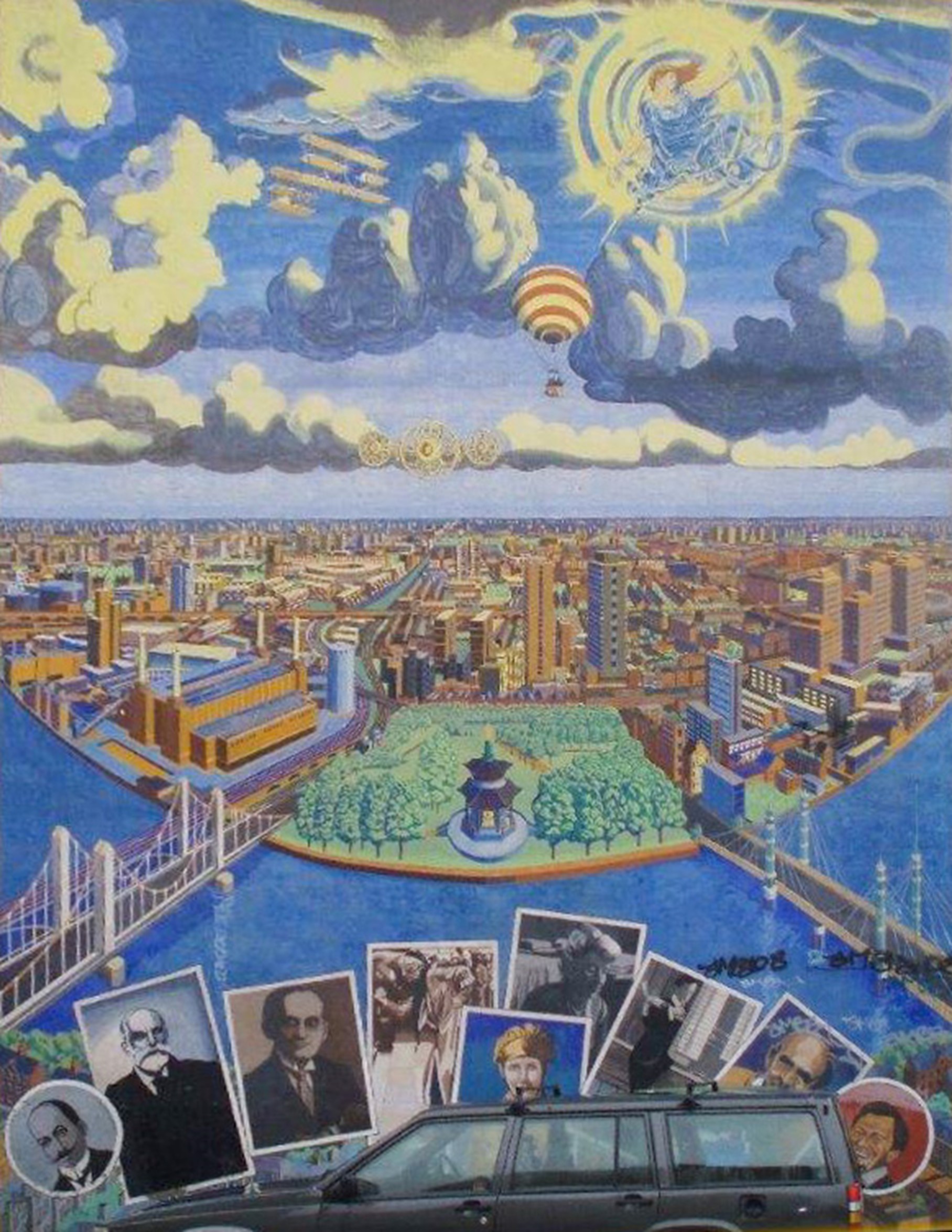 Photo and © Tony Belton; resized by Tomos Jones Photo and © Tony Belton; resized by Tomos Jones |
There are other major Barnes murals in south London: all of them notable for their sheer size, colour, boldness, political content and community involvement. Some of the most notable are Brixton’s (Coldharbour Lane) Nuclear Dawn; Stockwell tube station’s War Memorial; and Battersea’s (Carey Gardens) A Brief History of Time and Thessaly Road’s A Day at the Seaside.
Brian Barnes constantly involved school kids, local people and local personalities in the design and execution of his murals. He lived for his art and I remember that he told me once of his plan to go to Bahia Blanca, a city on the east coast of Argentina, to an international festival of murals. The plan was that this otherwise undistinguished city would allocate one wall each to 50 international artists, invited to decorate the city. It was a wonderful plan, which anyone who knew Brian would know that he’d have loved. It would also have expanded his artistic experience and range. But, as so often, the problem was money. Neither Brian nor Bahia were rich and the artists had to be self-funded!
There was another side to Brian and that was his life as a political activist. In 1983 he became the inspirational genius behind the Battersea Power Station Action Group (BPAG). BPAG, he told me some 10 years ago, met weekly for over 30 years with Brian creating the agenda, writing the minutes and basically running the show – all that takes some doing. He was also a long-term executive member of the Doddington and Rollo Community Association (DRCA) and an active participant in many local campaigns and issues. He was frequently enthusiastically articulate about his very particular viewpoint. However, as the chair of several of these sessions, particularly at the DRCA, I’d have to say that Brian was not always very concerned with achieving consensus. The vehemence of his passion did not make for practical success in everyday politics, nor on occasions for civilised debate. But it made great street art.
RIP Brian Barnes, committed community activist and great muralist.
Councillor Tony Belton’s Battersea December 2021, Newsletter (# 150)
- Living through, what is hopefully the nearest thing to the Plague we will ever know, is certainly an experience – even if, one we would have wished to miss. But it is almost unfathomably personal, depending upon family life, age, life situation, wealth, location, occupation, etc., etc. I am talking from one tiny segment of the population. The comfortably off, owner-occupying, socially established, mature population. Though, even here the range of reactions are massive. My partner, Penny is putting nose to the grindstone, churning out books – actually enjoying not going to the cinema or to the noisy restaurant. Me? I am kind of reducing risk factors to a degree; going out a bit but happy to have an excuse not to. Many of my peer group have hardly stuck their heads out of the door and yet others, within Government restrictions, are flying the world almost regardless of the climate crisis and COP26.
- Lots of past generations, of course, have had their trials. My parents, for example, spent most of their twenties separated by war, and their parents, my grandparents, suffered the more deadly 1914-18 War AND the deadliest of modern pandemics, the 1918 so-called flu epidemic. My peer group appears to me to be uniquely lucky to have been born into Welfare State Britain and now, many of us, comfortably off as we enter a Climate Crisis through a Pandemic. And yet we can be so complacent and mean about it, when we should be generous and open about our good fortune. (One or two caveats, even for my generation: it is so important to be busy and, hopefully, not unhappily lonely).
- November started with me being pinged and self-isolating, so I missed Wandsworth’s Civic Awards and a couple of social events. However, I was clear for a grand Labour Party event at the Park Plaza Hotel, Waterloo. I, and a dozen other Labour councillors, were the guests of Cllr Peter Carpenter at a celebration of Labour and its associated SME (Small and Medium-sized enterprises) members. SME business is not generally thought of us as a home base for Labour, which is more frequently associated with Trade Unions and large, smoke-stack or nationalised businesses. SME4Labour is however a vibrant new part of the Labour Party, very much inspired by first-generation Brits, who have made good. A high point of the evening was Leonie Cooper’s award as Greater London Member of the Year. Congratulations to Leonie, who as many of you will recall, was a Latchmere councillor before moving to Tooting in 2010.
- On 11th November, Penny and I flew to Copenhagen for the Annual Meeting of the Danish Eighteenth-Century History Society, where she was the keynote speaker. I wanted us to avoid air flights – if possible, but discovered that it was practically impossible. There used to be a ferry from Newcastle to Esbjerg on the Danish west coast, followed by a simple train ride to Copenhagen. But cheap airfares have undermined that ferry’s economic viability. And the only real alternative is a 36 hour trip by ferry to Rotterdam and a combination of rail journeys across Holland and Northern Germany and finally Denmark. How can we truly face up to the climate crisis when the Government not only continues to subsidise air travel, but actually increases its subsidies as Chancellor Sunak has just done to the detriment of rail and ferry services? Is this Government serious about anything?
- On the 12th we went for a long walk through central Copenhagen. It’s such a quiet, well-behaved city compared with noisy, rumbustious London. There are
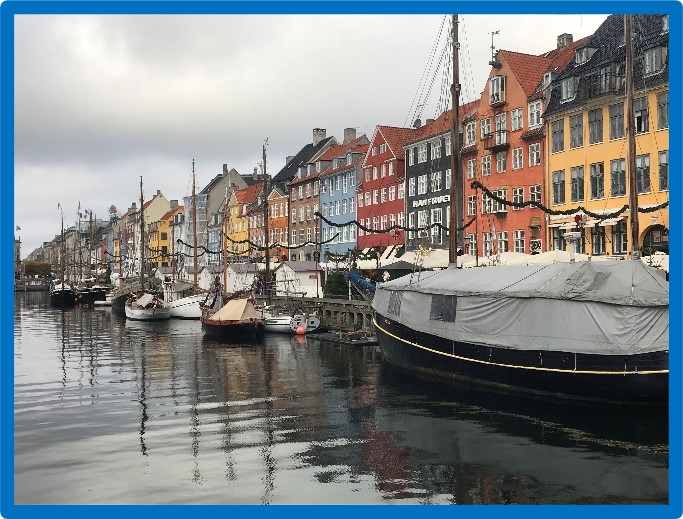 famous tourist spots like Nyhaven (Newhaven – pictured here), pedestrianised streets and thousands of cyclists. But the cyclists somehow belong to a different era from here in London. They are not Lycra-clad speedsters but sit-up-and-beg shoppers with shopping baskets. But before some of my cycle-loving colleagues get too envious of Denmark, I should point out that British pedestrians would never tolerate the inequities meted out to pedestrians in Copenhagen – no minimum width of pavements, no protection against parked cars or bikes, no control over obstructions. The pedestrian really is at the bottom of the pile.
 - The lecture and the guest appearance of the International President, Penny, went well and so, I must
 say, did the delightful socialising on both of our evenings
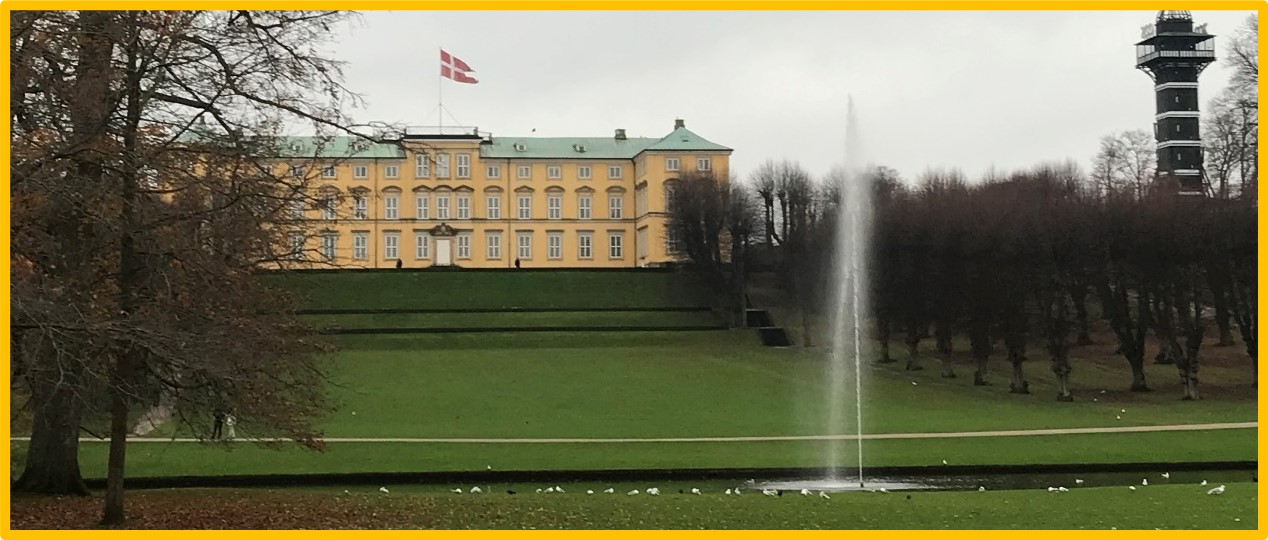
 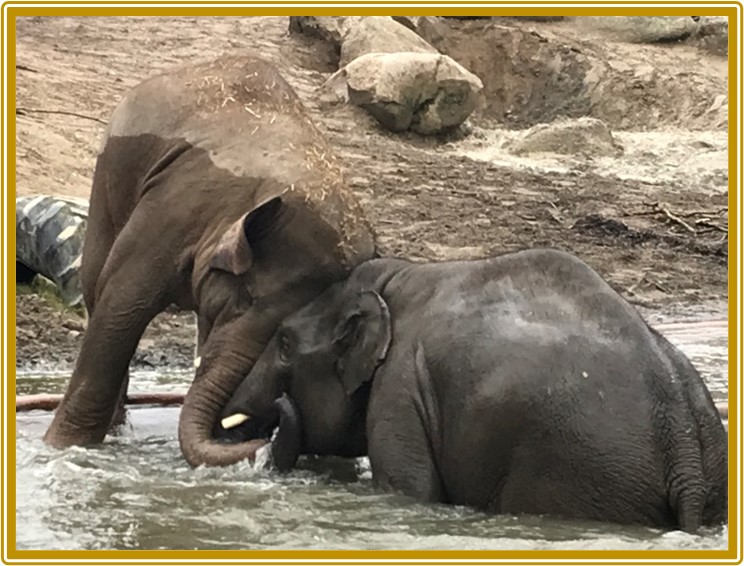 there. On the 14th before our return home, we went for a tour of the Fredericksburg Gardens, a Hyde Park equivalent attached to the Palace, pictured here. But the stars of the afternoon were in the elephant enclosure of the neighbouring zoo, which is clearly visible from the Gardens. We were entertained by two elephant teenagers, who were intent on pushing each other into a pond they shared with plenty of ducks, who sensibly kept their distance!
 - We returned home on the 14th but what a hassle! On the way out, we had a saga of problems. And, as for returning, our efforts to complete the correct forms on strange computer keyboards, to satisfy the Covid inspectors and, and …… led us to conclude that foreign trips of less than at least two weeks are just off the agenda for the foreseeable… And, moreover, we got pinged again two days later, presumably because of someone we met/passed at Heathrow!
- On the 15th, the day before I went into self-isolation for a second time, I had a meeting of the Wandsworth Conservation Area Advisory Committee (WCAAC). I have mentioned this committee before but not discussed it much. It is a very worthy group of local amenity groups, who advise the Council on potential developments in Conservation Areas and who, unsurprisingly, usually have a conservative outlook on developments. On this occasion, the main discussion was about the proposed development of the All England Tennis Club into and over the area of what is now the Wimbledon Park Golf Club. Whilst that is of little direct interest to Battersea, I know many “Wimbledon” fans will be fascinated. In essence, the Championship is doubling in size; the qualifying tournament will be held on-site and not as now in Roehampton; it will provide many, many more practice courts (apparently compared to the other majors the lack of practice facilities is a “scandal”); it will also ease the obvious “wear and tear” pressures of playing on grass as opposed to hard courts. As a by-product, much of the current golf course will also become a genuine park rather than an effectively private open space. The proposals looked good, but, of course, the plans still need close scrutiny.
- Once again self-isolation meant that I did not attend November’s Planning Applications Committee on the 23rd, except in Zoom-mode. In every other respect, it was also like October’s PAC – there was nothing exciting on the agenda; it was mundane; it was ordinary; it was part of the bread-and-butter of local government and it was very well done
 with thought and care. I was again impressed by the quality of the councillors’ involvement and contribution.
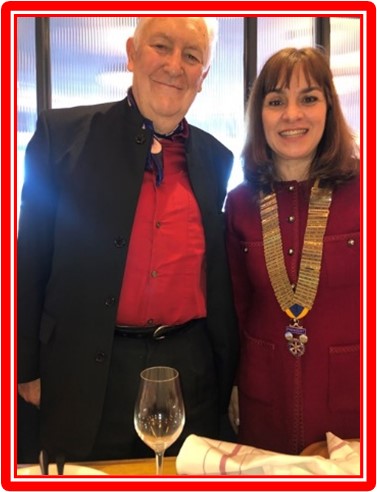
 - Some months ago the Battersea Park Rotary Club invited me to talk at their weekly lunch-time meeting on 25th My topic was “50 years of life as a councillor”. The lunch was at Wright’s, one of the new restaurants in the Battersea Power Station development. I thought the talk went quite well; the Rotarians said it did; but then they would, wouldn’t they? Here I am after the event with Rotarian President Senja Dedic.
- Whilst I was there, I was struck by the sight of the
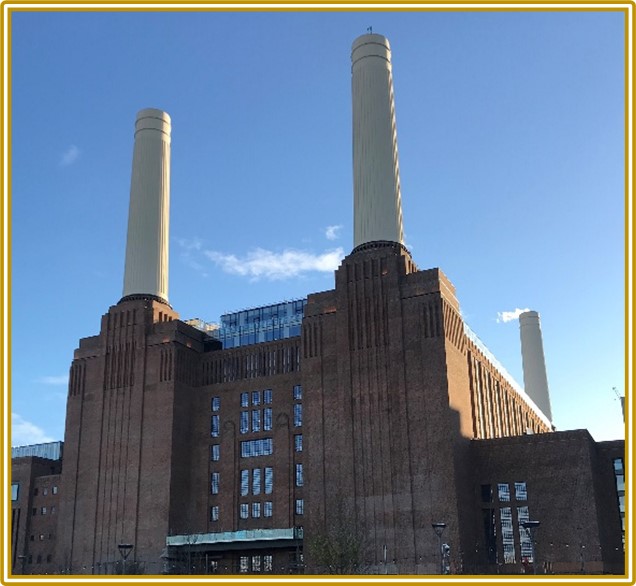 Power Station. Since I was last there it has taken on the looks of a completely new building, in sparkling condition and almost ready for its new life as a town centre, full of shops, living and work. It was, as you can see, a brilliant day: bright and very cold and the Power Station looked at its best. I got into a discussion with two friends, who work there and who are very committed to its success. I suspect I irritated, or annoyed, them with my scepticism about the plan for what is being called “a new town centre”. Personally, as yet I find the development a tad sterile; it’s certainly acquiring some of the patina of success, but there isn’t any authentic urban life there. I hope that I am wrong but ..?
 - The 25th was also the day of a by-election in Wandsworth’s Bedford ward. Congratulations to Labour’s Sheila Boswell, who won by one vote! I suspect that both Tory and Labour parties were almost equally surprised by the result. Labour was certainly. And presumably, the Tories were a bit sickened, having got so close. It will have done no harm as long as the obvious lessons are learnt, starting with the very clear one that the electorate is not quite as keen on turning out for what will seem to many as meaningless by-elections even if we, active practitioners, think they are important. On the following Sunday, 60-70 Labour stalwarts zoomed their collective frustrations and irritations in a solemn post mortem.
- On the last day of the month, news broke that local artist and political campaigner, Brian Barnes had died. I first met Brian during the Battersea Society’s campaign “to save” Albert Bridge. It was under assault from modern traffic, which its nineteenth-century designers hadn’t anticipated. It was a story very familiar to modern Londoners in the form of similar arguments about Hammersmith Bridge. Demolition and reconstruction was, of course, the “rationalists’” answer but they had not allowed for campaigners, who commissioned the young, unknown Battersea artist, Brian Barnes, to design several beautiful posters in defence of the bridge. An agreed compromise was the largely unnoticed but successful buttress under the bridge’s central span. It has now been there for 50+ years.
- Way back then, I was Chair of Planning and later the Opposition lead on planning, when his most famous mural was designed, created and demolished. The mural, “The Good, the Bad and the Ugly”, was a massive 150 feet long, 18 feet high (45 metre by 5.50 metre) political statement of how he, and some others of us, would have liked Battersea to become. A great broom was sweeping away all the noxious industries of nineteenth-century Battersea and replacing them with smiling children and nice new homes. But, like medieval paintings of heaven and hell, Brian had much more fun painting the ‘bad’ than he did the ‘good’ – after all, one set of smiling children in a flower garden doesn’t cover much of 150 feet. I am proud to claim a small role in the artwork, as Brian included me and Wandsworth’s then Director of Planning, Mike Tapsell, on the mural, being tossed about in what was a figurative tide of rampant capitalism. Four Tory councillors, led by Chris Chope (now Sir Christopher Chope, the notorious right-wing Tory MP) also starred in the painting. Unfortunately, the demolition men gave it short shrift when building today’s Morgan’s Walk.
- My favourite Barnes mural is called Battersea
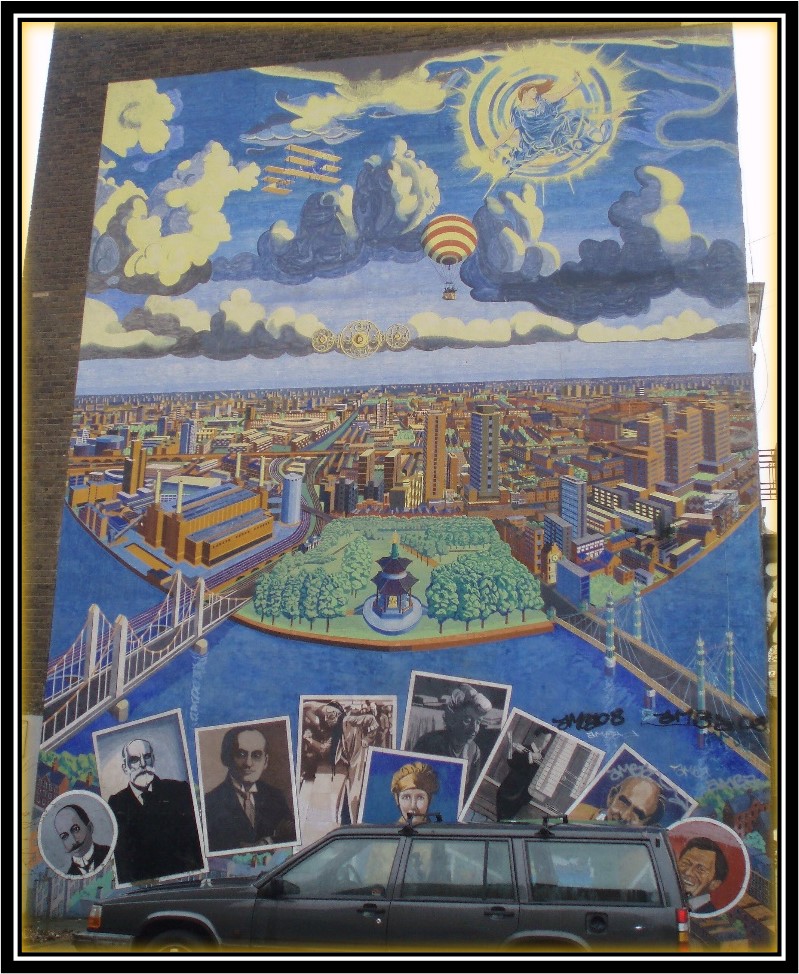 in Perspective and is in Dagnall Street on the wall of what used to be the Haberdashers’ Arms, now converted into flats. The mural is a visual tour of Battersea, from Roman jewellery found in the Thames to Battersea Park’s Peace Pagoda. It demands a detailed description, but, as this photo shows, it is also difficult to picture, whilst retaining the correct perspective.
 - There was another side to Brian and that was his life as a political activist. In the early 80’s he was the inspirational genius behind the Battersea Power Station Action Group (BPAG). BPAG, he told me some 10 years ago, met weekly for over 20 years with Brian creating the agenda, writing the minutes and basically running the show – that takes some doing. He was also a long-term executive member of the Doddington and Rollo Community Association (DRCA). I was chair of the DRCA for some years around the turn of the century and I can vouch for the fact that Brian was a very idiosyncratic, and not always easy, member of the association – at least from the chair’s perspective! RIP Brian Barnes, committed community activist and great muralist.
- Finally, can I urge you all to get fully vaccinated – if not for yourself then for your friends and family, who deserve not to be infected by a disease that you might otherwise be carrying. To my mind, refusing to get vaccinated is not a display of sturdy individualism but rather an anti-social indulgence.
My Programme for December
- Omicron looks likely to destroy much of my Christmas, and I am afraid maybe yours as well. I very much hope that I am wrong but the sudden appearance in late November of this new strain of Coronavirus, and the threat of other variants to come suggests to me that there must be more lockdowns to come.
- That will leave me with a meeting of the North-East Surrey Crematorium Board on the 7th December, a Labour Councillors’ Group on the 9th, the Council Meeting on the 15th and the Planning Applications Committee on the 16th.
- As for the festivities themselves: I have the usual round of potential parties, but how many happen, or I go to I am not sure. Only one has been cancelled so far!

Did you Know?
Last month I asked, whether you knew this local horse trough, which I had noticed the previous month. The answer is that it stands on Trinity Road, outside the County Arms.
And this month?
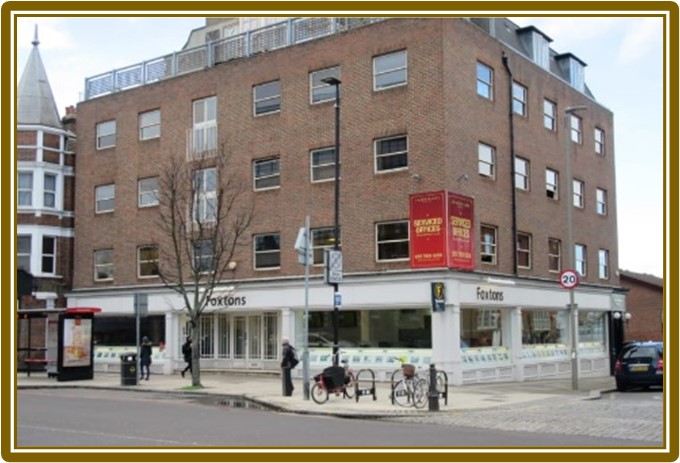
Many of you will know this building: Foxtons, large, modern office block on the corner of Theatre Street and Lavender Hill. But do you know what was there before being severely bomb-damaged in the 1940s and demolished in the 1950s? You might find a bardic clue in the address.
Councillor Tony Belton’s Battersea November 2021, Newsletter (# 149)
- September was hectic; October was both quieter and yet more challenging! During years in politics, I have been “interviewed” at more than 40 selection meetings prior to standing for election. This kind of competition is not unique to politics; but it always means competing with close colleagues and friends. That is stressful and the track record shows I have a mixed record at it! For most of the rest of the month I went coughing and spluttering into voluntary self-isolation – and that is boring.
- Saturday, 9th October, was a tough day. I had two selection meetings; one successful and the other not. The first was in the new 2 member ward of Falconbrook, where my colleagues Kate Stock and Simon Hogg were triumphant. Congratulations to them and all the best for the real election next May. The second selection meeting that day was in the new Battersea Park ward, where I was successful along with my new colleagues Juliana Anaan and Maurice McLeod. I look forward to working, and hopefully winning, with them next May.
- Wandsworth’s Council Meeting was held on the 13th Sadly and inevitably, Covid 19 has put everything, including Council Meetings, into the shade. The pandemic, not to mention the climate crisis, has eclipsed the relatively minor issues of running the Council. However, it does remain important that we have a lively political forum, in which to debate how we run our society, when hopefully we can put Covid behind us. Meanwhile the Council Meeting was rather second tier!
- On 14th October, I went to my cousin’s funeral
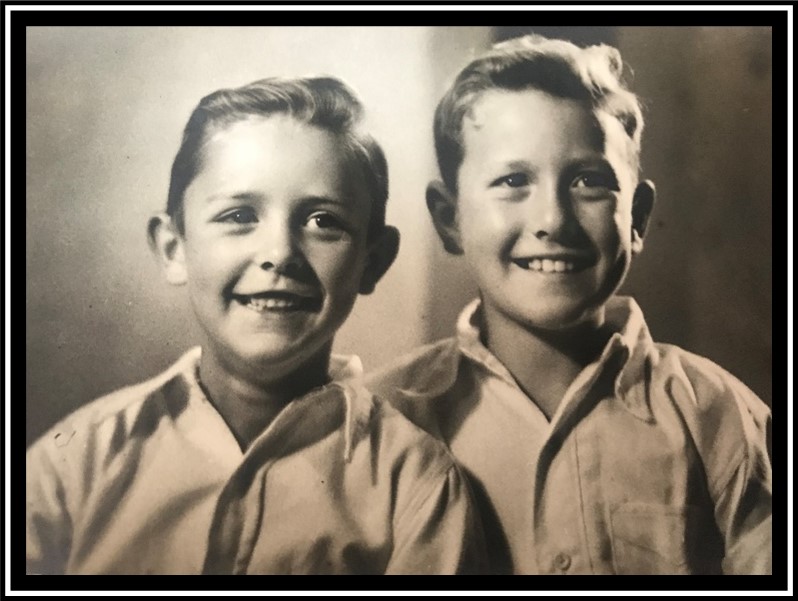 in Braintree, Essex. He and I were never very close, but immediately post-war, because he lived in Southend-on-Sea, my parents would send me off for a couple of weeks in the summer holidays from Tottenham to live with him, and my aunt and uncle. Penny and I made the 150 mile round journey (and stayed the night) to mark a family passing. It was good to see old family members again after so long. The “butter wouldn’t melt” picture is of David and me. David is the older of the two of us and the picture dates, I guess, from August, 1948.
 - After the funeral on the next day, 15th October, Pen and I drove the short distance to Colchester, where amongst other things I got a penalty notice for driving into a bus-lane I frankly didn’t see – oh, well, the price of urban living! Why go to Colchester? To visit an old colleague and friend, Guy Wilson, who was elected as a Wandsworth councillor in 1968. The three of us were part of the 1971-78 Labour Council. We had a conversational ramble through the successes and disasters of that Council – and my word there were some great successes and one very large disaster, the implementation, or not, of the 1971 Housing Finance Act!
 The picture is of the three of us, Guy on the left, then Penny, and me, along with Margaret Morgan and Martin Linton, celebrating our 1971 victory at a recent 50 year celebration!
- On reflection, the funeral, especially the wake, was a super-spreader event. I haven’t heard of any consequential Covid 19, but I have had a nasty cough ever since and so on 16th October I put myself in self-isolation, despite a negative test – and self-isolation is very boring!
- Self-isolation meant that I did not attend the October Planning Applications Committee, except in Zoom-mode. Although there was nothing very exciting on the agenda, I was impressed by the high quality of councillor involvement and contribution. It was mundane. It was ordinary. It was not going to save the world from environmental disaster; but it was part of the bread-and-butter of local government and it was very well done with thought and care.
- On a quite different matter, one old friend of mine, who makes her living from graphic design, tells me that she likes my newsletters but hates the cross-page justification I have used in the first 3 paragraphs of this newsletter. She thinks it looks much better simply left-justified as in the last 5 paragraphs. Tell me, what is your view? What is the readers’ opinion?
My Programme for November
- On the 4th November, I was going to be at the Civic Awards ceremony at the Town Hall with my colleague Juliana Annan – but I am afraid self-isolation continues to rule that out.
- On the 7th November, Battersea Labour Party is having a Jazz Night at Clapham’s Bread and Roses That is usually an enjoyable occasion and I hope to be there!
- Some of you may remember that Penny was elected for a four-year term as President of the International Association for Eighteenth–Century Studies and we had plans for attending multiple international conferences. Of course, Covid has put a stop to all that. But now Denmark has taken the plunge and so from 10th-14th November we hope to be in Copenhagen – our first trip (holiday, well working holiday for her) in two years. No doubt many of you have not had a break either, so you will know how exciting that feels!
- The November Planning Applications Committee is on 23rd There will probably be a contentious planning application to convert the Clapham Common Bowling Green to a Pitch and Putt course, amongst other items – watch this space!
- Battersea Park Rotary Club invited me give a talk about my 50 years as a councillor and, no doubt, about what has or has not changed during that time. I get lunch in return on 25th I look forward to that but must think just a bit about what really has changed?
Did you Know?
Last month I asked, “Which ward will be abolished next May and, take with it, the proud record of being the only ward in Wandsworth never, ever to have been anything other than represented by Labour councillors?”
That was so easy/boring/inconsequential (delete to taste) that none of you bothered to tell me that it is, of course, Latchmere, the only ward permanently represented by Labour!
And for this month’s puzzler:
I thought I knew my local horse troughs but last month I noticed this one, for the first time, despite passing it a 1,000 times. It is a slight cheat as it is very marginally outside Battersea’s boundaries. Do you know it? And can you point me to a similar trough that is very definitely in Battersea?
If it helps, Yes – they are pub seats in the background.
Councillor Tony Belton’s Battersea October 2021, Newsletter (# 148)
- What a month! Two funerals, a death, a wedding and a “50 years as a councillor party” in the first fortnight; Council candidate selections amid confusion during the whole month; petrol queues and empty supermarket shelves at the end of the month; a new undergound station (or two) for all of us; a new baby for fellow Councillor Kate Stock; and entombment in a Sporle Court lift for me – and those are just the headlines! Oh, and a pro football games.
- 3rd September was the day of Kathy Tracey’s funeral. Kathy was a strong Tory councillor and therefore wicked – but actually not on every issue.
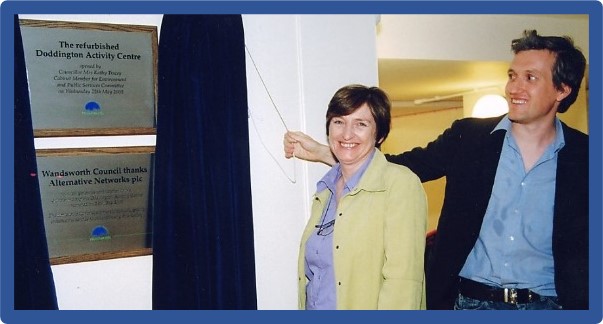 She of course supported, what to me, were some fairly outrageous Tory policies, but, as boss of Wandsworth’s Children’s Services, she genuinely cared for “children looked after” (or “taken into care” in lay language). She was a passionate supporter of girls’ education and of sex education – perhaps particularly for boys! I well remember an epic battle she fought with some hard-right young Tory councillors on that particular issue. I suspect that she might well have become the Leader of the Council, if she had been a man. Here she is after the refurbishment of the Doddington Activity Centre. I certainly respected her.
- On 4th September, fellow councillor Annamarie Crichard invited me to join her and her husband, Steve, at Wimbledon AFC’s new Plough Lane stadium for the league match against Oxford United. I had been to the old Plough Lane stadium,
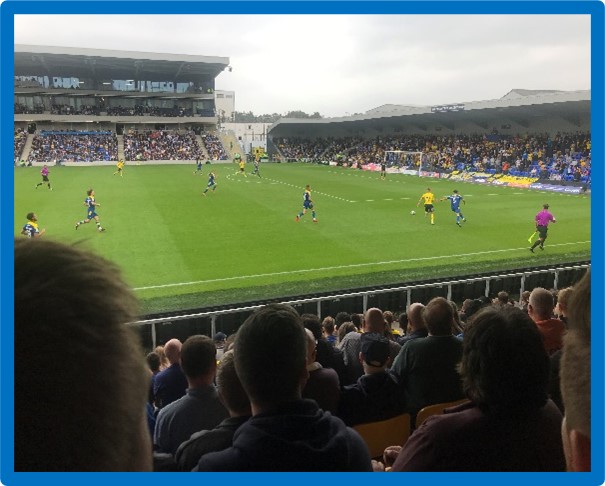 with my parents, in the 80s – but what a difference. The new ground is very neat and well organised and there is clearly space for the expansion required if the club were to be promoted (unlikely this year but they were in the Premiership equivalent forty years ago). One startling difference between new and old was the playing surface. It was like playing on a carpet as opposed to the mud that used to pass for a football pitch in the 80s. As for the game itsrlf, Oxford United started well and took a 1-0 lead into the second half. But then the Dons came good and ran out 3-1 victors.
- The 9th September was the day picked for the
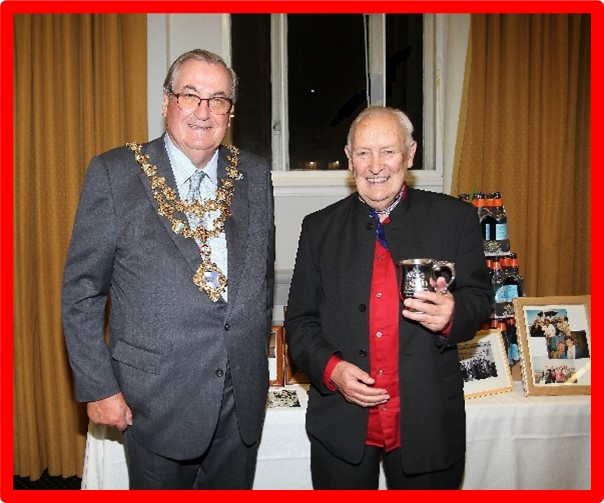 Celebration of my 50 Years as a Wandsworth councillor. It seemed to go well; and I am delighted to record again my thanks to all who put so much effort into its organisation. And to those of my fellow councillors who funded the event (no Council-paid-for junketing here!). I greatly appreciated the engraved beer tankard presented to https://www.msn.com/en-gb/feed me by the Mayor and which I am holding close to my heart in this picture.
 -
- And then on 10th September I attended the Quaker funeral of an old friend, Ron Elam. Ron and I were “flat neighbours” in the 1960s and worked together in County Hall from then until the abolition of the Greater London Council in 1986. Away from County Hall, he became a very senior and experienced school governor, travelling the country inspecting and monitoring school governing bodies. Although a Labour Party member, he was frequently used by Tory Wandsworth Council to help and advise on the recovery of failing schools. The Quaker funeral service was very moving, very restrained and very comforting. In general, I’m not one for religious occasions and find some positively off-putting but I must say that the Quakers are in a different class! Plain speaking from the heart is hard to beat.
- To complete the week, on the Saturday, Penny and I were off to the delightful village of Aynho in Northamptonshire for the wedding of one of my colleagues from University – Yes, you read that properly – one of my colleagues from college in the 60s. Mind you it was his third wedding and a very cheerful, happy day it was – lots of dancing, including by me!
- The following day, Penny and I explored the village.
 It didn’t take long. It’s not very big but it is spectacular, with a magnificent seventeenth-century mansion (Aynho House), which is used for wedding parties, but not by our party. The most spectacular of the village sites is St. Michael’s Church. It was originally fourteenth-century, but it was destroyed by fire in 1723, except for the tower. Amazingly enough the church was rebuilt in the mid eighteenth-century to look like a country house of the period, but with the church tower standing rather incongruously at one end of it.
- It really was a turbulent fortnight.
- The Planning Applications Committee (PAC) on 16th September included one fascinating decision regarding yet another massive application in Nine Elms. To be honest, I didn’t quite understand it as we were asked both to defer making a decision and to delegate it to the officers. That procedure was very strange and I don’t recall a similar case in all my years’ experience. After all, if there was no urgency, which a decision to defer seemed to imply, then logically there would be enough time to come back to the Committee for due consideration and therefore no need to delegate. It looked frankly odd to me and to most of my Labour colleagues, but the resolution was passed by the Tory majority. I will certainly keep my eyes open to see what follows from their decision!
- One of the biggest events in Battersea
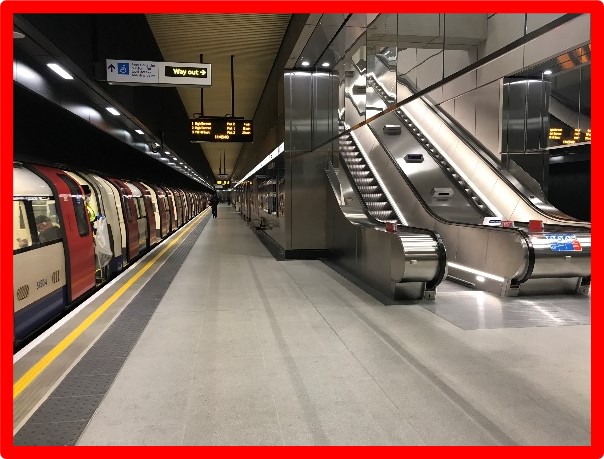 in 2021 has to be the opening of the Battersea Park underground station. I didn’t go to the actual opening but I did travel from the station to the new Nine Elms station just a few days later. What is so noticeable is how clean, fresh and empty the station and the platforms are. It is a timid commuter’s delight but the impact on TfL’s finances is too dreadful to contemplate. Of course, the line needs to continue to Clapham
  Junction. That would transform the pattern of usage but the money just isn’t there (without government intervention), despite what some critics are claiming. As a result it does run the risk of becoming a massively under-used facility. One fascinating indicator of this is the lack of business at mid-day in the massive Sainsbury’s lower car park at Nine Elms and its usea as a training ground for these young in-line skaters!
- If you are not interested in the minutiae of politics, you should skip this paragraph because much of the rest of September was taken up by Labour councillors and newcomers competing to be the party’s candidates in next May’s Borough election. The process has been delayed by Covid, and complicated by the ward and boundary changes. So, to take an obvious and personal example, the old Latchmere ward will cease to exist in May 2022 and its three councillors, Simon Hogg, Kate Stock and myself, are competing with two newcomers for the two Falconbrook councillor positions. By definition we cannot all win. It’s a tense time in Battersea Park, Falconbrook and Shaftesbury & Queenstown wards but we will know our candidates by 10th October.
- Meanwhile, life continues! On 19th September,
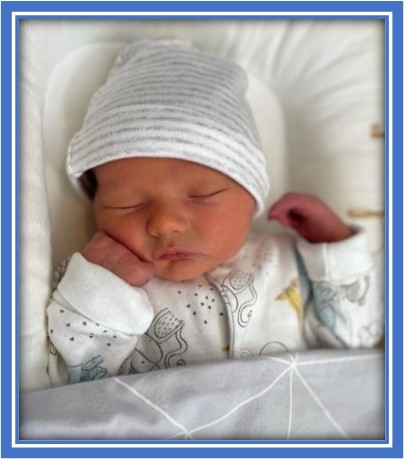 fellow Latchmere Councillor Kate Stock gave birth to a 10 lb 4 oz baby boy, named Jude. Congratulations to Kate and her husband, Tom. Kate doesn’t, by the way, believe in half measures. As well as coping with Jude, and his young sister Edie, and with ward reselections, she and Tom moved house on 30th September and became very near neighbours of ours.
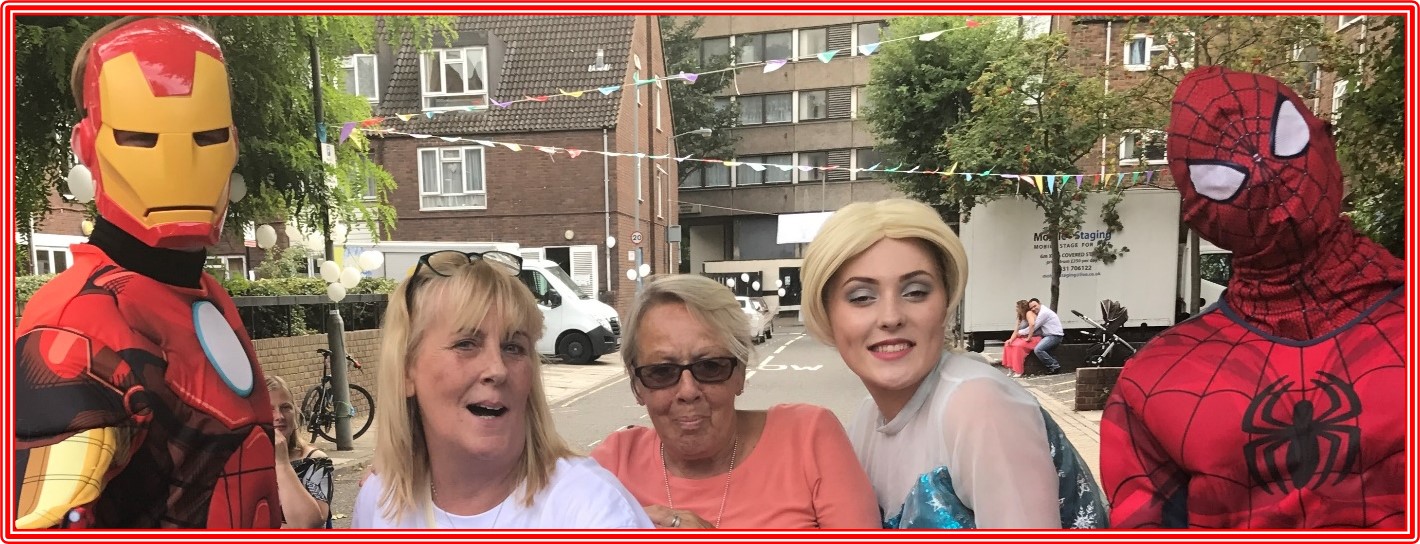
- On September 23rd Kambala Cares, one of the two main volunteer groups helping to cook, shop and care for the vulnerable during the Covid lockdown, organised a party for its volunteers. I went as did Cllr Hogg and, most significantly, Mayor Richard Field. The party organised by Chair Donna Barham was well deserved by the many volunteers and very enjoyable for all.
- As a councillor, I make regular tours of
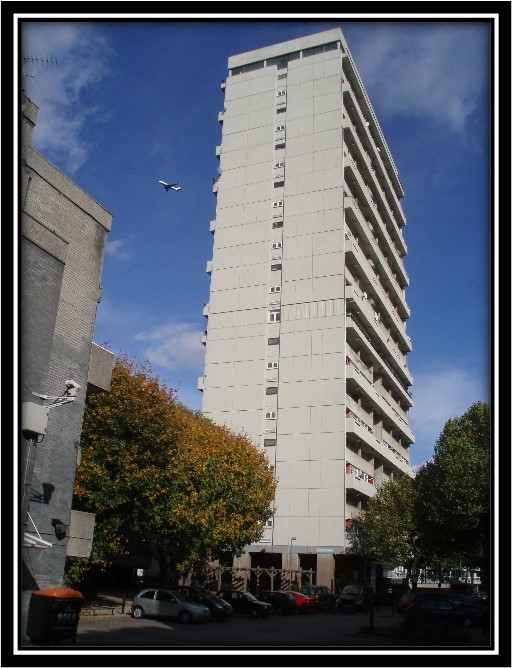 Latchmere. On September 25th, I visited a constituent in Sporle Court (pictured here), the old high-rise, giant of north Battersea before all these new higher developments. As it happened, my constituent lived on the 19th I was alone in the lift, thank goodness, because as it started there was a great clunk, which worried me rather. The lift continued but, when it stopped, just inches short of the 19th floor platform, the door would not open! Have you ever been trapped in a lift, regardless of which floor it was on? An interesting experience! It was a warm day, so the first thing I did was take off my vest. It was getting hot in there. A few years back I had a bad attack of claustrophobia when in a long dark tunnel. It is essential to keep calm. So, it wasn’t great to be told by Penny, when I rang through to her, “Don’t panic!” She sounded like a government minister on speed!
- Actually the alarm system worked as it should and, after about 40 minutes, a team of 5 fire-fighters arrived and prised the doors open. Phew! I now have first hand experience of what many of our residents fear on a daily basis; and, whilst incidents like mine are not that frequent, minor lift malfunctions are. Is this the result of poor maintenance? Or a function of age and/or cheap original products. By the way I did visit my constituent!
- Talking about not panicking, What do you think about the Government’s performance during the petrol crisis, during the food delivery crisis, during the never-ending Covid crisis? Perhaps there is no need to panic about petrol, food or Covid but there certainly seems to be good reason to panic about our government and its competence levels!
My Programme for October
- Well, of course, Labour councillors in Battersea are pre-occupied with the tense, process of selecting candidates for the council election in May 2022. Thankfully the decision day is not now far off and then normal life can resume!
- In terms of regular, scheduled meetings I have the full Council on 12th October, and the Planning Applications Committee (PAC) on the 19th.
Did you Know?
Last month I asked, “where I was in Latchmere ward  when I took this picture of more than 100 solar panels?”
Plenty of you had an answer to this and many were nearly, but not quite, correct – such as the response that I was on the train pulling into Wandsworth Town station. The actual answer was on the 10th floor of Oxborough House, which is the tallest of the new blocks on the “newish” development in Eltringham Street.
And this month a different teaser:
Which ward will be abolished next May and take with it the proud record of being the only ward in Wandsworth never, ever to have been anything other than represented by Labour councillors? And don’t say that is a difficult question!
Councillor Tony Belton’s Battersea September 2021, Newsletter (# 147)
- I realise that, more than once, I have started my newsletter with the less-than-startling comment that the previous month had been quiet but, in this case, August really was a quiet month – as you perhaps would expect. But I did have a meeting on Friday, the thirteenth (not that I am superstitious), with the current developers, Balance Out Living, of the site on the corner of Culvert and Battersea Park Roads – the one surrounded by a blue hoarding, which forces pedestrians onto the road. I say the “current” developers, as the previous ones disappeared at some point after getting planning permission. Don’t ask me whether they were Covid-burnt or market-roasted but, one way or another, they have gone.
- The new developers plan to build a “community living” space. Interestingly it will be the third planning application for such a development in Wandsworth, that I can recall over the last few years. Work on the other two, one near Earlsfield Station and the other in Chatfield Road, just off York Road, is quite advanced. The concept is to build blocks of living spaces, supported by a host of communal activities, such as workspaces, film and TV rooms, kitchens, and a cafe/restaurant. The end result would be like the best student apartment blocks but in a more luxurious style than that usually associated with students. The age range of the projected residents is wider than you might imagine (based on a couple of similar developments built in West London 10 years ago) though, of course, this kind of block is not very suitable for either families or the elderly.
- A consultation leaflet was distributed to the immediate neighbourhood in the last week of August describing the proposed development.
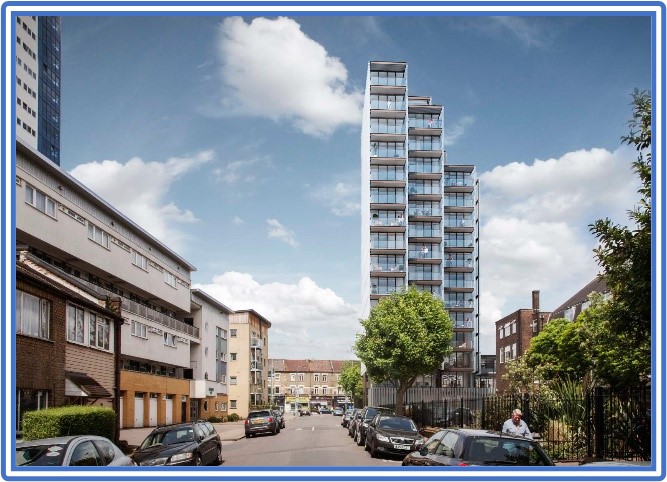 Here is a CGI (Computer Generated Image) of the original and this one is not very different. It is going as high as 13 storeys, which, in my opinion, is still far too high for this site; but, as the previous permission is still valid, there is nothing we can do about that. There is though the hope of work starting on the site soon and a promise that the school’s sports hall will be built as soon as permission is granted, which could be in October or November. So it is broadly good news for the school, its pupils and the residents of Dagnall Street, who have had to put up with a building site for far too many months, even if the development is still in my view too high and too large for this site.
- On the 19th August, I had the Planning Applications Committee (PAC) Only three of the applications were for sites in Battersea and two were of only very, very local interest, but the picture shows the third, a new 8 storey building, on Battersea Bridge Road, opposite the Union pub.
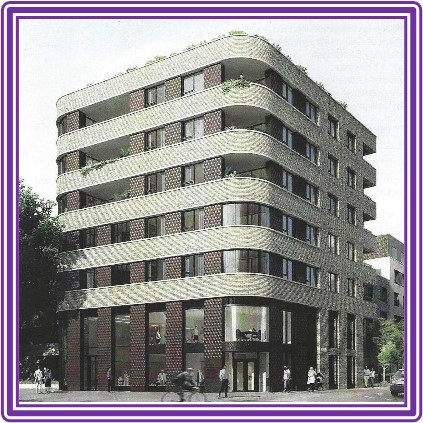 It includes 24 residential units, of which 9 are, so-called, affordable units, above some offices and most interestingly a community/church hall on the ground floor. The development is part of a controversial re-generation of the Surrey Lane estate. By the way, on this occasion only 54 members of the public watched the PAC online but, interestingly, another 80 viewers tuned in later to the podcast, no doubt to catch up on what happened to applications of relevance to them. Interestingly enough, one of the local Tory councillors, and the Battersea Society, objected to the height of the building and thought it out-of-character. Is this an indicator of the “Tory worm turning” against Battersea’s incessant upward development?
- Unfortunately the Committee was held on the same evening as the Battersea Society’s summer party at St. Mary’s church. I was sad to miss that party, as it is one of the nicest social events of the summer. My regret was compounded by the rain which forced Battersea Labour Party to abandon its Battersea Park picnic on 21st August and re-locate it in the pub, the Magic Garden – pleasant enough but not the same as a picnic, nor as Covid secure!
- On one of my ward walkabouts, I came across the 3 security men guarding the Battersea Methodist Chapel. At some time in August, some protestors occupied the chapel building with the intention, they claimed, to take it and turn it into a community resource. They had thought that they were occupying a “council property” and were quick enough to repent and leave when they discovered it was still a church property. Good for them BUT isn’t it worrying that they clearly did not think that council ownership was, in any sense, good for the community? The trust between publicly elected bodies and the public, so strong when I was a kid in the immediate post-war years, is today dangerously torn asunder.
- I also came across this development site, which is
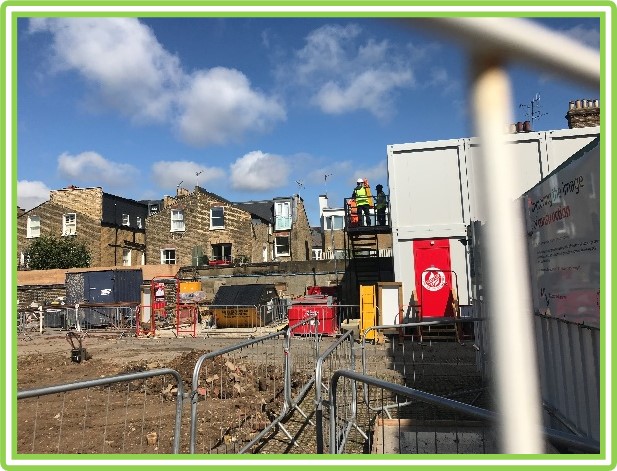 the start of the Council’s building work on the new Northcote Library, right across the road from the current one. (For those who know it well, it is the site of the old Chatham Hall, scene in the past of jumble sales, political meetings, tenants associations and more recently of a day nursery). The old, much liked but totally inaccessible library building (you try it with a wheel-chair!) is likely to be replaced in 2023/24 by shop-fronts and housing in a style no doubt appropriate for Northcote Road.
- On 30th/31st August Penny and I visited family in Winchester……very pleasant, lousy weather, nothing special.
My Programme for September
- September (and maybe October) will be occupied with the very intense, nervous process of selecting candidates for the council election in May 2022. The process is the first step towards the Council Election and is in some ways the biggest hurdle to overcome. If you get selected in a “safe Labour” ward, then you are halfway to being elected as a councillor in May. The same is, of course, also true for Tory candidates in “safe Tory” wards. But the problem is that, after the ward boundary changes and redistribution, no one quite knows which wards are safe. So, if your local councillors are a bit snappy and nervous, then forgive them – they are probably having a trying time in selection meetings!
- In terms of regular, scheduled meetings I have the Conservation Advisory Committee on 2nd September, the Crematorium Board on 7th and the Planning Applications Committee (PAC) on the 16th.
- Meanwhile, on the 12th September, we are going to the wedding party of an old college friend, who got married a year ago and has planned about three other Covid postponed parties. Tony (yes, another Tony) has given up waiting on an official end to Covid and has decided to go with the flow. The party is in the lovely little Northamptonshire town of Aynho.
- The following week is the week of the Labour Party Conference, which of course is followed immediately afterwards by the Tory Conference – something tells me that there are going to be some hard battles during that fortnight!
Did you Know?
Last month I asked, “Which Olympians from this year’s Tokyo Olympiad either live in Battersea or were said on TV to have had family watching the event on TV in Battersea?” Quite clearly none of you were interested in that question as not one of you even attempted an answer. All I can say, is that one athlete, a member of the equestrian team and a silver medallist, name of Tom McEwen, was said by the TV commentator to have parents watching at home in Battersea.
And for this month can you tell me 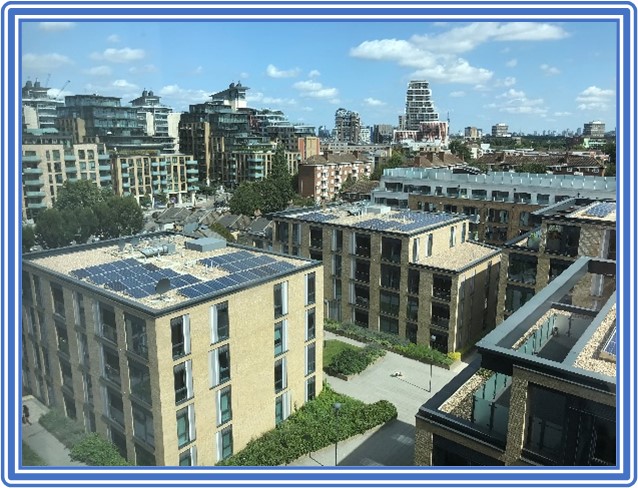 where I was in Latchmere ward when I took this picture of more than 100 solar panels?
PS. In the summer I gave an hour’s zoom talk to the Battersea Society, called Battersea, 1801-2021, the history of this London suburb. It went quite well – I am told, so I just wondered whether any readers would be interested in hearing a repeat. Let me know at tonybelton99@gmail.com and I will timetable a repeat zoom session.
Councillor Tony Belton’s Battersea August 2021, Newsletter (# 146)
- 1st July. I was on tenterhooks that evening as Kim Leadbeater won the Batley and Spen by-election for Labour by 323 votes. You will remember that this was the seat where the Labour MP, Jo Cox, was assassinated by a right-wing fanatic in 2016, and her successor resigned this year, when she became the Mayor of West Yorkshire. Labour had lost the Hartlepool by-election as recently as 6th May. Things did not look good for Labour or for Keir Starmer, but, in fact, Labour, in the person of Kim, just held on and suddenly the glitter had gone from the government. Johnson is beginning to get the bad press he so clearly deserves, with his own MPs getting uncomfortable about his failure to deliver. Unfortunately, there is as yet no sign of the public returning to Labour in any great numbers, but at least the Tory Party rocket looks to have burnt out.
- 6th July. I took
 Battersea’s Labour M.P., Marsha de Cordova, to the Centre Court, Wimbledon, where we saw Angelique Kerber comfortably beat Karolina Muchova, 6-2, 6-3. But the day was not vintage Wimbledon. There were showers preventing us from walking the show; Marsha had had very short notice of a Shadow Cabinet meeting called for early the next day and was clearly concerned about that, whilst I was also pre-occupied. Meanwhile, the match was not great, with Kerber (pictured here) dominating from first to last.
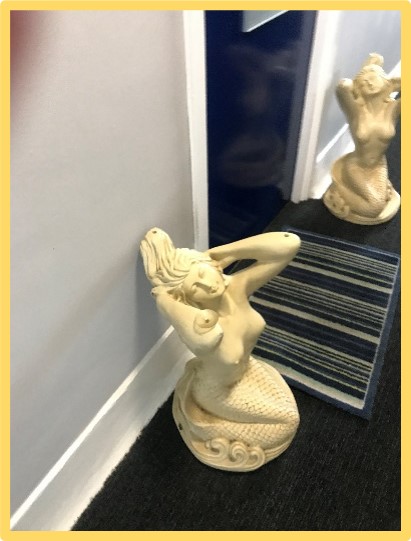 It is sometimes amusing, when walking round Battersea streets, to see just how people decorate their gardens or, in this case, their corridors. But I have never seen the internal corridor of a “Council block” with statuary quite like these ladies on the right! I loved them.
- 12th July. I introduced our MP, Marsha de Cordova, to Battersea United Charities (BUC) – well virtually – in a Covid-approved sort of way. Both Marsha and BUC seemed pleased with the meeting, although both the trustees and Marsha would clearly have preferred a real face-to-face meeting. The BUC told Marsha of the kind and type of charitable grant they make (i.e. educational grants within the ancient parish of Battersea) and she, in her turn, suggested that they might wish to use her to publicise some of their projects, in order to increase the number of applicants.
- 19th July had been set up by the Prime Minister as Freedom Day. What an absurd notion! Freedom from what? Clearly not from Covid-19 as it is obviously fighting fit and ready to fight another day; freedom from regulations that are designed to keep us alive? So that we can be free to be infected? Or free from fear? Tell that to someone who is immuno-compromised. Freedom from caring for the sick and dying? Tell that to nursing staff; tell it to doctors. One thing, that we definitely are not free from, is the absurd statements coming from this most irresponsible of all governments.
- On 21st July I had a Wandsworth Council Meeting. It was a curious occasion. The Government had, earlier in the month, ruled that we councillors could no longer have hybrid meetings – that is, meetings held with both online and actual presence of councillors. However, there are several councillors with health issues, which prevented them from being there in person. Moreover, because of social distancing rules, we were, to some degree, discouraged from attendance, because the Council Chamber, large as it is, is not really large enough to allow adequate social distancing. All these factors made me decide to stay away, making this one of the very, very few Council Meetings that I have missed since May 1971.
- Watching the meeting online, I just did not think that the Council Meeting worked in procedural terms. I am not kidding myself into thinking that many of the public would want to watch such an event. It turns out that there was an audience of 75, but that total included half-a-dozen absent councillors, like me. In fact unless one knew the arcane processes of the Council, the procedures must have been indecipherable. I, for one, let alone the other 74, hardly knew what was going on!
- The Planning Applications Committee, on 27th July, featured an application for a two-form entry primary school in Nine Elms, just west of the American embassy. It was a Council application made on the basis of estimates of the future child population in Nine Elms. It is an inherently risky business, building a new school for an estimated future, as yet not born, child population: the Council will be criticised if there are too few 5-11 year-olds but, of course, it would have been crucified if, having granted permissions for the large developments in Nine Elms, it had not provided enough school places. The application was agreed unanimously. The other applications were of only local interest, though of course important to the applicants.
- On the 28th July, Penny and I set off for a three day trip to Alnwick,
 Northumberland, where we stayed with some old friends. We had, however, never visited their house before – here it is, an early nineteenth-century house close to the centre of town with a view of the castle. We had a great time and their garden boasts having its very own hedgehog, which we did see one night. It was the first hedgehog that either of us had seen since at least the 1960s. I imagine that there may be hedgehogs somewhere in Battersea Park, but can anyone confirm a sighting in Battersea?
- On our first day there, we went for a walk from
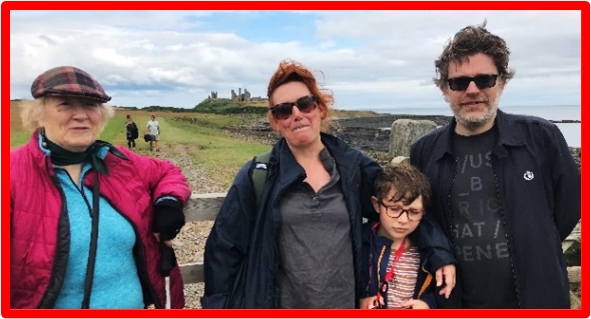 the tiny port of Craster to Dustanburgh Castle. On the way back we were spotted by Battersea residents and fellow Labour Party members, Ed and Aviva with their son Henry – small world! Here they are with Penny, about a mile from the castle, which is clear on the horizon.
- Alnwick itself is a small market town with its own castle. But castles are, as they say, ten a penny, on this coast
 with Bamburgh Castle, seen here, one of the most impressive. They are not display castles nor nineteenth-century follies; they are nearly all twelth- or thirteenth-century fortifications; and many played key roles in either defence against the Scots or the century of battles, culminating in the so-called Wars of the Roses, which basically settled the English (and I mean English not British) monarchy on the Tudors.
My Programme for August
- In terms of formal Council Committees or Council Meetings, there is only the Planning Applications Committee (PAC) on the 19th August.
- But I do have occasional management meetings about planning and housing issues and, of course, the regular flow of casework, helping constituents.
Did you Know?
Last month I asked, “Where in Battersea was the location of a pioneering aircraft factory, named Omnia Works, where WW1 fighter aircraft were made? And where, again in Battersea, did its owner and managing director live?”
There is a blue plaque commemorating Hilda Hewlett, the first woman licenced as a pilot, on the building at 4 Vardens Road, off St. John’s Hill. Vardens Road was the site of her Omnia Works, where aircraft, including WW1 fighter aircraft were made in 1912-14. Hilda herself lived at 34 Park Mansions, Prince of Wales Drive. Well done, Spen and others.
And for this month can you tell me:
Which Olympians from this year’s Tokyo Olympiad either live in Battersea or were said on TV to have had family watching the event on TV in Battersea? Clearly, I don’t have a definitive answer but can we collaboratively put together a list of, say, 3 which would be roughly three times Battersea’s proportion of the British population?
Councillor Tony Belton’s Battersea July 2021, Newsletter (# 145)
That was June, June that was
- 1 June. I was walking along Trinity Road, in Wandsworth Common, when I saw this magnificent hearse. Obviously, it marks a sad event for someone, somewhere, but it also provides a spectacle and an insight into cultural diversity, between the sombre nature of some funerals and the joyous celebration of a departed life “enjoyed” by others. (please note this version of the blog is without pictures – techie problem! I hope to sort shortly)
- 5-6 June. Penny and I went Eastbourne for the weekend. On the Saturday we went to Pevensey Castle, five miles from Eastbourne, where William the Conqueror landed at the start of his conquest of England. The magnificent ruins of the Castle command a splendid view over the coastal plain/marshes and of the sea, which has retreated a couple of miles since 1066. This photograph of the Norman castle ruins is not the best – of the castle – but I chose it for one very special feature and that is the gun emplacement set in the Norman Tower during the Second World War – an eleventh-century pillarbox defence. So, from some fortifications at Pevensey in Roman times through to its military use in the twentieth century, it has had an active history of 16 centuries – a truly unique British castle.
- On the Sunday, we went on the “Annual Family Walk” from the Birling Gap to the top of Beachy Head. I was a little doubtful about whether I could make it all the way, but managed OK. The trouble was that, whilst the rest of the country was basking under a beautiful sun, we were trapped in a sea fog and couldn’t see the sea, the Beachy Head light-house or almost anything else. And the day had started with this beautiful and tranquil, if unspectacular, dawn at about 3.45 am!
- 7 June. I went to a lecture organised by Labour Heritage and given by Baroness Dianne Hayter. She was talking about a book that she had written in 2006 on the centenary of the Parliamentary Labour Party (PLP) and about the 29 MPs, who in 1906 got together to form the PLP and, effectively, the Labour Party. The book, called Men Who Made Labour, is a record of the lives of these 29 men and their experiences as the first Labour MPs. Nearly all were what we might call “working men”, with very few having had any formal education beyond the age of 12 or 13. Almost none had ever been to London before their election and none had had any exposure to life in Parliament. The challenges they faced were immense compared to most modern-day experiences. But nevertheless, through self-education, hard-work and endless commitment they became over time Cabinet Ministers and, in at least one case, Prime Minister. Dianne, an old friend, told the story with passion and understanding – it was an hour’s Zoom well spent.
- 10 June. This time, I was doing the talking – to Croydon Trades Council. Croydon Borough Council recently decided to hold a referendum on 7th October this year, when the voters will be asked whether they want to have an elected Mayor or to keep the current Leader and councillors model. As it happens, one of the Trades Council members recalled reading an article I had written in 2007, on why elected mayors are “bad news”. Hence I was invited to speak. My speech went well but I think most of the audience was on my side before they had even heard a word. Nevertheless, it was good to get a good reception. If you are interested in my arguments against elected Mayors, then you can see the article on my blog at tonybelton.wordpress.com/
- Constituency Boundaries. Boundaries are extremely important to people deeply involved in politics. It may seem very boring to most but it is a matter of life and death to real politicos. It is because they have manipulated electoral boundaries so efficiently that the Republican Party is stronger in the US House of Representatives than its poll numbers would suggest. Indeed the word “gerrymandering” is an American word of abuse, originally aimed at the Democratic Governor of Massachusetts called Elbridge Gerry and the boundaries he drew up in 1812 for a new voting district, shaped, it is said, like a salamander or as the Boston Weekly Messenger called it a “Gerry-Mander”.
- This comment is a long-way round to introducing the fact that the Boundary Commissioners have recently produced their latest proposals for parliamentary boundaries. The whole point of these proposals is, of course, to try and bring some kind of democratic equality to bear on the electoral process by making parliamentary constituencies of more or less of equal population size – the law actually allows a 5% variation. Unfortunately, geography is nowhere as neat as arithmetic, and so five constituencies are defined by geography and not by population numbers. They are the islands of Orkney and Shetland, the Hebrides, Anglesey and two on the Isle of Wight.
- Fortunately on this occasion, the growth in Battersea’s (and the Borough’s) population more or less reflects the growth in the country’s population, hence no gerrymandering is required. The three Wandsworth constituencies of Battersea, Putney and Tooting, as proposed, are almost unchanged. But Tory Party MPs may be less keen than they were to implement the boundary redistribution, because, since the 2019 General Election, they do not stand to gain as much as they had previously expected – or at least that is what I have heard Labour cynics say! And, if that is the case, then maybe – as so often before – nothing will happen. We really ought to take these crucial decisions out of the hands of active politicians, and into the hands of the independent Electoral Commission.
- 22 June. I had a meeting in the morning of the North East Surrey Crematorium Board – and after its routine business, I was shown the grave of John Archer, famously the first black Mayor of a major local authority when elected Mayor of Battersea in 1913. I must confess that the grave itself is fairly unremarkable but it has its place in Battersea history, even if the graveyard is located deep in Merton! Or even Sutton?
- On the way back home from the Crem Board, I passed an unusual scene in Christchurch parsonage garden. Not exactly where I expected to see a rehearsal of Oscar Wilde’s The Importance of Being Ernest but that is what it was – and I never found out when and where it was produced but it made for an entertaining surprise for anyone walking along Candahar Road, just off Battersea Park Road!
- That same evening there was a meeting of the Planning Applications Committee and, as regular readers will know, there is usually something of interest on the agenda. But on this occasion – nothing. So, I pass on to the Education Committee, which had two items that sparked an interest. The first was a Report on Wandsworth Independent and State School Partnership. Now, with one of the largest private-sector engagements in public education in the country, one would think that this issue has to be of major significance to Wandsworth local education authority. But with the final recommendations saying “This paper sets out the plans to strengthen the relationships between Independent and State schools in Wandsworth with a view to establish a long term mutually beneficial cross-sector partnership adding value to both sectors and securing targeted support for disadvantaged pupils in the borough…There is no additional financial implication for Council” – the heart sinks.
- The second item that caught my eye was the Report by the Director of Childrens Services on Wandsworth catch up strategy – that is, to catch up on education following all the disruption caused by the Covid Pandemic. How exciting and demanding one thinks, until reading the recommendations which say, and I quote, “No decisions are required on it by the Council”. That was Council politics in June, that was!
My Programme for July
-
- On July 1st we have the result of the Batley and Spen by-election – of course Labour won but more about that next month!
- I am taking Battersea’s MP, Marsha de Cordova, to Wimbledon on 6th July, which will be fun.
- On July 12th I have a meeting of Battersea United Charities, where Marsha will be a guest.
- On 15th July both Kambala Cares and the Battersea Society are having their summer parties.
- A meeting of the Special Neighbourhood Team is due to be held on 20th.
- There is a Council Meeting on 21st July.
- On the 23rd July the Falcon Estate Residents Association Committee is having an annual dinner.
- The Planning Applications Committee (PAC) is on the 27th July.
Did you Know: Last month I asked, “How many pubs are there in Latchmere ward? Their names? And how many have closed to your knowledge in the recent past and their names?”
Not one of you tried a reply, and I don’t know the answer but let us work it out, working from west to east. There is the Anchor in Hope Street, the Asparagus and the Suburb in Falcon Road, the Latchmere and the Clockhouse in Battersea Park Road and the Flag in Culvert Road, and that is that – I think. Closed: in the recent past: the Grove, the Duke of Wellington, the Meyrick Arms, the Prince’s Head, the London, Dover and Chatham Railway Tavern, pictured right, and the Havelock Arms. So, 6 down and 6 remaining; pubs really are an endangered species in our current environment!
And for this month can you tell me:
Where in Battersea was the location of a pioneering aircraft factory, named Omnia Works, where WW1 fighter aircraft were made? And where, again in Battersea, did its owner and managing director live?
 Tony Belton
 Tony Belton