Councillor Tony Belton’s Battersea March, 2018, Newsletter (# 105)
- February was a short and quiet month, which will
 probably be best remembered for the brutal way it ended: with the coldest winter snap we’ve suffered in years. Still, it had the occasional compensations, such as my walk on Wandsworth Common near Bolingbroke Academy on the 28th.
 - Back to the beginning, on 7th February we had the Council Meeting but, as I have said before, this does not have the civic significance that it had when I first became a councillor. Indeed, the only discussion of any interest was the technical background to the March decision on Council Tax, which essentially signalled that there are not going to be any really unpleasant surprises when the Council Tax bills come out later this month. If you are interested in my views on local taxation then go to https://tonybelton.wordpress.com/
- February 8th was the centenary of the reform which gave the vote to almost all British women over the age of 30. Wandsworth Labour produced an electronic leaflet to commemorate the occasion, starring women “we knew” personally, who won the right to vote and were directly involved. One was Nellie Florence Belton, my nan who is on the left, with baby Nen, my aunt, and grandfather, Ernest. The script tells of how Nellie gloried in taking a lift to the polling station in a white, open-top Rolls Royce, driven by the Tory MP. But, thanks to the secret ballot, she did not have to tell him that she had voted Labour.

- On Friday, 9th February, I had the pleasure of going to a small theatre in Barnes to see a farce, called Liberty Hall, which was written by an old Battersea friend of mine, Robin Miller. Robin is an actor, who has now turned to writing plays. This was her second, the first being a murder mystery called Murder on Cue. Appropriately for a farce, the plot was truly farcical but the characters were all credible and their reasons for coming on stage and leaving it were nearly always coherent. The script was funny and everyone ended up with the partner they deserved. I haven’t seen Murder on Cue but, on the basis of this play, I do hope Robin will write more plays and, perhaps, get them produced “up Town”.
- Two days later my partner and I went to the Clapham Picture House to see Three Billboards Outside Ebbing, Missouri. It is billed as a “black comedy”, but it is so searingly black, so piercingly bitter and so tough that it is difficult for me to think of it as a comedy in any sense at all. I thought it was brilliant but there is another view – see my blog. Go and see the film and let me know your views. It is coolly directed by an Englishman, Martin McDonagh, and brilliantly acted particularly by the lead, Frances McDormand.
- On Sunday 11th, we went off to the National Portrait Gallery to see the exhibition of Cézanne portraits. Picasso said of Paul Cézanne that he
 “was like the father of us all” and of course his most famous landscapes of Provence and the south east of France are major works in the Impressionist portfolio, but I must say his portraits did not grab me. I thought that this self-portrait was an exception to my rule that his portraits revealed very little about character. But it is never a waste of time going to the National Portrait Gallery because it has a restaurant with one of the best views of London, even if the food is not cheap. The Tudor room, next to the restaurant, is also a delight, especially with its paintings on wood of Tudor high society from Elizabeth l down – many by unknown painters.
 - On the following Tuesday, I had another meeting of Wandsworth’s Labour Shadow Cabinet. We discussed how the election campaign is going and where and when to apply our resources. We assumed that the Tories will, in the build up to May 3rd, spend more money than we can afford, but that we will have far more canvassers. Then we had a presentation from our advisors before moving on to further discussions about the manifesto. I guess some will think that writing a manifesto is a simple, ten-minute job – not at all.
- The first use of a Manifesto in British political history is Sir Robert Peel’s 1834 Tamworth Manifesto. With the Tory Party, in a very poor position, Peel decided it was essential to make a statement about the party’s purpose and objectives. Ironically, he did not win the subsequent election, but he did set a standard, which every political party has felt it necessary to follow. The Manifesto is not just “a piece of paper”, but a statement of a party’s aims and objectives, against which the party can (and should) be judged – at least until the next election and the next manifesto. It is, therefore, far more important than the fact that very few of the public actually read manifestos. It is a work still in progress.
- On 20th February, the Grants Committee made various grant awards to voluntary organisations across the Borough. I am not a member of this committee and don’t know the detail but, between us, my colleagues, Simon Hogg, Wendy Speck and I, have nominated and supported the second highest number of successful grant applications in the Borough. The range of plans and suggestions are amazing. This round included grants to aid the teaching and learning of IT skills at the Mercy Foundation, Falcon Road; a food waste project, the brainchild of Providence House youth club and the Venue in Park Court; and, most excitingly, the teaching of circus skills!
- The February meeting of the Planning Applications Committee was on the 22nd and, unlike last month, it was a fairly low-key affair, with no application of anything other than very local significance. However, it was announced, at the same time, that Peabody Housing Association have gone into partnership with Battersea Power Station to provide 386 socially rented homes in Nine Elms. This is nowhere near the number of “affordable” houses that should be delivered on site but it is good news that such a reputable Association as Peabody has been selected to deliver the ones that do come.
- Twice during the month, I had meetings about the developments in the so-called Winstanley Regeneration project, the second being with the Design Review Panel on 23rd February. This was strictly about the project from a design and architectural point of view and I was simply an observer as the “independent” review panel quizzed the architects/designers. It was instructive to hear experts talking about designing and delivering a major new development. The other meeting was more generally about the shape and form of the plans as they develop and I am becoming a little concerned about it. There appears to be a kind of “mission creep” going on, with the towers on York Road getting higher and higher and the density in other parts of the estate rising but without sufficient social gain. After the May 3rd election, this project may need a thorough review.
- I was back to the Vaudeville theatre on the evening of 23rd to see Oscar Wilde’s Lady Windermere’s Fan. It was typical Wilde, a brilliantly funny comedy about the English upper class; but, if you stop and think about his plays, he is also very much a feminist. His men are usually hopelessly feckless, rather silly, not exactly evil but more than a little irresponsible. His women know the score and understand the inevitable ironies and tragedies of life. I now realise that Wilde’s plays are rather more serious than I had thought.
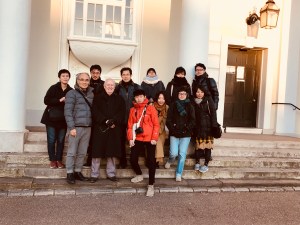
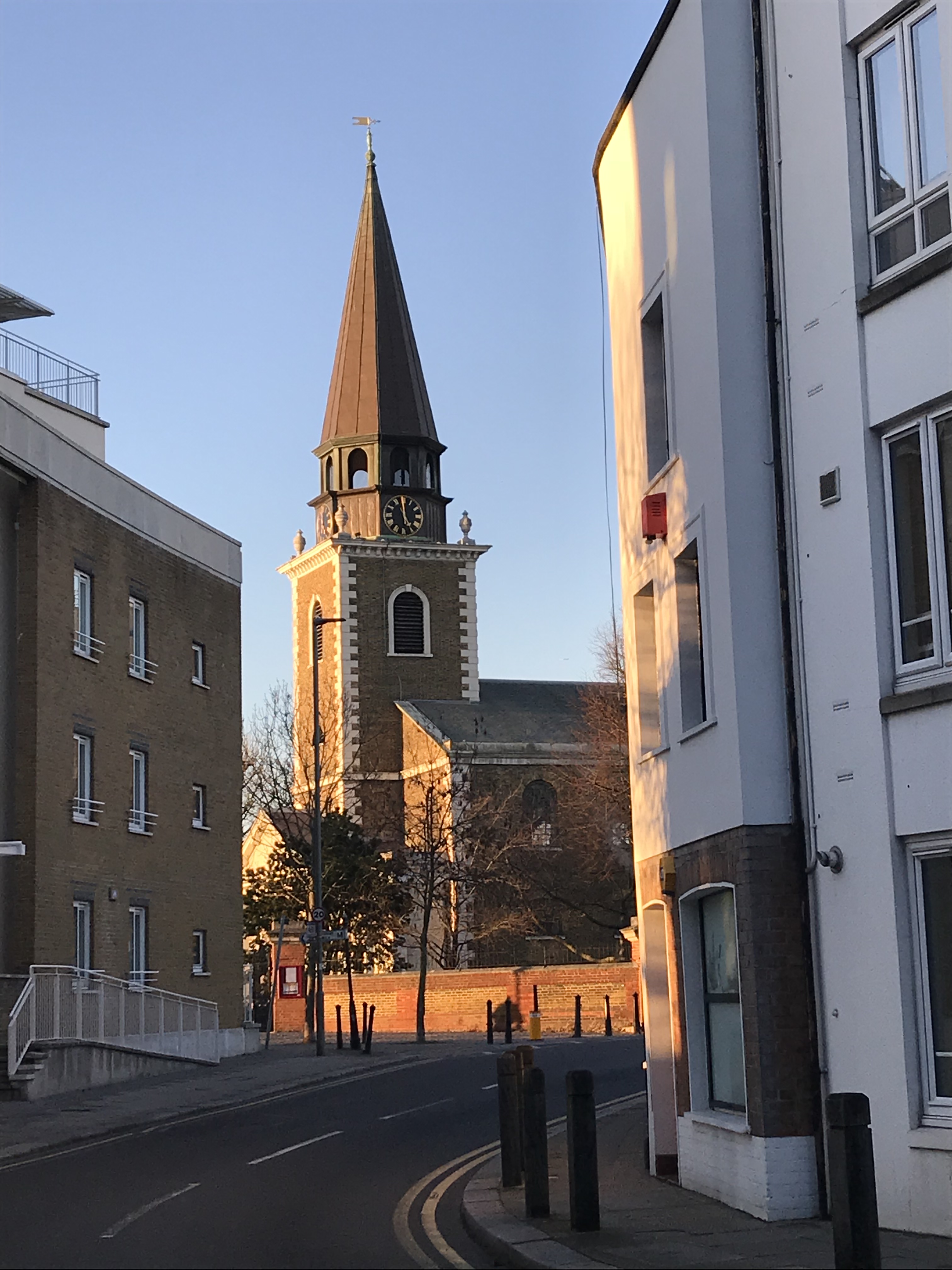
- On 25th February I led a history walk from the Latchmere pub, round the Latchmere estate to Battersea Square and along
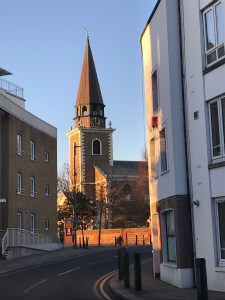 the riverfront to Battersea Park. It was for my partner’s group of Japanese students in an Anglo-Japanese exchange visit. Here is a frozen group of students on the steps of St. Mary’s and, what I consider to be, a simply beautiful and brilliant picture of the church in the setting sun, from the Square
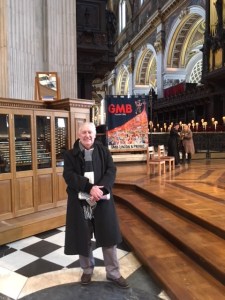
 - On the 27th, I went to a memorial service for Mary Turner (1938-2017). She was born in Tipperary, Ireland; came to Britain as a young woman; worked
 her way up from being a “dinner lady” to being President of the GMB and, in 2004, appointed Chair of the Labour Party. I had had only a very brief acquaintanceship with Mary at the Party Conference, but her warmth and enthusiasm, which is obvious from this picture, was utterly charming.
 - But let’s be honest, it was also a great opportunity to go to St. Paul’s and take in the grandeur of the surroundings, not as a tourist but as a participant in
 a service.
 - Finally, on the 28th I was crazy enough to go to Wembley to see my team, Spurs, beat Rochdale 6:1. Of itself that is hardly worth a mention but for two things: first the game was played in a snow-storm (and that was why it was crazy) and secondly it involved the highly contentious use of the VAR (video assisted referee) system. For what it’s worth my own view is that VAR is here to stay, that it has to get better and faster than it was on Wednesday, but, also that soccer will lose something as a result: VAR depends upon review and re-consideration, when soccer is about pace and non-stop action. Rugby is well suited to VAR, but soccer, I am afraid, is not. I was obviously pleased with the result and look forward to further victories in 2018!





My Programme for March
- The Conservation Area Advisory Committee meets on 6th March. The applications being considered are not of wide significance but it is interesting to note that they include three Victorian pubs, all under threat. They are the Prince of Wales in Battersea Bridge Road, the Queen Arms in St. Philip Street and the Bedford, on Bedford Hill.
- On 7th March there is the Council Tax setting Council Meeting. It will also be the last Council meeting before the May 3rd Borough Election and hence there is bound to be much boisterous and largely juvenile party sledging – but it won’t do any harm and “boyz will be boyz” as they say.On the 8th there will be a Wandsworth Business Forum at the Grand in Clapham Junction.
- On the 9th there will be Gordon Passmore’s funeral at St. Ann’s Church, St. Ann’s Hill. Gordon was a Tory councillor, largely for Putney ward from 1964-1971 and for Northcote ward from 1974-2006. Unlike many Tory councillors, he was not a hard-line Thatcherite but from an older more community-based tradition. I will be going.
- On 15th Harris Academy, previously Battersea Park School, are holding a “First Give” award for students, where they are competing to win a prize for the best presentations in support of favourite charities. The school has asked me to be one of the panel of judges – sounds fun.
- On that evening there is also the police’s Special Neighbourhood Team. I have missed this panel recently, because of clashing commitments, and so must make a big effort to be there.
- The Planning Applications Committee will meet on the 22nd.
Do you know?
Last month, I used this picture and asked:
- Where? When? How?
- How many things can you name that are still there and what are they?
- And can you name what is there now?
Many of you replied – correctly. It was after all fairly easy but the answers are:-
- St. Mary’s Church is at the bottom and Battersea Church Road runs from the bottom to about 2 o’clock. I am not sure of the date but judging by the kind of traffic that one can see I would guess it was taken between 1945-1960 from a helicopter.
- Well, the church obviously but also the houseboats on the river. And, of course, the roads. It is also possible that a couple of the old houses on Battersea Church Road might be there above Bolingbroke Walk.
- And now there is the Montevetro building, the Morgan’s Walk development and in the bottom right the Somerset estate.
And this month’s question:
Britain’s greatest engineer, Isambard Kingdom Brunel (1806 – 1859), who built the Rotherhithe Thames Tunnel, the Clifton Suspension Bridge, most of the Great Western railway and the first iron ship, has a little-known connection with Battersea. As it happens, the connection might just have appeared right at the top of this picture. Does anyone know what the connection might be?
WHAT’S HAPPENING TO COUNCIL TAX? DON’T SWITCH OFF – IT’S IMPORTANT!
The UK’s system of funding for local government* is in a mess – and getting rapidly messier. Let me explain why. Take the current budget forecasts for Wandsworth Council. They have become byzantine. One line in the forecast for the financial year 2018-19 2018 shows that the Council has been allocated a £12.9 million grant known as the New Homes Bonus Funding (NHBF). Extraordinarily, ten years ago no one would have known what this acronym meant. Yet now it is closely matched by an estimated income of £11.9 million from the equally bizarrely named Improved Better Care Fund (IBCF). Each of those separate sources of income is almost as large as the traditional Revenue Support Grant; and from next year onwards, they are forecast to be larger.
The New Homes Bonus Funding was intended to incentivise local authorities to build homes. In Wandsworth it has been so successful that the Council has the second highest level of NHBF grant in the UK, after Tower Hamlet’s massive £20.7M. By contrast, Wandsworth’s linked* Borough of Richmond receives £2.2M from this fund; and Wandsworth’s neighbours Merton and Lambeth £2.4M and £9.7M respectively, approximately a tenth and less than half of Wandsworth’s.
Is there any real rhyme or reason about this state of affairs, other than it being a reflection of the amount of available building land? And does anyone think that the current explosion of development in either Wandsworth or Tower Hamlets is sustainable in the longer term?
If the new system has incentivised anything, it has incentivised local authorities to give planning permissions for larger, higher and more dense developments. Developments that are notorious not as homes but as ghost towers, safety deposit boxes for funds often of dubious origins and designed to gain speculative profits for their usually foreign owners. Developments, moreover, that are unpopular with most of the local residents who live nearby; and which are not doing anything to resolve London’s urgent need for low-cost accommodation.
Meanwhile, the Tory Government continues to reduce the Revenue Support Grant (RSG) each year, as indeed it said it would. Its ultimate aim is to end central government financial support for local government. However, the policy has already run into predictable problems. For example, financially-strapped Councils are struggling to carry out their statutory duties with disastrous consequences for the provision of social care. To compensate, the government has had to introduce and now increase grants from a new Improved Better Care Fund (IBCF).
This is, of course, a misnomer since the fund provides neither an improved nor a better service than the care system as it had already operated under the Revenue Support Grant. It is, however, specific, tied funding from central government, targeting one specific service. That outcome is precisely what local government had repeatedly said that it did not want, because it implies much more, and more specific, centralised control. Ear-marked funding means that there is no scope for sensible local adjustments to changing patterns of need – and no scope for local decision making. That’s a sorry state of affairs that – in theory – the Tory government says that it too does not want.
As part of setting local Councils ‘free’, the Tories now offer Councils control of the local Business Rates, the property tax paid on all commercial and industrial businesses within a Council’s boundaries. Yet the funds raised from such a source are wildly unequal across Britain. It therefore leaves Council income disastrously at the mercy of the rise and fall of business activity, which is almost totally defined by geography and geology, i.e. how near to London, or to North Sea oilfields, or to major commercial hubs each particular authority happens to be.
So the Tory government has introduced a Business Rates ‘top up’ scheme. In Wandsworth’s case, in 2018/19 the top-up of £35.650M is very slightly more than Business Rates themselves at £35.594M. So, what does this manoeuvre mean? It is actually a rate equalisation grant, designed to balance what would have been the massive inequalities of a few Councils in the midst of property booms having money to spend, whilst most Councils elsewhere are desperately short of funds – in practice Councils are no more “free” of central allocation than they ever were.
At the same time as all these muddling interventions from central government, the real local tax, the Council Tax, becomes less and less significant. Both major parties are absolutely aware that, at less than 10% of the budget, its impact on Council finances today is minimal. Both parties also know that the legal scope for raising Council Tax is very close to zero. In Wandsworth, that state of play won’t stop the majority Tory party from running scare stories about Labour’s alleged profligacy and the risk of Council Tax rises. However, such accusations will be shadow boxing, while Councils everywhere lose money, lose any semblance of local autonomy, and carry the can for failing services, which are actually failing for lack of either proper or reliable funding.
The irony is, of course, that the historic system of Domestic Rates, levied on housing property values, which was the traditional way of raising money for local government, was beautifully designed to tackle a modern-day curse – under-occupation. That is, to raise reasonable (not outrageous) sums of money from people in very large properties who otherwise pay hardly anything in local rates. When under-occupation is detected in the state sector, it is brutally both controlled and penalised by forcing council tenants to pay the notorious Bedroom Tax. Introduced by the Tories in 2013, it was described as removing the ‘Spare Room Subsidy’ (i.e. ending the so-called subsidy from the state to tenants who had under-used rooms).
Yet, in the private sector, under-occupation is neither controlled nor penalised. The result is not just that half of the British population live in spacious luxury and vote for penalising the poor but also that Britons live in the country with the lowest taxes on private housing in the world, outside of mini-statelets like Monaco. Exactly, of course, the reason why in 1989-90 Thatcher abolished Domestic Rates in favour of the failed Community Charge (Poll Tax).
Remember that? Since then successive governments have struggled to find a reliable and fair basis for funding local government. This current Tory administration is lurching from expedient to expedient. The system is becoming ever more byzantine – and under-funded.
So, whilst the British people want and expect first-world standards and services, they have been simultaneously encouraged to expect third-world levels of taxation. The result is that Britain gets aircraft carriers without any aircraft; a health service once admired across the world but now financially on its knees; an education system collapsing under the weight of failing and corrupt out-sourced academies; a probation service run by unaccountable, monopolistic out-sourced companies who cannot even deliver basic security; a costly railway system heartily loathed by its customers; and a political system which holds out promises of services which it cannot deliver.
It’s a genuine tragedy that, amidst these massive challenges, local democracy is being threatened as never before. Local government finances, and therefore essentially local government itself, have been nationalised to within an inch of their life. But the resultant byzantine system simply doesn’t work. It doesn’t work for local Councils or for the central government – or for the voters.
Council finances need proper reform. The system needs to return to something like domestic rates – which need regular revaluing, to take account of changing property values – and a modest degree of rate equalisation between wealthy and poor regions. It’s not rocket science. It’s the lifeblood of local democracy.
∗ This the Text of a speech that was prepared for delivery at Wandsworth Borough Council Meeting on 7 February 2018 but not delivered.
∗ The administrative systems of Wandsworth and Richmond Borough Councils have been merged since 1 April 2017.
Three Billboards Outside Ebbing, Missouri
-
-
- I went to the Clapham Picture House to see Three Billboards Outside Ebbing, Missouri. It is billed as a “black comedy”, which I suppose is fair as there are many funny lines but it is so searingly black, so piercingly bitter, so tough that it is difficult for me to think of it as a comedy in any sense at all. The film uses the landscape of backwoods rural America to frame a story of brutality and violence presided over by a good ‘ol boy style of sheriff. It is coolly directed by an Englishman, Martin McDonagh, and brilliantly acted particularly by the lead, Frances McDormand.
- McDormand plays an embittered mother of a murder and rape victim out to reap vengeance upon the supine, corrupt, unaccountable police and, if she can find him, her daughter’s killer. It is painfully honest and depressing for the hopes of a liberal America BUT in the last reel she finds an ally in one of the cops and as several of the players start showing moral growth, we are left with a parting question mark. Is vengeance sufficient? Is it perhaps even worse than the original crime?
- I thought it was a brilliant film but there is another view. One which says that this is a metropolitan view of hill-billy country and that the moral growth is all too convenient and the apparent evil all too neatly framed for credibility. Go and see it and let me know your views.
-
 Tony Belton
 Tony Belton