Councillor Tony Belton’s North Battersea, September, 2016, Newsletter (# 88)
| 1. OK, so I know it’s still August but I am off tomorrow and won’t be back until well into September and so here is a very short September Newsletter.
2. I wasn’t really complaining last month, just commenting, that I had received a criticism of the July newsletter, but I would like to thank you for the many very positive responses I got in reply to that criticism. In fact, as a number of you remarked on the scale of Wandsworth Council’s operations, it has given me lots of ideas for my future “Did you know” sections! 3. So what did happen in August? Well, I started, as promised, on August 2nd by reviewing, with members of the Battersea Society, their suggested list of buildings of local historic and/or architectural significance. It was a magnificently eclectic list, ranging from stink pipes (built over Victorian sewers to allow the smell to escape – yes, there are a couple that I know of in Battersea) to Victorian post boxes, from splendid nineteenth-century houses to long sets of granite paving stones. We even decided to ask for the listing of four Winstanley murals – see “Did you know?” below. 4. I had my Council surgery  St. Mary’s RC school, Queenstown in Battersea Reference Library on Saturday, 6th August, and then on 10th August I visited the new St. Mary’s R. C. Primary School in Lockington Road. The site is called Battersea Exchange as a reference to the connection between Battersea Park and Queenstown Road railway stations. It is developing fast, and will contain several hundred flats, as well as the school which will open for some classes this September. It should be noted that a few years ago, the school would have been built by the Council, using taxpayer money, but this school is built as a by-product of private development. Is that a good thing? Saves us all money but possibly only at the cost of allowing bigger, more profitable developments? 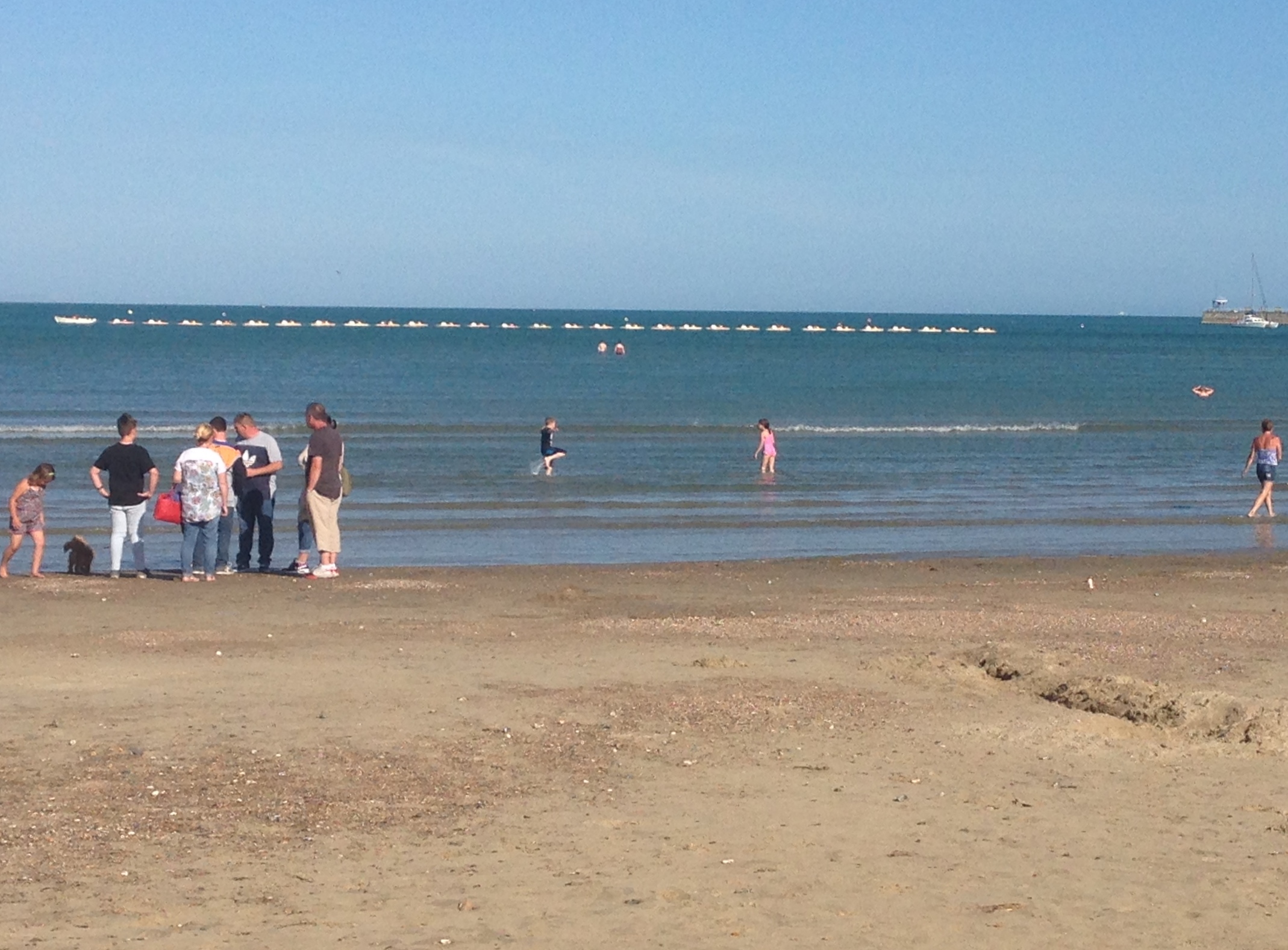 Pedalos on way home 5. On the 7th I, and my partner, decided to go to Weymouth for a day trip from Clapham Junction. It was a great day, very sunny and warm, and a reminder of just how good it is to have CJ on our door-step and, therefore, every south coast resort within a couple of hours from home.  Wandle, Charlie Reed, Turf Project 6. On the 12th I was persuaded to go to an exhibition on the River Wandle: A constant Amid Change Exhibition. It was organised by the Turf Centre, Croydon, which is a non-profit artist-run community project. Actually if you know as much about the River Wandle and its long industrial history as I do, then you would find it disappointing, but as East Croydon is only 10 minutes from CJ it was no great hardship. (The first Council I ever served on (1971-74) started the Wandle Walk alongside the river. It seemed a bit of a joke back then but now it really is a pedestrian and bicycle highway). It was a small exhibition of the paintings by local school teacher Charlie Reed and in themselves they were nice enough. This was my favourite. 7. I had the Planning Applications Committee on 15th. It really was a nothing event with only 7 really minor applications, but the hot news, that has a big impact on  Hope Street Sports Latchmere, is that the Hope Street Sports Centre has been saved for at least a couple more years. This happy reprieve is, perhaps, a completely unexpected result of the Brexit vote, because, instead of proceeding with a private development of luxury properties, just off Shuttleworth Road, the company concerned is selling its stake in the site to Wandsworth Council for council housing. The site will be used to re-house tenants and leaseholders from the Winstanley, during the regeneration. 8. I think that Simon Hogg, Wendy Speck and I can reasonably claim some credit for this outcome as ward councillors. We have kept constant pressure on the Wandsworth administration for a full one:one replacement of social housing being redeveloped on the estate and for the Hope Street Centre to be kept until an adequate replacement is provided as part of the Winstanley regeneration. This new site frees up space for the Council both to provide social housing and keep the Centre open. 9. Another piece of good news is that as well as starting night services on the Northern and Central lines of the underground as from 19th August, Transport for London (TFL) announced an improvement of evening and week-end services for the 344, a bus route, which many of you use. The improvement is an increase in regularity with it becoming a one in 10 minute as opposed to 12-minute service; sounds really small but it is an 18% increase! 10. On the 18th we had the by-election in Tooting ward. Labour’s candidate, Paul White, a close friend, won with a majority of 823, which represents a swing to Labour of over 8%. The turn-out of 20% was, of course, very low as it always was likely to be for an August by-election, but nevertheless it was a welcome victory. 11. On 19th August, we are going to stay with Mary Jay, Douglas Jay’s widow, in Oxfordshire. Most readers will not know either Douglas or Mary, but Douglas was Battersea’s M.P. from 1946-1973 and a member of Harold Wilson’s Cabinet, 1964-67. Douglas was a doughty politician – he campaigned against the inner London motorway box and won (the Box would have obliterated much of modern Battersea, creating a Spaghetti Junction centred on the Latchmere) and against Britain’s entry into what was then the Common Market (and lost). I wonder what he would have said about the Referendum result. I know he would have been very dismissive about the Referendum so-called “debate”. 12. And on Monday, 23rd, I am off for my three-week holiday to Florence and then the Croatian coast. My Programme for September 1. I am at the Planning Applications Committee on the 14th September. 2. And the Met Police’s Special Neighbourhood Team (SNT) meeting at the George Shearing centre on the15th, although I must admit that recently I have missed the SNT rather more than I would have liked. 3. I have the Wandsworth Conservation Area Committee on the 19th September. And on 20th, the Community Services Committee. 4. Then on Saturday 24th September I have the Labour Party Conference in Liverpool. I am not at all sure that I will be going to it, even though it can be great fun. This year though it will be much enlivened, for good or for ill, by the announcement of the result of our big Leadership Election between Jeremy Corbyn and Owen Smith. What price a peaceful week after that? Do you know? Last month I asked which 150th anniversary was being celebrated this year at the Este Road Fire Station. It was in fact the 150th anniversary of the Metropolitan Fire Service. And the Este Road building was said to be a “cut-price” miniature of the Victoria Embankment’s London Fire Brigade Headquarters. Do you see the resemblance?  Winstanley Estate I said in paragraph 3 above that we asked for the listing of four murals on the Winstanley estate. Here is one of them in Thomas Baines Road. Had you ever really stopped and looked at it? And can you tell me anything about them, such as the name of the sculptor? |
Why throw money at the Town Halls to resolve the financial crisis?
In my last blog I suggested that the Government should use local authorities to kick start the economy. There are many advantages to using local authorities rather than very large infrastructure schemes like HS2, Hinckley Point nuclear power station, Trident replacement or even the Olympic Games.
Many of these very large capital projects are politically contentious and sometimes very slow to have an impact. Most get bogged down in expensive public enquiries and a proportion probably won’t come off. What is more much of the early expenditure is spent on highly paid staff, such as lawyers, architects and designers and not construction and support staff. An equivalent £1billion spread amongst Britain’s 500 plus local authorities would, on the other hand, have an almost immediate impact.
£10 or £20 million given to my local authority, Wandsworth, could be used to buy every school pupil a laptop or to implement 10 or 20 small, local environmental improvements. I think we would have little problem in spending most of it within a couple of years, with an immediate small but significant local economic impact. Such a nation-wide scheme might, of course, include some silly, vanity projects and some failures but nothing as disastrous and costly as failed and useless mega-projects. What is more such a scheme could easily be targeted to, say, the local authorities in the poorest parts of the country, with the highest unemployment rates or the worst health statistics.
I see William Keegan in the Observer (7th August 2016) agrees with me about using local authorities to kick start the economy, though I must confess I am more one of his disciples than the other way round!
A similar suggestion comes from one of today’s great iconoclasts, Simon Jenkins. He suggests that the simplest solution would be to throw money directly at people. His suggestion reminds me of Alistair Darling’s scrappage scheme, which gave people £2,000 to car owners to scrap their old car and buy a new one. But Jenkins’ idea is more open-ended, in that people could spend on clothing, food or, and here’s the rub, foreign holidays – I have nothing against foreign countries, of course, but, if one is trying to kick start the UK economy then giving it all to Benidorm seems rather pointless.
The problem with Jenkins’ idea is, it seems to me, that it is not targeted to those most in need and there would, I think, be considerable difficulty in targeting, say, the lower paid or the unemployed. It is an interesting idea and gets round Jenkins’ perennial scepticism about bureaucracy. But the time of local democracy has come (again). Think of Joseph Chamberlain in Birmingham in the 1880s or John Burns in Battersea in the 1900s, think of Attlee and McMillan boosting council house building in the 1940s and 1950s.
Boosting the local economy means boosting local democracy and society. Forget quantitative easing, which goes to the banks; forget big vanity projects, over-budget, over-time; think local – NOW.
Austerity in the Town Halls; Recession out there for working people
Today the Bank of England took crisis action by lowering interest rates to 0.25% and throwing money at the business heights of the economy. Will it work? Cutting rates to 0.5% seven years ago didn’t. Nothing, Osborne did, really changed the equation.
What would work immediately, however, would be to take the heat off public expenditure. What do I mean?
Well right now Wandsworth and Richmond-upon-Thames are cutting service levels and reducing the number of jobs right here in south west London under pressure from this Government’s cuts in local government grants; 400 jobs to be precise. And all because the Tory party has an ideological commitment to reducing the size of the state – whatever that means.
The same thing, and worse, is happening in every local authority across the country. Similar cuts are happening in many more public sector organisations.
Meanwhile what do the councillors do? Well, all of us were under great pressure to vote for the jobs cuts. The majority (Tory) party councillors voted for the cuts because they cannot face opposing “their” government and the minority (Labour) councillors are not in a position to defy the government and are “scared” of being accused of voting for an increased Council Tax.
I’ve been around long enough to remember when the Ted Heath Government (1970-74), the Thatcher Government (about 1982-86) and the first Tony Blair Government (1997-2002) faced similar economic crises. What did they do? They threw money at local government with orders to spend, spend, spend in an attempt to kick-start the economy.
The public sector turned out to be far more effective than throwing money at the banks; that was tried in 2009 and it didn’t work.
Just when will Teresa May take the same kind of actions and just how silly will the cuts of 2010-16 look when that happens?
Councillor Tony Belton’s Latchmere August, 2016, Newsletter (# 87)
|




 Tony Belton
 Tony Belton