Puccini’s La Bohème
I saw Puccini’s La Bohème at the London Coliseum, on 23rd October. This romantic tragedy of Bohemian Paris is well known and the music is, of course, ravishing. It was, also, beautifully and precisely conducted by Xian Zhang.
The production, however, drew a pretty miserable picture of La Belle Époque Paris. The programme notes quote a contemporary as saying, “Bohemia is a sad country. It is bordered on the North by need. On the south by misery. On the east by illusion. And on the west by the infirmary”. You could believe it watching this.
I suppose that makes it a great production. It certainly convinced me that late nineteenth century Paris was not my dream “Back to the Future” destination. The rich clientele at Café Momus are not appealing and the poor students seemed to me to be a little pathetic rather than tragically romantic.
So why am I even bothering to write this up? One simple reason – the performance of Corinne Winters as Mimi. The English National Opera artists are of course brilliant but the young American, from Frederick, Maryland, outshone everyone. Her power, her range, her musicality out-classed everyone.
Watch out for Corinne Winters, surely a super-star of the future.
Suffragette
Went to see Suffragette (dir. Sarah Gavron, 2015) at the Brixton Ritzy on Friday, 6th November; not sure exactly what my expectations were but I was hugely impressed by this factional (fiction based on fact) story about woman’s struggle for the vote in the years immediately prior to the First World War. From the off (1912), the street scenes in Bethnal Green and in Westminster were very convincing and the pace of the action suggested a director in total control of her material.
Not too sure, as memory tricks me, but I think that I was taught at school that the suffragette movement had indeed succeeded in raising the profile of women’s suffrage as an important political issue but it was really the War that brought them the suffrage in 1918. With women working in the munitions factories, in nursing and catering, in the transport and many other industries, it had become almost irrational not to grant them the vote. It was, I think, a history written from a male, patronising perspective. Men had at last decided to be fair and decent.
This film is an excellent counter to that complacent perspective. It tells of bitter, intimate (husband v wife) and local (neighbour v neighbour), conflict. Surely victory was as much delayed by War, as speeded on by it. The story is told with a light touch. A young mother, Maud Watt, played exquisitely by Carey Mulligan, drifts almost accidentally into being a curious spectator. Then the dynamics of her situation, the attentions of her sleazy supervisor, the peer pressures of her workmates and her neighbours’ push-and-pull her slowly but inevitably into activism – and the loss of her marriage and her son.
The story cleverly weaves Maud into the events that led to Emily Davison’s death under the hooves of Anmer, King George V’s horse in the 1913 Derby. The screenplay by Abi Morgan is sensitive throughout and the whole film has a superb historical feel, even if there are some arguments about the political detail – it is doubtful that Emily Davison intended to die and also unlikely that a Cabinet member’s wife would have behaved as displayed.
There was a personal appeal for me, because it reminded me so much of stories from my paternal grandmother. She was a seamstress from inner north-east London, who walked to work in Oxford Street. She had four children, was widowed in 1918, and was proud of her vote in the 1919 General Election. Her loathing of Winston Churchill, Home Secretary in the Asquith Government; her politics (and just maybe mine) is illuminated by this film.
It is almost redundant to talk of other great performances, notably that by Helen Bonham-Carter’s and a guest appearance by Meryl Streep as Mrs. Pankhurst; or of the gruesome nature of forced feeding. The film also has a lot to say about the nature of opposition. When does “illegal” action become justifiable? Is violence ever justified? How responsible does opposition have to be? Go and see it, if you haven’t done so already.
Councillor Tony Belton’s Latchmere November Newsletter (# 78)
October highlights
- October began and ended with the Rugby World Cup or RWC
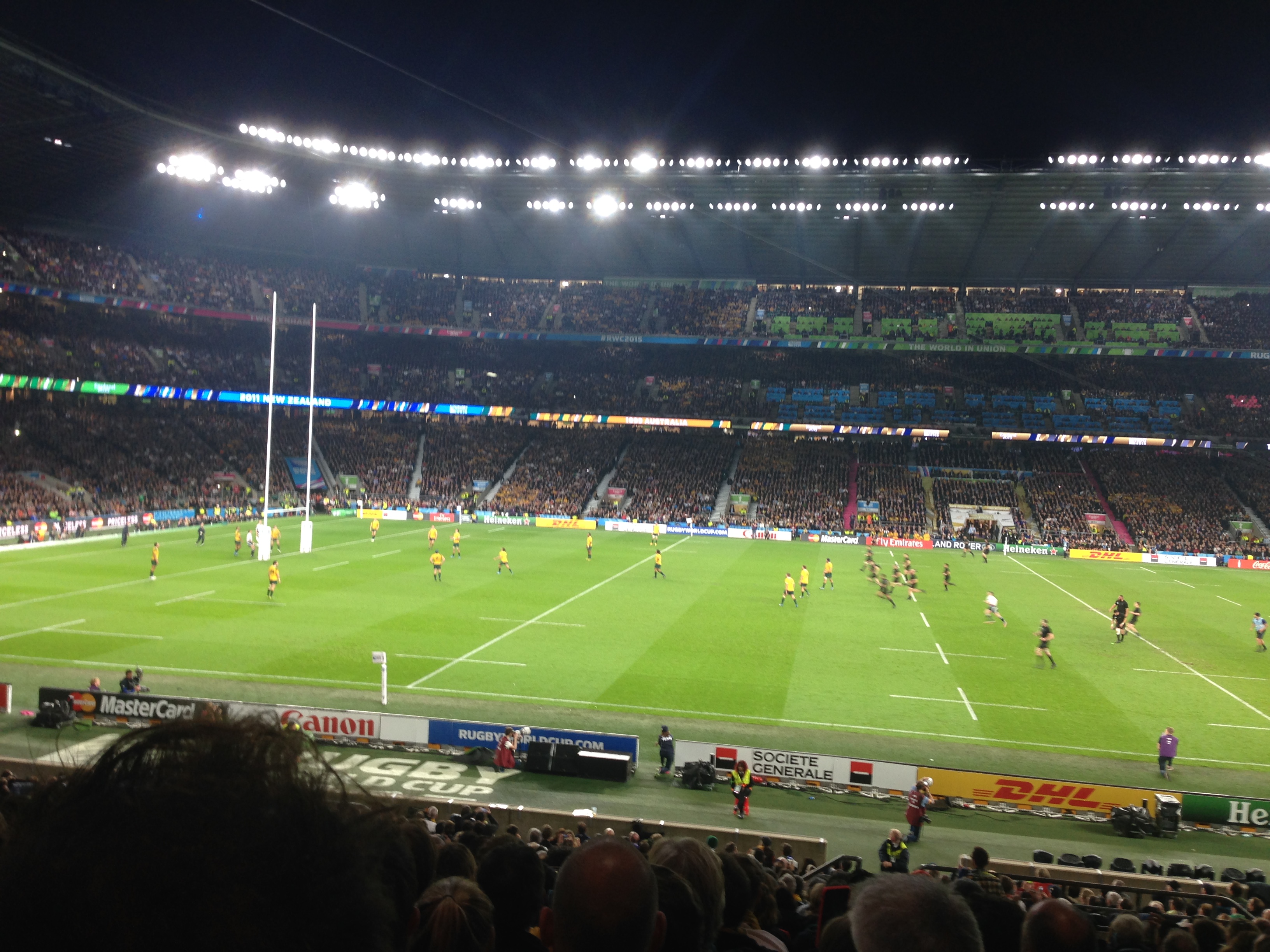
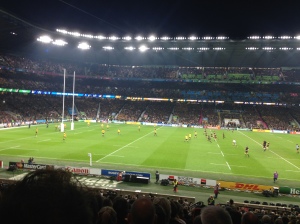 as it liked to call itself. I decided, last minute, that I had to take in the experience so looked up the web to get a guide to lower cost, accessible tickets and it came up with Argentina vs Tonga on October 4th at Leicester City’s new ground. It was a beautiful autumn day, both sets of fans were great fun (but especially the Argentinians) and the teams gave us an exciting high scoring game, with the Argentinians coming out on top 45-16. It wasn’t really as one-sided as that score suggests until halfway through the second half. But then on 29th October I got a call from ex-Battersea MP Alf Dubs, asking if I wanted to go to the Final at Twickenham, with him. He had two complimentary tickets! New Zealand beat Australia 34:17 in a brilliant game. The second half was very dramatic and NZ were definitely worthy winners. But one has to say that the Ozzies put on a grandstand second half. In the picture, New Zealand’s fly-half, Dan Carter, is in the process of kicking a penalty goal – spot the ball! It’s there on its way!
 - On October 6th, I attended what I thought was going to be the Covent Garden Market Authority’s AGM. But to be honest, it was a bit of a jolly and not very instructive about the CGMA plans. However, it was my first visit to a completed part of the large, new Riverside development and it introduced me to a rarity – a new Battersea pub, the Nine Elms Tavern, which is on the riverfront. It will be interesting to see whether these massive developments evolve into real communities or not – I fear they won’t, because to me they are not very people-friendly!
- The following day, I was at the very different Katherine Low Settlement (KLS) AGM. KLS is one of the most significant community centres in Battersea, with a wide range of community services such as English lessons for non-English speakers, housing and debt advice, campaigning against FGM(female genital mutilation) and other courses and advice sessions. There must have been well over 100 people there and it was just a little bit of a party. It was a busy, lively evening.
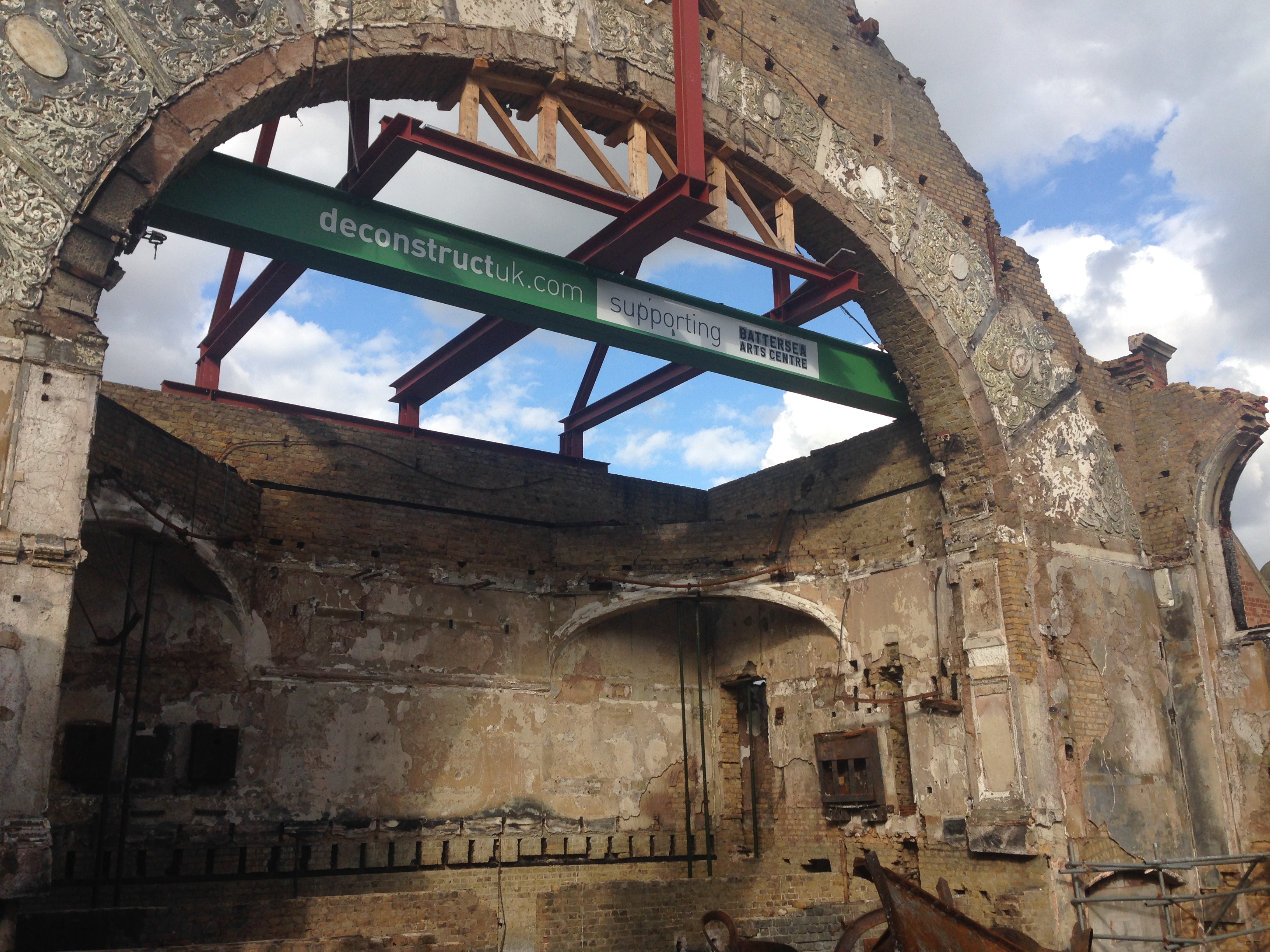
- On the 8th October I joined many other interested locals touring the burnt
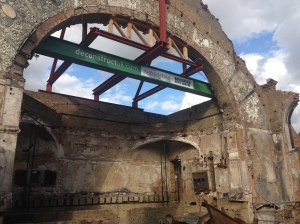 out Battersea Town Hall (the Arts Centre, BAC). The main structure of the Town Hall stands, as you can see in this photograph, but much else needs to be rebuilt and replaced. Fortunately the great late nineteenth century organ was at the “repairers” when the fire hit and so that was largely untouched and simply awaits a new home. The plans for the re-building looked good: they are not a simple re-build of the old hall, nor are they simply a plagiarism of the past, but a modern space suitable for its future as an entertainment hall, a modern theatre.
 - The following week-end of 10th/11th October I went on a trip to the First World War battlefields at Ypres in Belgium, along with many other councillors. As I said last month, councillors paid for the trip out of their own pockets – there was absolutely no public money spent on the trip. On the Saturday we visited several large cemeteries within two or three miles of Ypres city centre, and
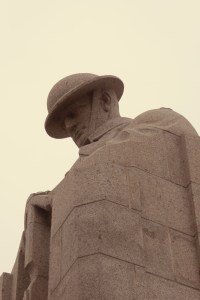 very emotional it was too. The picture is of the statue of The Brooding Soldier, at the St. Julien Canadian cemetery. The trees have been trained into the shape of exploding shells and the shrubbery is designed to simulate the appearance of poisonous gas floating through the battlefield – the local battle at St. Julien was the first use of poison gas.
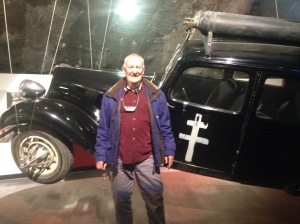
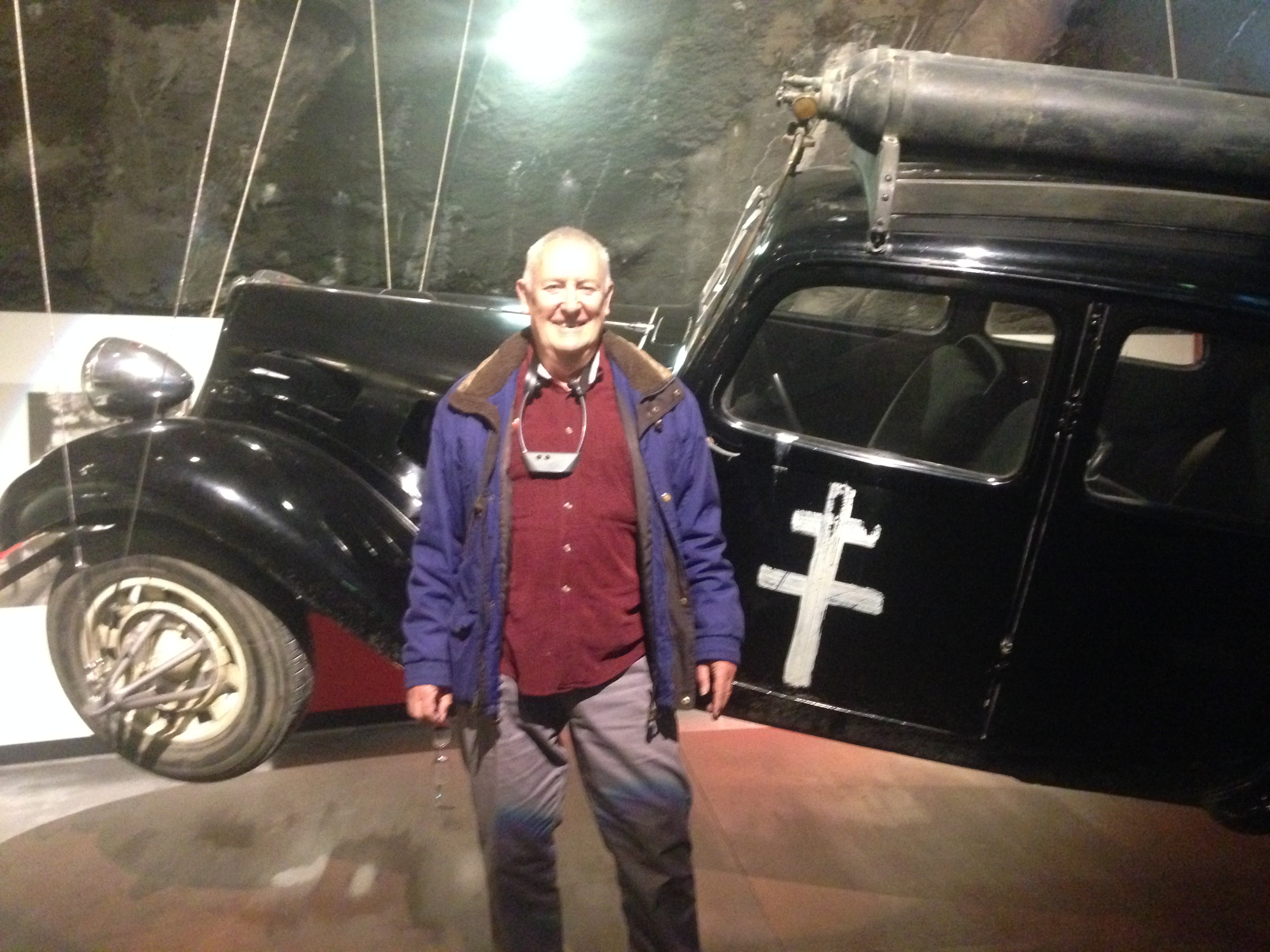
 - On the Sunday, we went to Waterloo and toured the site of Wellington’s great victory over Napoleon. On the Monday, we toured a V2 rocket site, not far from Calais, which has been converted to a museum about war. This really bad picture of me is only here because of the car – a vintage French car (Citroen Light 15) much used by the French resistance. I owned one a few years ago here in Battersea but mine was bright, pillar box red!
- I also went to the Menin Gate on each of the three evenings we were in Ypres. It is a town gate, a bit like Marble Arch, with the names of the many thousands of British (and Empire, as was), soldiers, who lost their lives in the Ypres salient and whose bodies were never found. It is the site of an absolutely remarkable ritual. On July 2nd, 1928, at 8 pm the townsfolk conducted a simple, short memorial service to honour the dead of the First World War. It became a ritual, which has taken place every evening at 8, come rain or shine, since then – apart from the period of German occupation in World War II. On the three days I was there, there must have been about 1,000 people present on every night. They are of all ages and come from all over the world. If you are anywhere near Ypres, I recommend it. It is impossible not to be moved by the Last Post, played every evening by a bugler from the town’s fire brigade.
- The Council Meeting on 14th October highlighted two major debates. One was a rather complacent, self-congratulatory motion from the Tory councillors, noting how good they are. The other was about the plight of the refugees trying to get into Europe – debating society stuff, I know, but this second one was a serious discussion about a serious subject.
- The Planning Applications Committee of 15th October had the
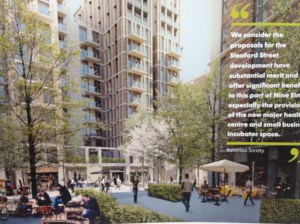 usual selection of applications right across the Borough but none of them had any great relevance to Latchmere. One large Battersea application was perhaps of interest to all. It was about the area round the entrance to Covent Garden Market and was for mixed retail and 374 residential units in blocks up to 18 storeys high. 310 of the units are “affordable” but we all know what that means – less expensive than the market price but far too expensive for most of us!
 - On the 18th October, I led 18 people on one of my Battersea History walks. It was as enjoyable as ever and a couple of people came along, thanks to reading about it in my newsletter. So if you are interested drop me an email and I will include you on my next trip.
- I attended a seminar on homelessness in Wandsworth on October 19th. Depressingly, the Borough “still” has 1100/1200 families in temporary accommodation. It is forecast to rise to 1300 by the end of the year. The explosion of construction in north Battersea, surely as great as anywhere in the country, is doing nothing for the housing crisis in the Borough. Simply building more will not get us anywhere if we do not tackle issues of distribution and control – we need more social housing for families on low income, not expensive housing for those who simply want them to add to their portfolios.
- Went to see La Bohème at the Coliseum on 23rd November. What can one say? Fantastic music, tragic story of impoverished youth in a raffish but slightly unpleasant Paris of La Belle Époque, but the most interesting thing, maybe, was that the players were young, unknown British singers (there were a couple of young Russians as well) led by Corinne Winters. You know how opera stars are often depicted as very large, even fat, ladies with heaving bosoms. Well Corinne Winters is a diminutive, slight figure on stage, but with the most powerful, soaring voice. Watch out for her!


My Programme for November
- On November 1st, I spoke at a meeting at York Gardens Library about the Borough’s plans for the Lombard Road/York Road area, of which more next month.
- I am, would you believe, attending a seminar on trees on 3rd November! How many there are in the Borough, about pruning and caring for them (I guess), their diseases and their importance, Tree Protection Orders (TPOs) – Yes they do exist.
- On 4th I have an Education Standards Committee, when we will be reviewing Somerset Nursery and Garratt Park schools.
- On the 5th we have the Civic Awards Ceremony when councillors recognise the contributions of half a dozen local people who have contributed to the life of the Borough.
- And on the Saturday I am doing the Councillors’ surgery at Battersea General Library.
- On the 10th, I have the Planning Applications Committee and on the 19th the Education Committee.
- On the 11th there will be the annual Remembrance Day service in Battersea Park at the war memorial.
- On the 21st the London Councils annual conference takes at the Guildhall. This is a London-wide gathering of councillors, which starts off as a showcase for the Mayor – a half-hour show from Boris – followed by more serious discussions of the issues facing London, from housing to transport, from education to planning.
- In the last week of the month, I am due to be visiting Graveney School and St. Anselm’s and finally on 28th I have the annual meeting of SERA, a green lobby in the Labour Party of which I am the Treasurer. It looks like a busy month!
Did you know?
Lots of you were correct in replying that Clapham Rovers won the FA Cup in 1880. Rovers, Jarvis Kenrick, actually scored the first ever FA Cup goal in a 3–0 victory over Upton Park on 11 November 1871, but the club’s greatest achievement was winning the Cup outright in 1880 with a 1–0 win over Oxford University at the Kennington Oval.
On 22nd October, I went to the Battersea Society’s lecture on London’s lost rivers –all those rivers that flowed through to the Thames and which are largely culverted and hidden from view. One, of course, flows through Latchmere and has a road, a school, a couple of estates and a pub named after it. You all, of course, know the name of the river. What is it? Where is its source? Where does it flow through Battersea and where does it debouch into the Thames?
 Tony Belton
 Tony Belton