Warfare or Co-operation
The Relationship of elected councillors and salaried local government officers.
Who are Council officers? Are their interests different from those of councillors’? Do the officers work to the same objectives? Are they motivated by the interests of the electorate as interpreted by the majority party or by rules coming from Whitehall and the law courts? What do they think of elected councillors?
The first thing to note is that officers are not simply local equivalents of the national Civil Service. The Civil Service exists principally to carry out the wishes of the crown, as was, and the elected Government, as is. So historically the civil service administers the Crown’s Government and cares little, at least in theory, for MPs, who from their perspective are merely the electoral body from which the Prime Minister and his colleagues are chosen.
Local government officers, on the other hand, are appointed by their respective Councils, at least in principle, to provide ALL elected members equally with advice. Hence the most junior councillor, even if in a minority of one, and, say, the Leader of the Council have equal rights to get advice, whether on procedural or personal matters, and assistance with constituency issues and casework. In that sense, the junior councillor has access to the highest level of senior officer advice available, in a way that MPs can only dream of from Civil Service Departments. In my experience, new councillors often fail to recognise this opportunity and seldom take advantage of the resources that are there for them.
Local Government officers, however, also serve the elected majority administration of whatever political persuasion. Hence whilst advising councillors as to how they might frame any criticism of the majority party policies, the officers must be careful not to over-step the mark into advising against the administration’s policies.
This is a delicate balance to maintain on a tight-rope and is perhaps why councillors often seem to have more difficulty accepting the political neutrality of their officers than do national politicians of the Civil Service. In my own case, as a councillor on a strongly Tory Council, namely Wandsworth, I have encountered several different but in some ways jaundiced views about the officers.
Some opposition (and here I speak of Tory opposition councillors in the 70s as much as of Labour ones later on) councillors have now, and always have had, an instinctive suspicion that the officers carry out the administration’s policies, not just because that is their job, but because they really are Conservative or Labour supporters.
I could give many examples and no doubt that is why there appears to be more of a tendency to cull senior officers after a change in power at a local rather than a national level.
Other councillors simply think that the officers just happen to be doing their job as best they can. Perhaps because of my background as a local government officer, who wanted to be a “public servant”, I instinctively lean to the view that officers want to perform a public service well. Hence, in the broadest sense, I expect officers to want a healthy and well-funded public service and, therefore, to be inherently more inclined to Labour rather than Tory attitudes, or at least those Tory attitudes that want to limit or even abolish local government services. But clearly this is no more the case than believing that all teachers are Labour voters. Maybe they should be but they most clearly are not – the same is true of local government officers.
But if local government officers are more variegated than elected members often assume, they do have one thing in common and that is their background in local government. Hence they are coloured by the extremely rule-based, legally-encompassed nature of their jobs. Ironically, the attitudes and approaches this training engenders often infuriates councillors, Labour and Tory, who are frustrated by the officers’ very (small c) conservative approach. So that many councillors often end up thinking they have more in common with the “hated” enemy across the Chamber than they do with the officers.
Again, this viewpoint may be dramatically shaped by my experience in Wandsworth where leading lights in both major parties have been very radical in their outlook, whether over their opposition to the Motorway Box, or their pursuit of GLC abolition, or their enthusiasm for an expansionist Council, 1964-90, or a contracting one, 1990-2015. But, whichever the political party, the cries of frustration were often aimed at the cautionary approach of the officers, and not the robust opposition of the opposition councillors, who were merely and quite appropriately doing the job of opposing. Labour and Tory councillors can sometimes behave rather like rival football teams, who are only stopped from having a really good argument by the man with the whistle, the referee or officer, who says, “You can’t do that – we don’t have the powers”.
This state of things results in some misunderstandings, which are reflected in some surprising ways. For officers, whose job it is to carry out the majority party policies and deliver the best possible service within that constraint, the tactics of the opposition can look most confusing. After all, if opposition councillors genuinely believe the services would be better if run by them than by the current majority party, then it becomes relatively easy to justify almost any form of legal wrecking tactics, with the only constraint being what the electorate might think.
From officers, unable to imagine themselves in the opposition’s role, such opposition looks stupid at best and unprincipled at worst. But on the other hand opposition councillors need some room for manoeuvre and may even manufacture opposition rather than run the risk of becoming irrelevant lobby fodder. Any officer, who whilst supporting the administration’s policies, points subtly to the weaknesses in the policies without actually leading the opposition by the hand, deserves the support and praise of both the opposition and, actually, the majority party, which needs a vibrant opposition to keep it on its toes.
Is there any conclusion to draw from this meditation? Well I think there is. Forgetting the time-servers of whom there are enough amongst officers, majority and minority party councillors, I think its best always to recognise a complex mix of motivations is at the heart of any argument.
So we’re not talking about open warfare between councillors and officers, nor complete co-operation either. It’s a complex but endlessly fascinating process of opposition, co-operation and something else between.
Councillor Tony Belton’s Latchmere June Newsletter (# 73)
May highlights
- To state the obvious, the May 7th General Election was a great disappointment for me and the Labour Party. I know that Will Martindale would have made an assiduous MP but that was not to be. Clearly the electorate was not convinced by the thought of Ed Miliband as Prime Minister – he obviously had a bad press, though possibly demonstrated in the TV debates that he didn’t really deserve it. Again, the electorate also clearly believes the Tory story about the blame for our current economic difficulties. I think that story is nonsense (clearly Labour didn’t cause the US sub-prime markets to crash), but one can’t deny that the Tories won the publicity argument.
- Although I wish things were different, I have to admit that Jane Ellison is an effective MP – so congratulations, Jane. In the longer term Labour appears to have a tough task winning back the Battersea constituency. On a national level, it does rather concern me that so few eligible voters voted for a Tory Government and yet the Tories have a strong hand in Parliament. It can’t be right that only 25% of the electorate voted Tory, but they have more than half our MPs.
- The first past the post system has worked very, very well for the Tory party and, ironically, for the SNP. Both the Greens and UKIP had over 1 million and 3 million votes, respectively, and yet have only one MP each. It is a good system for the Tories but is it doing British democracy any favours? I rather think not. My worst fear is that, with Scotland and Wales going as they are and the south east outside of London going the way it is, with Labour strengthening its position in London, even if not in Battersea, that we are becoming a very divided nation, indeed.
- One of the delights of campaigning is discovering little
 gems, such as this inscription at the corner of Broughton and St. Philip Streets, which reads, “For what shall it profit a man if he shall gain the world and lose his own soul” Gospel according to St. Mark. I must have passed it a thousand times but never noticed it before! Have you noticed it? It is at the corner, just as one turns left coming down Silverthorne Road towards Queenstown Road.
 - The Annual Council Meeting took place on 13th May. That is the occasion when the new Mayor is elected. This time it was Queenstown ward’s Nicola Nardelli. It is an occasion when the Mayor has as much time as she wishes to take saying whatever she wants to and is, of course, unchallenged. My word what a biased account she gave of the changes in Battersea over the last 40 years. She appeared to have no knowledge of, or at least little sympathy with, that very different Battersea, the Battersea of heavy industry, the Battersea which I talked about in the history walk that I led on 24th May – see picture of the people who came on it with me. If anyone is interested on coming on my next walk, just let me know and I’ll add you to my list.
- The Planning Applications Committee met on the 21st May. The two biggest applications were again in Battersea and were both approved. The first was what I think of as a pile of plates awaiting washing up, except that it is for a 28 storey block, which given the size of the first floor is more like 30. It would, not long ago, have been the highest building in Battersea (apart from Battersea Power Station and the giant gasometer next to Battersea Park station), higher even than Sporle Court. But now higher blocks are going up in Nine Elms and Wandsworth Town Centre, all within the Battersea constituency. I opposed this particular application on the grounds it included so little affordable housing. (Affordable housing is a strange description of property designed for people on earnings of £70,000 a year).
- The second was a giant development just where the large gasometer was a couple of months back. It included 839 residential units, including affordable housing; approximately 5,700sqm of flexible commercial floorspace including retail, financial and professional services, cafe/restaurant, offices, education, community and leisure uses within buildings ranging from 2 to 26 storeys high; together with landscaped private amenity space and public realm, including publicly accessible routes through the site; an energy centre; basement car parking; basement and ground level cycle parking; refuse storage and servicing and provision for vehicular access. You might be surprised that I supported this application, but actually, if there is anywhere in Battersea that can support 26 storey buildings, then this site, between the railway lines and flush up against the Power Station, is it.
- By the way, if you want to see how the gasometer was demolished go on to BBC’s iPlayer and look up a BBC2 programme called the Wrecking Crew. It’s really good TV about a very local subject and can be seen at http://www.bbc.co.uk/iplayer/episode/b05x1f6c/demolition-the-wrecking-crew-episode-2. It’s only there until about 20 June, so don’t put off watching it!
- Here is the gasometer in all its glory – and the pile of washing up!
- Last month I asked you to forgive my cynicism, as I suspected that Tory councillors did not want to agree contentious applications shortly before the General Election. My cynicism promises to be put to the test in the next couple of months with more very large applications coming forward on 2 sites within yards of each other on York Road. These plans already have a mass of negative reaction from local residents but I don’t expect that to cut much ice. Nevertheless, if you object, please put in an objection – local voices can and do make a difference.
- On Saturday, 30th May, I was interviewed for Wandsworth Radio’s Sunday morning show. As it happens the show had a technical glitch and I believe that the 15 minute interview will be heard on 7th June. If you want to hear this internet programme then all you need to do is go to http://www.wandsworthradio.com/. Indeed let me recommend that you pay the station a visit anyway and see what it is like.

My Programme for June
- On 11th June I have the Education and Children’s Services Committee and on the 18th the Planning Applications Committee.
- On June 18th from 10am – 4pm, Big Local SW11 will be hosting a jobs, training & opportunity day to signpost local provision at Providence House. The aim is to encourage people to come along and explore current job opportunities, meet industry & training professionals, get 1:1 advice, try new skills and enjoy workshops and training sessions. Workshops available on the day will cover ICT in the workplace, interview skills, CV building, confidence building, recruitment best practice as well as more practical skills-based tasters. Big Local SW11, you will recall, is a resident-led group that has been awarded £1 million from the Big Lottery fund to spend in the SW11 area over the next 10 years. The website is http://www.biglocalsw11.co.uk/. Along with Big Local SW11 helping us to make it a great day are South Thames College, Wandsworth Workmatch, Providence House, Wandsworth Lifelong Learning, WOW Mums enterprise club, STORM, Generate, Well-kneaded, SPEAR, Generate and others. Please, do come and join us. Big Local SW11 is also looking for mentors so to sign up for workshops please visit www.biglocalsw11.org.uk.
- This week-end I am off to Dorset for a couple of days with the grandchildren, aged 1 and 2 (with their parents to do the nappies, etc.). Penny and I are looking forward to that.
- I have written a couple of times about the plans for the all-weather astro-turf pitch in Falcon Park. There has been a lot of public disquiet about this possibility, so much indeed that the Town Hall planners have taken the plans back for re-consideration. I doubt whether the idea is dead and buried but public consultation has at least forced a re-consideration. I have been assured now that there will be no planning application before September. Watch this space for further updates.
Did you know?
 Only two of you replied to my question last month about the tower block named after Douglas Jay, M.P., and I am afraid that Peter’s answer was wrong. It was not Park Court on the Doddington estate, as my respondent suggested, but rather Park South, sitting on Battersea Park Road – well done, Kathleen. Here it is and here also is a famous incident from 1829, which took place in Battersea Park,
 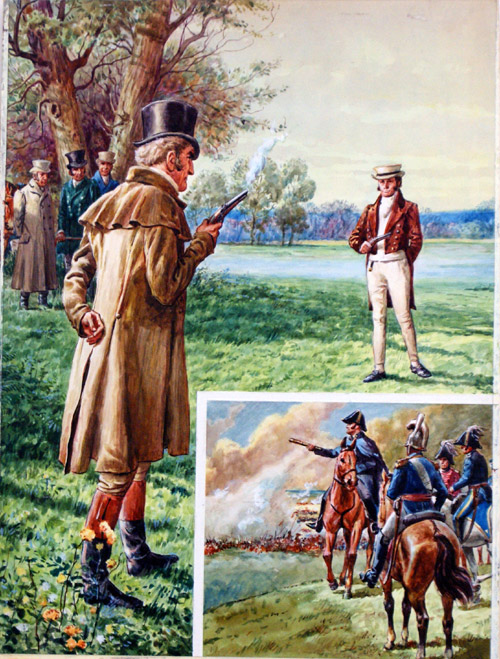 or rather what used to be called Battersea Fields, before it became the park. It is a duel between a serving British Prime Minister and a political rival. It features in my history walk. Can anyone tell me who the Prime Minister and his opponent were and what were they fighting about? (The clue is in the inset picture).
 Tony Belton
 Tony Belton