Schools, community and local authorities
I attended Wandsworth’s Education & Standards Group (ESG) last Wednesday (22/10/14). It is an attempt by the Tory Council to maintain some kind of role in our fractured education system. Given the competent, conscientious set of Tory members on the Group, the review seems to be working but I am sure it is an illusion! It is all based on the “magician’s smoke and mirrors”.
Until 1997, the British (actually English and Welsh) education system was a largely coherent, local government controlled system. The Blair Government decided to add to this mix “independent” academies and faith schools, where independent meant funded by national government but run by largely autonomous organisations. But then in 2010 the truly Jacobin Michael Gove became the Secretary of State and he set about introducing academies, faith and free schools as quickly as possible. He made it impossible for local authorities to build new schools, even in areas of fast population growth like London and he forced any school with a poor inspection report out of the state system. This haste was a naked attempt to destroy the traditional structure by the time of the coming 2015 General Election.
But I happen to believe that Wandsworth Tories see the dangers of this policy and are using the ESG (and its similar Free Schools and Academies Commission) to try and mitigate the worst effects of Govian chaos. The Group’s main function is interviewing the Heads and Chairs of Governors, usually of two schools in an evening, in a four yearly cycle. The purpose is to assess the school’s performance and to help schools to improve or to maintain it. The role is, however, largely advisory, since Ofsted clearly makes the inspections and the assessments that really count.
This lack of a formal role may not matter too much with schools operating well, where a few words of encouragement and appreciation from the local authority are all that is required. But what if the school has difficulties? One school we saw last week, according to Ofsted, “requires improvement” and “is not good because”, amongst other things, “teaching across the school requires improvement”. To be fair that assessment was made in 2012 and, since then the school has a new governing board and has been taken over by the Chapel Street Schools – a new group of academies. Nonetheless Wandsworth’s own education officer, and indeed the councillors, were clearly not convinced that the performance is improving sufficiently rapidly to be of much help to the current cohort of school kids.
Chapel Street Schools Trust, according to its website, is linked to the Salvation Army. There are eight such schools although two of them are not due to become Chapel Street Schools until 2015 or 2016 and two others, including the Wandsworth school, have only become Chapel Street schools this year, having been forced out of the local authority structure by the Government. The Trust did not even exist in January, 2012.
Do Chapel Street Schools have any experience in getting a school, required to improve, in fact to improve? Do their seven staff (again apparently and according to their website) have any relevant experience? Well one or two of them have been teachers but that’s about it. As the discussion about the school’s progress developed, I couldn’t help but wonder what the Council’s education officer and his inspector colleague thought of the matter. They after all are only responsible for running 85 schools most of which now achieve Ofsted ratings of “outstanding” or “good”!
What can we do about our concerns? Can we help the school through its difficult patch? Can we help with skilled resources? Apparently not as it is no longer a local authority school. We can, however, ask to go and visit the appropriate Regional Schools Commissioner and tell him our concerns.
Who you might well ask is s/he? Well in Wandsworth’s case it is the South London and South East Commissioner to whom we should turn. He is one Dominic Herrington, who until recently was a senior civil servant and Director of the DFE’s Academies Group. As far as I can tell Mr. Herrington is solely accountable to the Secretary of State. Nothing in the structure has anything remotely to do with the public or elected authorities, except of course that the Secretary of State is an elected MP but appointed to the job by the Prime Minister. Herrington’s appointment was announced, without fanfare, in a Departmental press release in September, 2014.
The Commissioners for the other regions are: two Chief Executive Officers of Academy Trusts; Essex’s Director of Education; the Heads of two grammar schools and of two Academy schools. The trenchant views of the General Secretary of the NUT are worth reading at http://teachers.org.uk/node/21434.
None of these regional commissioners seem to have anything remotely like democratic legitimacy. Yet between them they control, or at least oversee, millions and millions of public money. David Cameron, and his Education Secretary Michael Gove (most of the damage was done prior to the Cabinet re-shuffle), have successfully led an assault on much of local democracy and local accountability.
Academies, faith and free schools are all, of course, overwhelmingly funded by us, the taxpayers yet they are free from any democratic overview except at the rarefied national, Secretary of State level. Will a Labour Government have the courage to restore a coherent, democratic education system? Will the on-the-ground experience of councillors, who regularly visit and oversee schools, be lost from the system, to be replaced by faceless non-elected commissioners?
School Governors & governance.2
Hilary writes to tell me that I am wrong (see blog earlier this month). She tells me that skills are necessary in the modern governing board and that the time of the stakeholder is past. Well I agree on the last point but that is a regret and I need to thank Hilary for forcing me to make my point more clearly.
It is actually worse than I relayed. Now that we are looking for skill sets and not stakeholders we are also handing over most of the appointment process to the Head. The end result is not likely to be people in a very strong position to challenge either head or school.
In my considerable experience as a governor, it was mainly the stakeholders, who had the self-confidence and frankly the clout to challenge the head or the school’s ingrained modus operandi. In future as more and more governors are appointed through school controlled mechanisms there will be, in my submission, less and less, not more and more, challenge.
As once a technician and for a long-time a councillor, I think I know, which was the more likely to be a challenger. Give me the councillor over a financial whizz any day.
School Governance & Governors
A recent Wandsworth Council report blithely announced that governing bodies are being shifted from a stakeholder model to one based on skill sets. There was clearly a presumption that this was not only the Government’s intention but also a “good thing”. Well as a semi-detached governor of some 20/30 years standing, I have a rather different view.
I take it that the stakeholder model refers to school governing bodies dominated by local authority nominees, or local politicians, community representatives, teachers, trade unions and others with a “stakeholder” involvement with the school. I am further assuming that the move towards skill sets refers to knowledge of budgets, of HR skills, and the thousand and one other skills that could be said to make up the requirements of a managing board. I suppose the polite way of describing this is calling it a professionalization of the governing body role.
Could anything be worse! Surely the point of the governing body is not to do the work of the professional staff, or to be unpaid accountants and treasurers, or to stand in for what the local authority once did, or to manipulate spreadsheets, but to make the school part of the community. It is really important that the community should have a say in its local schools, but under this Government schools are becoming independent businesses run by and frequently in the interests of the heads.
Let’s hope that it is not too late for an incoming Government to stop and indeed reverse this trend.
Councillor Tony Belton’s Latchmere October Newsletter (# 65)
September highlights
- I had a Big Local lunch on 11th September – not real business I know,
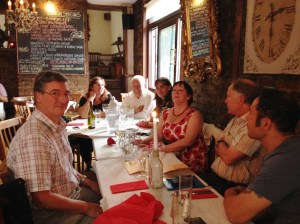 but it does help to keep in touch. Here is a picture of us in Fish in a Tie in Falcon Road, which by the way, if you have never been there, is just about the nicest, cheapest food of its style that you can get in Battersea. Stephen Holsgrove the head of Thames Christian College is on the left and then Sandra Munoz, me, Senia Dedic, my councillor colleague Wendy Speck, Providence House youth club boss Robert Musgrave and Pennethorne resident Andy Beech.
 - In my new role as Labour’s Speaker on education I have had several meetings with senior education staff in an attempt to catch up with the current issues. And one in particular came up at the Education and Children’s Services Committee on 17th September and that was the subject of admissions to primary schools. At the moment admissions are based on proximity to the school but also on siblings, that is whether a child already has a brother or sister at the relevant school. In essence the Council is wondering whether the so-called siblings rule should be scrapped and admissions solely based on proximity to the school. The Council is going out to consultation on the matter. What do you think? Do you think that if a child has a brother or sister at a school s/he should have priority in a schools’ admissions policy or should it just be based on proximity to the school. Let me know what you t
 hink!
hink! - I went to GCSE Success’s Annual General Meeting on 20th September. It was held at York Gardens Library. I do think this is a fascinating voluntary organisation. Set up by a resident of Pennethorne House, Ella Spencer, it is devoted to helping kids on the local estates fulfil their potential at GCSEs and get the best possible exam results. If anyone has a son/daughter who needs volunteer specialist assistance to get through examinations I recommend that you get them to York Gardens Library on a Saturday morning at 10 am!
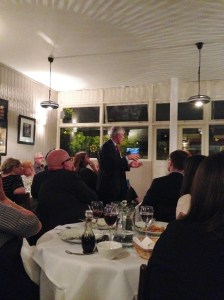
- On the 25th I went to the Tooting Labour Party’s fund raising dinner, where the guest speaker was Jack Straw. Here is a picture of him giving his after dinner speech. He made a robust defence of the Labour Government’s actions in Iraq, including the current bombing campaign against Isis. I am afraid that I am not convinced and am rather inclined to the view that the west cannot resolve what is clearly a Middle Eastern Civil War. I have seen it compared with Europe’s seventeenth century Thirty Years War between Protestant and Catholic – I rather fear that it is an apt comparison.
- I did not this year go to the Labour Party Conference, which seems not to have been a very exciting occasion! But I rather suspect that the confidence that the Tory Party showed at their conference last week is going to turn out to be misplaced.
- I went on a tour of Wayford Street and Este Road estates on 30th. It was
 pretty uneventful but we came across this piece of graffiti on the wall at the junction between Wayford Street and Candahar Road. Take a careful look. It is a picture of a dove of peace, I guess, holding under its left wing a knife, a pistol, a hand grenade and an AK 47. Is it a cry of pain against the barbarities going on in the Middle East? It certainly is very political.
 - On 17th September the weather was so beautiful that I decided to take the day off and take the train from CJ to Brighton for the day. I came across the Western Pavilion, which I had never seen before. It was built in 1827 by Amon Henry Wilds, an architect who had worked on the famous Pavilion, for a rich client. Below is a picture of it and I am sure many of you can see the similarities between it and the Royal Pavilion. Whilst I was there I also took a picture of the rather sad sight of the West Pier rotting and crumbling into the sea.


My Programme for October.
- I have meetings about the New Covent Garden development on 2nd and 6th
- I am visiting the Holy Ghost primary school in Nightingale Square on 14th.
- There is the now only quarterly Council meeting on 15th October and Planning Applications Committee on 16th.
- I hope to be at the Caius House youth club on the 27th.
Did you see Christ Church in the Guardian on 1st October? 
The picture is by photographer David Levene and is of Christ Church School’s vegetable garden. I don’t know why it found its way into the Guardian’s centre spread but it is a great picture of the children in the garden, which is behind a fence on Fownes Road, squeezed in between the estate and the main railway lines out of Clapham Junction. I was there when the school first took over this spare plot and it is just amazing to see the transformation they have made to what was an overgrown site. Well done, Christ Church.

Western Pavilion, Western Terrace,  and West Pier
 Tony Belton
 Tony Belton