Wot? No Fish!!
Went to Battersea Arts Centre (BAC) last Friday (18/7/14) to see Danny Braverman’s one-man show Wot? No Fish!! He and Nick Philippou are working together using this show as a springboard to re-form the Bread & Circuses Theatre Company.
It was a tour de force of story-telling, enhanced, not hindered, as it happens on Friday by a 30 minute break thanks to a rogue fire alarm – an incident which merely enhanced our admiration for Danny’s skill as a “village or clan” story-teller.
Braverman uses pictures drawn on the back of his weekly wage packets, by Abraham Solomons to tell a seemingly simple story of an East End Jewish family. Solomons presented the pictures along with the packets’ contents to his wife every week from the mid-twenties to the mid-fifties and in the course of it told a story of great charm and considerable complexity.
The end result was not a classic theatrical drama but a story, told with great skill and dramatic impact. It was the story of writer/performer Danny Braverman’s own family, and felt like an intimate family history told by an old friend. His quiet conversational voice emphasised the tenderness and warmth of that family.
The pictures were back projected on to a screen, which was the stage back-drop, and were part of a very cleverly constructed show. On the way we explored the nature of Jewish and ethnic identity, of poverty and wealth in society and of family love and togetherness. There were bad times. We see the pain that the couple have faced during their lives together, particularly when an autistic son is institutionalised. That week’s picture showed the middle-aged couple with a wall between them – very poignant and very simple.
The script includes an interesting take on the nature of history: not a simple line, nor regular cycles; more like a spiral of change but touching upon older contact points as it spirals. Indeed the programme notes claim that the show “is the helix as a metaphor for history”.
The performance ends brilliantly, as the final picture is animated: the couple walk up the hill together, with birdsong on the sound-track. On the verge of being schmaltzy but the warmth and humanity triumphs over that unworthy thought. If you get a chance to see it – do NOT miss it.
MH17 – A one-off disaster or an inevitable by-product of modern warfare?
Heard of Iranian Air Lines flight 655? It was a regular daily flight from the Iranian town of Bandar Abbas to Dubai, which on 3rd July 1988 had 290 on board, though maybe significantly only 39 non-Iranians. It was brought down with all 279 passengers and crew killed by a US fired missile from USS Vincennes. Captain Will Rogers III, a career naval officer, was in command of the Vincennes. He was awarded the Congressional Legion of Merit.
Vincennes was a guided missile destroyer of the US navy, whose crew failed to distinguish between a civilian airliner and an expected Iranian attack force. However, a fellow senior officer in the Gulf hinted that having such a gung-ho commander in the field was at the minimum a risk. Despite the “disaster” a couple of years later Rogers was promoted to be commander of the US Naval Tactical Training Group responsible for training officers in handling combat situations.
The United States and President Reagan got away with this incident amazingly scot-free in terms of worldwide condemnation or criticism. In most people’s language this was a war crime and although considerable compensation was paid, as far as I know the US has never apologised. At the UN, the then Vice-President George Bush argued that it had been an accident of war.
And yet in all the comments on the missile attack on MH17, I have not seen a reference to the Vincennes incident. Comparisons have been made with the Soviet destruction of Korean Airlines KAL007 with the loss of 269 lives off Sakhalin in 1983 and the Ukrainian downing of Siberian Airlines flight 1812 in 2001, with the loss of 88 lives, but not the Vincennes. I rather suspect that says something about the soft power of the US as opposed to the “soft (power) weakness” of Russia.
These four “military incidents” alone have claimed 945 civilian lives over the last 26 years. I don’t know how many have died in air crashes, where the military have not been involved, but I wouldn’t mind betting that military incidents are the single most important cause of aircraft disasters. Perhaps we should spend as much time on how to avoid such fatalities as the designers and engineers spend on improving aircraft safety and performance – no flights within 1000 miles of combat zones, higher levels of locking devices on missiles, passenger involvement in flight path choices?
The Tories face a disaster called Europe
There will always be a right of centre party – of course – but every now and then the Tory Party faces a disaster, a cataclysmic event from which it takes them 10 or 20 years to recover. This happens when long-cherished immovable beliefs and policies come into conflict with financial, political or economic reality.
The examples that come to mind are the 1846 Repeal of the Corn Laws and the 1902 struggle over Imperial tariffs – both in effect about trade policy and import tariffs. In 1846 the interests of the English aristocracy and their farming businesses were beginning to come into conflict with those of the new industrial and commercial elite of Victorian Britain. The catalyst for the 1846 Repeal of the Corn Laws was the Irish Famine. Five years of one of the worst famines in recorded history (the Irish population fell from over 8 million to 6.5 million, which is what it still is to this day) forced Sir Robert Peel to repeal the protectionist Corn Laws.
The party split and it was not until one of the rebels opposed to Peel, Benjamin Disraeli, managed to make the Tories relevant to the new might of British Imperialism with his “one nation” Toryism that they again achieved a parliamentary victory. Disraeli’s win in 1874 was their first since 1841.
Half a century later in the early 1900s the Tory party once again tore itself apart over trade protectionism. This time it was fear of the new growing industrial might of Germany and the USA, which posed the political problem. Joseph Chamberlain resigned from the Government in 1903 to lead a campaign for Imperial Preference levies in opposition to the free trade policies pursued by Prime Minister, Balfour. Chamberlain thought that putting a tariff round the Empire would protect British trade, particularly in India, Canada and Australia, from these aggressive, rising competitors. Balfour wished to maintain the free trade essentially created by the 1846 Repeal Act.
The dispute over free trade or protectionism resulted in big victories for the Liberal Party in the 1906 and 1911 elections. Once again it was 20 years later in the totally different post-WW1 1920s before the Tory Party resumed its “normal” role as the party of Government.
And now in 2014-17 I think we face a similar prospect of Tory division and defeat over trade policies, where once again cherished Tory party notions come into conflict with the political realities. This time the Tory notion is the nostalgia for the UK as a great power and our collective failure even today to come to terms with the truth – that we are an important European nation, dependent upon our relationship with the rest of the continent. The external reality, which is posing the issue so starkly, is the EU.
David Cameron, with his tactics over the Juncker/European Commissioner vote, has made himself uniquely unpopular in Europe and put himself into a truly awful negotiating position for the post-Election “reform” of the EU. As a result it is almost inconceivable that he could win terms from European politicians, which would be remotely acceptable to a large number of Tory MPs or with anyone with UKIP tendencies.
Cameron, therefore, now faces a major dilemma over the 2017 Referendum vote. It’s almost inconceivable that Britain’s industrial and commercial elite would accept or fund a Government and party, which wanted to opt out of the EU, but it also beggars belief that the current Tory party would support a pro-EU campaign. Where would that leave Cameron – dependent upon Labour votes?
There is, of course, one way out for Cameron and that would be to lose the May, 2015, General Election. But assuming that is not his plan then his leadership seems to be leading the Tory Party inexorably into a cul-de-sac and another split over trade policy, with the right wing eventually merging with UKIP and becoming a Tory Party devoid of any real electoral prospects for a dozen years or more. Meanwhile do the pro-EU Tories hitch themselves to the by-then surely divided Liberal/Democratic party? It is an intriguing prospect and holds out great prospects for Labour.
Councillor Tony Belton’s Latchmere July Newsletter (# 62)
June highlights
- The first month of a new Council was an odd experience for me on several counts! For starters, it is the first time since 1971 (Yes, 1971!) when I haven’t been in some kind of leadership role either in office or in opposition during the first month of the new Council– so I only hear second-hand what has being decided! Secondly, the Labour leadership, in its wisdom, have decided to give me the lead role on the Education and Children’s Services Committee – schools and school children but also quite a lot more, and a new experience for me. I continue to be on the Planning Applications Committee.
- Under financial pressures from the Government, the Council has decided that the Council and most Committees are to meet only 4 times a year instead of 6 and that there should be fewer councillors on each committee. This might seem like sensible financial efficiencies to those of you with a very business-related background but to me it seems like dangerous under-mining of the democratic process. I find it difficult to see just how councillors can build up a level of expertise and common understanding – call it teamwork if you will – on the basis of meeting and talking to each other so infrequently. Why does that matter? Well in my mind I think that is a sure-fire recipe for leaving the paid officers in charge and removing the elected members, and in the end, you the electorate, out of the process. It also will result, I think, in further centralisation of the already over-centralised British governmental system. Officers will never, ever be able to resist the threats and bullying tactics that Governments, Labour as well as Tory and Coalition, use on local authorities. Not that we councillors always did but at least we stood a fighting chance! What does that mean for me? Well I will do my best to be a voice for a more democratic and slightly more rebellious (perhaps “questioning” would be a better word) role for councillors.
- My first meeting as Children’s Speaker was fascinating. It was a meeting of the so-called Academies and Free School Commission. “What on earth is that?”, I can hear you cry – well a jolly good question. The Commission is a Wandsworth Council special, a Tory joke, a bureaucratic piece of hypocrisy and/or a jolly good idea – take your pick.
- Let me try and explain. Michael Gove came into Government with a more or less explicit plan to get rid of local education authorities (LEAs) – he doesn’t want local councillors involved in running schools. His argument is let’s leave running the schools to the Heads (oh, and of course, Michael Gove).To achieve his objective Gove has forced schools to become academies, as he is currently doing with Battersea Park School which is due to become a Harris (Carpet and also Tory funding grandee) Academy; he has also ruled that all new schools have to be either so-called Free Schools or Academies – as in the Jewish Mosaic school set-up in Putney.
- However Wandsworth Council actually thinks it is doing quite a good job as an LEA and also doesn’t want one of its main functions stripped from it. So it has appointed this Commission, in order to advise the Government on which organisations should be allowed to run schools and/or start up new ones.
- Funnily enough, I think it probably does quite a good job and, by the way, it is a model being recommended by Government for other LEAs to follow, despite it being set up precisely to thwart the Government’s objective of keeping councillors out of the process. The ironies are endless! We had Church of England representatives at the Commission arguing that they were NOT at all like faith schools – they don’t want to be caught up in the backlash against Muslim faith schools which is now embroiling Birmingham. The Commission is chaired by a Baroness Perry, a stalwart of the education establishment who says on Google that “My biggest mistake was underestimating how awful the Inner London Education Authority could be,” but interestingly enough never seems to have been elected to anything in her quango-studded life. She actually didn’t get the irony about the Church of England.
- Unfortunately, from the Tories point of view, they have to have a minority party member on this commission. I am not usually as political as this in my newsletter but the Commission is an absolutely fantastic example of making decision-making the province of the great and the good, and of course by definition Tory, and keeping everyone else out of it
- My second meeting was a far less contentious visit to Allfarthing School– don’t know what the kids made of it but I enjoyed it! Though I do wonder a bit what these visits of supposed bigwigs actually accomplishes – an interesting occasion for us (there were some half a dozen councillors) but to what end? Well, one thing that strikes a relative newcomer to the world of primary schools is just how female dominated they are. Is this one reason why boys are falling further and further behind girls in school performance and if so what can we do about it?
- As for the Education and Children’s Services Overview and Scrutiny Committee itself on 25th June, I hardly know what to say. There was a presentation from young people on the work of the Youth Council in Wandsworth. It was all very nice and interesting and said a lot about what the Youth Council do but I am not at all clear that it had anything to do with the meat of local politics. Another interesting paper was one about the re-tendering out of the Leaving Care Services. This is a really important service, which is responsible for mentoring, almost parenting, children in care when at the age of 16 or so they have to move out of Council care and into the wide world as independent people. For those of us with a well parented background, the thought of being out on your own at the age of 16 seems horrifying, or perhaps terrifying. So it really is an important service but there doesn’t seem anything for councillors to decide about it, other than to proceed with the tendering! It seemed to me important to ensure that the service would not be threatened by the tendering process – but that was all.
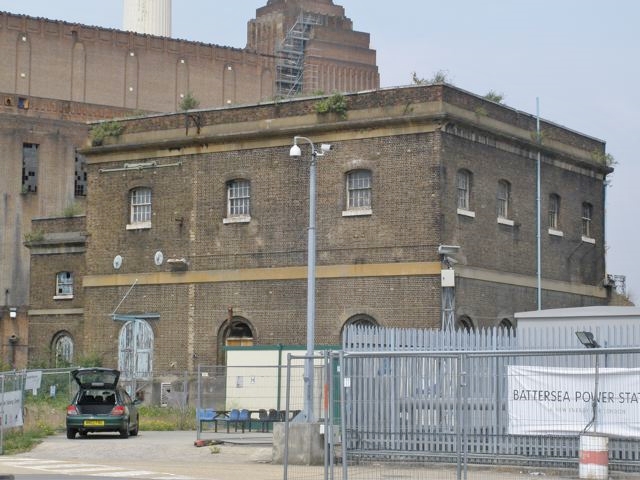
- On the 17th June there was the Planning Applications Committee. There were lots of applications but none of them very significant except for the three Council applications for the expansion of Albemarle, Hillbrook and Allfarthing primary schools and another for the demolition of the Battersea Power Station’s Pumping Station. The primary school expansions are a sign of the population explosion happening in the Borough and most particularly in the central and western parts. It is ironic that the Council closed some dozen schools and sold off the sites in the late 1990s and early 2000s and is now desperately trying to expand many of the ones that remain.
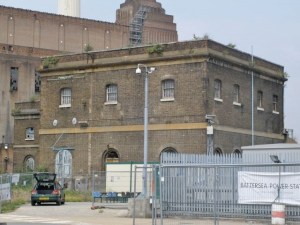
- As for the Pumping Station, there was quite a campaign to refuse this application to demolish the station with many people confusing its demolition with concerns about the demolition of the Power Station. In my view the campaigners were deliberately trying to confuse – surely there cannot be too many people concerned about a building that is almost totally unknown to Battersea residents and whose continuing existence, the developers claim, was merely delaying the day when the Power Station is at last re-opened.
- By the way, the south west chimney of the Power Station will be demolished in the next few months with re-building said to be completed by 2016, by which time work will have started on the other three chimneys.
- On a personal level, I and partner, Penny, went to Spain for a week with
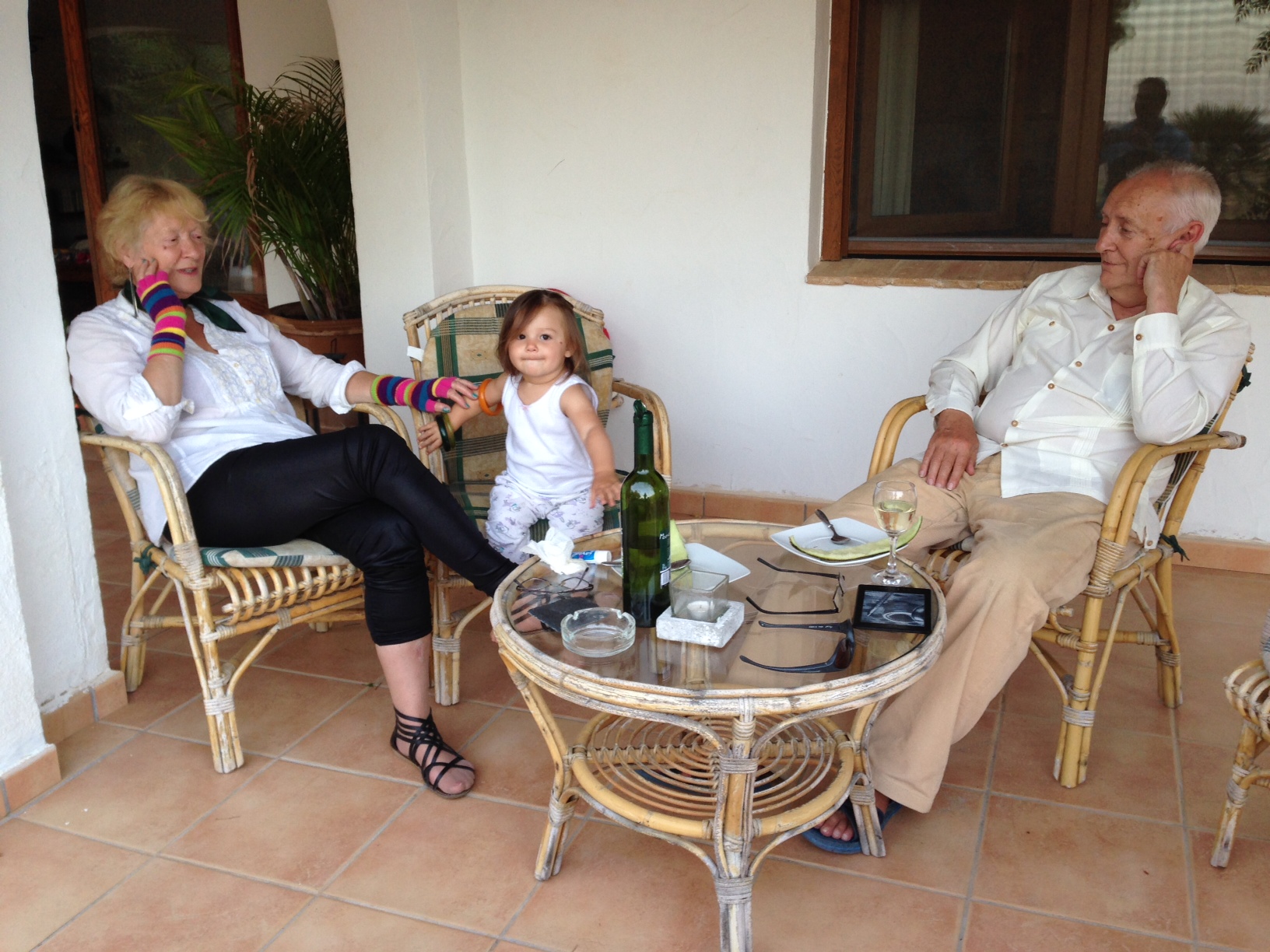
 the grandchildren and their parents. The excuse was a friend’s 60th birthday party in a small Spanish town called Jesus Pobre, which also had its annual fiesta. Plenty of bulls (not one killed – Spain is changing), flamenco, Rioja and rather tragically for our hosts Spain’s 5-1 defeat to Holland in the World Cup! Here is Scarlett, with Penny and me!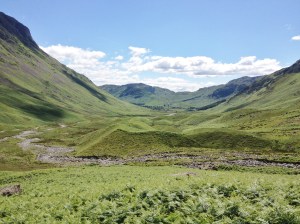
- And a week later, I went to the Lake District to scatter the ashes of my old friend and fellow Labour councillor Peter Ackhurst from the top of Bowfell. The picture gives an idea of the beauty of the Lake District for those who don’t know it.
- And on the last day of June, ex-Council Leader Edward Lister, now Deputy Mayor of London, announced the plan to introduce a Formula-E race in Battersea Park in the summer of 2015. Formula-E is motoring racing’s response to criticism of Formula 1 as a non-green sport, designed to burn up more carbon fuels in 2 hours than any other sport. Formula-E, as I understand it, would focus on electronic-powered racing cars and might just become the model of motor racing in the 21st century. If successful it would presumably be the first of many annual grand prix events and would bring massive crowds to Battersea Park and possibly disturb/ruin Battersea Park for the best part of a whole summer month. Just what do you think we should do in response – welcome the idea with open arms or resist the plan to the end?

My Programme for July
- On 2nd July I have an Education and Standards Group, which investigates school performance – on this occasion Allfarthing School and Latchmere’s own Sacred Heart Primary School.
- July is always the height of the summer social scene. One of my favourite parties is the Knowsley Street Triangle party on Saturday, 5th July. Then on 10th there is the Battersea Society summer social in the grounds at St. Mary’s – always a splendid occasion – if the weather is good. And on 12th Women of Wandsworth (WoW) are having a BBQ for the elderly at Haven Lodge.
- On the 16th there will be the first Meeting of the new Council. This is always an interesting occasion as one weighs up the strengths and weaknesses of the new councillors but is, of course, almost unknown to you the electorate. If any of you fancy coming then do get in touch with me and I will ensure that you get a tour of the Council Chamber and a ring side seat at a Council Meeting.
- The Planning Applications Committee, which will meet on 17th.
Do you know about Ron Elam’s Battersea photo collection?
My friend Ron Elam has been collecting photographs and postcards of Battersea for the best part of 40 years! He has something in the range of 40,000 of them stored in a large shed in his back garden. He used to run a market stall, occasionally in Northcote Road and more frequently in Bellevue Road. Well he has now published a book “Battersea Through Time”, with his colleague Simon McNeill-Ritchie, and included in it many photographs from the past but with every picture from the past alongside its modern equivalent.
Everywhere from Clapham Junction to Lavender Hill, Nine Elms and Battersea Park is featured.
Here is a sample from the east end of Battersea Park Road in 1920 and today.![batt pk rd 2014[1]](https://tonybelton.blog/wp-content/uploads/2014/07/batt-pk-rd-20141.jpg)
![batt pk rd 1920[1]](https://tonybelton.blog/wp-content/uploads/2014/07/batt-pk-rd-19201.jpg)
The book is priced at £14.99 but for the next month it can be obtained for £12 if you mention the Wandsworth Guardian by contacting Mr Elam on 0208 874 8544 or by emailing ron@localyesterdays.demon.co.uk.
 Tony Belton
 Tony Belton