Trade Unions – more power to their elbows
There can be little doubt that in the battle between capital and labour, the shift of power from capital to labour which characterised early post-war Britain, has gone into reverse. The apogee of union power was the moment of the collapse of the Ted Heath Government in February, 1974.
The unions had exercised great power in the fifties, when they did much to raise worker standards of living to unparalleled heights in a far more equal society than we see today. This also happened in the United States and in the rest of the English speaking world, especially Canada, Australia and New Zealand.
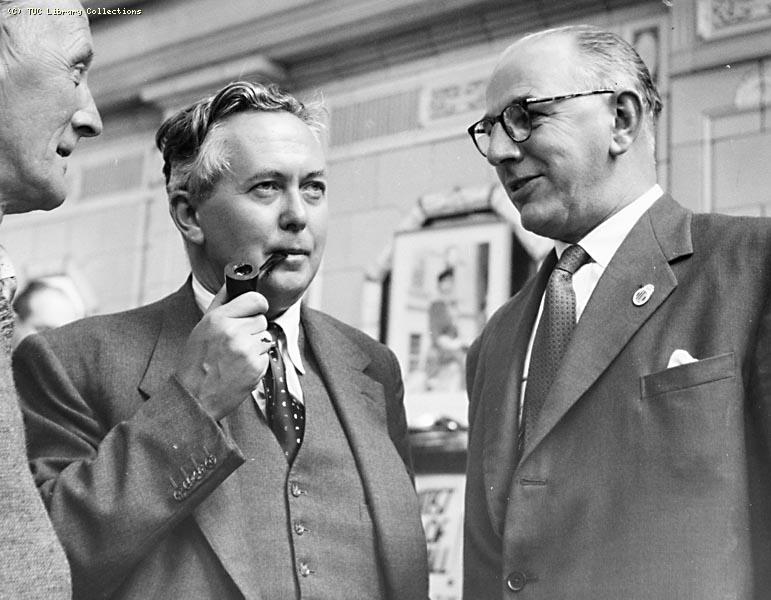 The unions did not get much credit for this achievement especially from the overwhelmingly hostile press, but they were generally recognised as a pillar of British society. One dramatic symbol of this rise was Harold Wilson’s promotion in 1964 of Frank Cousins, General Secretary of TGWU (Transport and General Workers’ Union), to be Minister for Technology, a post of high importance to the Government, focused as it was on the “White Heat of Technology”. (pictured right)
It was reasonable to expect that the unions were likely to become a long-term, central element of the corporate state – rather as they are in modern Germany, their historic role being to a considerable extent a product of British advisors in the immediate aftermath of World War II. Unfortunately the unions over-reached themselves and missed this historic opportunity, perhaps for all time.
Even in the sixties, Hugh Scanlon (AEU – Amalgamated Engineering Union) and Jack Jones (TGWU) were the media’s “Terrible twins”, as they exercised union power in many a disruptive industrial dispute. But more damagingly they also took on the politicians and thwarted Barbara Castle’s attempt to draw them into the corporate state through the mechanism of her policy white paper In Place of Strife.
There was little doubt that the trade union movement was a powerful voice in the land. So much so that one opinion poll in 1977 showed that 54% thought Jack Jones was the most powerful man in the country. But many others thought that unions should keep to “their proper role” of defending and strengthening workers’ rights and pay and conditions and not indulge in political activities. The battle over the trade union role in society was to be joined in earnest in the 1980s.
In 1973-74 the miners’ leader, Jo Gormley, had led the miners in a successful campaign for higher pay, which had ended with Labour’s General Election victory of February 28th. Ted Heath had gone to the country asking, “Who rules?” The country replied, “Not you mate” (The Tory Election Manifesto was called “Who Governs Britain?”). But an apparently great miners’ victory sowed the seeds of the unions’ downfall, most especially the NUM (National Union of Mineworkers). The unions arguably became complacent and expected favours from the incoming Labour administration. But by the time Thatcher became PM, the Tories were adamant that they would never be subject to union power again.
So when Thatcher decided to close mines and reduce the size of the mining industry, she set up quite deliberately the battlefield for a war against the miners. Unfortunately for the left, and I would argue for the country, the miners were now led by Arthur Scargill. He was keen to exercise power but had neither the native cunning nor the considered approach of Gormley. Scargill went into battle when British coal stocks were at a record high and British dependence on coal was declining as North Sea oil and gas was coming on stream. (It was ironic that at the same time as she was condemning trade unions in the UK, Mrs. Thatcher considered them to be a bulwark of freedom in communist Poland!)
The decline of union power had begun and has continued ever since, with New Labour almost as keen not to go back to the days of union ascendancy as the Tories.
But now we can see what a long-term disaster that decline has been for the majority of the workforce and for the country. Now neo-liberalism is in command. We have millions on zero hours contracts – not just working for exploitative private employers but also for local authorities, the NHS and the civil service. As a country, we “compete” for having the most flexible work-force, for having the weakest labour protection laws and for paying the lowest wages.
As a Councillor I know only too well the pressures on local authorities to put every task out to competitive testing or rather to the ruthless exploitation of labour. Once we had women, and they usually were women, providing home help and meals on wheels to pensioners, and working regular hours at trade union negotiated rates. Now we have temporary part-time workers, possibly paid at lower than legal minimum wages – many of whom are not paid for travel time between jobs. Just imagine what the salaried middle classes would make of not being paid for travel time between clients.
My colleagues are so beaten down by standard clichés such as “the users do not care who delivers the service, they only care about the quality of the service” that they just do not see that the logical end of this process is a low paid, low skilled, low spending labour force. Not many years ago Wandsworth’s Tory Leader provoked derision on the Labour benches when he claimed that the workers’ pay and conditions were no concern of his. Now his remark would pass without comment or criticism; it would be the statement of the obvious.
The Tories used to say that Labour only cared about the providers and not the consumers. If it was ever true, it is no longer, at least for the workers by hand – workers by brain, such as doctors, airline pilots, lawyers, still have their unions (and the Labour Party), or professional associations to look after them. But the workers by hand are left helpless against the neo-liberals. And they get little help from Labour, hence the party’s weakness amongst its traditional supporters.
But now – at last – the public at large are becoming more aware of the imbalance between labour and capital with large and growing campaigns for the “the living wage” and against zero hours contracts. The Labour party is in danger of being way behind public opinion.
The brightest of the capitalist class knows well that a low paid and low spending workforce is not of much benefit to them; they recognise, even if Tory politicians don’t, that the demand element of the economy cannot be ignored. Labour must campaign for higher wages, a doubling of the minimum wage, the end of internships, the death of zero hours’ contracts and a closer and healthier relationship with a vibrant trade union movement.
The trade unions in general are weaker today than they have been for a hundred years. We need them to be more powerful and to take a more active role in the guidance and direction of business in this country. We need works councils and trade union involvement in management, defined in law as it is in Germany. We also need fair but restrictive legislation on the right to strike – again Germany would be a good model. We need a workers’ movement, which is stronger than it is today. We need more power to their elbows.

 Tony Belton
 Tony Belton