Councillor Tony Belton’s Latchmere June Newsletter (# 50)
May highlights
1. You will recall that last month I wrote about Grant Road exit from Clapham Junction station being kept open and the installation of a temporary bus-stop opposite Battersea Park School. Well I am afraid that one reader tells me that the Grant Road exit has been open until 1 am for years and TfL have completely failed to install the temporary bus-stop. So much for boasting of achievements before they are delivered! But more seriously TfL is extremely unresponsive to us the public and our demands. I must continue to chase them up.
2. I did not mention it last month because it would have been tempting fate but on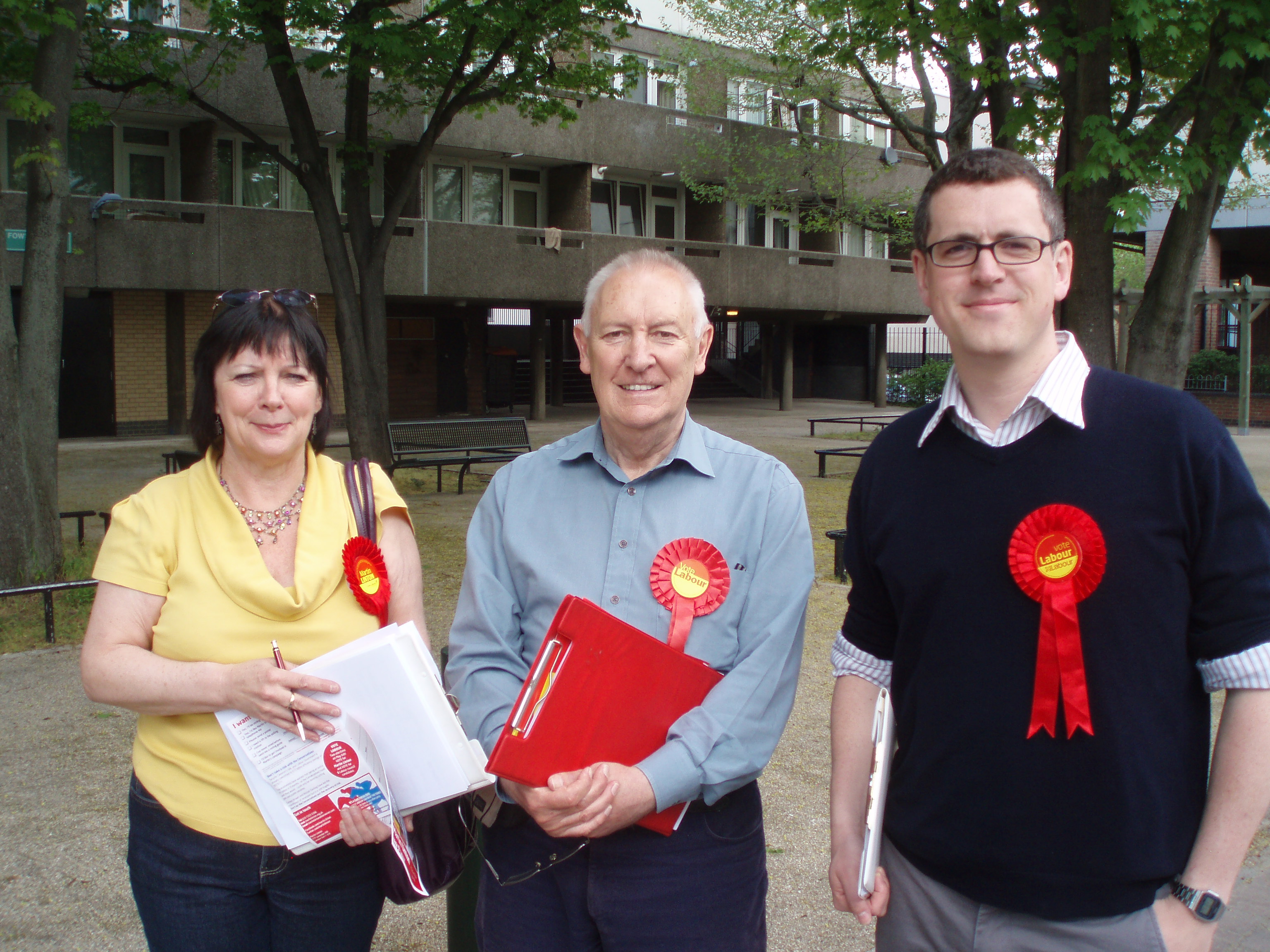 May 11th the Labour Party selected its candidates for next year’s Council election. I hope that you are as pleased as I am that we three, Simon Hogg, Wendy Speck and I were re-selected and will be standing as your Labour candidates next May 22nd. Here we are outside Fowler Court in May, 2010.
3. Do you know the Mercy Foundation? It is a newish charity, maybe two years old, established by and paid for by Victoria Rodney. It is situated behind the Prince’s Head on Falcon Road. It was established to provide IT classes for local people, who have not had the benefit of further and higher education. But it has also become a kind of drop-in centre for plenty of “difficult to reach” locals. Well on the last few Tuesday mornings I have been there and taught English to a class of largely Somali women. And last Tuesday two more volunteers dropped in. There are far worse things to do if you have any spare time!
4. I went to a guest lecture from the poet laureate at Roehampton University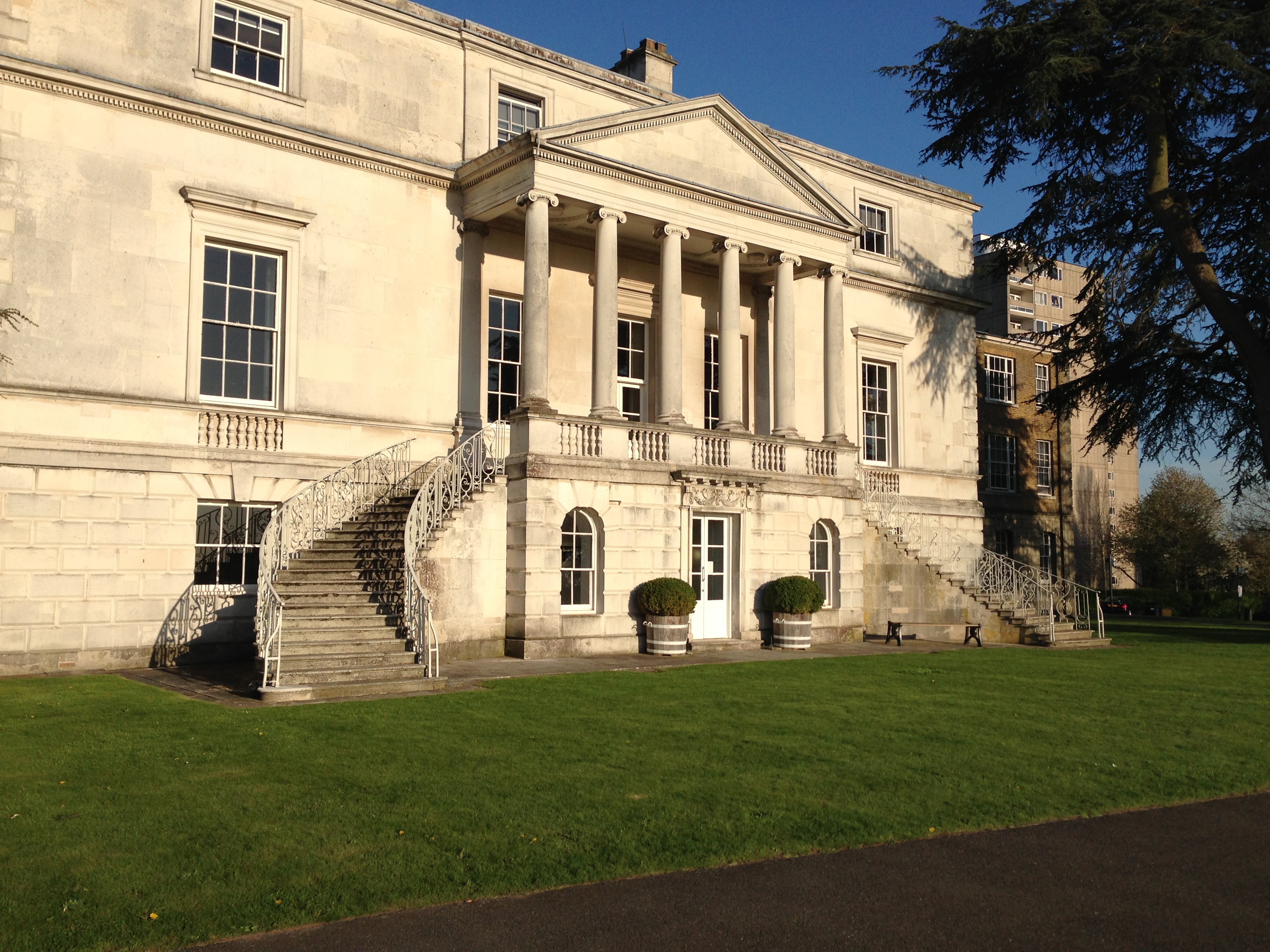 on 1st May. It was a wonderful evening in this terrible spring and the lecture was in a grand eighteenth century mansion, called Parkstead House, with a simply beautiful view over Richmond Park, even if the lecture was not quite my cup of tea. But what I did not know was that Parkstead House, pictured right, was where Gerard Manley Hopkins, the nineteenth century poet worked and studied.
5. To be honest there was not a lot to talk about in May indeed even May’s Planning Applications Committee on May 8th was low key. There were no Latchmere applications and indeed very few of anything other than very local significance.
My Programme for June
1. I am leading a history walk on 1st June at 11pm (not 2 pm as stated last month) as part of the Wandsworth Heritage Festival. It costs £10 per head and I guarantee that I will teach you something about the neighbourhood that you don’t know. Kids are welcome and, of course, free. We start on the corner of Albert Bridge Road and Battersea Park Road right opposite the Latchmere pub. If you are thinking of coming then please email me – nice to know the numbers to expect.
2. There is a Planning Applications Committee on the 6th June, which unfortunately is the same evening as the Police’s SNT (Special Neighbourhood Team) – so I will have to miss that.
3. We are going to try and hold a councillors’ surgery in the mosque next Friday or Saturday.
4. The Big Local Group is meeting on 10th June at the Wilditch.
5. I have the Housing Committee on the 19th June and Strategic Planning and Transportation Committee on the 24th.
Did you know?
About Elizabeth Braund, who died on 20th May at East Shallowford Farm. I didn’t know much about her either but I know a bit more now. In this picture Elizabeth is welcoming a visiting group of Battersea boys.
In May I paid a hurried visit to the Providence House prize winning. Providence House Youth Club is right next to the busy Falcon Road/Este Road bus-stop. It was started by Elizabeth in the early sixties at the time when the old north Battersea was being demolished and replaced by the many tall blocks so well known to us in Latchmere today.
Elizabeth knew that the wholesale demolition of communities, as well as old, bombed out slums, was likely to be very disruptive to society. This is why she put so much effort into developing the Club. Then she bought East Shallowford Farm on the edge of Dartmoor as a place to take Battersea kids down on the farm. It had to be Dartmoor because the Home Counties were she thought too tame and the youngsters needed just a bit of adventure and Dartmoor was the nearest wild place to London. In this rather indistinct picture she is welcoming some of the youth club members on a visit to the farm. You can read about it by looking up her name, or the farm’s, on the web.
And here are four club members admiring her picture at a recent event at the club.
Robert Musgrave of Providence House writes: “It is the end of an era for Providence House. Around 1960, Elizabeth Braund first started the youth work in the old Providence Chapel before today’s housing estates were built.
In 1970 she opened the present building on Falcon Road to consolidate the work with young people and families. In 1975 the new adventure to Dartmoor began, with the opening of East Shallowford Farm in 1976.
On Monday 20th May 2013, Elizabeth passed away at her home, East Shallowford, just 3 weeks short of 92 years. Her legacy is in the lives of countless Battersea and Wandsworth families.
It is the end of an era. A new era begins.”
Peter Ackhurst
- Peter by Brenda Holtam, 2011
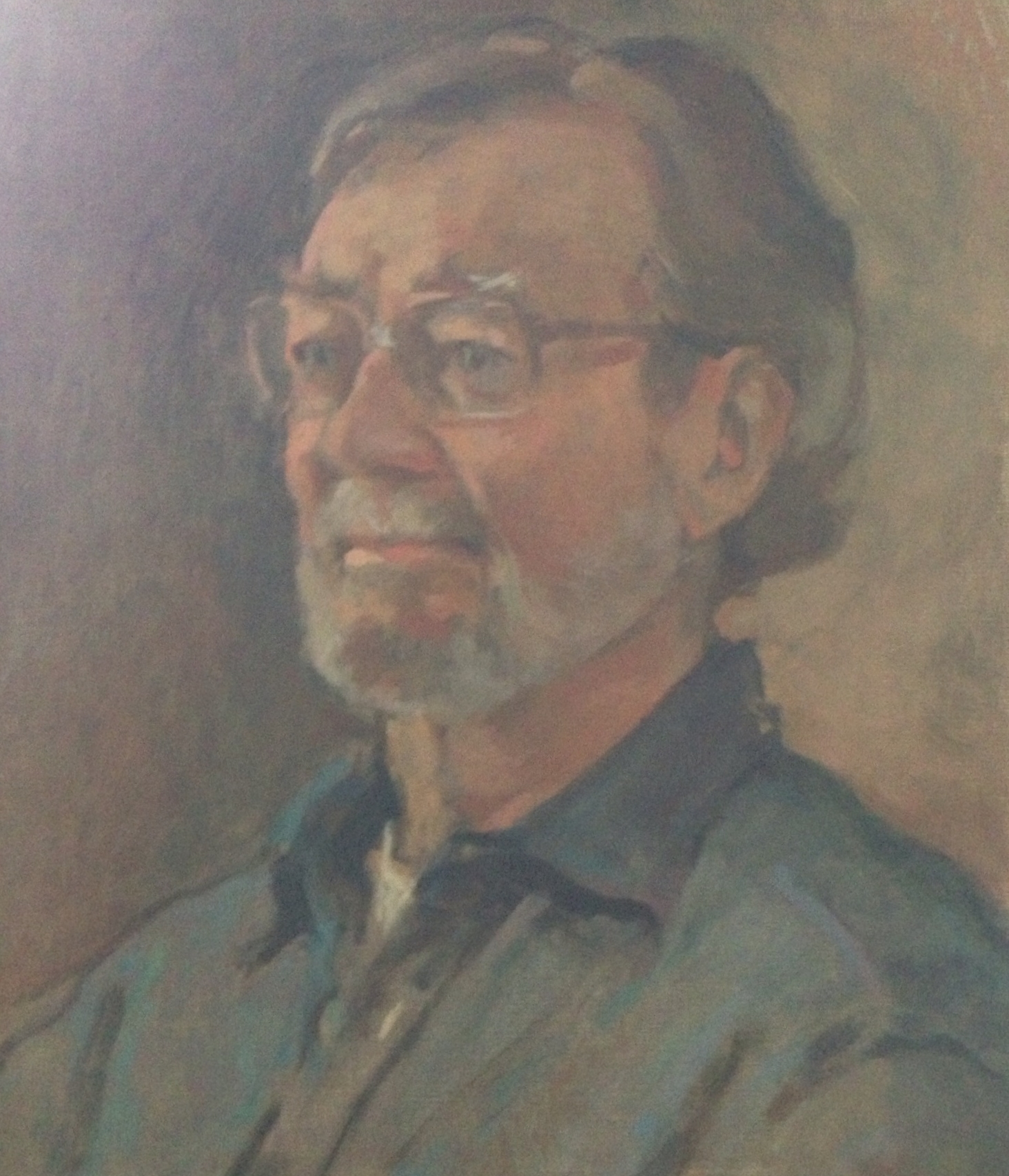
Peter Ackhurst (7th March 1935 – 4th June 2013) died peacefully in his sleep on 4th June. Peter was born in Louis Trichardt township, Limpopo, South Africa on 7th March 1935. His early life was spent in the more hard-line Apartheid provinces of South Africa, the Orange Free State and the Transvaal but when he went to Rhodes University in the Eastern Cape his rather more liberal tendencies came to the fore, so that by the end of his student days he was the national secretary of NUSAS, the National Union of South African Students. This was not like being the Secretary of GB’s NUS. NUSAS was in conflict with Boss, the Bureau of State Security, the powerful, one might say thuggish paramilitary wing of state apparatus. Peter as the General Secretary of a students’ union was under suspicion and observation; he felt he had to get out but for a time he could not get a passport, but eventually the regime relented and Peter came to UK in 1955.
I knew a couple of white, anglophile SA students, who escaped from South Africa at about this time. Some had seen enough of politics and never raised another political fight of any kind but not Peter (or his near contemporary, also Putney resident, Peter Hain). He joined the Putney Labour Party (PLP) in 1963. It was good timing. The constituency had been Conservative since it was created in 1918 and it was part of the old Metropolitan Borough of Wandsworth, which had again been Conservative since its creation in 1900.
But then Hugh Jenkins won the Parliamentary seat in 1964 and a year later the Borough was merged with industrial, working class Battersea and for the first time Putney had both a Labour MP and a Labour Council. Seven years later Peter stood for the Council in the then fairly safe Labour ward of Fairfield. He was part of a team of young Labour Party activists, led by Putney agent and sitting councillor Ian McGarry, who not only worked to find seats for themselves in winnable wards, but together as a team to make sure that their friends and political allies were equally likely to get elected.
In May, 1971, Labour had a massive victory winning 54 of the 60 Council seats. And so began a very exciting and turbulent seven years, when the Motorway Box was defeated, a massive programme of housing construction was maintained, Wandsworth got a modern social services system and some semblance of a planning system. The Thames and Wandle walkways were begun; parks were built; the Battersea Arts Centre was created and many other bold initiatives taken.
But there was also the battle over Ted Heath’s Housing Finance Act, when Labour councils took on the Government over the ultimate control of council housing. The Government was bound to win. Labour Councils made the great mistake of taking on superior forces on a battlefield of the Government’s choosing. The radicals lost, resigned their posts, took them back again within a year, but had lost their enthusiastic innocence – and the balance between local and national government was destroyed, possibly never to be regained.
During this time Peter was Deputy Leader of the Council, 1972-75, Chair of the Highways Committee 1971-72 and Chair of Policy and Finance 1975-78. Putney parking schemes were for ever etched on his mind as an unwinnable fight.
Peter was a man of great charm with a lovely voice – he was always a delight at any social gathering, with a story or an argument for every occasion. He could be irascible and bad tempered but had the wit never to remember an argument the following day. His deafness became a bit of a social handicap in later life. He was a terrific and inventive cook and never seemed so much at home as when cooking for friends and an extended family in a Lake District cottage or his large kitchen diner in Holmbush Road.
One of his greatest gifts was his extended family. His wife’s first husband is as concerned about Peter’s kids as he, Peter, is for Annie’s children by her first husband. They all play and occasionally work together and there is no doubt that Peter has been the pivot of that family network.
Peter was a keen and gifted amateur artist; professionally an architect; a much loved boss who finished his career as a Director of (was it?) the Housing and Development Department of Hammersmith and Fulham Borough Council. He was full of plans, but usually found life too absorbing and full of diversions to give him enough time to convert them into reality.
He was a personal friend, and a holiday companion a dozen times when we played appallingly bad golf together and fought over bird sightings and then talked of the day over bibulous suppers and a cigar – or two.
I will miss him as will his wife Annie and children, Stephen and Gillian, and all of Annie’s family – and many others.
 Tony Belton
 Tony Belton