Bedroom Tax – and as for the Lib/Dems?
I left out the Lib/Dems from my last blog re marginal constituencies – perhaps it’s because I come from Lib/Dem free Wandsworth but a reader pointed out that it has a potential impact on them too, so here is my analysis of top Lib/Dem marginals.
Of the top five marginal Lib/Dem:Labour seats three have majorities less than the number of households affected by the Bedroom Tax!
They are:
Norwich South; 310; 1973
Bradford East: 365: 1023:
Brent Central: 1345: 1057: majority greater
Burnley: 1818: 957: majority greater
Manchester, Withington: 1894: 2678
Bedroom Tax – the political impact on the Tories
What I did not say yesterday was that in 17 of the 20 tightest Tory:Labour marginals the number of households affected, and I mean households and not voters, is greater than the Tory majority in 2010.
The data is by constituency:
Constituency: Majority: Households affected
1. North Warwickshire: 54: 766
2. Cambourne and Redruth: 66: 454
3. Thurrock: 92: 1140
4. Hendon: 106: 680
5. Oxford and West Abingdon: 176: 572
6. Cardiff North: 194: 1067
7. Sherwood: 214: 804
8. Stockton South: 332: 1431
9. Lancaster and Fleetwood: 333: 555:
10. Broxtowe: 389: 581
11. Truro and Redruth: 435: 500
12. Newton Abbot: 523: 326: majority greater
13. Amber Valley: 536: 559
14. Wolverhampton South West: 691: 1396
15. Waveney: 769: 788
16. Carlisle: 853: 1181
17. Morecombe and Lunesdale: 866: 700: majority greater
18. Weaver Vale: 991: 1397
19. Harrogate and Knaresborough: 1039: 684: majority greater
20. Lincoln: 1058: 1155
One has to ask: Did they know what they were doing when they introduced this abomination and of course the resounding answer is NO.
The Briefcase – a play by Timothy Turner
I am a “prop star”; well at least I own a prop star. All because fellow Labour councillor Billi Randall emailed her friends asking if anyone had a briefcase and I, being of an older generation, confessed that I had, which is why some weeks later I was seated in the front row of community arts theatre, Theatro Technis, watching this new play starring my briefcase.
Timothy, the author, is the 26 year old son of my Council colleague Billi and she was also there proud to see the launch of Tim’s play-writing career – and a very promising one it is too, at least judging by this opener.
A one hour duopoly, beautifully acted by Harry Lobek and Joel Samuels, the Briefcase is a philosophical discussion on the nature of decision making and indeed of discussion itself. Was the glass half full or half empty? Should the briefcase be opened or left shut; if opened it could reveal something that would make life better or worse? Was it worth the possible joy of one or the risk of the other?
As Turner explored one could see clear references to Stoppard, Beckett and Pinter not least the lack of action in this style of theatre and the difficulty of beginning and ending. Indeed in my view the ending was the weakest element of the play – it just stopped. But the format avoids the dramatist’s perpetual problem of how to get the actors on and off the stage – we all know that even the greatest once descended to “Exit followed by a bear” – since both actors were on at both beginning and end.
However, Turner very ingeniously reversed the roles of the two characters halfway through the play when the action man suddenly became the prevaricator and vice versa. This gave him all kind of licence to play with the arguments and characters. The conclusion? I think Turner believes the means is more important than the ends; or perhaps that self-discovery is more important than action. It would, though, also be perfectly possible to conclude that Turner is very critical of over-rationalisation and much in favour of getting on with life.
The play was witty, complex and sophisticated. It was also clever and polished and hugely enjoyable. Turner also directed the play and no small feat that. Billi tells me that he is planning other plays. I hope he manages it. This was a very, very promising opening.
Bedroom Tax – How Tory councillors fail to support their own constituents
Most of us are now well aware that the poorest in our community face a deluge of damaging benefit cuts on Monday, 1st April, including the vile Bedroom Tax. I will write another blog, another day about the vicious nature of this tax and just what it displays of Tory attitudes to council or social sector tenancies, but today I wanted to focus on the particular impact in Wandsworth.
The Guardian has just produced a very helpful map of where the impact is greatest and in its commentary says that the impact is counter-intuitive. I think that means that the journalist expected the hardest hit areas to be the great northern industrial cities. But in fact the worst hit single area of all is Wandsworth and the whole south east region including many of the most affluent parts are almost as hard hit. So whilst the “tax” for having one bedroom “too many” in Wandsworth is £912 per household per year, just down the road in Esther it is £851 and in Kensington it is £839.
This is because the tax is a function of the rent levels and with much lower rents in, say, Hull the impact on individual tenant households is rather less; actually it is £489 in Hull. But there are more than 2,000 households affected in each of the three Hull constituencies and only about 900 in each of the three Wandsworth ones.
Bizarrely this means that Wandsworth Tories have been aggressively promoting this vicious “tax”, which results in hitting their constituents harder than anywhere else in the country. It also means that they are supporting a policy, which is taking approximately £3.5 million out of the Borough’s economy. Knowing the area, as I do, this will cut living standards in Roehampton and Latchmere (the council flats on north-side of Clapham Junction station), where ironically the Council is now looking to invest £100 million precisely because of the under-privileged nature of the area.
Irony of ironies this is happening in the very same week as millionaires are getting £100,000 p.a. tax cuts and given that there are said to be 6,000 of them in the country, with Wandsworth’s share at least 35, what we see here is a Cameron/Osborne swap of money from the poor to the rich. And what do we know about the relative spending habits of rich and poor? Well for one the rich are more likely to spend some of their money in St. Tropez and Bermuda and much less likely to be spending it in the rundown shopping areas of Falcon Road and Danebury Avenue (the two main shopping streets in Latchmere and Roehampton).
I hate to think what Robin Hood would have made of it all but I can’t see how any Tory can be seriously surprised if we have many more civil disturbances – or at very least massive refusals to pay rent.
Affordable Housing Battersea Style
I want to tell a story about affordable housing Battersea style.
Sister’s Avenue is a road full of rather grand Victorian houses, including one Victorian block of Mansions, running from Lavender Hill through to Clapham Common. At some time during WWII a bomb clearly took out 20 or so houses on each side of the road at the Common end – plenty of evidence in Battersea at just how bad the Luftwaffe was at hitting Clapham Junction station.
In the 50s and 60s Battersea Borough Council built some pleasant and ordinary council houses, all gone right to buy, and a small 2 storey block of 6 flats. When Wandsworth Council (as it had now become) went Tory in 1978 they started an aggressive sales policy – by aggressive I mean that rather than just sell when a tenant expressed interest the Council ran sales fairs, gave prizes for landmark sales – the thousandth, etc. – and generally did their level best to stimulate sales.
79 Sister’s Avenue was the first of the block of flats to be sold in 1983 for £13,500. By January, 1989, all six flats had been sold at an average price of £17,950. Good luck you will say to then residents. Wandsworth had created 6 new affordable units for sale and resale – bully for Right-to-Buy and Tory policies.
By 2007 Robinwood Ltd, a property developer was sniffing around. The developer clearly saw an opportunity to increase the asset value. 2007 was a busy year and by the end of it all six flats were owned by Robinwood having bought them from the owners at an average price of £315,000 (NB for accuracy it should be noted that I do not know the price of one of the flats and so this is an average for 5 but there is no reason to think that the sixth would be substantially different).
Robinwood, or their agents, put in a planning application to build six large town houses. These six have just been completed and are on the market with Savills, the top people’s estate agency and the prices vary from £1.725 million to £1.925 million – checked out with Savills today, 13/3/13.
In 30 years we have gone from having 6 council owned flats, which by any standard would have been affordable at a rent of £20 per week (WBC average rent in 1983 was £20.12), to genuinely affordable private flats and now to luxury housing at nearly £2 million a shot.
The strange irony of this is that this tale works for both Tory and Labour Partys. For people of my persuasion it highlights the terrible divisions between the rich and the rest (the people living there were not the really poor) and what Tories have allowed to happen to the stock of affordable housing. It highlights the brutal callousness of Wandsworth Tories and displays why they are so contemptible in the eyes of many on the left.
For Tories it has helped to improve the Wandsworth environment ensuring that the rest of the housing in Sisters, and Battersea in general, continues on an upward curve; it has improved the housing stock; it has made Wandsworth a better place to live in. It highlights the head in the sand, conservative (small c) nature of Labour members.
Matching up these completely disparate views of life is the stuff of political controversy.
Councillor Tony Belton’s Latchmere March Newsletter (# 47)
February highlights
1. On Friday 1st February I flew from Luton to Tel Aviv with a group of 30 people organised by Labour Friends of Palestine (LFP). We were on a fact-finding tour. LFP is organised by ex-Battersea MP, Martin Linton, and this trip had a very Battersea feel about it with other trippers being my colleagues Councillors Wendy Speck and Simon Hogg. (Here we are with a banner given to us by the Mayor of Hebron.) This was no ordinary trip however but a pretty tough, hard-working one. (Oh and before any cynics say otherwise, it was all paid for by us!)
We met the Palestinian Foreign Secretary and his number two, the Governor of Hebron Province and the Mayor of Hebron City. We met Meir Margalit, a Jewish, left-wing Jerusalem city councillor with the difficult portfolio of looking after Palestinian affairs in East Jerusalem. We had a discussion with the British Consul in Jerusalem and were given a talk by a senior UN representative with responsibility for Palestine. We had discussions with the relatives, mainly mothers of course, of Palestinian prisoners, mainly young men of course, in Israeli prisons.
- We visited a Palestinian refugee camp in Ramallah, a Bedouin encampment
 in the Judean desert, a Jewish settlement and several Palestinian villages surrounded by Jewish settlements – and all in four days! Oh and we also managed to fit in one or two of the major tourist sites such as the Church of the Sepulcre, the Wailing Wall and the Dome on the Mount (Christian, Jewish and Moslem sites) in Jerusalem, as well as the Church of the Nativity in Bethlehem and the tomb of Abraham and his family in Hebron. The picture is of a sunset scene in the Judean desert.

It was a busy trip, which of course I could write about for pages and pages but I will try and make just a few brief observations. First, and whilst I hadn’t expected Palestine to be at all hot in February I was not prepared for it being even colder than London was last month. Jerusalem is 3,800 feet or 1,000 metres up in the Judean Mountains and with clear nights the temperature really plummeted.
Secondly whatever the politics I was struck by the overwhelming physical ugliness of man’s inhumanity to man – the thirty foot high, 700 mile long wall that the Israeli Government is building round and in Palestine is as ugly as the picture suggests. Anyone who saw the Berlin Wall or the wall in West Belfast will know exactly what I mean.
But there are also a lot of half-demolished homes, where the Israeli authorities have decided to move Palestinians out, or half complete homes where the Palestinians in return have half built homes without planning permission (I longed for Britain’s planning systems). There are brand-new sparkling highways for Israelis built alongside litter-strewn, wreck-spattered, pot-holed roads for Palestinians (puts our pot holes into context!). Not even South Africa under Apartheid had segregated roads, did they?
On another note the religious sites, the churches, mosques and synagogues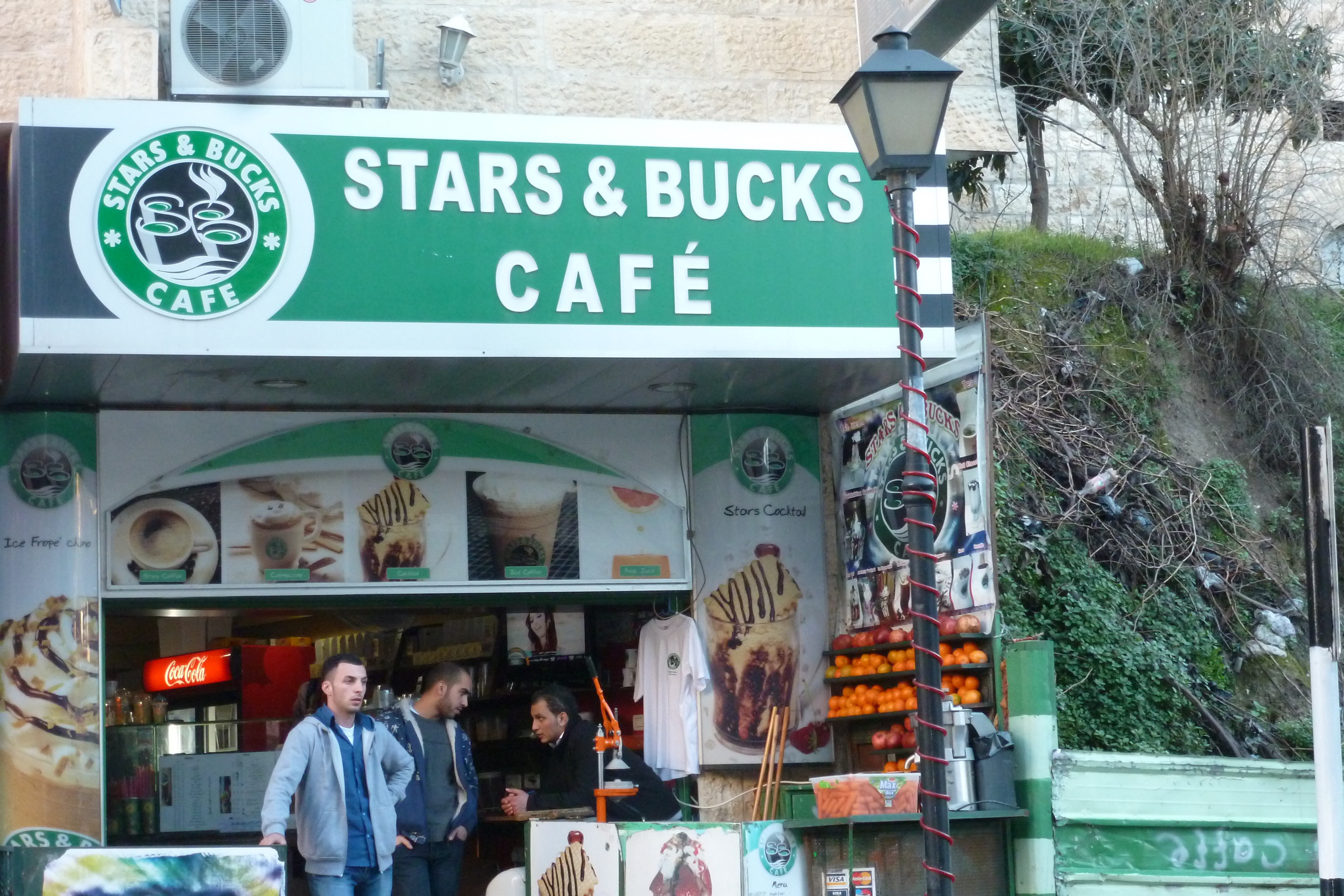 don’t really work for me partly because as they are shared between faiths they had neither the over-the-top garishness of say the Greek Orthodox Church nor the puritanical simplicity of a British church. But I also did not warm to kissing the very spot where Jesus was born – partly because the person, who decided where that spot should be lived 300 years after Christ and couldn’t have possibly known. And the old Xmas carol “Oh, little town of Bethlehem” will never feel quite the same now that I have seen the traffic, the mess and the commercialisation of religious tourism in modern Bethlehem. Though occasionally, as here, it has its amusing sides. But the real point of the trip was to look at Palestinian/Israeli relationships and what lies in the future for them.
The first thing to say is that life for the under-dog is always going to be rough and at the moment the Palestinians are the under-dogs all right. One doesn’t have to be anti-Israeli or pro-Palestinian to see that being bossed around by gun-toting 20 year old Israeli soldiers can be a demeaning experience for a middle aged Palestinian and an absolutely infuriating one for a 20 year old, unemployed, one. But more importantly experience on the ground tends to suggest that the much talked about two state solution just does not look a credible possibility. Palestine is just too small, and too broken up by ever-expanding Jewish settlements to be viable.
It may be pie-in-the-sky but a united non-sectarian, democratic state seems to me to the only possible future for the two peoples. But that can only happen if one, two or three other things take place. They are that the USA decides it can no longer afford, or no longer wants, to fund the Israeli state; that the rich Arab states decide between them that they are going to fund Palestine as generously as the USA does Israel; or finally that the people of the area get fed up with beating themselves up just as pretty much the whole of western Europe decided in the years after 1945 that two millennia of war was just about enough. Funnily enough, I think it may happen sooner than you think!
2. The day after we got back, 6th February, was the Council Meeting. One thing that certainly could be said for our trip was that it put the normal Labour:Tory badinage into context! There really was not a big debate but there was some discussion about paying all Council staff at least the London Living Wage of £8.55 per hour. Despite paying our top officers over £100,000 apparently we cannot afford to pay a minimum of £8.55!
3. The Planning Applications Committee on 11th February had few interesting applications but there were five for Boris bike docking stations. I have mentioned before that £2 million is being spent on this scheme in the Borough. None of these were in Latchmere, because none of those designed for Latchmere have been objected to, but I have a feeling people are not going to be pleased when they see the number of such docking stations planned. I also have my own suspicion that the scheme will not be quite so successful here as in the City and the West End, not least because out here it starts getting hilly and Latchmere Road Hill is pretty steep however young and fit you are.
4. The Strategic Planning and Transportation Committee had a paper about lobbying for a Heathrow/Clapham Junction link, which will be of interest to many in the ward. But perhaps more will be interested that the Council is looking into making parking enforcement the same on Council estates as it is everywhere else. You may know that car clamping, which the Council used to do on estate roads is no longer legal so the Council had to do something. It also obviously wants to save money by having the same traffic warden system everywhere in the Borough. I am not sure exactly how it is going to work but clearly the intention is to have one system that applies on both estate roads and public roads – and about time to, some would say.
5. On the 26th we had the Housing Committee and I really am struggling to think of anything interesting to say about that – so I won’t report anything.
6. On the 19th Jane Ellison organised a meeting at Providence House to discuss the plans for the extension of the Falcon Road Mosque. Representatives of the mosque presented their plans and Jane had asked me, as a member of the Planning Applications Committee, to outline the planning position and just some of the planning issues.
There were about 50 people present and local concerns were expressed. The major concern was clearly parking though there was mention of the proposed change in the building line and of the installation of a dome. At one point, the meeting threatened to get a little lively but I have to admit Jane handled it very well – ‘tis pity she is the wrong party!
7. I have an apology to make to everyone. On 8th February I had 10 solar panels fitted on my roof and became a member of the “oh so green brigade”. It is obviously the reason that we haven’t seen the sun since.
My Programme for March
1. There is a Council meeting on Wednesday, 6th March (OK, I know that’s passed but that will have to wait until next month!), with Planning Applications on the 12th.
2. The Falcon Road Estates Resident Association is on the 7th but there is also a Big Local meeting at Providence House on the same day. I will go to the Big Local meeting.
3. The Big Local is having a couple of consultation meetings. One is at the Sports Centre in Hope Street and will be an opportunity for locals to give their views on what the area needs. The second, much larger event will be a fun day for all on Saturday 16th. In the morning this will be centred on the Chapel in Pennethorne Square and in the afternoon it will be centred on York Gardens and the Library and will include football coaching, bouncy castles, face painting, etc. You name it and it will be there.
Do you know?
Maureen Larkin? I can’t remember when I first met Maureen but it was at an 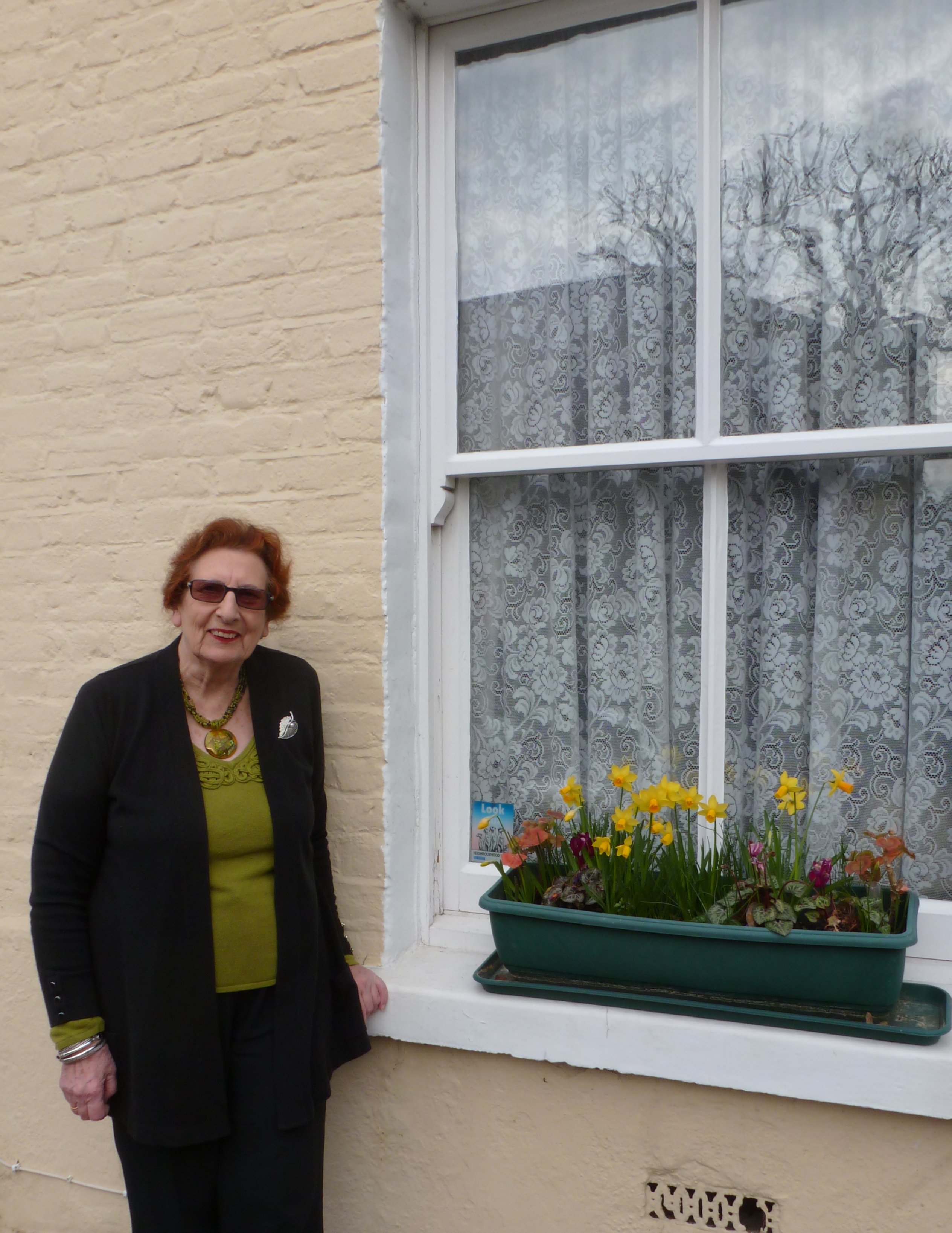 election, when I was standing for the Labour Party. I guess it might have been 1982. I called on some chap and got talking to him and it turned out that he had lived in the same house since the fifties and as I expressed surprise he told me about Maureen who was a far more senior citizen. So I called on Maureen and she told me she was born in her house in 1932 and as you see she is still there in the same house 81 years later. Can anyone beat that? Let me know if you can.
Many of you will know Maureen, who is still today very active as the Membership Secretary and Events Organiser of the Battersea Society. She has in her time been the Secretary or organiser of the Triangle (Poyntz Road, Shellwood and Knowsley Roads) Neighbourhood Watch and the Residents Association. She organises the Triangle Annual street party (she says she doesn’t organise it nowadays but I bet she has her say), which by the way I can say from experience is by far the best in the Borough.
In 2010 Maureen was presented with a Civic Award by Wandsworth Council in recognition of her services to the community. I remember it as a splendid occasion where she was accompanied by her daughter, Terry Barber. When I went round and took the photograph we chatted about Battersea when each little terraced house like hers had a family living upstairs and another downstairs and when the shared loo was a brick out-house in the yard, when the bath was a tub under the sink and Battersea, then the major industrial centre in west London, was filthy with coal soot and industrial grime.
Maureen clearly loves her community but she is not such an old sentimentalist to believe that everything was so good in the good old days, indeed she very much looks forward to tomorrow’s event to be organised and insisted that I had the Triangle party date firmly in my diary.
 Tony Belton
 Tony Belton